Showing posts with label Notes Written in Old Books. Show all posts

Friday, April 25, 2014

Click to enlarge

As you can see above, a 1922 high school sophomore named Jennings Keffer liked to doodle. Those scribblings — and many more, as I'll show you in a minute — appear in an old Shakespeare text that was recently found at a bookstore by a music blogger who calls himself Devil Dick. Although the Shakespeare book has nothing to do with music, Devil Dick found the doodles so enticing that he decided to post them on his blog and try to find out more about Jennings Keffer.

So what sort of doodles did a high school fella create in 1922? Pictures of girls, for starters. And what kinds of girls would be of interest in 1922? Take a look (for all of these images, you can click to enlarge):

It's hard to express how much I love that. I particularly like the cigarette and the bells — scandalous! It's worth noting that while flappers were just becoming a pop-cultural phenomenon in the early 1920s, the term "flapper" has much deeper roots and was long associated with prostitutes, so the word may have had an extra forbidden-fruit quotient or with young Jennings.

Here's another set of doodles from the book:

The most interesting thing here, at least to me, is the pair of baseball drawings on the left side, because Jennings was coming of age at just the right time to be swept up in the national mania surrounding Babe Ruth. The Babe had set a single-season record by hitting 29 home runs in 1919 (the previous record of 27 had stood since 1884) and then completely changed the sport by hitting 54 homers in 1920 and 59 more in 1921. When Jennings was making these doodles in the spring of 1922, Ruth was at the peak of his larger-than-life celebrity arc, and baseball was coming into its own as a powerful cultural and economic engine. Even without televised games, it all must have been a very exciting time to be a teen-aged baseball fan.

If Jennings was a high school sophomore in 1922, that means he was probably born around 1906. Sure enough, Devil Dick did some research and determined that Sidney Jennings Keffer was born in 1906 in West Virginia and died in 1995 in Ohio. You can see Devil Dick's post about all this, including several more pages of doodles, here.

(My thanks to reader Jeff Ash for letting me know about this one.)

Thursday, January 17, 2013

Screen shot 2013-01-17 at 1.26.43 PM.png
Click to enlarge

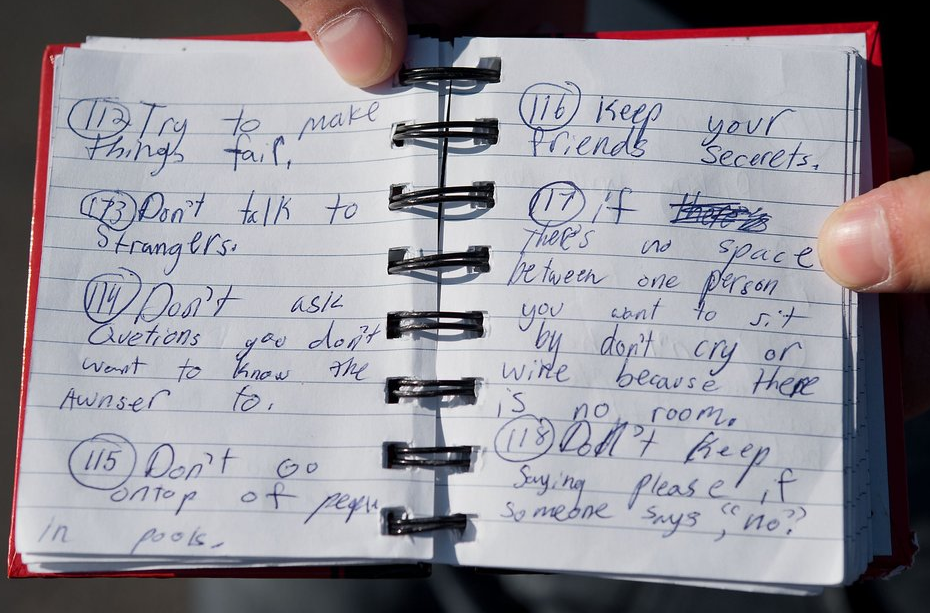
What you see above is a book of "rules to live by," filled out by a child. As you can see, some of the rules are rather endearingly worded: "If there's no space between one person you want to sit by, don't cry or wine [sic] because there is no room," for example, and "Don't ask questions you don't want to know the answer to."

The book, which contains 157 numbered guidelines, was found in the parking lot of a California Walmart by a 20-year-old employee named Raymond Flores. He thought the book was too special to be consigned to the trash, so he contacted local media outlets in an attempt to find its author/owner. It turned out to be the work of two cousins: Isabelle Busath, 10, and Isabella Thordsen, 8. Flores was able to meet with them and return the book to them earlier this week.

Here's a short video clip about the story:


(Special thanks to Sue Kendall for pointing me toward this one.)

Monday, August 27, 2012

Screen shot 2012-08-27 at 7.40.54 PM.png Screen shot 2012-08-27 at 7.41.02 PM.png

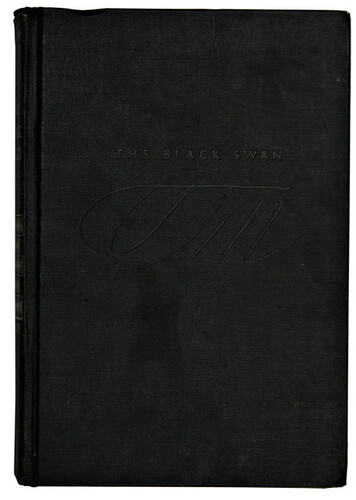
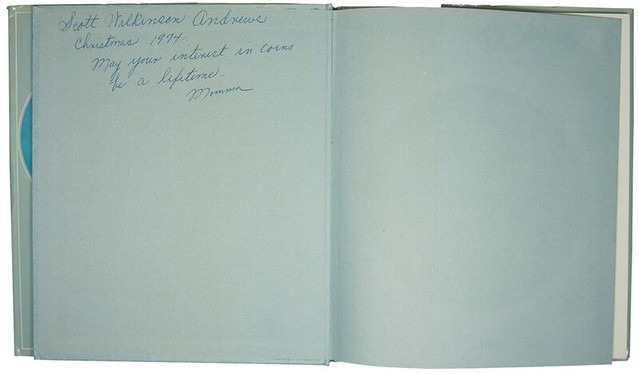
Back in April I posted an entry about the Forgotten Bookmarks blog, which is about little treasures found inside old books. Now I've learned about another web site with a similar but distinct mission: Together, as Always, which is devoted to documenting handwritten inscriptions inside of books, usually on the front endpapers.

What you see above is a typical example -- a 1963 edition of Gulliver's Travels, with the following inscription:

Marlyn,

Hope that you can read this. Next time I'll do better.

Creed

Hmmm. Did he mean he'd "do better" in terms of his handwriting? His probable misspelling of Mar[i]lyn's name? Something else? It's hard to know exactly what it means, but there's definitely an undercurrent of sadness there.

This sense of awkward melancholy can be found in many of the inscriptions, like this one:

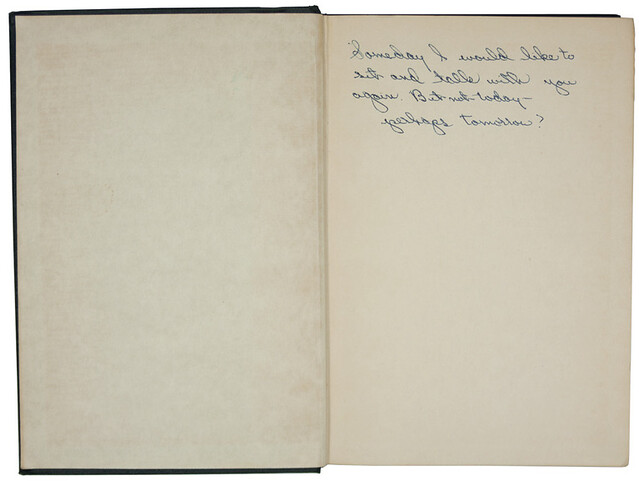
Screen shot 2012-08-27 at 7.24.36 PM.png Screen shot 2012-08-27 at 7.24.46 PM.png

It reads, "Someday I would like to sit and talk with you again. But not today -- perhaps tomorrow?" So odd. Was that some sort of olive branch being offered after a lengthy détente? An inside joke? Just a case of clumsy phrasing?

Together, as Always is the work of an artist named Julianne Aguilar, who found all the books in Texas thrift shops. In her "About" page, she says the project "explores ownership, and how an object can still be owned even after being discarded." She goes on:

Books give a gift-giver a unique opportunity to personalize their gift. Names, dates and occasions denote for whom the book was intended, the date it was given and why. These highly personal messages are discarded with the book and will be read by anyone who owns it in the future. Almost no one seems to make any attempt to remove the inscription, even if it was written in pencil. As a result, these books feel like they still belong to someone, as though to own them is to own a stranger’s secrets. The thrill of these objects is their mystery and their unwillingness to let go of the past.

Nicely put. I could keep on citing favorite inscriptions from the site, but I'll restrict myself to just one more:

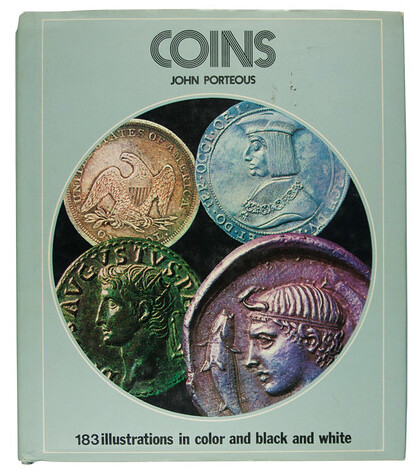
Screen shot 2012-08-27 at 7.58.43 PM.png Screen shot 2012-08-27 at 7.58.49 PM.png

In case you can't read the inscription there, it says:

Scott Wilkinson Andrews

Christmas 1974

May your interest in coins be a lifetime.

Momma

I assume she meant to say that his interest in coins should last a lifetime, but whatever -- it's more endearing this way. And speaking of endearing, when's the last time you saw someone sign a note with "Momma"? Nice.

To explore the rest of Together, as Always, look here.

(Special thanks to Kirsten Hively for telling me about this excellent site.)

+ + + + +

Update: After I posted this entry, I sent a note to Julianne Aguilar, telling her how much I like her site and letting her know I'd blogged about it. She wrote back with the following:

I am honored to be featured on your blog -- especially because I so love Permanent Record! Believe it or not, when I read your story on Slate last fall, I was in the first planning stages for my own project, and it was a big inspiration. At the time I was working in archives in a small town in West Texas and found myself wanting to read and make work about archives. Your story really got me looking around for anything forgotten, which took me to the only thrift store in town, which was conveniently directly across the street from my apartment, which is where the book collection began.

How cool is that? I've become a fan of her project, and she was already a fan of mine!

+ + + + +

Slate update: I just delivered the latest full-length Permanent Record article to my Slate editor, who says it's tentatively scheduled to run during the week of Sept. 10. This article took an unusual turn -- it's about a story emerging from one of the report cards, but the story isn't about the student connected to the card. That's all I'll say for now, except that I think you'll like it.

Saturday, April 7, 2012

7048160255_09cc418962_o.jpg
Click to enlarge

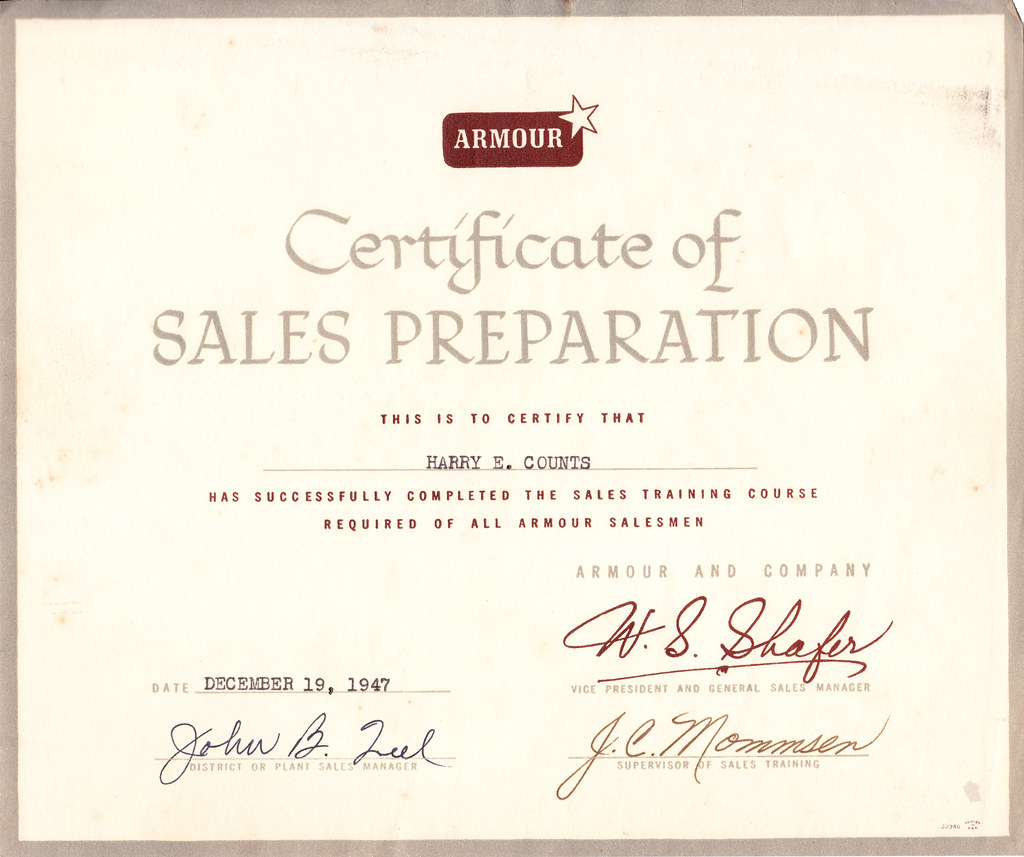
I collect lots of vintage meat-related ephemera -- old butchery catalogs, old butcher shop photos, old recipe booklets with the word "Meat" in the title (I have about 60 of those), and so on. So when I recently came across an eBay listing for an old looseleaf binder filled with assorted Armour Meat Products brochures, I pounced.

But what I didn't realize, because the eBay seller didn't mention it in the auction listing, was that the materials in the binder had been used by an Armour sales trainee in 1947. His name was Harry E. Counts, and his certificate for having completed his sales training, which I found buried in the back of the binder, is shown above.

The binder also included more than 80 pages of notes, all in pencil, presumably taken down by Harry during his training -- very Permanent Record! The notes are actually much more interesting than the printed brochures. Much like the case of the vintage coat with the bounced check and shopping lists in the pocket, I once again bought something that I thought was pretty cool and ended up with something else even cooler.

Harry didn't have the best handwriting, but it's good enough to get a sense of the sales class he was taking, which was apparently geared toward giving the trainees a grounding in modern butchery practices and Armour's product line. Given the volume of the notes, the class must have taken at least a week.

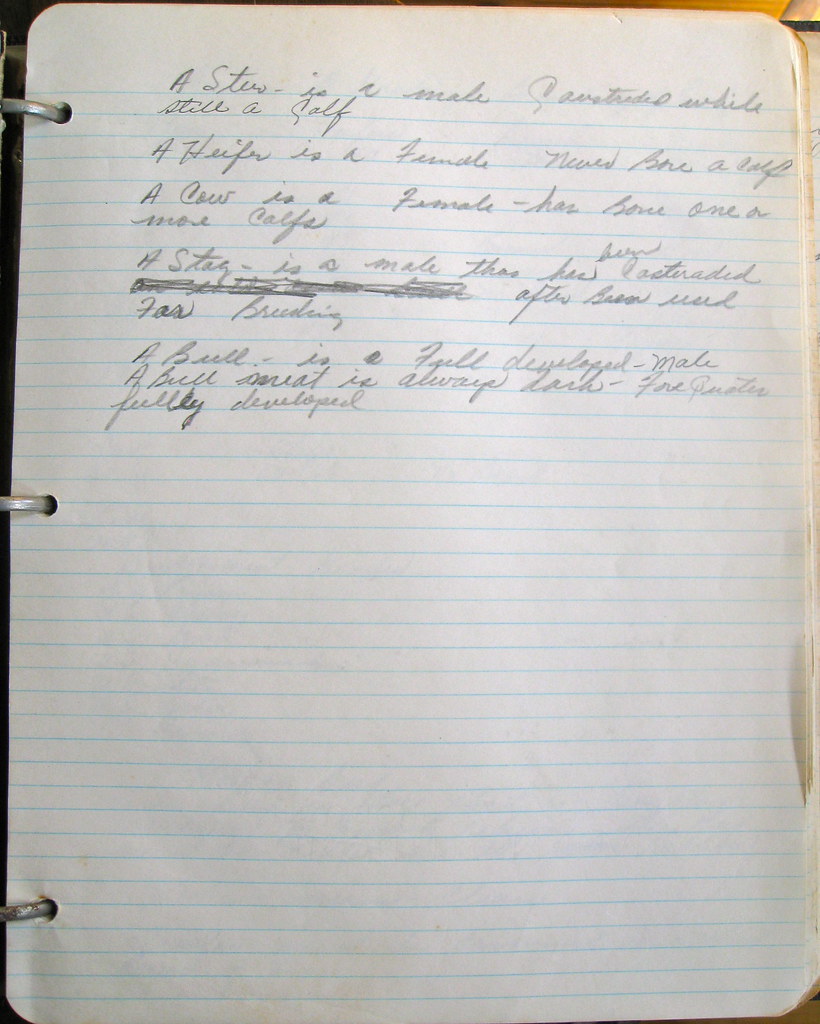
A lot of Harry's notes read like Livestock 101. Here's a page explaining the difference between a steer, a heifer, a cow, a stag, and a bull (note Harry's spelling of "castraded"; you can click on all of these photos to see larger versions):

IMG_1459.jpg

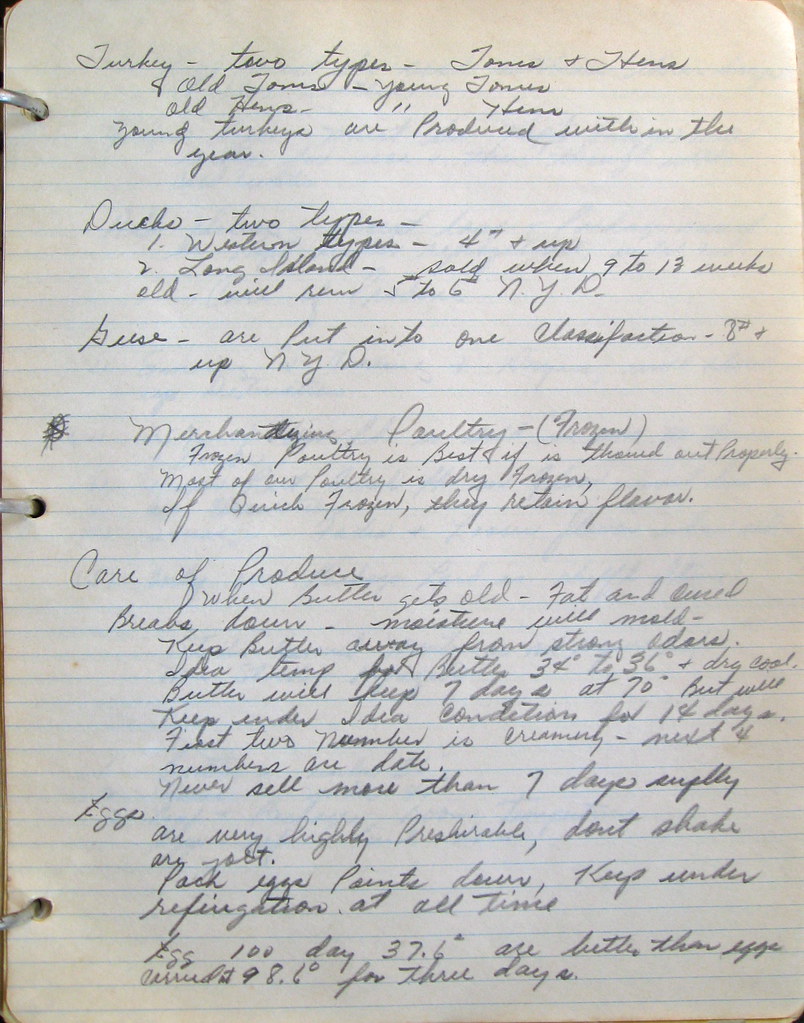
And here's one describing the various types of turkeys, ducks, and geese:

IMG_1491.JPG

Here's some good info on fresh and smoked sausages (I especially like the designation toward the bottom of the second page -- "Loaf Goods"):

IMG_1479.JPG IMG_1480.JPG

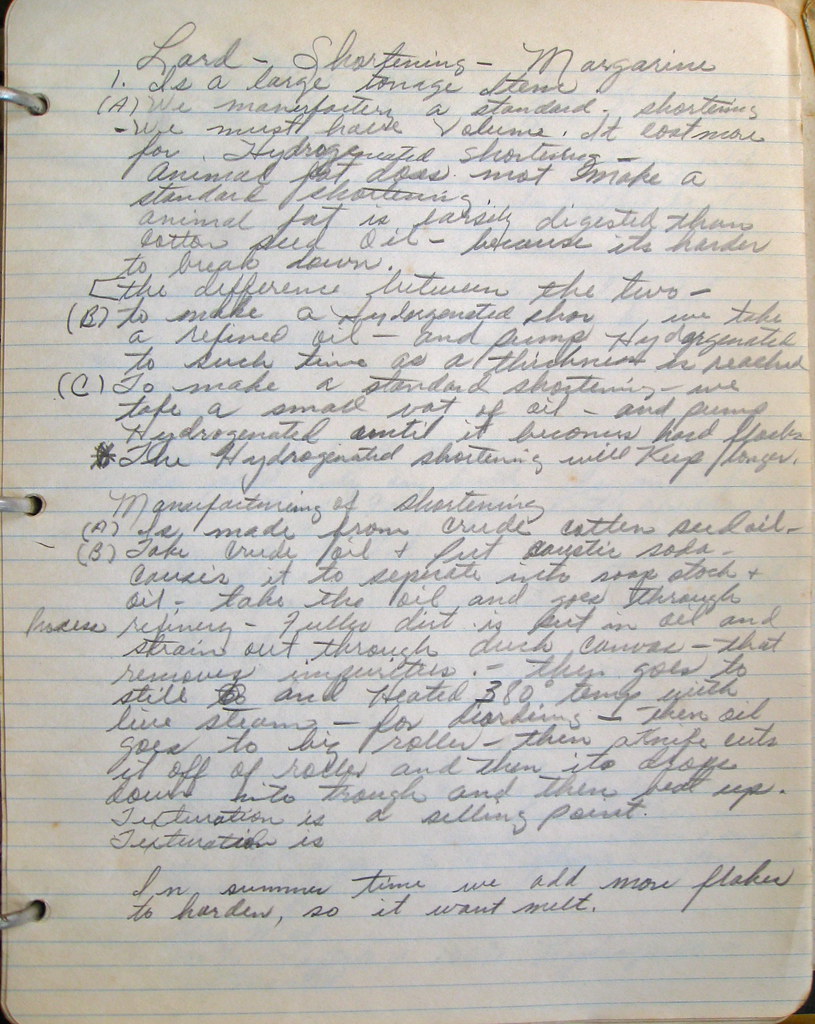
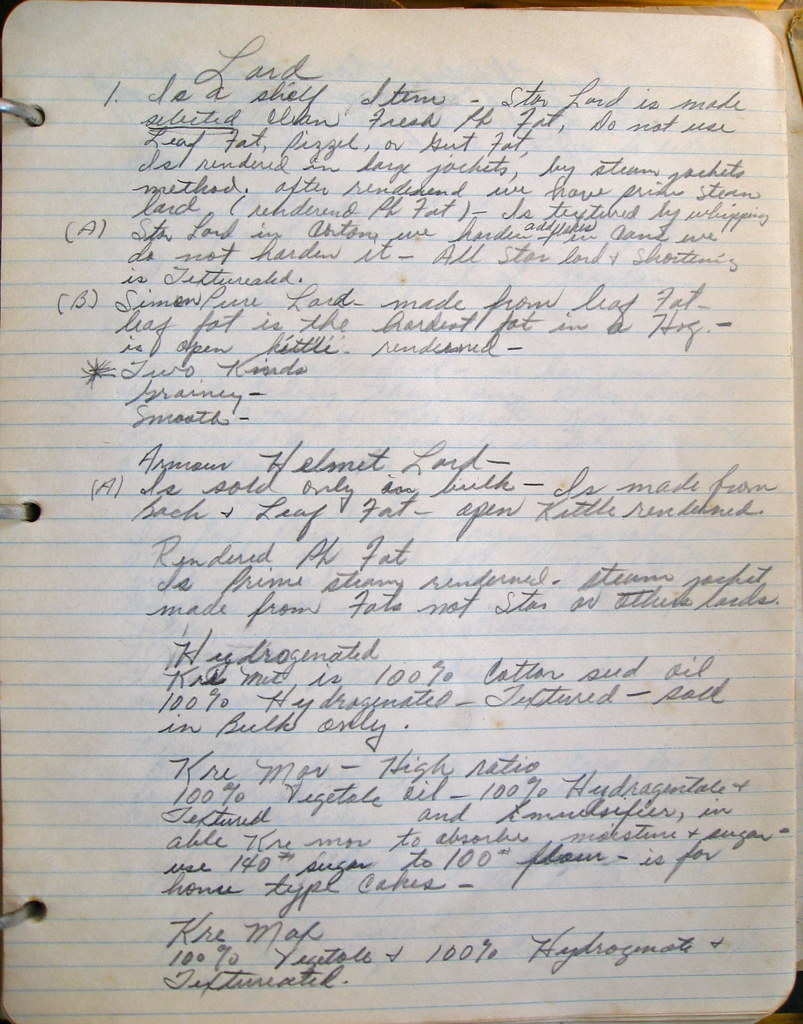
Fun facts -- no, really! -- about lard:

IMG_1483.JPG IMG_1484.JPG

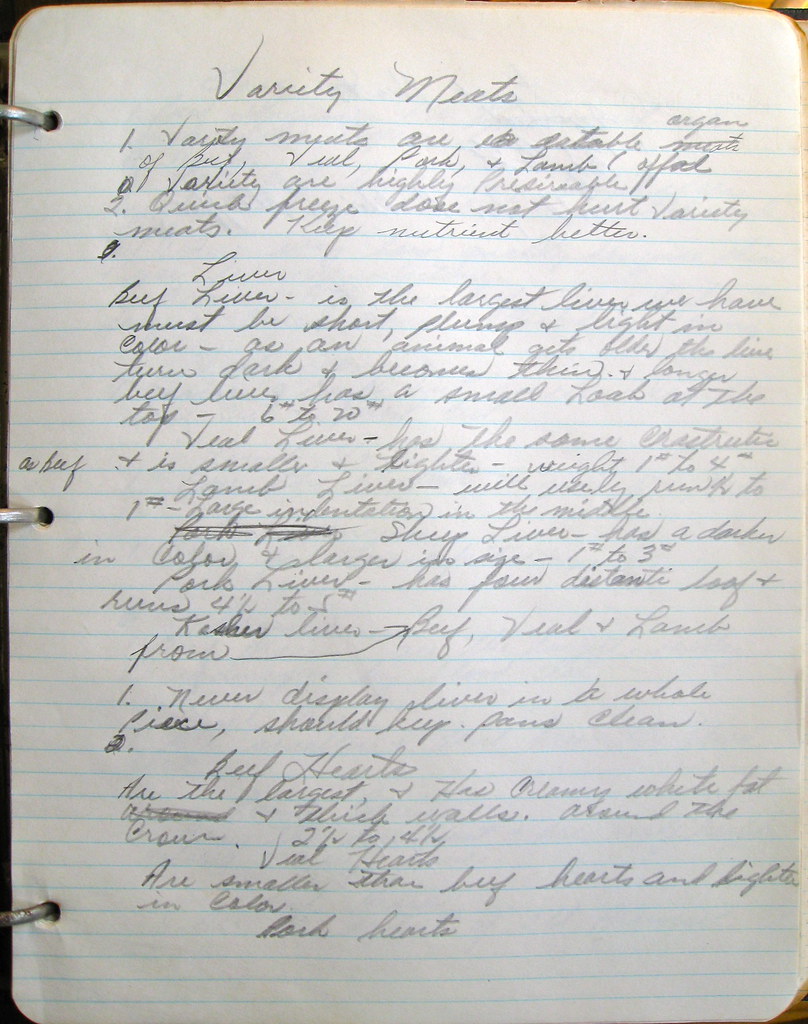
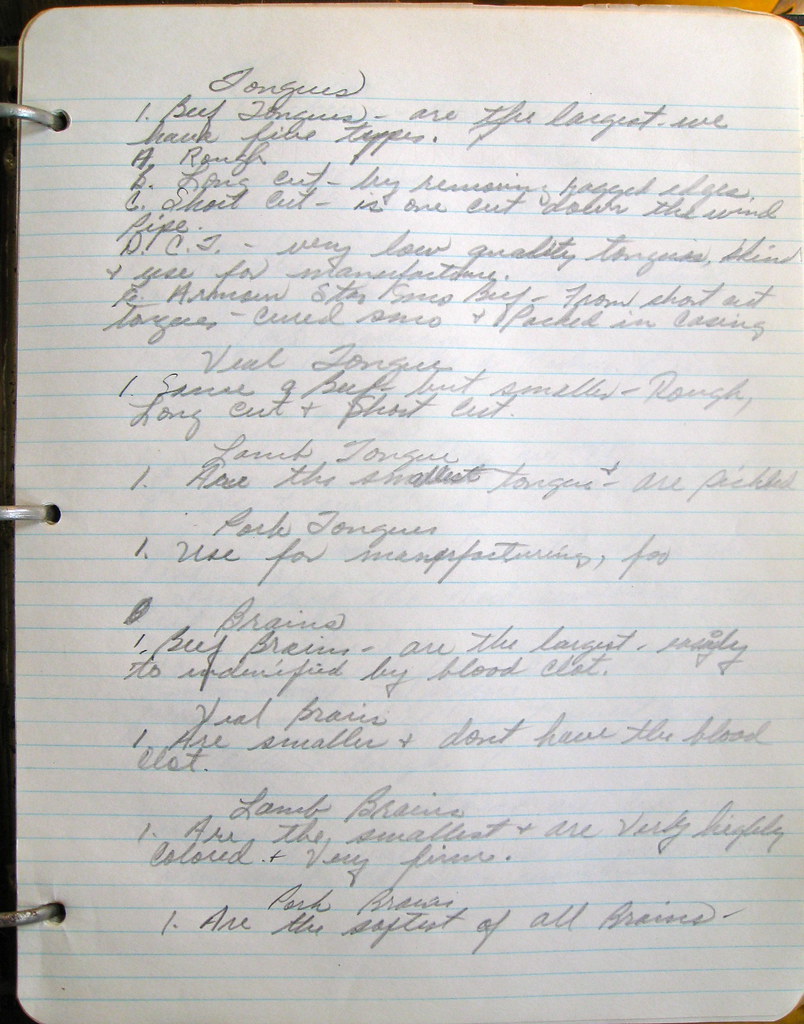
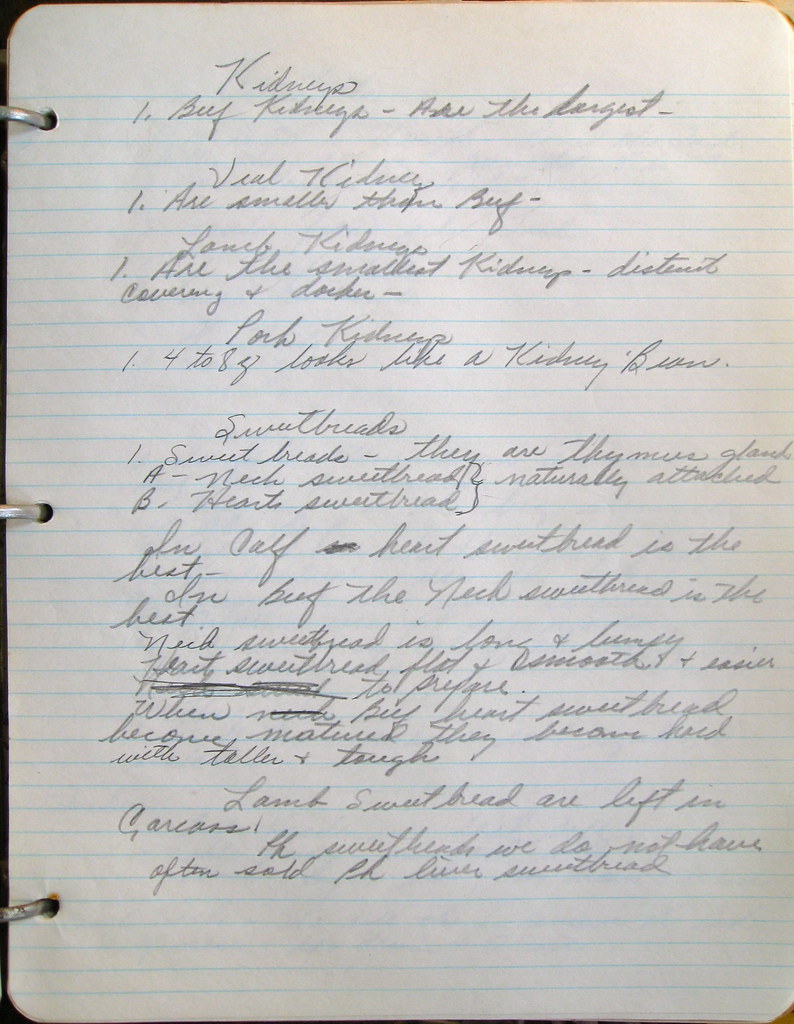
I'm sure it would have been interesting to have sat in the back of the room on the day the class learned about variety meats, tongues, kidneys, ox tails, and "fries" (i.e., testicles -- or as Harry spelled it, "testicals"):

IMG_1471.jpg IMG_1472.jpg IMG_1473.JPG IMG_1474.JPG IMG_1475.JPG

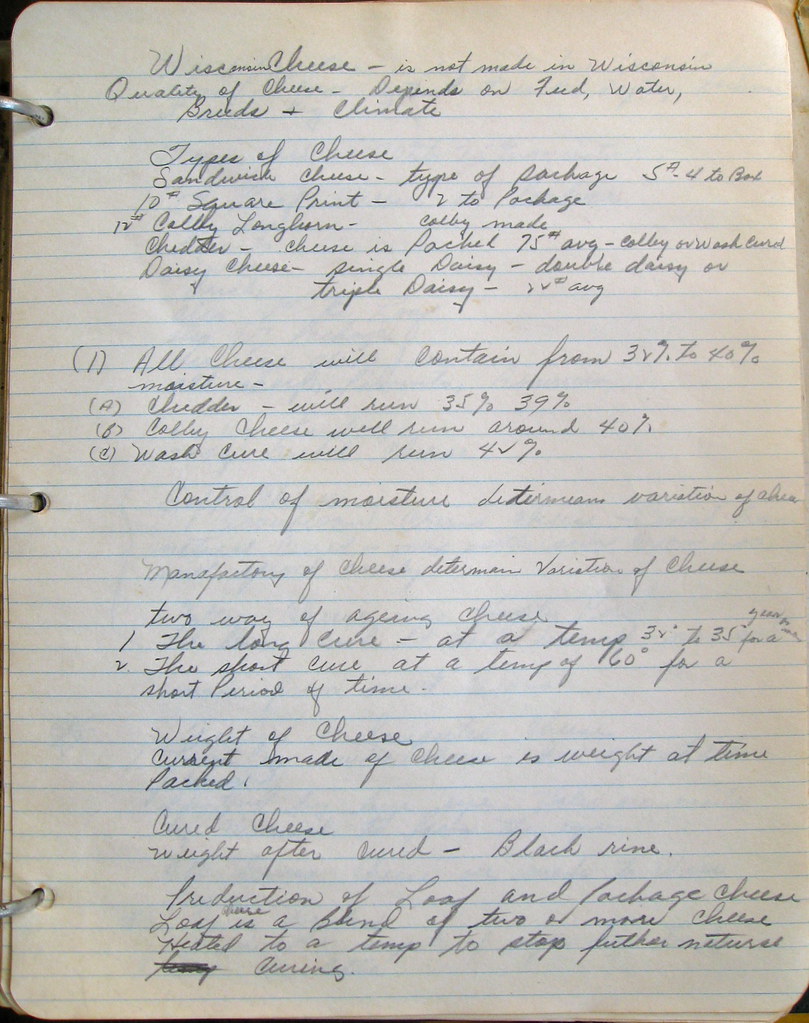
One of my favorite notes is on this page, which begins with "Wisconsin Cheese -- Is not made in Wisconsin":

IMG_1489.jpg

And who was all of this knowledge and expertise aimed at? Why, Mrs. Consumer, of course:

IMG_1496.JPG

And so on. If you want more, I photographed over 50 of the pages and gathered them into this set.

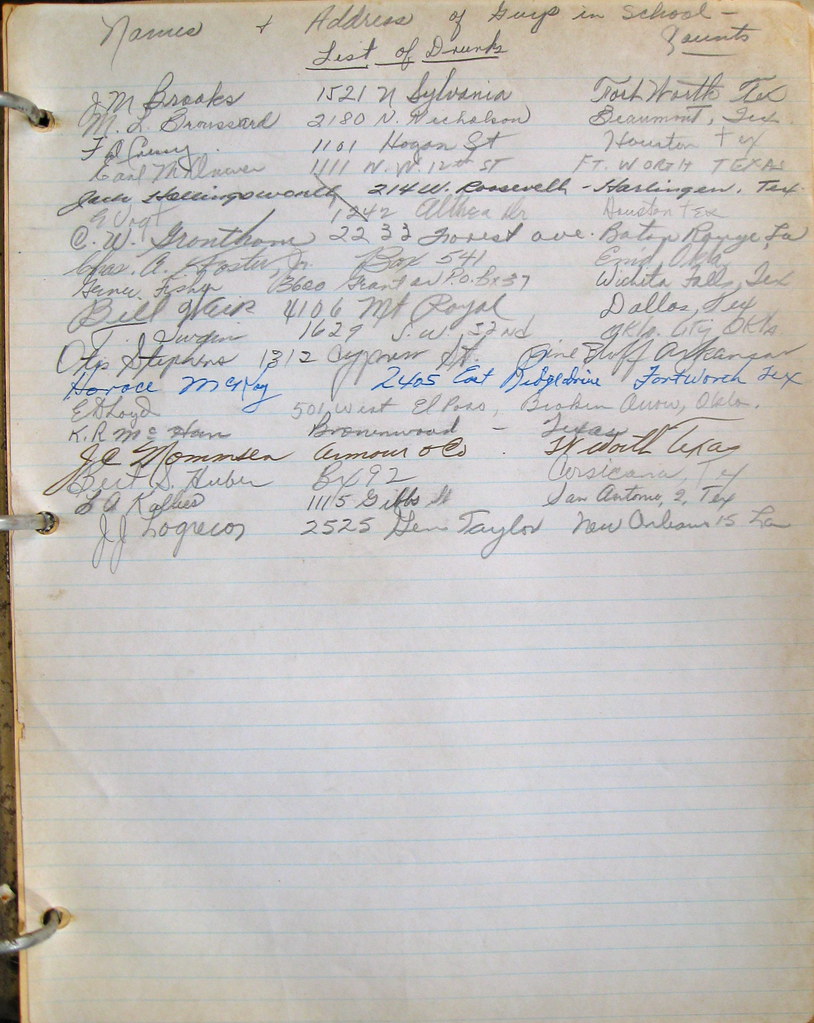
Toward the end of the binder is a list of the names and addresses of the "guys in school," also described as "List of Drunks" -- presumably Harry's fellow trainees. As you can see, they're all from Texas, Oklahoma, Louisiana, and Arkansas:

IMG_1500.JPG

And here's the oddest thing of all: The very last page in the notebook has instructions for a pyramid scheme fueled by a chain letter, purporting to "bring you and your friends a sizable nest egg in a very short time. Take a look:

IMG_1509.JPG

Interestingly, the last person in the chain -- O.D. Stephens of 1312 Cypress St. in Pine Bluff, Arkansas -- was also one of Harry's classmates. Was Harry playing his friends for suckers? And why was something like this in his sales training notebook?

Nearly all the chain mail addresses are from Pine Bluff, so I'm assuming Harry was probably from there as well. And of course we know he worked for Armour. Unfortunately, some quick Googling based on those parameters failed to turn up anything, and I don't have time right now to go digging through census records and other resources. But if anyone reading this wants to track down Harry, I'd like to know more about him.