The woman shown above is Alicia Collier, who lives in Old Greenwich, Connecticut. She's holding a postcard that was recently arrived at her address in the mail. Just one problem: The postcard wasn't for her — it was for a previous inhabitant of her house. That's because the postcard was mailed and postmarked in 1948 (click to enlarge):
As you can see, the postcard was addressed to Linda Benner. It's hard to read the message because it's sideways, so here's a transciption:
Dear Linda
This is where we are staying Thursday night. Look for the x and that marks our window.
Love,
Mommy
It's not clear why the postcard took 66 years to be delivered. Collier, the woman who received it, did some research and determined that Linda Benner, the card's intended recipient, was five years old when the card was mailed in 1948. Here's how she looked around that time:
Unfortunately, Linda and her mother, who sent the postcard, are both now deceased. But one of Linda's sisters is still alive, and Collier plans to deliver the postcard to her soon. You can read more about this here.
I learned about this story from PermaRec reader Cliff Corcoran. He's the stepson of Linda Benner's living sister — the one to whom the postcard will soon be returned. Small world.
Photos by Ted Barron; click photos to enlarge; click song titles to listen
.
My friend Ted Barron, who runs the excellent music website Boogie Woogie Flu, recently purchased a 78-rpm Billie Holliday record from 1937. As you can see in the photos above, both sides of the record's sleeve were inscribed with the word "Cole."
Tucked inside the sleeve was a postcard. Postmarked in Jersey City, N.J., on Feb. 21, 1953, it was addressed to one Max Cole at "Station W.O.V." in New York (click to enlarge):
The text of the postcard reads as follows:
Hi, Max,
A bunch of the fellows and myself catch your show from 6:30 to 6:55 every morning on the way to work. Our only regret is that we can't hear your whole show. If you have a chance, we would appreciate a Sinatra record during the time mentioned above. The boys from Continental Can in Paterson would really enjoy this.
Thank you,
Al Russo
Tom Napp
Tony LaManna
Wow, that postcard offers so many potential avenues of investigation! One at a time:
• Max Cole — the postcard's addressee, and whose surname is written on the record sleeve — was a giant of New York City radio, where he worked for 60 continuous years. Prior to that he was an actor, although that chapter of his career was interrupted by his military service in World War II. (You can get further details in this fascinating obituary.) Cole's first radio job after the war was at the New York station WOV — the station to which the postcard was addressed. Which leads us to...
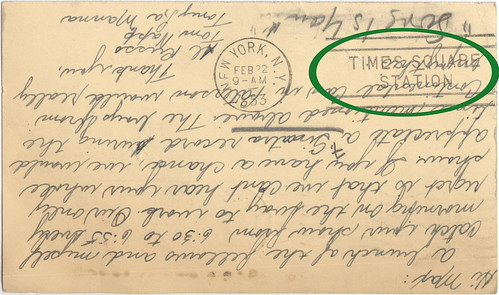
• WOV was a New York radio station with a long and complicated history. It was at 1130 on the AM dial from 1928 through 1941, at which point it moved to 1280. (In 1959, the station was sold and its call letters changed to WADO, which still operates at the 1280 frequency today.) Max Cole worked there from 1946 through 1955. During that period, the station's studios were located at 132 W. 43rd St. — the heart of Times Square — which explains why the postcard was processed by the Times Square Station post office:
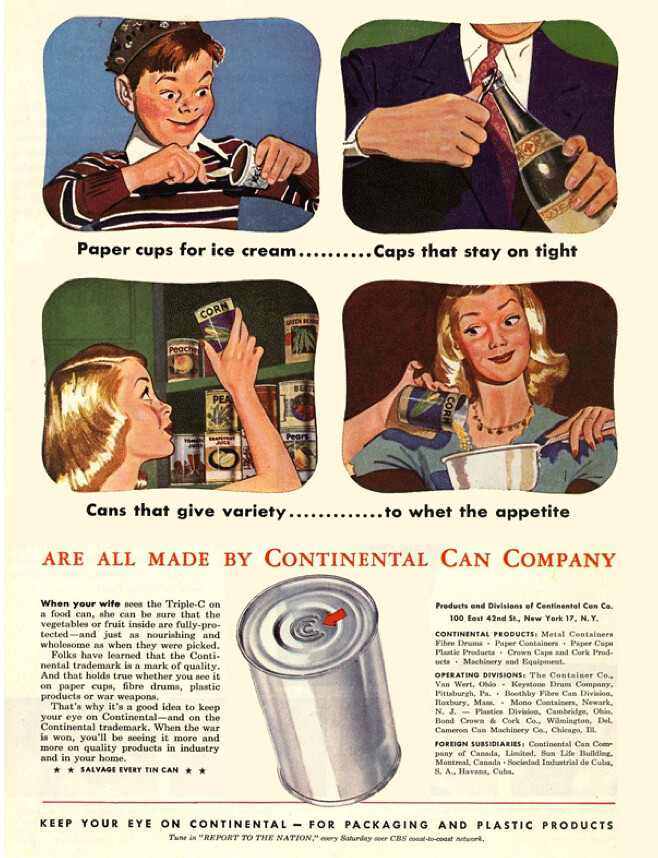
• Continental Can Company, where the men who sent the postcard worked, was one of America's two primary can manufacturing companies in the 20th century. (The other was the American Can Company.) By 1954, one year after the postcard was sent, Continental Can had 81 plants spread out across the country, including the one in Paterson, N.J., where the postcard guys worked. Here are two of the company's ads from the 1950s (click the lower one to enlarge):
Although the postcard guys worked at the plant in Paterson, the postcard itself was mailed from Jersey City, so at least one of the three men who sent it presumably lived there. Interestingly, Google Maps shows that the drive from Jersey City to Paterson takes 27 minutes. That matches up perfectly with the postcard's reference to the employees listening to Max Cole's radio show "from 6:30 to 6:55 every morning on the way to work."
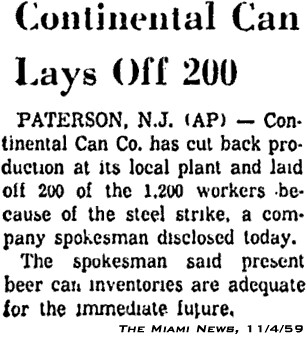
In 1959, six years after the postcard was sent, the Paterson plant laid off 200 workers due to a steel strike:
Were the postcard guys still working for Continental in 1959? If so, did they get caught in the wave of layoffs?
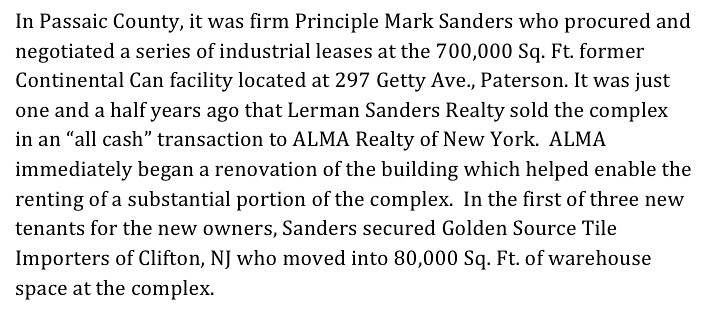
Changes in the packaging industry eventually led to Continental Can's demise (you can read more about that, and the rest of the company's history, here), although I'm not sure exactly when the Paterson plant closed. The building is listed as a notable sale on the home page of a New Jersey realty company. Details of the sale, which took place in the fall of 2011, are as follows:
• Al Russo, Tom Napp, and Tony LaManna are the three Continental Can employees who sent the postcard. If we assume that they were at least 25 years old when the postcard was mailed in 1953 (and possibly quite a bit older than that), they would now be at least 85 years old. In other words, there's a strong chance that they're now deceased, so I went looking for obituaries. I found this obit for an Alan Russo, who lived in the right place and was about the right age, although there's no mention of whether he worked for Continental Can. I also found a death notice for an Anthony LaManna, again without corroborating details. I was unable to find anything regarding Tom Napp. (There were several death notices for people named Tom Knapp, but they weren't the right age.)
• Frank Sinatra — well, you know who he was. It makes sense that the Continental Can guys would have requested one of his songs, since Sinatra was born in nearby Hoboken. I really like that the postcard refers to him simply as "Sinatra" but that someone — presumably Max Cole — wrote in Sinatra's first initial, just for clarification (click to enlarge):
• "The Song Is You" is a song title written in the lower-left corner of the postcard, and is apparently the Sinatra song that Max Cole chose to play for the Continental Can employees. The tune, which was written in the early 1930s by Jerome Kern and Oscar Hammerstein II, was a favorite of Sinatra's. He recorded it eight times during his career, beginning with a 1942 session for the Bluebird label. That's probably the version Cole played. This one goes out to the boys at Continental Can:
Several of Sinatra's subsequent versions of the tune are available here.
Interestingly, it appears that "The Song Is You" was not Cole's first choice of what to play for the Continental Can employees. If you look closely at the lower-left corner of the postcard, you can see that another song title was written and then erased before "The Song Is You" was written (click to enlarge):
The first song title is tantalizingly close to being legible, but I can't quite make it out. Can anyone else decipher it?
———
One Additional note: Although the postcard was postmarked in Jersey City on Feb. 21, it was processed by the Times Square Station on Feb. 22 (click to enlarge):
This is interesting for a couple of reasons. First, Feb. 22 was a Sunday in 1953. More notably, Feb. 22 is Washington's birthday, which was still a Federal holiday back then. (The default Monday for Presidents Day didn't come into use until 1971.) So the Times Square Station post office was apparently one of those rare branches that are always open, or at least always processing, even on holidays.
I'm more attuned to Feb. 22 than most folks because my parents got married on that date in 1948. The idea was that their anniversary would always be a holiday. Unfortunately, Presidents Day put an end to that.
———
So that's a pretty detailed breakdown of the info on the postcard. But there are still some unanswered questions. For starters, it's odd that the postcard ended up tucked inside a Billie Holiday 78, instead of in a copy of "The Song Is You." More importantly, what happened to Messrs. Cole, Napp, and LaManna? Would anyone like to delve a bit deeper into that research? It would be amazing to reconnect this postcard with the descendants of the guys who sent it.
(Special thanks to Ron Underberg for research assistance on Continental Can.)
Thursday, January 31, 2013
Today we have our latest installment of Charlene Dodds's postcard rephotography project (previous editions of which can be found here, here, here, here, and here). Here's Charlene:
Heading northwest from Bedford, Pennsylvania, I went looking for the famous Horseshoe Curve just to the west of Altoona. The curve is shown on a postcard I found with my great aunt’s college-era postcards [see above]. It was never mailed and is blank on the back, but I suspect she and her chums took an adventure to see this engineering marvel, purchased a postcard as a souvenir, and decided they didn't want to part with it, especially since cameras were not commonly owned back then. The postcard was probably their only visual record of their visit to the curve.
I eventually located Horseshoe Curve, which is part of a rail line that was constructed to shorten the distance between Harrisburg and Pittsburg and eliminate the need for another line. The 220-degree curve was incorporated to lessen the steep grade and allow safe passage of trains. Even so, before the invention of modern braking systems, the rails were regularly pulled up and switched around to give equal wear to both sides, doubling their lifespan. So many troops were moved along this line during World War II that the Germans hatched a plot to blow up the tracks and even landed men on our shores to do just that. (The FBI ended their plans.) The curve is so ingrained into the local culture that Altoona's minor league baseball team is called the Curve.
Horseshoe Curve looks much the same today as it did back then. But trespassing on the rail tracks is illegal and dangerous, so I couldn't take a proper photo and had to settle for a contemporary postcard:
Next: I was intrigued by the postcard of Bickford Fire Brick Co. ("Largest Fire Brick Plant in the World Under One Roof"), which was sent to my grandmother from “Fritz & Foster” in 1924 (click to enlarge):
First, what is a fire brick? I discovered it is a ceramic brick made to withstand high temperatures inside a fireplace, furnace, or iron smelter -- and of course there were lots of those in nearby Pittsburgh. Clearfield County, Pennsylvania, is known for the high quality of clay used in manufacturing these bricks, and Bickford Fire Brick Co was “what is probably the finest, best equipped and one of the largest fire-brick plants in this country," at least according to in a state review in the 1930s. Alas, there is no trace of this plant left in town, so I wasn't able to photograph it.
Continuing farther west, I searched for Conneaut Lake Park, which was shown on a postcard received by my grandparents in 1948. The day I arrived was picture perfect, just as depicted in the postcard (click to enlarge):
While I was taking photos, there was a great influx of motorcycles and many vans, from which emerged various tattooed folks. Then a loudspeaker announced, “Ladies and gentlemen, we appreciate your patience. Ozzy Osbourne and Black Sabbath will be here any minute. Their plane has finally landed and they are on their way. The show will be well worth the wait.” My grandparents would roll in their graves if they knew this idyllic site was about to be overrun by the heavy metal hordes.
My continued thanks to Charlene for sharing her stories and family postcards with us.
Thursday, December 27, 2012
Today we have the latest installment of Charlene Dodds's rephotography project, in which she's visiting places shown on old postcards sent to and from members of her family. (In case you missed it, previous installments in this series are available here, here, here, and here.)
Here's the latest from Charlene:
The next stop on my tour of Pennsylvania was Waynesboro, a town General Robert E. Lee passed through after the Battle of Gettysburg. A schoolmate of my great aunt’s had sent her a postcard from Waynesboro over the summer break in 1917. The postcard showed three grand houses along Clayton Avenue. I had no trouble finding the proper street, but I had to drive back and forth several times before I realized that the tiny trees shown in the postcard had grown so much in 95 years that they now largely obscure the houses, one of which you can just barely see peeking through in the photo I took [for all of these images, you can click to enlarge]:
You can get a better view of that house in this shot, although it doesn't duplicate the original postcard perspective.
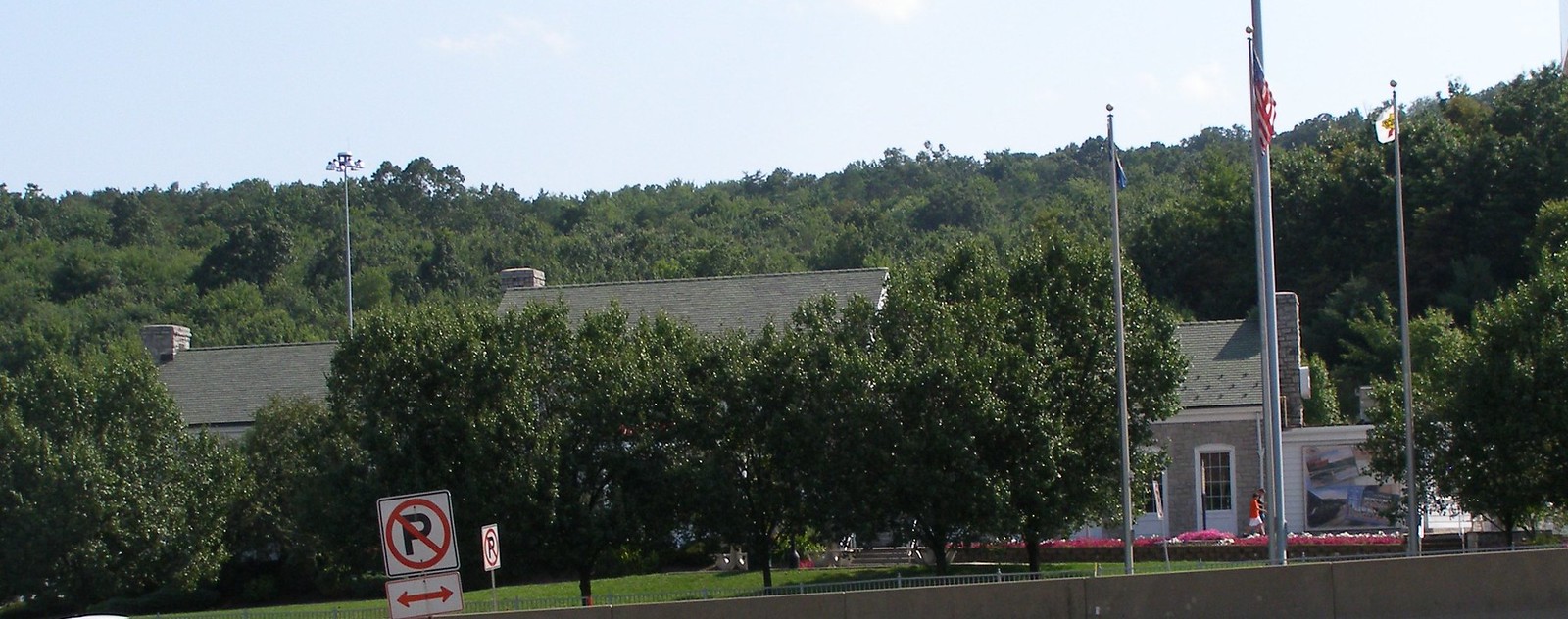
My next stop was the Bedford rest station on the Pennsylvania Turnpike. This spot was a big hit for my paternal grandfather, who sent many postcards back home to his kids from this place, including a view of a Howard Johnson restaurant known as "the Midway." I discovered that the building shown is on the south side of the roadway. Roadway traffic necessitated a high concrete wall dividing the directional traffic lanes, so a second, near-identical restaurant was built on the north side of the road. That one is still there -- but much like the houses in Waynesboro, it's now largely obscured by trees:
My other grandfather, on my mother's side, also had a connection to the Turnpike. He had been the surveyor for this road many years earlier. My mother -- his daughter -- has regaled me with stories of when she was very small and he would take her along in the dead of night to “shoot the stars” with a sextant, which is how the workers plotted where to lay the roadbeds before GPS. It's fascinating to me that both sides of my family had a link to the Turnpike years before my parents would eventually meet.
That's it from Charlene for this time around. More soon.
Tuesday, December 4, 2012
Today we have another installment of Charlene Dodds's rephotography project, in which she's visiting places shown on old postcards sent to and from members of her family. (In case you missed it, previous installments in this series are available here, here, and here.)
Here's the latest from Charlene:
For the next leg of my trip, I drove southwest from Harrisburg, and dropped in on Mechanicsburg, Pennsylvania. Mechanicsburg was originally named for Conestoga wagon mechanics who settled this area in the early 1800s. When the Cumberland Valley Railroad came through town, bringing more growth to the area, mechanics in the burg serviced the trains. The many train lines through Mechanicsburg aided in transporting troops during the Civil War. In 1923, Jubilee Day was started by a pre-Chamber of Commerce group. This fair, which takes place on the third Thursday of June, is now considered the largest and longest-running one-day street fair on the east coast.
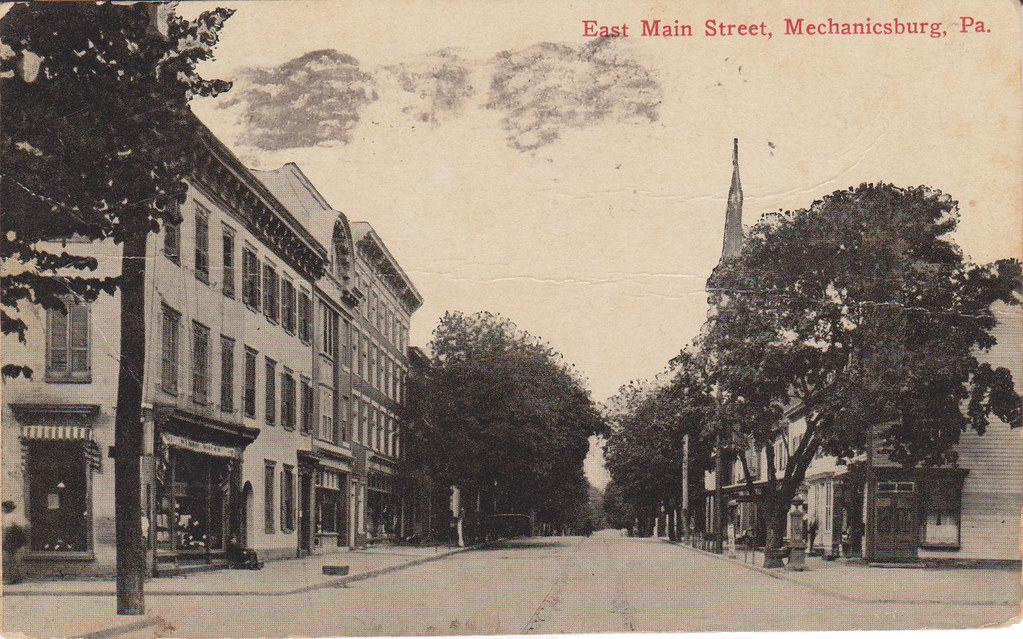
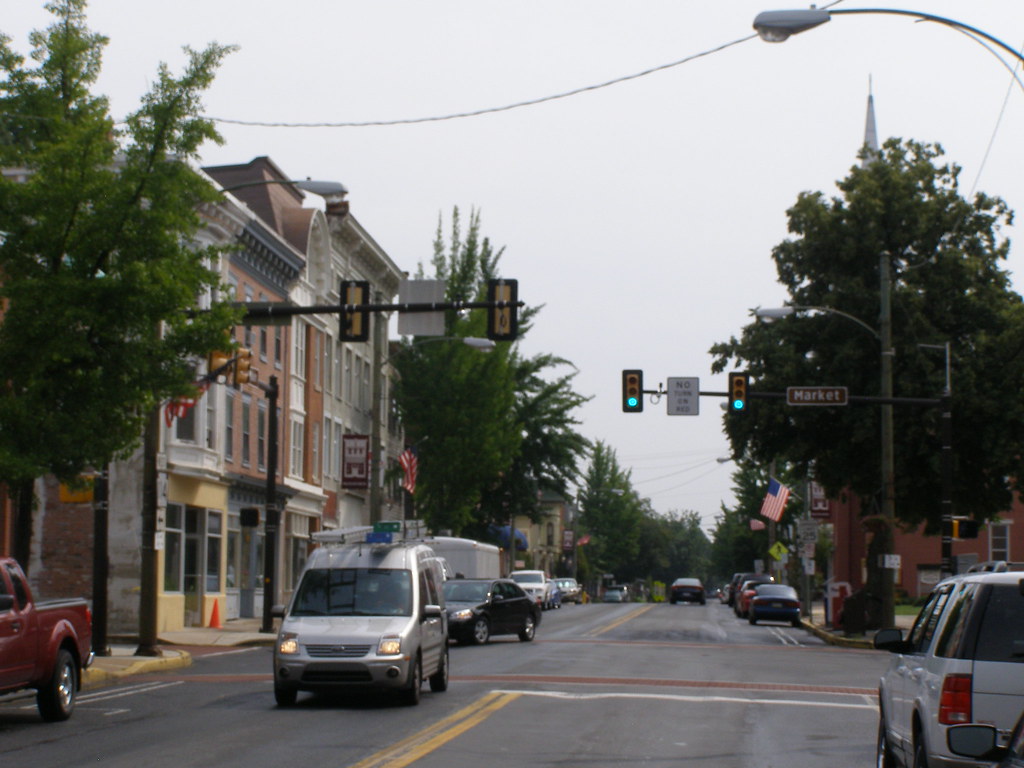
Many of the same buildings from a century ago are still standing, including the ones shown in a postcard that was sent to my great aunt in 1917. I matched the view in the postcard by taking a photograph looking east from Hershey Violins on West Main Street [for all of these images, you can click to enlarge]:
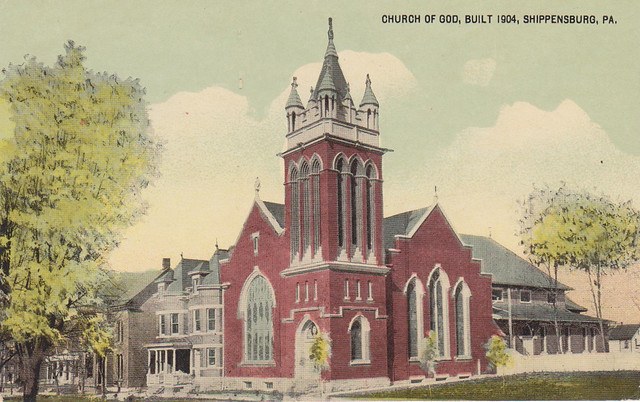
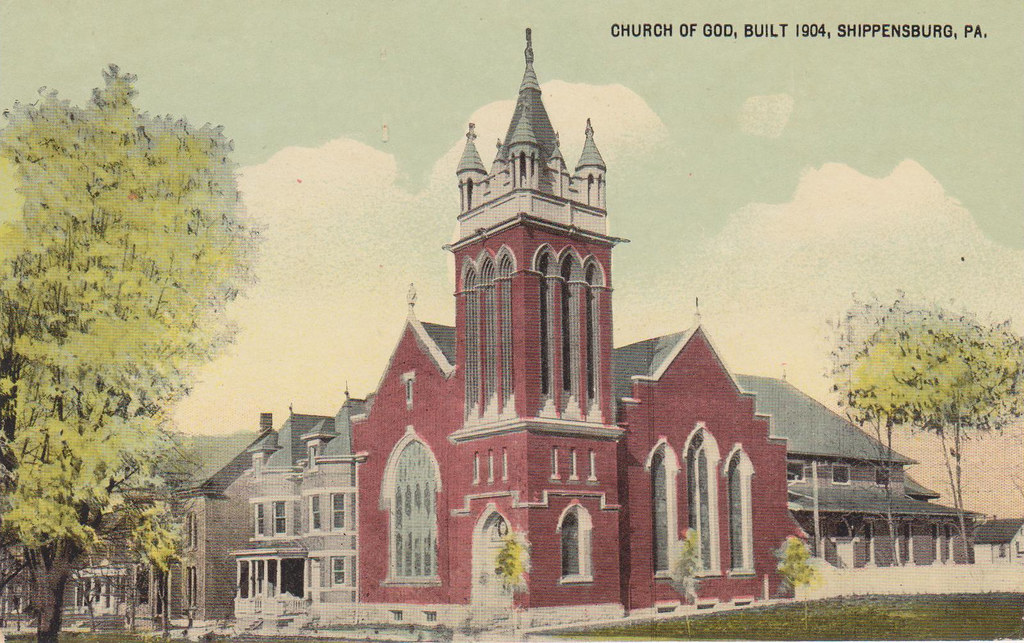
Continuing southwest, I arrived at Shippensburg, Pennsylvania. The old church on King Street, completed in 1904 still survives, albeit with a few alterations to the tower. Still, it is recognizable as the same structure shown in this old postcard:
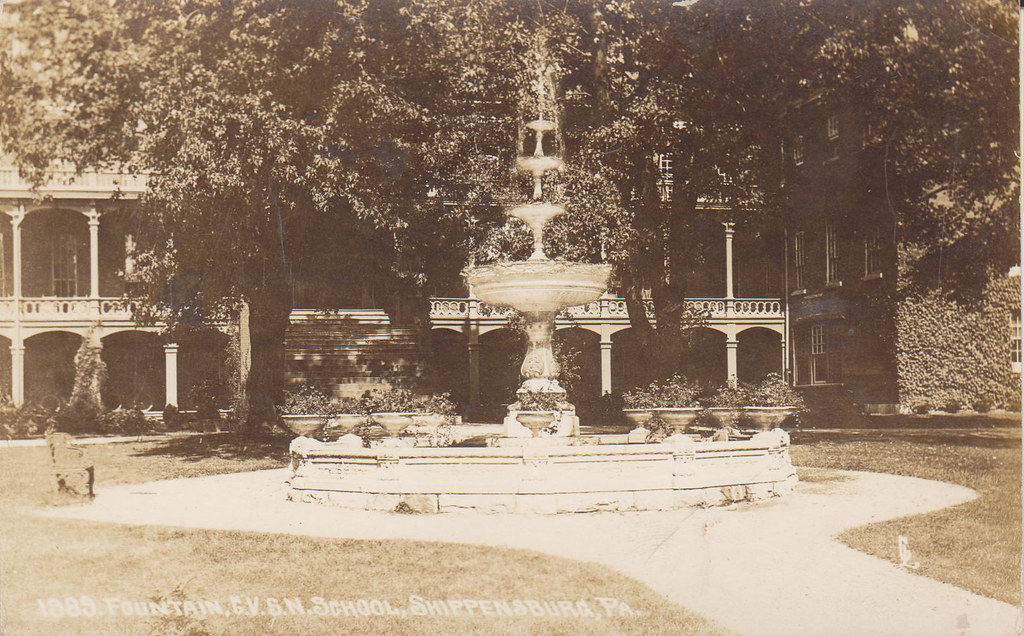
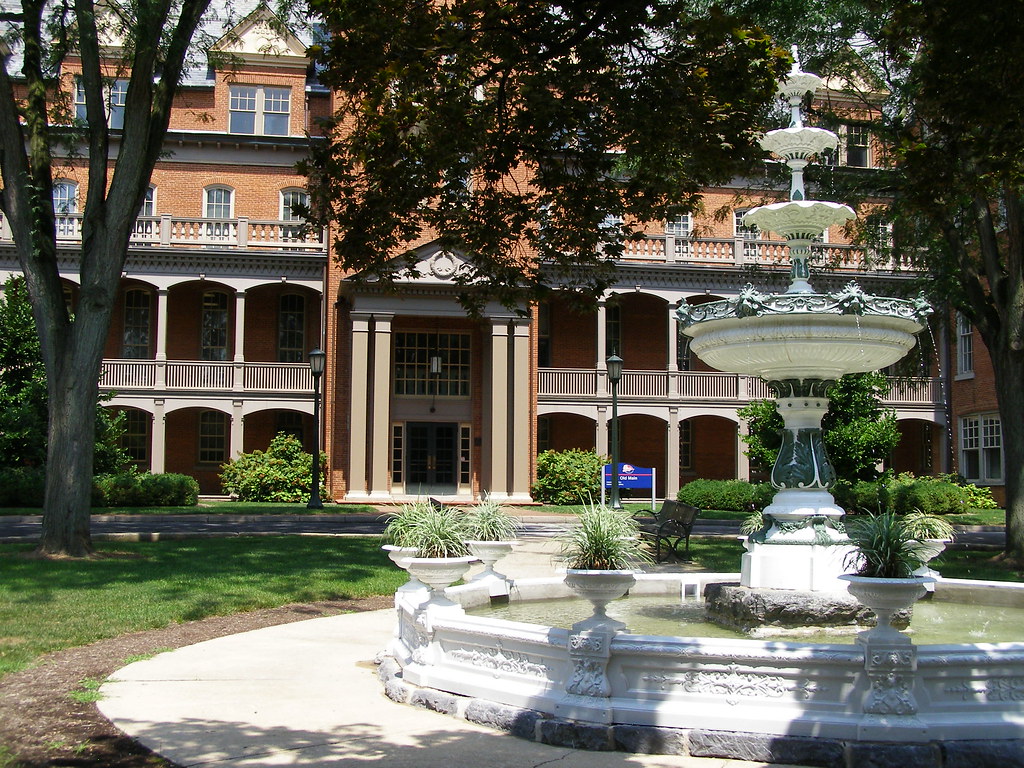
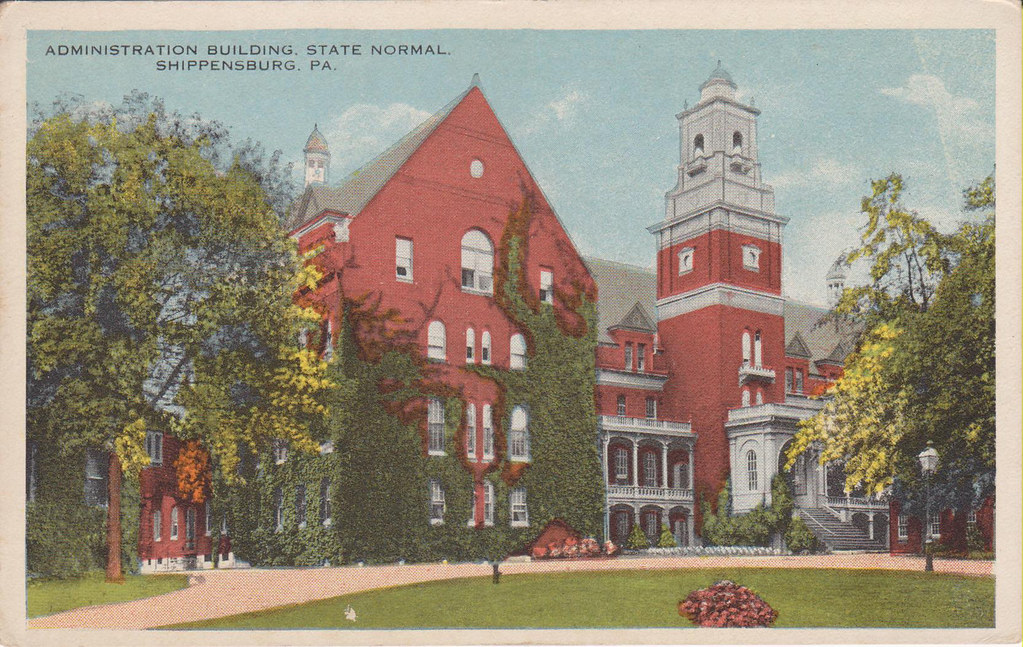
My great aunt attended Shippensburg College just outside of town. The college recently completed a refurbishing of the ornate fountain in front of the main building. The fountain and the building both look very similar to how they looked in these old postcards:
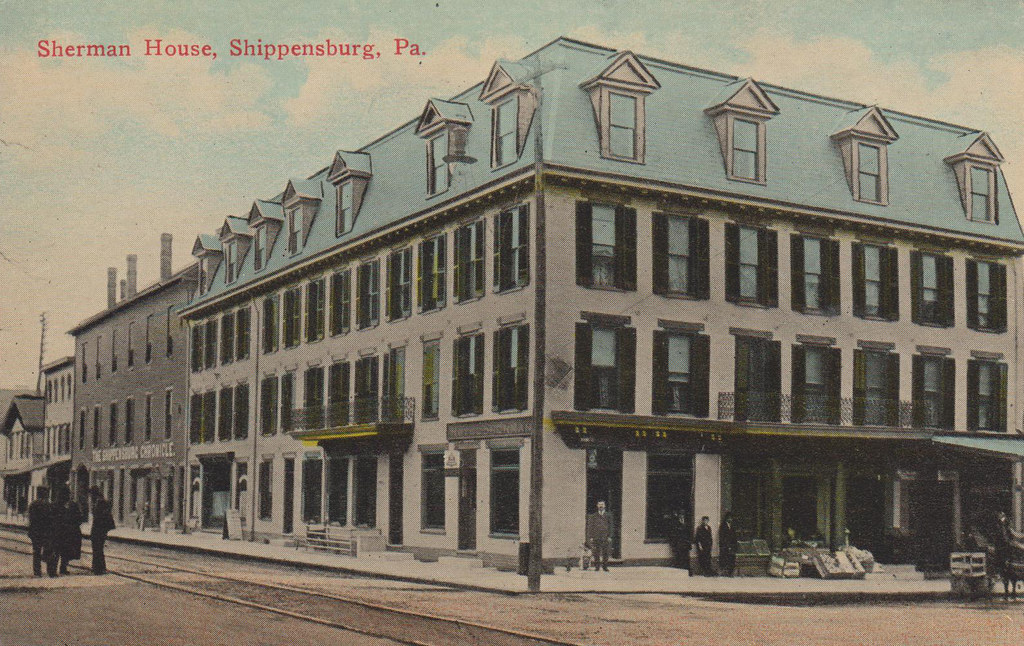
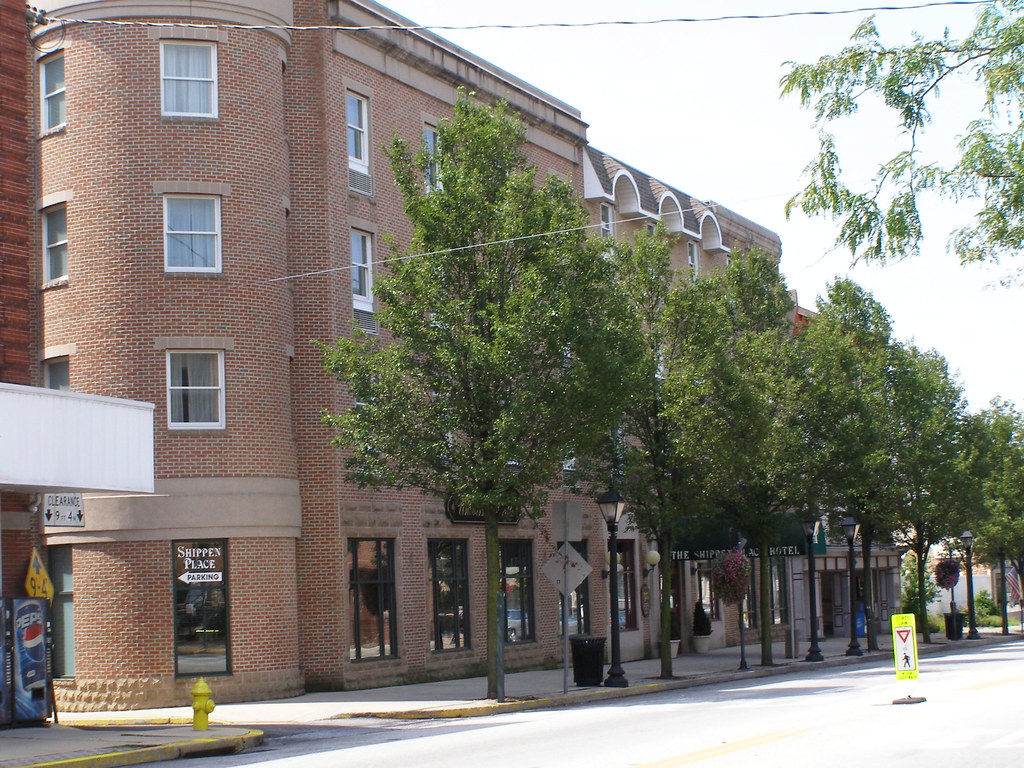
Back in town, the Sherman House has not fared as well. An old hotel originally known as the Union House, it was renamed and given new signage as Confederate troops approached, in hopes the it not be destroyed. Time has wrought worse alterations to “Shippen Place.” Looking carefully, one can see the original lines of the old hotel shown in this postcard, although xxpansion has pushed the wall outward, converting what was once a side street with rail tracks into an alley:
That's it from Charlene for now. I'm sure we'll be hearing more from her soon.
Friday, November 23, 2012
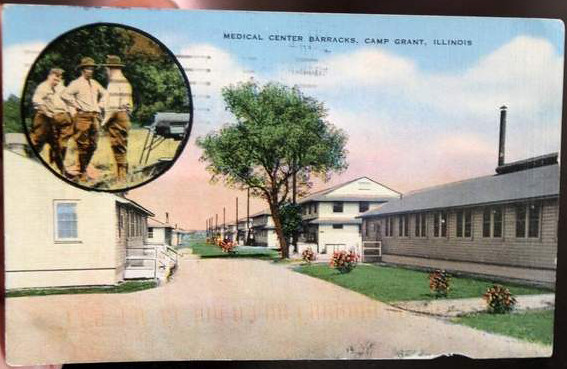
What you see above are the front and back of a postcard that was mailed from Rockford, Ill., to Elmira, N.Y., in the summer of 1943. It arrived at the address listed on the postcard just last week -- more than 69 years after it was sent.
The postcard was sent to sisters Pauline and Theresa Leisenring by their parents. The parents were visiting their son (Pauline and Theresa's brother) George Leisenring at the Medical Center Barracks at Camp Grant, which is the location shown on the front of the postcard.
The message reads as follows:
Dear Pauline and Theresa,
We arrived safe, had a good trip, but we were good and tired. Geo. looks good, we all went out to dinner today (Sunday). Now we are in the park. Geo has to go back to Grant at 12 o’clock tonight. Do not see much of him. We are going to make pancakes for Geo for supper tonight. See you soon.
Love,
Mother, Dad
Unfortunately, Pauline and Theresa no longer live at the address on the postcard (or anywhere else -- they died in 1962 and 1954, respectively), so the postcard was received by Adam and Laura Rundell and their family, who now live at that address.
It's not clear why the postcard took so long to be delivered or where it might have been stowed over the past several decades, but the Rundells were intrigued by it. According to this article, they did some PermaRec-style research, tracked down some of Pauline and Theresa's cousins, and offered the postcard to them. The story quotes Adam Rundell as saying, "They seemed interested but so far haven't picked it up."
I'm not sure why the Rundells can't simply mail the postcard to the cousins, but then this postcard has already had one harrowing postal adventure, so maybe best not to tempt fate.
(My thanks to Sue Kendall for pointing me toward this story.)
+ + + + +
Slate update: I've been told that long-delayed 10th installment of the Slate series will finally run on Monday. Fingers crossed!
Wednesday, October 31, 2012
Today we have another installment of Charlene Dodds's rephotography project, in which she's visiting places shown on old postcards sent to and from her great aunt, her grandmother, and their friends. (In case you missed it, further details on the project are spelled out here, and Charlene's first report from the road is available here.)
Here's the latest from Charlene:
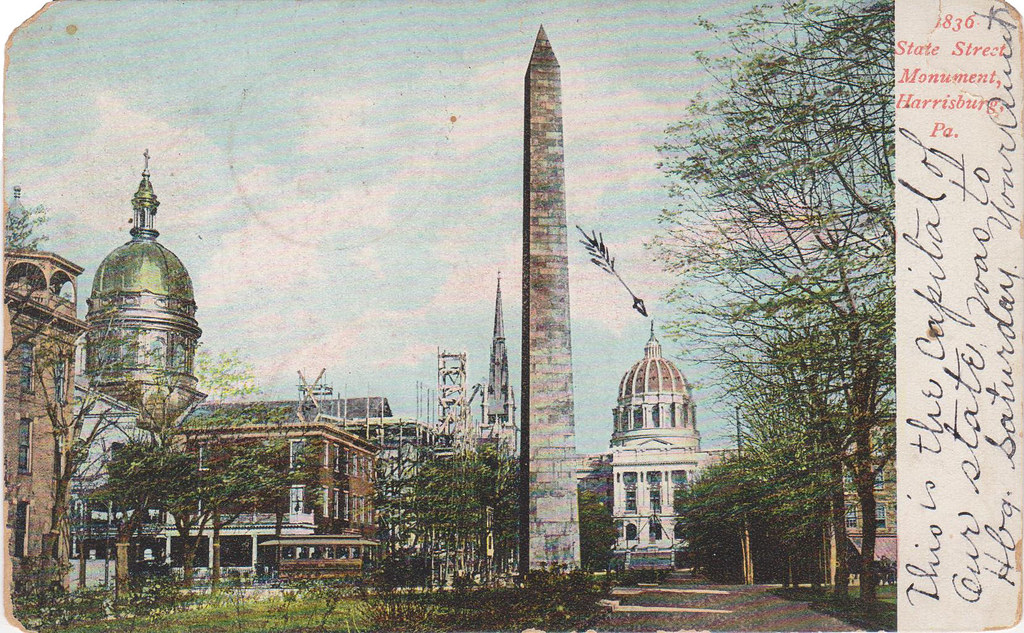
After my first stop in York, Pennsylvania, I headed north on I-83 to Harrisburg. I wanted to visit the state capitol building, which is shown on a postcard sent to my great aunt from her aunt in 1907.
Some quick background: This is actually the third capitol building in Harrisburg. The first one was destroyed in 1897 by a fire, and a second one was left unfinished due to lack of funds. The Capitol Building Commission was formed in 1901 to hold a competition open only to Pennsylvania architects. They selected a Beaux-Arts design by Joseph Miller Huston. Known as the Huston Capitol, it was designed in 1902 and dedicated in 1906, a year before this postcard was sent [for all of these images, you can click to enlarge]:
Here's a roughly equivalent view from when I visited more than a century after the postcard was sent:
Obviously, something's missing. What became of the Washington Monument-like obelisk that's show in the middle of the postcard image? It took quite a bit of research to uncover the answer. The Dauphin County Veteran's Memorial Obelisk was originally erected in 1876 in memory of the county’s Civil War dead. It stood 110 feet high and weighed over 600 tons. After decades of exposure to traffic and the elements left it looking a bit grim, it was refurbished and relocated to Third and Division streets, where it remains today.
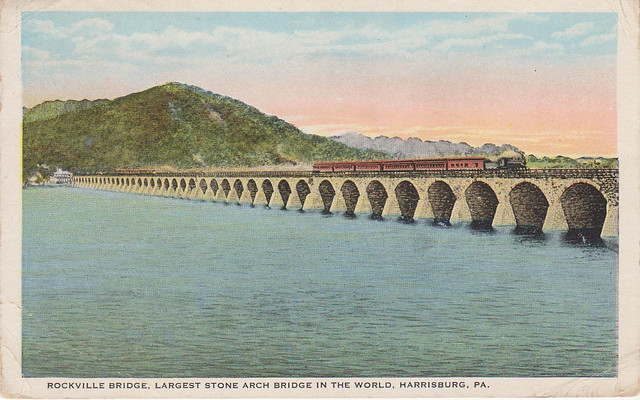
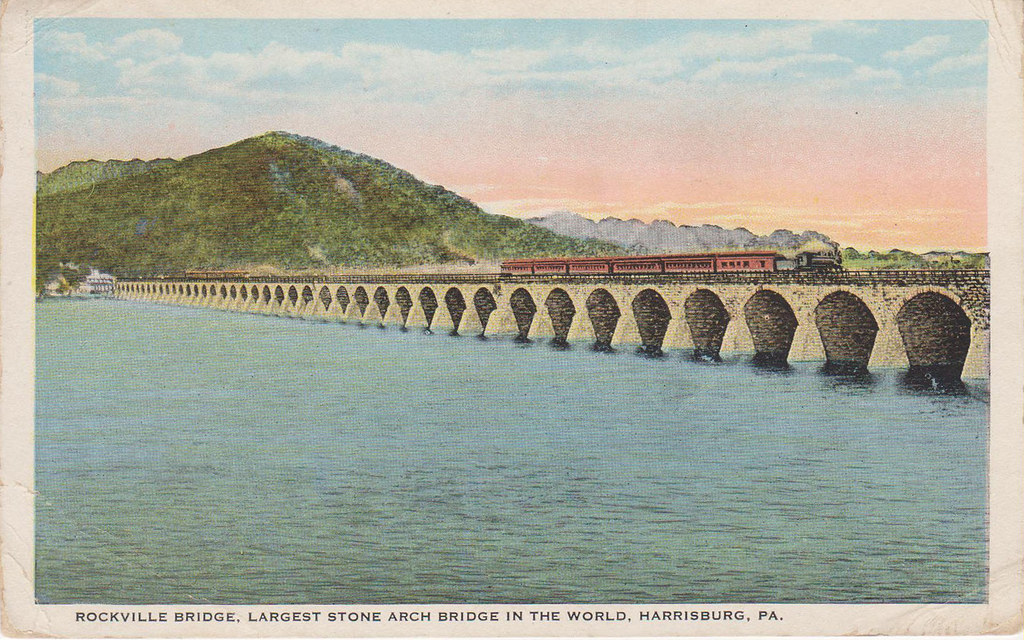
Next, I headed a few miles north of Harrisburg. My designation was the Rockville Bridge, the “largest stone arch bridge in the world,” according to this postcard sent to my grandfather in 1922:
The bridge was completed in 1902. Although it's no longer the world's largest stone arch bridge, it remains the world's longest stone masonry arch railroad viaduct, with a total length of 3,820 feet. You can learn more about the bridge here.
The bridge is still in use today. Here's how it looked during my visit:
----------
Very, very nice. Thanks for the great material, Charlene -- keep it coming.