Showing posts with label Old Receipts and Invoices. Show all posts

Monday, July 9, 2012

Screen shot 2012-07-06 at 7.55.39 PM.png

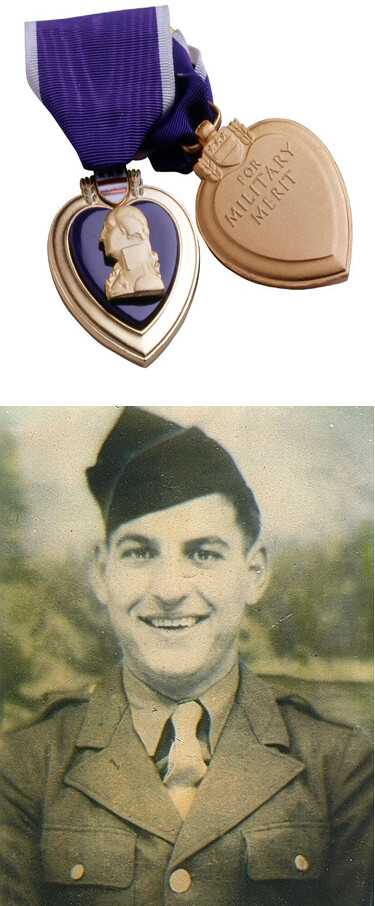
At the top of the page is a Purple Heart medal; beneath that is a photo of Army Pvt. Corrado Piccoli, who was awarded a Purple Heart during World War II before being killed in action later in the war.

Pvt. Piccoli and his Purple Heart are at the center of a really interesting report that ran on NPR on July 6. It's about a 31-year-old Vermonter named Zac Fike, who likes to seek out old military medals (in antiques stores, on eBay, etc.) and then tries return them to the soldiers' families. In the case of Pvt. Piccoli's Purple Heart, Fike was able to track down Piccoli's sister, who's now 85 years old, and return the medal to her. (Audio of the NPR story, along with a text version, is available here.)

This is, of course, very Permanent Record. As I listened to the NPR story, many of the details sounded so familiar to me. When Fike first contacted Pvt. Piccoli's sister, for example, she was initially suspicious of him, which is the same response I often get when contacting the family of a Manhattan Trade School student. By the end of the story, however, the sister tells Fike, "We were very fortunate that you were the one who ended up with the Purple Heart. You're part of our family now." I'm happy to say I've been on the receiving end of that type of sentiment as well, and it's a very humbling thing.

I don't mean to equate a report card's significance with that of a Purple Heart. But they both serve as powerful reminders that a simple object can carry stories, stir memories, and even serve as a conduit for intimacy between strangers. And like all lost items that become found, they can trigger the impulse to bring that wayward object back to where it belongs.

(Special thanks to Kirsten Hively for letting me know about the NPR story.)

+ + + + +

Finigan Update: I've now written several blog entries about the Finigan family of Darby, Pennsylvania, because I ended up with a bunch of their receipts, invoices, and other paperwork from the 1940s. In my last entry, I noted that Harold Finigan, who had established a tradition of hanging Christmas decorations in Darby, was likely deceased by now, and I wondered if anyone was now putting up the decorations in his stead.

That prompted the following note from reader Scott Jackson:

I asked a former co-worker about this. She's lived in Darby since the 1960s. She wrote back, "After Mr. Finigan died in 2005, there was a fire and the store that the family owned burned down. Everything in the store was destroyed, along with many of the decorations that Mr. Finigan put up. Darby is not the same place it used to be, which is very sad."

Too bad. But thanks for the info, Scott.

Friday, July 6, 2012

Delaware County Daily Times 3-30-63.png
Click to enlarge

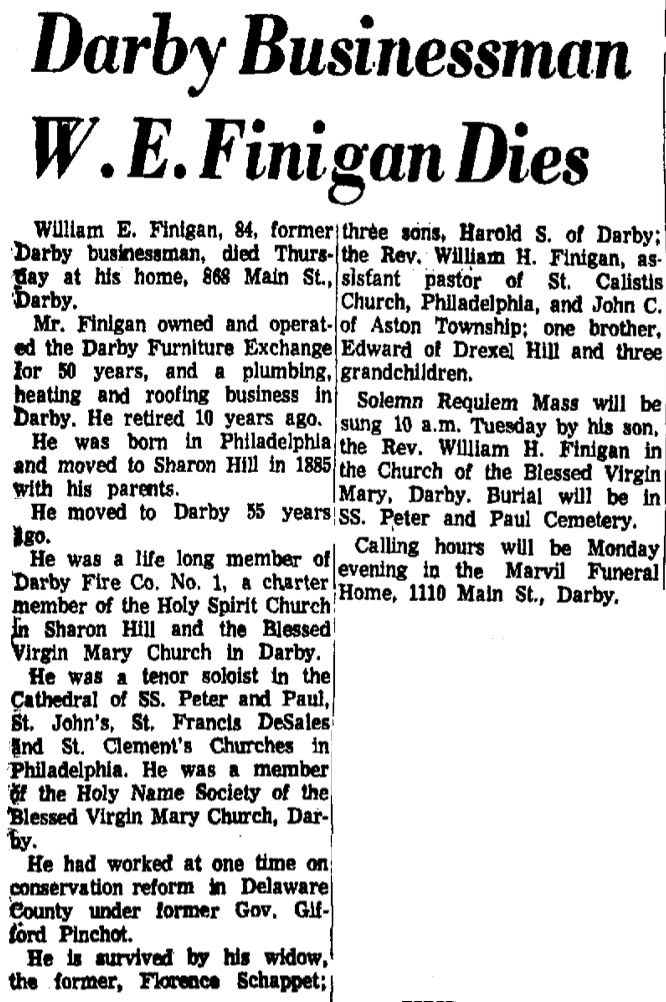
Remember my recent blog entry about William E. Finigan's invoices and receipts from the 1940s? Two readers were curious enough to do a little digging on Mr. Finigan, which led me to do a bit more research myself. One of the things I came up with, as you can see above, was Mr. Finigan's obituary, which was published on March 30, 1963, in the Delaware County Daily Times. The obituary says Mr. Finigan was 84 at the time of his death. That's consistent with the information found in this early biography of him, published in 1914, which states that he was born in 1879.

A few other notes regarding Mr. Finigan:

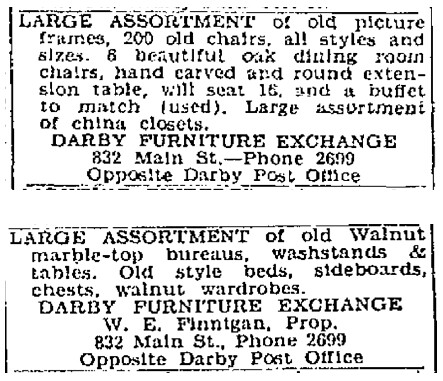
• As you may recall from that earlier blog entry, Mr. Finigan owned a furniture store -- the Darby Furniture Exchange. He advertised frequently in a local Pennsylvania newspaper called the Chester Times, running dozens of classified ads during the 1940s. Here are two fairly typical examples:

Screen shot 2012-06-30 at 4.18.36 PM.png

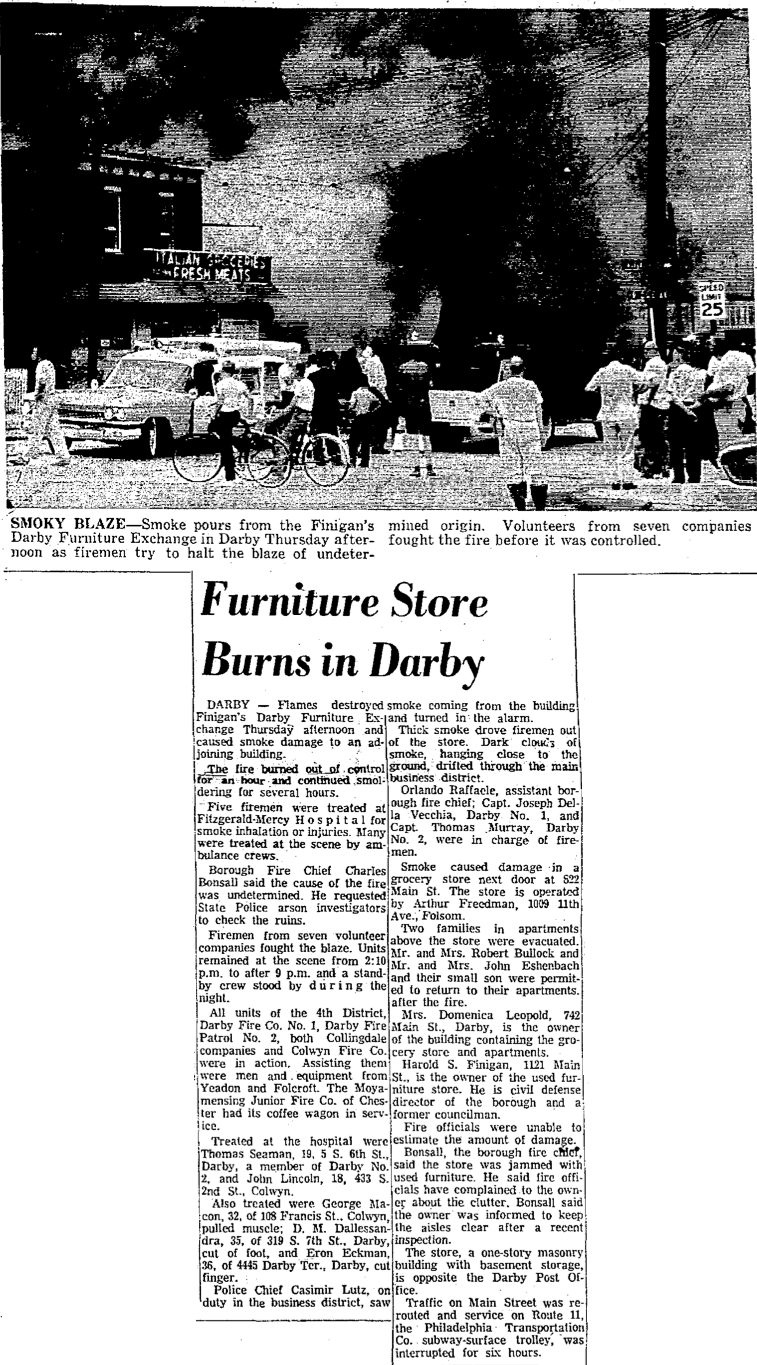
• According to the obituary, Mr. Finigan retired 10 years prior to his death, which would have been 1953. Eight years later, the furniture shop -- which by this point was being run by William's son Harold -- caught fire. Here's the story from the Sept. 8 edition of the Delaware County Daily Times (click to enlarge):

Delaware County Daily Times 9-8-61.png

According to the story, "[T]he store was jammed with used furniture. [The local fire chief] said fire officials have complained to the owner about the clutter." This is particularly ironic given that Mr. Finigan's obituary says he was "a life long member of Darby Fire Co. No. 1." Of course, he was 82 years old by the time of the fire, so he likely wasn't manning any of the hoses as the local firemen tried to save his family's shop.

• The shop was apparently rebuilt. According to this 1996 article, Harold Finigan -- William's son, who by this time was 87 years old himself -- was still running the Darby Furniture Exchange and had established a long-running annual tradition of hanging holiday decorations on Main Street around Christmastime. The article also states, "[Harold] Finigan said his father began the decorating tradition sometime during World War I."

Harold Finigan is likely deceased by now (either that or he's 103 years old). I can't find any current listings for the Darby Furniture Exchange, so the shop is likely gone as well. Does anyone out there know if anybody is still hanging Christmas decorations on Main Street in Darby?

(My thanks to Barbara Zimmer and James Breig for their contributions to this entry.)

Saturday, June 23, 2012

IMG.jpg IMG_0001.jpg

Sorry not to have blogged in a while. I've been busy with other projects (including the next feature-length Permanent Record piece for Slate, which I'll have more to say about in a minute).

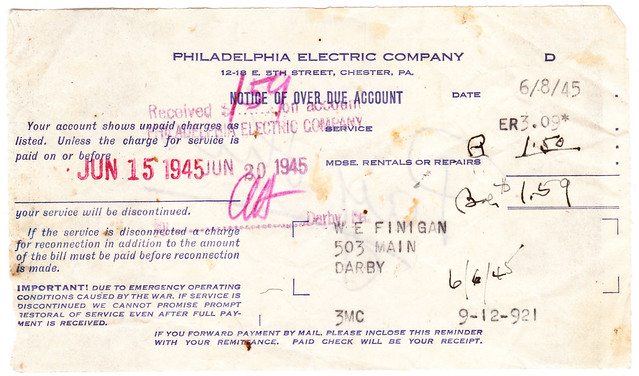
What you see above are the front and back of a bill sent on June 8, 1945, from the Philadelphia Electric Company to one William E. Finigan, whose account was in arrears to the tune of $1.59. As you can see, Mr. Finnigan was given one week in which to settle the outstanding balance or else his lights would be turned off. Judging by the stern "Pay this" note on the back of the bill, someone in the Finigan household took this admonition seriously.

This bill is part of a batch of mid-1940s invoices, receipts, and bills, all relating to Mr. Finigan, that I recently acquired. They're all interesting, but "Pay this" -- for the whopping sum of $1.59 -- adds a note of pathos that easily makes this slip of paper my favorite of the batch. (And no, I didn't intend for "pathos" to echo "Pay this," although that's a nice bonus.)

This wasn't the only time Mr. Finigan had to be reminded to pay an overdue electric bill. In December of 1944, he received notice of an outstanding balance of $18.11, which he paid six days later. Note that the address on these documents is different than the one shown on the document at the top of the page, however, so maybe one was for his home and the other for his business (for all of these subsequent images, you can click to enlarge):

IMG_0003.jpg IMG_0003 copy.jpg

And on Aug. 14 of an unspecified year, he received a friendly reminder to remit an overdue sum of $8.60:

IMG_0002.jpg

But I don't mean to imply that Mr. Finigan was a chronic deadbeat. Here are four electric bills stubs (complete with that beautiful hole-punch lettering you used to see on cancelled checks, paid invoices, and so on) that, near as I can figure, he paid on time:

IMG_0001.jpg

Mr. Finigan apparently ran a furniture business. Here's a receipt for an insurance policy on his shop:

IMG.jpg

Here's a receipt from William's visit to a local hardware shop (listing yet another address), which I'm including mainly because (a) I like the logo at the top of the receipt and (b) I love the intensity of the carbon paper transfer handwriting:

IMG.jpg

William isn't the only Finigan whose paperwork ended up in this stash of documents. Here's a notice of an unpaid car insurance bill, only this one is addressed to John Finigan, at still another address (the Finigans apparently owned or rented a big chunk of Main St. in Darby). Were William and John brothers? Father and son? I'm not sure:

IMG_0001.jpg

John Finigan, like William, apparently had some ongoing issues with prompt remittance. Here are three separate reminders to pay his annual 1946 dues for the Keystone Automotive Club (along with the fun information from the back of reminder):

IMG_0004.jpg IMG_0005.jpg

That's all I have on the Finigans. I admit that it's not much of a narrative -- more questions than answers, and not particularly burning questions at that -- but I still enjoy it when I find these small batches of items all relating to a particular person or family. Ephemera like this is so disposable that I figure anything paperwork that's survived this long wanted to be found, wanted to tell its little story. So now I've done my part to help that process along.

+ + + + +

Slate update: I've delivered the next PermaRec article to my editor at Slate, which means it should run within the next week or so. It's about two characters who I introduced last fall in the fourth article in the series. I'll have more to say about that in the next installment here on the blog.

Sunday, March 4, 2012

Screen shot 2012-03-03 at 11.47.46 PM.png
Click to enlarge

On the left is Rose Baggini, age 15, as shown on her Manhattan Trade School report card in 1932; on the right, Rose Baggini Vrana, age 95, in her Florida home on March 3, 2012.

Rose is the first -- and so far only -- living connection to Permanent Record. I interviewed her by phone a few weeks ago but didn't know what she looked like because she doesn’t own a camera or a computer. Fortunately, I was able to arrange for one of Rose's friends, Linda Cadovius, to take a photo of her and e-mail it to me. Linda, whose parents were close with Rose, lives nearby and looks in on her from time to time. Big thanks to her for serving as Permanent Record's first remote photographer.

My article about Rose will be appearing on Slate shortly -- stay tuned.

+ + + + +

Update: Remember all that stuff that I found in the pocket of an old jacket? I contacted the vintage shop where I bought the jacket and told them the whole story. "We receive a lot of merchandise, so we usually just pat down the items instead of checking each pocket," the owner told me. "I'm sure we've sold back hundreds of stray dollars and coins over the years." So much for my theory that they put random ephemera in random pockets, just for fun.

Meanwhile, my thanks to everyone who weighed in on the question of whether I should contact Ann Marie Kroznuski (the widow of the man whose stuff was in the pocket). For the record, my whole "Should I get in touch with her?" thing was meant to be rhetorical -- I don't plan to contact her.

Why not? Mainly because I think doing so would be selfish. When I track down a report card family, I gain information from them but I also provide lots of information for them regarding their ancestors, so it feels like a fair exchange. That's one of my favorite things about Permanent Record -- I'm giving as well as taking. But if I were to contact Ann Marie Kroznuski, it would probably be interesting for me (I'd get to ask her questions about the jacket, about her late husband, etc.), but what would she get out of it? A reminder of a check that she bounced years ago? Feels like a pretty one-sided interaction, which wouldn't be fair to her. So I don't think I'll be going there.

Wednesday, February 29, 2012

IMG copy.jpg IMG_0001 copy.jpg
Click on photos for larger versions

On Tuesday I bought a new pair of gloves. When I got them home, I decided I didn't like the color, so the next day I brought them back and exchanged them for a different pair. On my way back from the glove exchange, I decided on a whim to stop at a vintage shop in my neighborhood, where I came across this old jacket. I liked the cut and the fit, but I don't usually wear pale colors, so I wasn't sure about it. As I was trying it on, I felt something in one of the front pockets, so I reached in and pulled out a small wad of papers, all folded up. I didn't unfold them, but I could see that several of them had handwritten notes and appeared to be yellowed with age.

That was enough for me. I put everything back in the pocket and bought the jacket.

When I got home, I examined this new stash of ephemera, beginning with the check that's shown at the top of this entry. As you can see, it was written to pay a phone bill, but it bounced. It's not a report card, obviously, but it nonetheless feels very Permanent Record -- an old document of someone's personal details. How does this stuff keep finding me?

Naturally, I began searching for Ronald and Ann Marie Kroznuski. It turns out Ronald passed away just a few months ago in South Carolina, but Ann Marie is still alive. It feels odd to know that she bounced a check 36 years ago -- a small record of shame to which I'm privy (and now you are, too).

So what else was in the jacket pocket? For starters, a time card from Ronald's job:

Screen shot 2012-02-29 at 12.16.58 PM.png

No indication of what the job was, which is semi-maddening. Would it have killed Ronald's company to put its name on the time card?

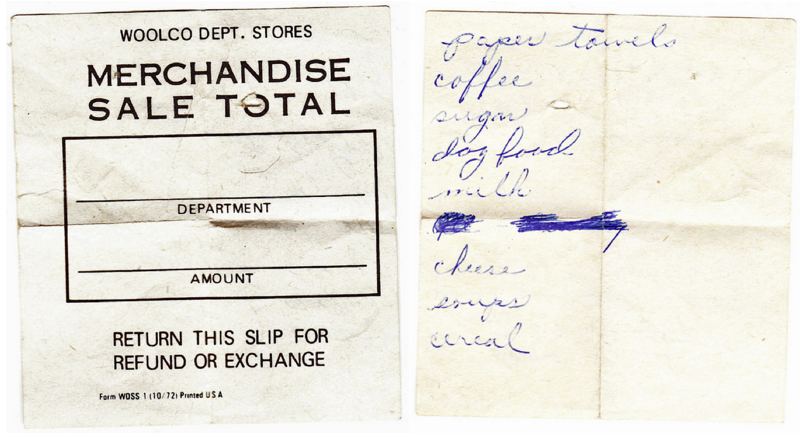
There were also two short grocery shopping lists. One of them was on the back of a small (2.5" square) Woolco sales slip:

Screen shot 2012-02-29 at 3.51.13 PM.png

The other shopping list was on written on the flap of an envelope (hey, just like the Gettysburg Address, right?):

IMG_0003.jpg

Next up, a receipt for a gallon of paint at Sherwin-Williams -- "Tivoli Green Accent 4492":

Screen shot 2012-02-29 at 4.02.49 PM.png

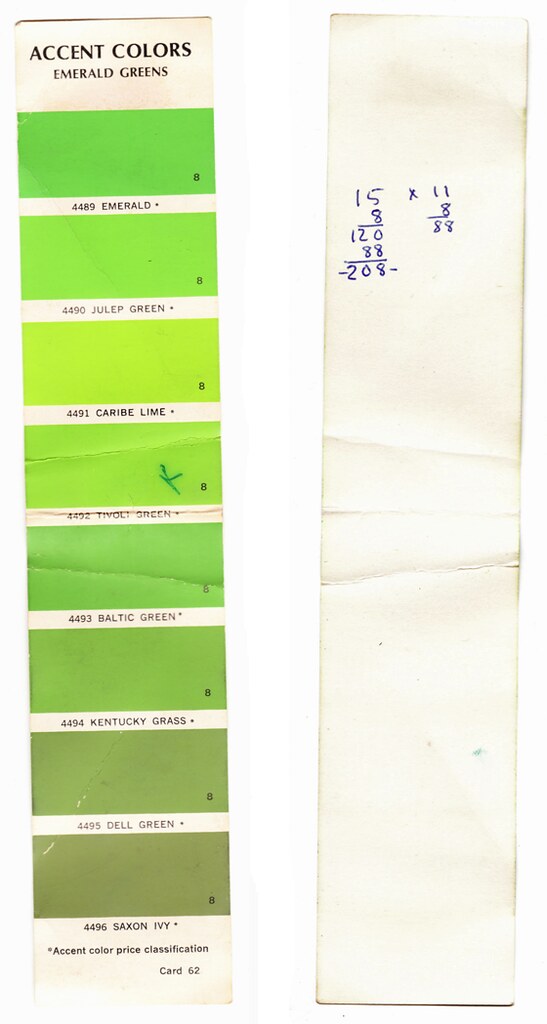
That paint color corresponds to one of the hues on this swatch strip, which has some basic arithmetic on the back:

Screen shot 2012-02-29 at 4.09.26 PM.png

Green, incidentally, has been my favorite color ever since I was a little boy -- another sign, if you choose to believe in such things, that this stuff was meant for me.

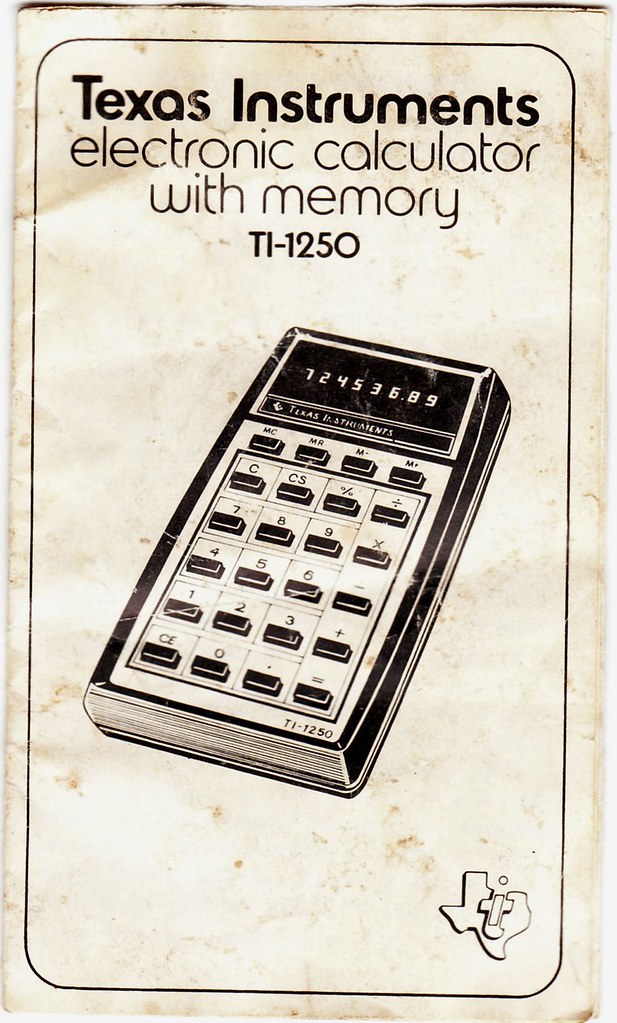
One final item -- a pocket calculator user's manual:

IMG_0006 copy.jpg

Hmmm -- if the Kroznuskis had a calculator, why did they have to do math on the back of the swatch strip? Maybe the latter inspired the purchase of the former.

That's it.

Did the jacket once belong to the Kroznuskis? If so, had these cards and papers been sitting in the pocket for 36 years until I found them a few days ago? And what about the staff of the shop where I bought the jacket -- don't they go through the pockets of a garment before putting it out on the racks? Maybe they found this stuff in the pocket but decided to leave it there, thinking it might make a nice bonus prize for the jacket's new owner? Or maybe they randomly seed their vintage clothing with assorted detritus, just because it's fun?

Meanwhile, should I contact Ann Marie Kroznuski? Should I just pack all of this stuff into an envelope and send it to her, with a note explaining how I found it? Should I send the material back anonymously, with no note? Or should I just leave her alone and enjoy these latest artifacts to find their way into my orbit?

Finally, consider this: What if I had bought the right color of gloves from the start?