Saturday, June 30, 2012

Screen shot 2012-06-30 at 1.44.58 PM.png
Click to enlarge

My friend Katy Amory recently told me about a project that feels very Permanent Record-ish. Here's the deal: In the mid-1700s, a British philanthropist named Thomas Coram opened the London Foundling Hospital, where poverty-stricken mothers who couldn't care for their newborn babies could anonymously "donate" the babies for adoption. In each case, the baby's record at the hospital was accompanied by a small piece of fabric or cloth provided by the mother -- a sort of textile fingerprint that could later be used for identification purposes if need be. As you can see from the example shown above, the fabric swatches were sometimes accompanied by heartfelt (and heartbreaking) notes from the mother.

Two and a half centuries later, the Foundling Hospital is now the Foundling Museum. All of the hospital's records have been kept and conserved, including the little fabric swatches (which also serve as one of the best surviving collections of 18th-century textiles). In 2010 the museum ran an exhibition called "Threads of Feeling," which focused on the swatches. You can see the exhibit here, and there's some good background information here and here.

These records feel like cousins to the Manhattan Trade School report cards -- each one represents a story waiting to be told, and collectively they tell an even bigger story. Great stuff.

Tuesday, June 26, 2012

Screen shot 2012-06-24 at 8.16.33 AM.png
Click to enlarge

Remember Miss Kotter, the job placement counselor who peppered many of the Manhattan Trade School report cards with very sharp commentary? Back in January I mentioned that volunteer researcher Cate Bloomquist had solved the puzzle of Miss Kotter's identity. I've now put that research to good use while writing the latest full-length Permanent Record article for Slate, which will be about Miss Kotter and one of the students she worked with. It should be published in a day or two.

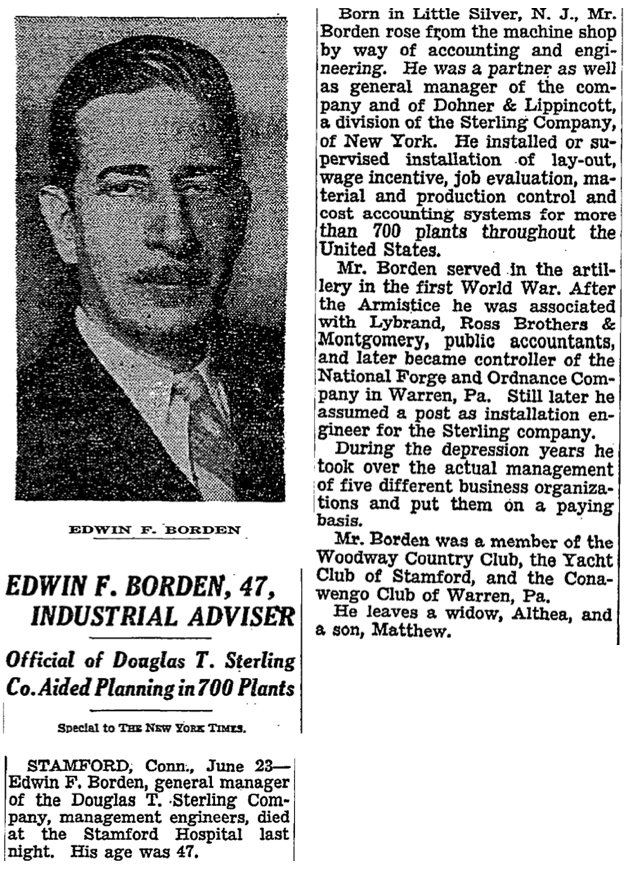
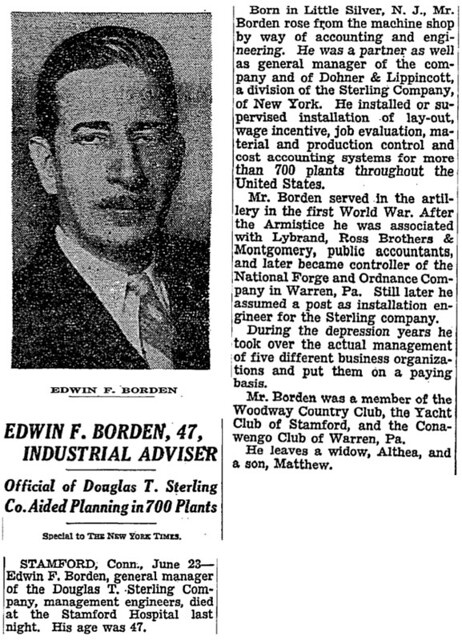
What you see above is a 1944 obituary for Miss Kotter's second husband, Edwin Borden. It was a key piece of evidence in Cate's sleuthing. Her research on this one was so amazing that I've decided to share the paper trail with you, so you can see just how much work is involved in tracking down someone for the Permanent Record project.

First, to set the stage: Miss Kotter presented a thorny research puzzle. Some letters in the report card files referred to her as "Miss Kotter" and others as "Mrs. Kotter," so I wasn't sure if Kotter was her maiden or married name. She signed letters as "A. Kotter" and referred to herself on the report cards as "AK" or "ADK," so I didn't even know her first name.

But Cate Bloomquist connected a bunch of dots that hadn't even occurred to me. She summarized her research process for me in the following rundown:

1. In Doris Abravaya's file, letters dated 4/27/34 and 9/4/34 are addressed to "Mrs. Kotter." But the 9/4/34 letter has handwritten note at the bottom that begins "AB." It appeared to me the B had been written over a K, but in Mrs. Kotter's same handwriting (which we've seen on many of the report cards). I began to think she must have married sometime in 1934. Or perhaps she had some other reason for a name change, but marriage was the most likely explanation.

2. Sure enough, the next letter in Doris's file, dated 9/13/34, was addressed to a "Mrs. A. Borden." Evidence was mounting for a marriage.

3. Then, in Marie Garaventa's file, last index card includes notes from "AK" and "AB" -- in the same handwriting. It appeared Mrs. Kotter had become Mrs. Borden, but what was her first name?

4. Selma Kaufman's file includes a letter from "Mrs. Althea Borden, Placement Counselor." Also, Maria DeTuro's file included a card signed by "Althea Borden." Again, compare the handwriting among all of these -- they pretty clearly match. I now had a first name for Mrs. Kotter/Borden.

5. Since Althea is a relatively uncommon first name, even for the 1930s, I searched on "Althea Borden" in the New York Times index, thinking I probably wouldn't get an overwhelming number of responses to comb through. I found a 1944 obit for an Edwin Borden [this is the obituary shown at the top of the page — Paul], and it listed his widow Althea and son Matthew. They lived in Stamford, Connecticut, though. Initially I was doubtful that this would be the same Althea as "our" Althea. Therefore, I decided to research the "Kotter" angle a bit more to see if I could find something more conclusive tying our Althea ("ADK") to this Althea Borden of Stamford, Connecticut.

6. I looked up the 1930 census and was able to find an Althea Koetter (not Kotter) living in Hoboken, New Jersey, with her husband Carl. Ancestry.com also pulled up two ship passenger manifests for Carl and Althea Koetter returning from Germany in 1929 and again in 1932. The passenger lists also provided Althea's date of birth: 12/17/1906.

7. I'm not always a fan of Ancestry.com, but sometimes it's very useful, and this time it provided the gold: a newspaper entry from the Reno Gazette, dated 4/4/1934, which stated that a divorce decree had been granted for Carl E. Koetter from Althea Dreyer Koetter -- ADK!! For our purposes, this was certainly enough evidence to show that ADK became Althea Borden sometime in 1934.

8. But was this the same Althea Borden listed as the widow of Edwin Borden in the 1944 obit? I turned to Ancestry.com again. This time I searched the public family trees for an Edwin Borden who died in 1944. Sure enough, an Edwin Floyd Borden popped up with the correct death date and tie to Connecticut, and his spouse was listed as "Althea Dreyer."

9. According to the Social Security Death Index, Althea Borden died in 1971 in Florida. It becomes more difficult to track down people the closer we get to the present time mainly because of privacy laws, etc., but I'm fairly confident that Matthew Borden (Althea's son) is likely still living because I don't see him in the Social Security Death Index. I could not find him easily/conclusively. However, the person who entered the Borden family tree on Ancestry.com is named Linda Brooks and I believe that she is a niece of Althea's. I think probably the quickest route to Matthew would be to contact Linda, or if Matthew has passed away, I'm betting Linda would have some pretty good info on the appropriate next of kin, given the amount of info she has on the family tree in Ancestry. Here is her contact information, which I found on whitepages.com….

And that's how Cate led me to Althea's niece, Linda Brooks, who in turn put me in touch with Althea's son, Matthew Borden (both of whom were very forthcoming and provided wonderful interviews). It's an impressive bit of detective work, no? Now you can see why I'm so grateful to have people like Cate helping me -- I could never have pieced this together on my own.

A few notes:

• If Althea's first husband's surname was Koetter, what does all her Manhattan Trade School correspondence list her as Kotter (without the first e)? I'm not sure, and neither are her niece or son. Carl, her husband, was German, and it may be that she simply wanted to Anglicize a German name that other people were prone to misspelling.

• Although Cate didn't mention this in her notes, it's odd that the 1930 census listed Althea's occupation as "None." She was definitely working for Manhattan Trade at that time, so I don't understand why that wouldn't have been listed. If it had been, I'm sure Cate would have known much more quickly that she'd found the right Althea Ko(e)tter.

• Althea's handwriting, which was part of the key to this puzzle, has a distinctive, businesslike appearance. Her niece and son both recognized it immediately when I showed them samples from the report cards. (Personally, speaking as someone who's had to read through a great deal of Althea's notes, I'm grateful that her handwriting was so legible.)

• Althea and Carl's Reno divorce was a classic of its era. No-fault divorce laws weren't yet common in the 1930s, which made divorce a lengthy ordeal. But Nevada had much less restrictive laws, and Reno was its biggest city at the time (Las Vegas was still just a small outpost town, not a resort). So Reno became famous for "quickie divorces," which is apparently what Carl and Althea opted for. Note, however, that the Reno Gazette clipping that Cate found didn't even mention the word "divorce" -- it simply said, "Decrees Granted." I wouldn't have realized that this was referring to divorce decrees, but fortunately Kate did.

I'm happy to report that there was a lot more to Althea than the stern disciplinarian whose voice comes through on the report cards. You'll be able to read her full story in the next Slate article, which should be published within the next week.

+ + + + +

An original 1906 article about the Manhattan Trade School for Girls is currently up for sale on eBay. I've read this article before on the web, but it's interesting to see an original copy of it -- more than 100 years old!

Saturday, June 23, 2012

IMG.jpg IMG_0001.jpg

Sorry not to have blogged in a while. I've been busy with other projects (including the next feature-length Permanent Record piece for Slate, which I'll have more to say about in a minute).

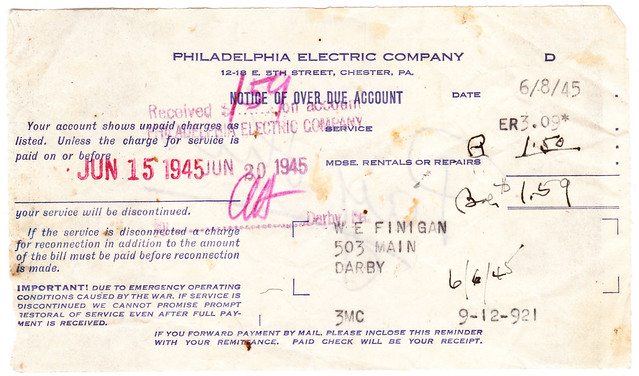
What you see above are the front and back of a bill sent on June 8, 1945, from the Philadelphia Electric Company to one William E. Finigan, whose account was in arrears to the tune of $1.59. As you can see, Mr. Finnigan was given one week in which to settle the outstanding balance or else his lights would be turned off. Judging by the stern "Pay this" note on the back of the bill, someone in the Finigan household took this admonition seriously.

This bill is part of a batch of mid-1940s invoices, receipts, and bills, all relating to Mr. Finigan, that I recently acquired. They're all interesting, but "Pay this" -- for the whopping sum of $1.59 -- adds a note of pathos that easily makes this slip of paper my favorite of the batch. (And no, I didn't intend for "pathos" to echo "Pay this," although that's a nice bonus.)

This wasn't the only time Mr. Finigan had to be reminded to pay an overdue electric bill. In December of 1944, he received notice of an outstanding balance of $18.11, which he paid six days later. Note that the address on these documents is different than the one shown on the document at the top of the page, however, so maybe one was for his home and the other for his business (for all of these subsequent images, you can click to enlarge):

IMG_0003.jpg IMG_0003 copy.jpg

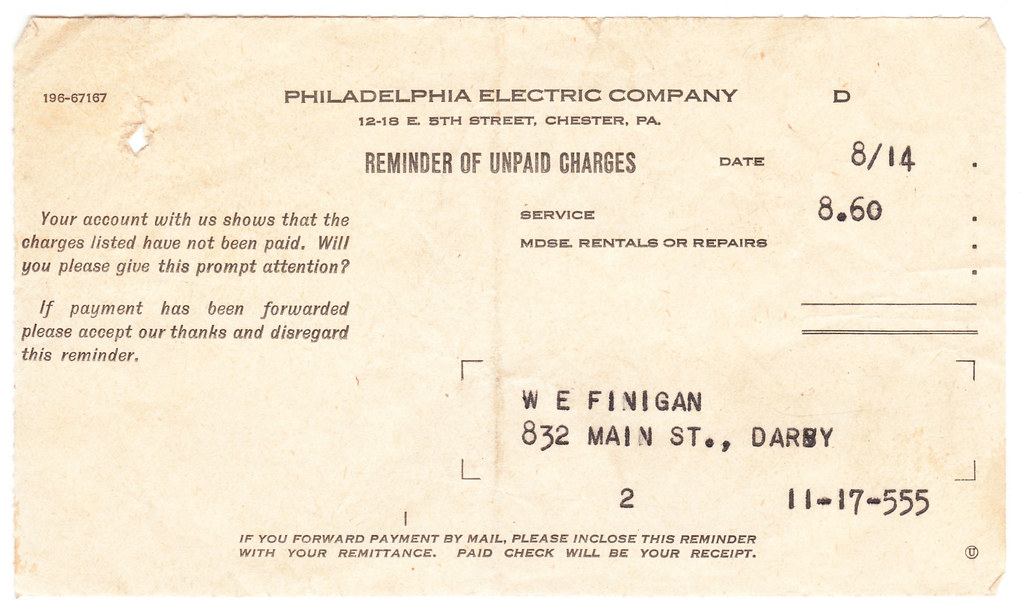
And on Aug. 14 of an unspecified year, he received a friendly reminder to remit an overdue sum of $8.60:

IMG_0002.jpg

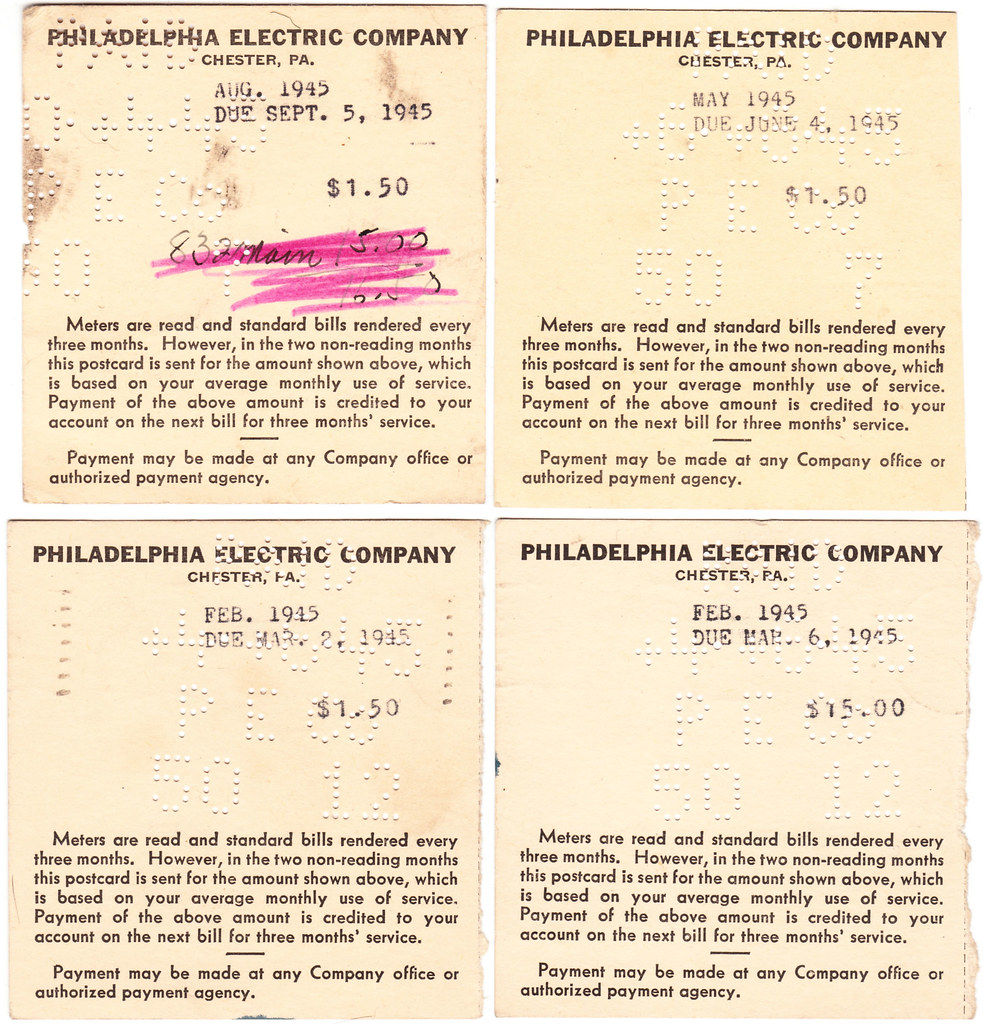
But I don't mean to imply that Mr. Finigan was a chronic deadbeat. Here are four electric bills stubs (complete with that beautiful hole-punch lettering you used to see on cancelled checks, paid invoices, and so on) that, near as I can figure, he paid on time:

IMG_0001.jpg

Mr. Finigan apparently ran a furniture business. Here's a receipt for an insurance policy on his shop:

IMG.jpg

Here's a receipt from William's visit to a local hardware shop (listing yet another address), which I'm including mainly because (a) I like the logo at the top of the receipt and (b) I love the intensity of the carbon paper transfer handwriting:

IMG.jpg

William isn't the only Finigan whose paperwork ended up in this stash of documents. Here's a notice of an unpaid car insurance bill, only this one is addressed to John Finigan, at still another address (the Finigans apparently owned or rented a big chunk of Main St. in Darby). Were William and John brothers? Father and son? I'm not sure:

IMG_0001.jpg

John Finigan, like William, apparently had some ongoing issues with prompt remittance. Here are three separate reminders to pay his annual 1946 dues for the Keystone Automotive Club (along with the fun information from the back of reminder):

IMG_0004.jpg IMG_0005.jpg

That's all I have on the Finigans. I admit that it's not much of a narrative -- more questions than answers, and not particularly burning questions at that -- but I still enjoy it when I find these small batches of items all relating to a particular person or family. Ephemera like this is so disposable that I figure anything paperwork that's survived this long wanted to be found, wanted to tell its little story. So now I've done my part to help that process along.

+ + + + +

Slate update: I've delivered the next PermaRec article to my editor at Slate, which means it should run within the next week or so. It's about two characters who I introduced last fall in the fourth article in the series. I'll have more to say about that in the next installment here on the blog.

Wednesday, June 13, 2012

pb-120611-civilwar-007.photoblog900.jpg

Do you recognize this little girl? If so the Museum of the Confederacy would like to hear from you.

The picture is one of eight photographs that the museum is trying to learn more about. They were found on the battlefield during the Civil War, in the pockets of dead soldiers. According to this Associated Press article:

Typically [the photos] were found by another soldier and handed down through generations. Ultimately an attic would be cleared or a trunk would be emptied and the photo would be given to the museum. Some have been in the museum's possession for 60 years or more. ... [N]ow museum officials are releasing the unidentified images ... on the admittedly remote chance someone might recognize a familial resemblance or make a connection to a battlefield where they were found.

You can see all eight photographs here. Some of them remind me a lot of the photos on the Permanent Record report cards, and the museum's quest to find the stories behind the photos feels a lot like the Permanent Record project, no? Hope they're able to connect some of the dots.

Friday, June 8, 2012

Screen shot 2012-06-08 at 1.26.25 PM.png

As I worked on the Slate article about Eva Rosencrans and Bee Zelin, it occurred to me that it might have been intimidating to for a woman to be related to Eva or Bee. After all, they were both big shots in the fashion industry -- were they always looking at people's wardrobes with a critical eye? Did they judge how people around them dressed, even (or especially) their relatives?

Margie Rosencrans -- Eva's daughter-in-law -- ended up with many of Eva's showroom sample dresses. She told me that Eva didn't necessarily critique her sense of style but that she had very specific ideas that didn't leave much room for argument:

She'd invite me up to the showroom three or four times a year and I'd get all the samples. She'd say, "Now Margie, you need this dress if you go to a formal event, and this one if you go to a cocktail party, and this one if you go to a PTA meeting, and this is if you're meeting someone for lunch." And the truth is, I didn't always like the dress. But I couldn't say no. It was a little awkward. So I ended up taking whatever she told me to take, and then if there was one I didn't like, I never wore it.

As for Bee, her daughter-in-law, Barbara Zelin, attended the Fashion Institute of Technology, where Bee worked, so Bee respected her training and her sense of aesthetics. Later in her life, Bee even allowed Barbara -- who went on to become an interior designer -- to remodel her house. "And that went fine," said Barbara. "She trusted me."

But Barbara's daughter, Stephanie Wilson -- Bee's granddaughter -- said things could occasionally get a bit tense. "She was the kind of woman who'd dress up to go get her mail," she said of Bee. "And I was a tomboy. I'm sure that did not thrill her. Hungarians are often stubborn, and we both were."

More follow-ups on Eva and Bee are in store soon....

Monday, June 4, 2012

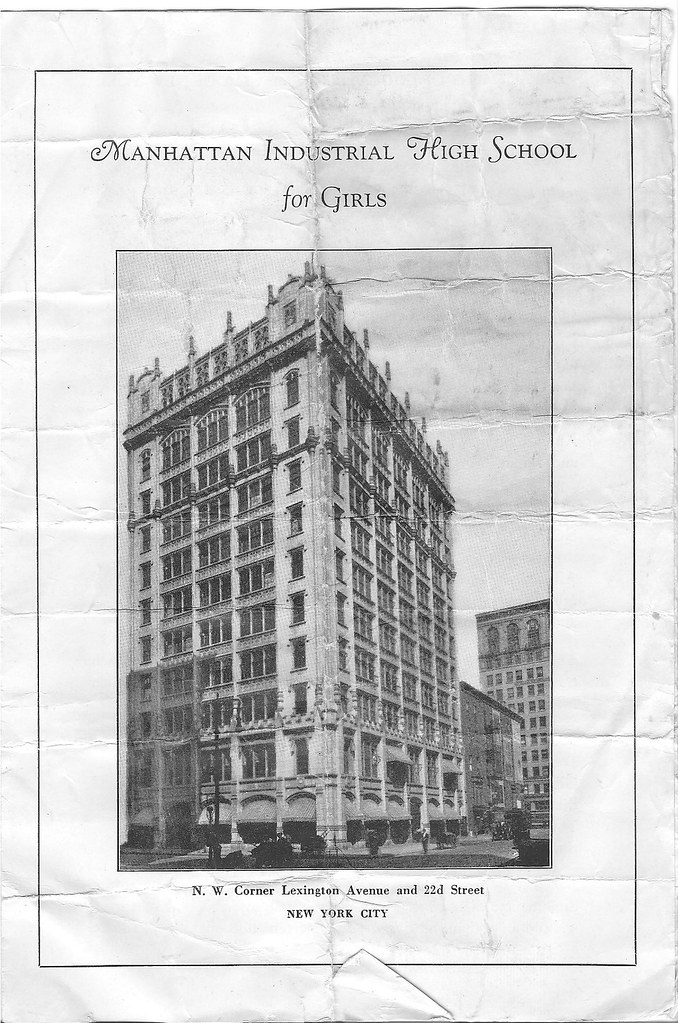
Front.jpg

What you see above is the front page of an old promotional brochure for Manhattan Industrial High School. That's the same school as the Manhattan Trade School for Girls -- the school changed its name around 1930. The brochure was found by Jane Montalto, whose mother, Florence Gattuso, attended Manhattan Trade from 1929 through 1931 (her report card is part of my collection). Jane, who I met and interviewed a few months ago, recently found the brochure while going through some of her mother's old papers and was nice enough to scan it for me.

I've never seen any of the school's promotional materials before, so this is an exciting find. There's no date on the brochure, but a few clues (including the name that the school was using at the time) suggest that it's probably from the 1932 to 1935 range. Interestingly, that means Florence obtained the brochure after she had already graduated from the school. Perhaps she was planning to share it with a friend or relative..?

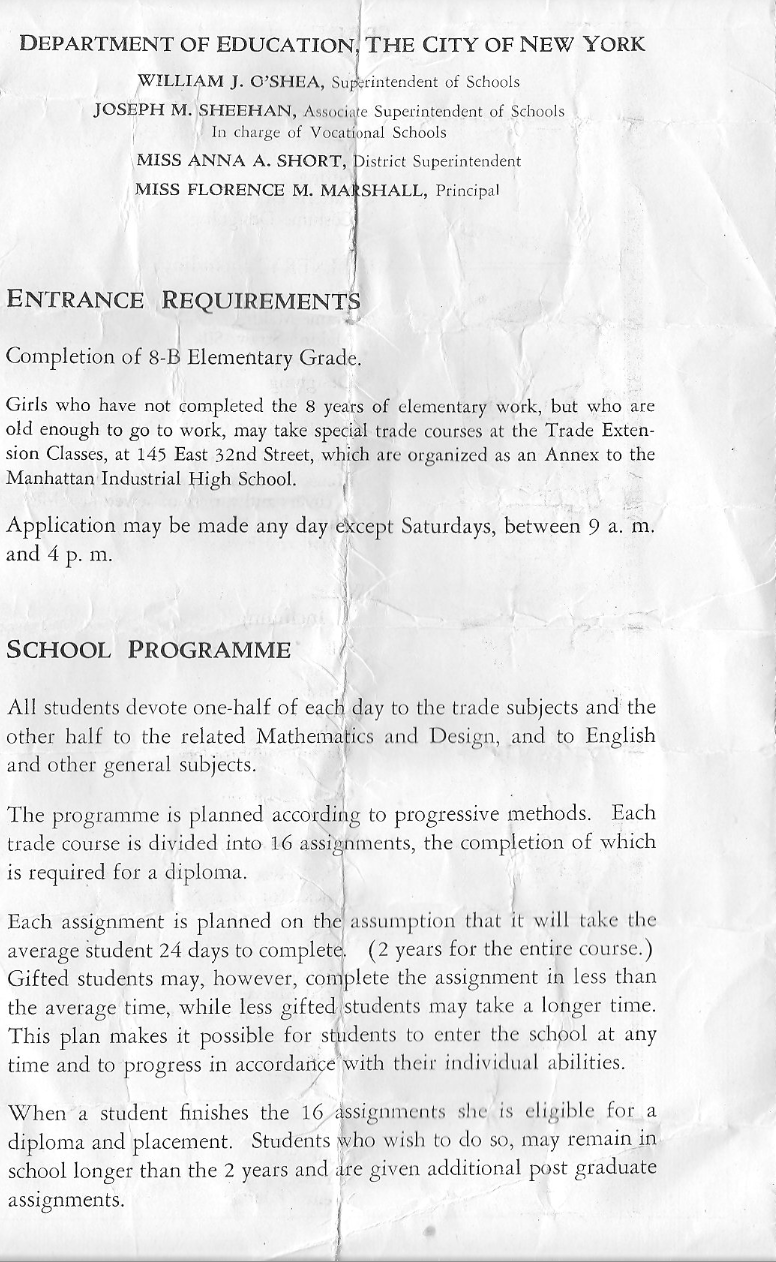
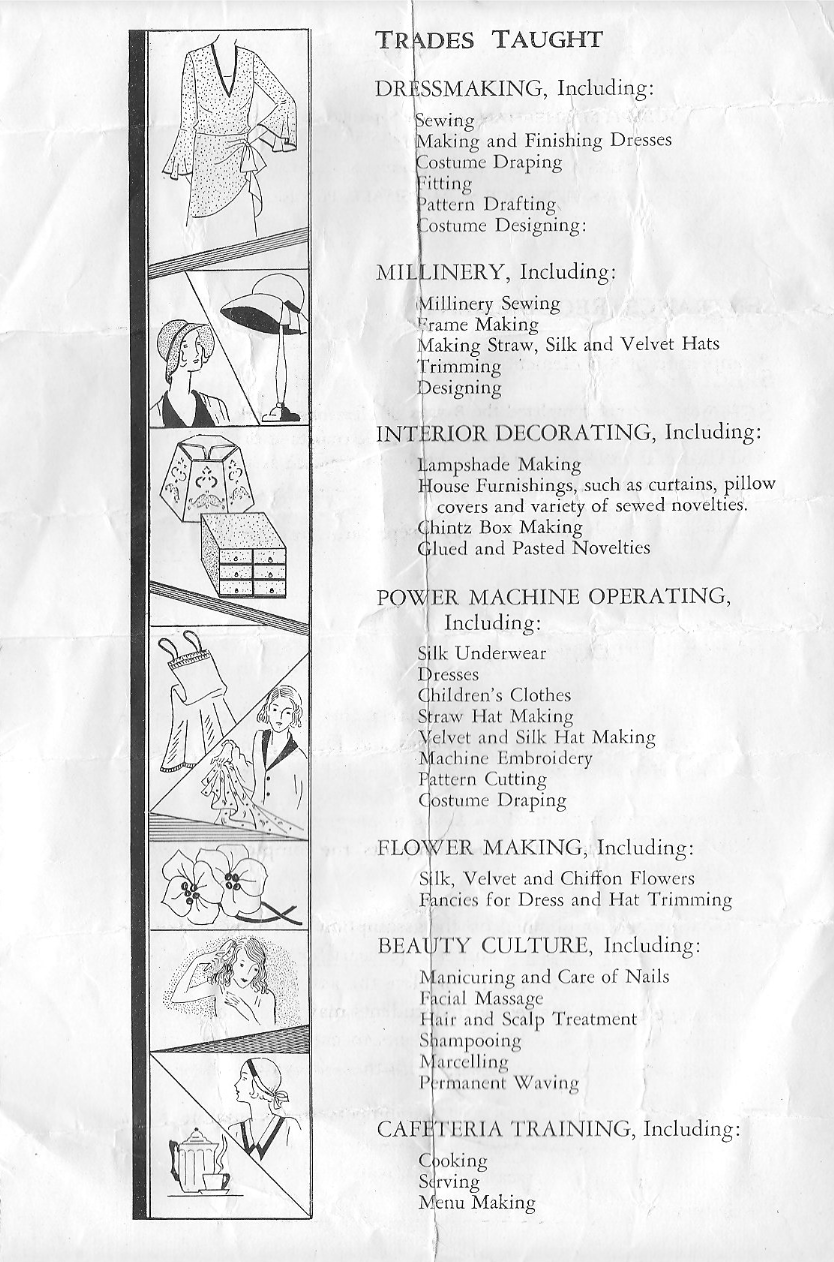
Here are the remaining panels from the brochure (for each of them, you can click to enlarge):

Screen shot 2012-06-04 at 12.05.52 AM.png Screen shot 2012-06-04 at 12.06.08 AM.png Back.jpg

The brochure confirms some things I already knew but also has some information that's new to me and some intriguing tidbits. A few thoughts:

• The building shown on the cover, at the northwest corner of Lexington Ave. and 22nd St., still stands today and is now a high school, although the original "Manhattan Trade School for Girls" lettering is still chiseled into the façade. (For more historical background on this building and Manhattan Trade's previous locations, check out the third Permanent Record article from the Slate series.)

• I knew that most girls attended Manhattan Trade after completing the eighth grade. I didn't realize until now, however, that the completion of eighth grade was a prerequisite.

• Fascinating to see the line, "The programme is planned according to progressive methods." I'd love to know what that meant in the context of the early 1930s.

• "Each trade course is divided into 16 assignments." This explains why each report card shows grades for 16 units.

• During the school's early years -- 1902 up through at least the early 1920s -- the trade offerings were dressmaking, sewing machine operation, millinery, lampshade making, decorative box making, and catalog sample mounting. The first three of these, which were the most popular, were called the needle trades; the latter three, the glue trades. But as you can see in the brochure, things had begun to change by the 1930s: The glue trades had all been folded into a larger trade course called Interior Decorating, and new courses of study had been added -- Flower Making (I had no idea the school had ever offered this), Beauty Culture, and Cafeteria Training. It's fascinating to see how the curriculum evolved to keep pace with the women's labor market.

• The mention of "Educational trips to Washington" matches up with notes I found in some of the girls' files ("Thank you so much for recommending me for the Washington trip," that type of thing).

• Very impressive that the school had its own savings bank. This is very much in keeping with the school's mission to teach girls how to survive in the world of work and business.

An amazing document, and a huge addition to our knowledge base regarding the school. Thanks so much to Jane Montalto for sharing it.

Friday, June 1, 2012

great grandma bee005.jpg
Photo courtesy of Stephanie Wilson

The last entry here on the blog was a follow-up on Eva Rosencrans, one of two Manhattan Trade students whose stories I told in my latest full-length Permanent Record article on Slate. Today I have a follow-up item on the other student profiled in that article, Bee Zelin (shown above with her great-grandson, Spencer, in 1998, when Bee was 88).

In the Slate article, I wrote, "Bee was a solid student at Manhattan Trade and went on to hold a series of dressmaking positions in the 1920s and '30s (one of which entailed a bit of drama regarding her wages). I realize that some readers don't get around to clicking on all the links in a story, and even those who do click can have difficulty reading the handwriting on the report cards. So here's a transcription of the pertinent section from Bee's employment file:

Jan. 5, 1932 [note from placement counselor]: Has worked approximately one week and has not been paid yet. Suggested Leagl Aid Society.

Jan. 7, 1932 [from employer]: Owe Beatrice $21, which she knew would be paid by the end of this week. I suppose she didn't mention the little suit I gave her. — Felice Cotin

Jan. 8, 1932 [from Bee]: Gave me inexpensive suit that was given her and that she could not wear. Pays all other bills at once, even $45 to advertisers. Think she should pay me.

Jan. 13, 1932 [from Bee]: Received $19 from F. Cotin. Promised the rest of it tomorrow. Did not get assistance from Legal Aid in order to obtain money.

Feb. 2, 1932 [from Bee]: F. Cotin still owes me $19.25.

April 13, 1932 [from Bee]: Suing F. Cotin for salary owed.

As you can see, Bee wasn't she about standing up for herself. When I interviewed her daughter-in-law and granddaughter for the Slate article, they both said they didn't know anything about this incident but that it sounded "very much like Bee," whom they described as a tough customer on several different levels.

"She was a very stern disciplinarian to her own child, and also as a grandmother," said Babara Zelin, Bee's daughter-in-law. The big exception appears to have been Spencer, her great-grandson, who's in Bee's arms in the photo at the top of this entry. "She was much more relaxed with him," Barbara told me. "My kids certainly weren't allowed to throw toys all over her house like he was! When I saw it, I couldn't believe it. Like, 'You're letting him do what?' "

I'll have more to say about Bee and Eva in the coming days. Hope you'll all keep checking back to read more.

Wednesday, May 30, 2012

LucilleSnowsuit1928.jpg

In my new Slate article about Eva Rosencrans and Bee Zelin, I quoted frequently from Eva's "memoir" -- a short autobiographical essay that her family encouraged her to write for posterity a few years before her death, provided to me by her son, Bob Rosencrans.

The memoir was an invaluable research tool for me (if only every Permanent Record student had created something similar!), and the bits that I quoted in the Slate article are just the tip of the iceberg. Over the next few days I plan to share some other excerpts that didn't make it into the Slate article but should nonetheless be interesting to anyone who read about Eva's life.

In the article, I mentioned that Nettie Rosenstein -- Eva's sister-in-law, professional mentor, and eventual business partner -- retired in 1928 but then revived her career a few years later when she and her husband lost most of their fortune in the stock market crash of 1929. During that short period when Nettie was retired, Eva worked for another designer, named Rosie Roth. One of the models at their showroom would go on to bigger things, as Eva recalled in her memoir:

One young woman was a tall girl with red, stringy hair. I preferred shorter girls and told her so. She laughingly said she as going out to Hollywood to try show business. Her name was Lucille Ball.

Ball's modeling work with Rosie Roth is confirmed by many historical accounts, including this one, although Eva herself is never mentioned -- understandable, since she was just one of Roth's employees at the time. The photo at the top of this blog entry is one of Ball's early modeling shots from this period, although I don't know if Eva had anything to do with the outfit she's wearing.

Eva had many other brushes with celebrity -- and so did her clothing. At one point in her memoir she wrote:

A lot of movie stars wore our dresses. They bought them and wore them. I saw a movie not too long ago, an old movie with Cary Grant and Eva Marie Saint -- I can't remember the name. And in she comes, wearing one of my dreses.

This movie was probably North by Northwest. But which scene? Which dress?

I'll have more excerpts from Eva's memoir in the coming days, along with some follow-up info on Bee Zelin (whose story was also told in the new Slate article). Stay tuned.

Tuesday, May 29, 2012

Screen shot 2012-05-29 at 6.54.16 AM.png

On the left is Eva Greene Rosencrans; on the right, Beatrice Gross Zelin. These two women, born 10 years apart, lived remarkably similar lives: They both grew up poor and Jewish on New York's Lower East Side; both attended the Manhattan Trade School for Girls; both went on to have significant careers in the fashion industry, where their respective impacts continue to be felt today; both had major brushes with celebrity; and both finished their careers in the same place, where they may have met. Their stories -- among the most remarkable tales to emerge from my collection of Manhattan Trade School report cards -- are told today in my latest Permanent Record article on Slate.com.

I have a lot of additional research material that didn't make it into the Slate article. I'll be sharing some of that information here on the PermaRec blog in the coming days -- stay tuned.

Friday, May 18, 2012

IMG_0001.jpg IMG_0002.jpg
Click images to enlarge

Sorry not to have posted anything in a while -- I've been busy working on the next Slate article. I'll have more to say about that in a minute, but first I want to tell you about a new batch of material I recently acquired.

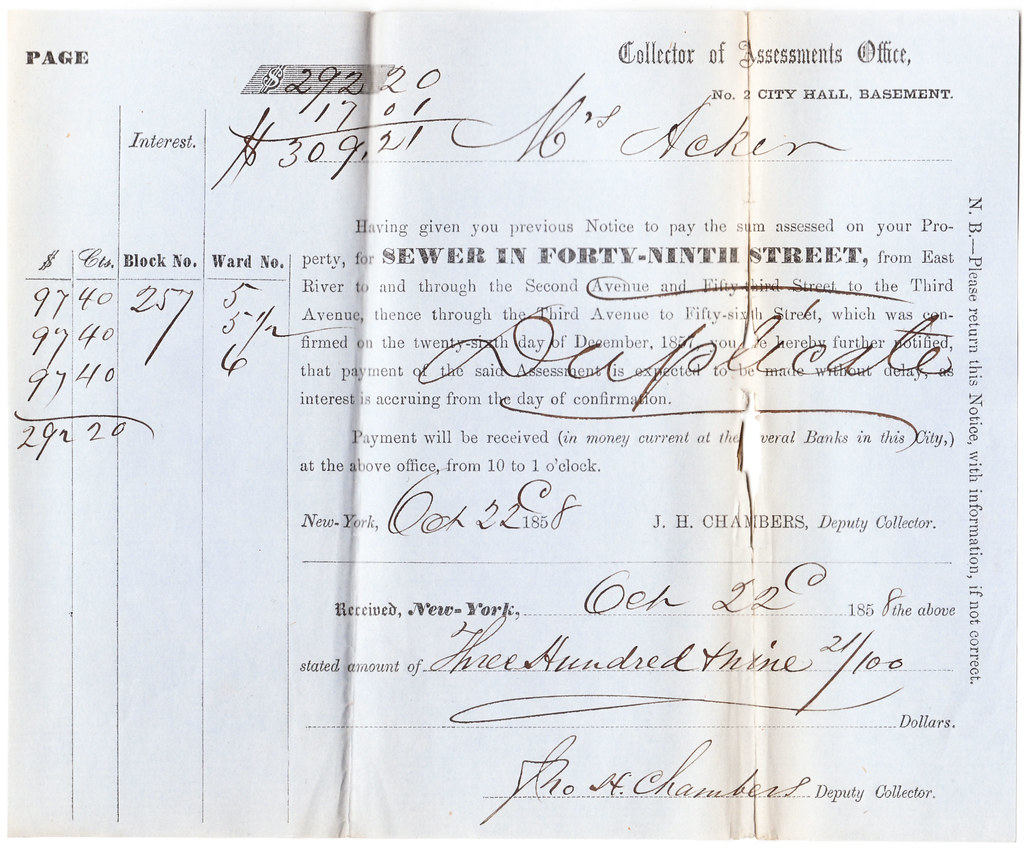
What you see above is a receipt for a New York City sewer assessment payment from 1858 and a New York City process server's affidavit from 1854. They're part of a big stash of mid-1800s legal documents, most of them pertaining to New York real estate, that my friend Amy Fritch recently gave me. Much like the old Manhattan Trade report cards, they're utterly compelling artifacts.

Amy found the documents some years ago while attending a party at a friend's offices in Chinatown (sound familiar?). "The office was in an old building that was in terrible shape and there was an entire room filled with old papers," she says. "Seriously -- floor to ceiling. Definitely a fire hazard."

Some of the papers looked interesting, so Amy took a few handfuls of them but didn't really know what to with them (again, sound familiar?), so she just kept them under her bed. Back in early 2010, when I was just getting started on the Permanent Record project, she brought out the papers to show me, and we spent a night oohing and ahhing over each other's artifacts -- me with my report cards, she with her legal papers, both of us saying, "These are amazing!" But I had forgotten about her papers until last month, when Amy moved away from New York and bequeathed the papers to me on her way out of town.

The papers are primarily from the 1840s, ’50, and ’60s. The documents include deeds, titles, mortgages, receipts, invoices, legal opinions, etc. They're all rendered in beautiful fountain pen script, and some have raised and/or colored seals.

All of the documents were folded; after 150 years, the folds and creases are pretty strong, and a few of the folds have cracked. Aside from that, though, the documents are in surprisingly good condition. They had clearly been protected from light, and many of them look and feel almost like new, the folds notwithstanding.

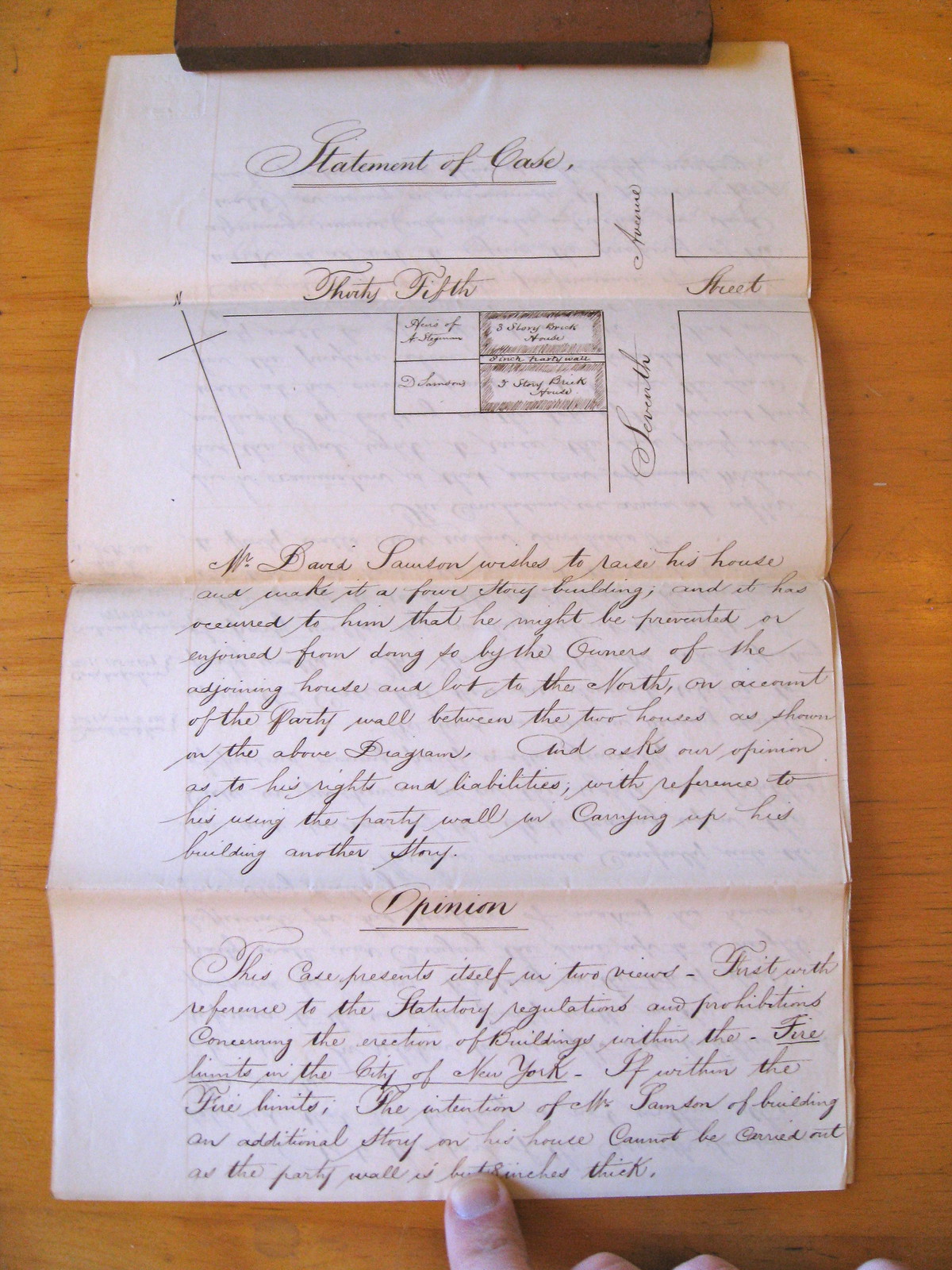
A few of the documents include little maps or diagrams showing the property being discussed. Here's a good example (click to enlarge):

IMG_1695.JPG

In case you're having a hard time reading the handwriting, here's the opening paragraph:

Mr. David Samson wishes to raise his house and make it a four-story building, and it has occurred to him that he might be prevented or enjoined from doing so by the Owners of the adjoining house and lot to the North, on account of the party wall between the two houses as shown on the above diagram. And asks our opinion as to his rights and liabilities, with reference to his using the party wall in carrying up his building another story.

The full opinion goes on for several pages. Interestingly, if you look closely at the diagram, it indicates that the house north of David Samson's house -- the one with whom Samson shares the "party wall" -- is labeled, "Heirs of A. Stagman." And if you go back and look at the process server's document at the top of this blog entry, you'll see that the summons was served on behalf of David Samson, and that two of summons recipients were Andrew Stegman and Metta Stegman. (Perhaps the "Stagman" label on the diagram was a misspelling.) So the legal opinion iwht the diagram relates directly to the process server's document. I assume there are lots of other commonalities and groupings running through Amy's papers, but I haven't spent enough time with them yet to suss everything out.

I took some not-very good photos of some of the papers, which you can see in the slideshow below (or you can click here to see the slideshow at a larger size in its own window):

I hope to be able to tell some of the stories behind these papers, just as I've done with the report cards. But assessing legal documents is a lot trickier than assessing report cards (at least for me, since I have zero legal training). If anyone out there has the background, expertise, and enthusiasm to assist me with this, let's talk. Thanks.

+ + + + +

Slate update: The next Slate article should be published in a week or so (maybe right before Memorial Day weekend, or maybe right after), and I don't mind saying it's a doozy. It's about two Manhattan Trade students who lived remarkably parallel lives, from their childhoods on New York's Lower East Side to their careers in the fashion world -- careers that both included a significant brush with celebrity and an enduring impact on apparel design that's still being felt today.

Meanwhile, in another development, it's possible that Permanent Record may soon have a theme song. Can't tell you anything more than that for now, but I'll have further details soon, I hope.

To keep up to speed on all things relating to the project, sign up for the Permanent Record mailing list. You can join by sending me a note here.

Sunday, May 6, 2012

Screen shot 2012-05-06 at 11.07.59 AM.png
Click to enlarge

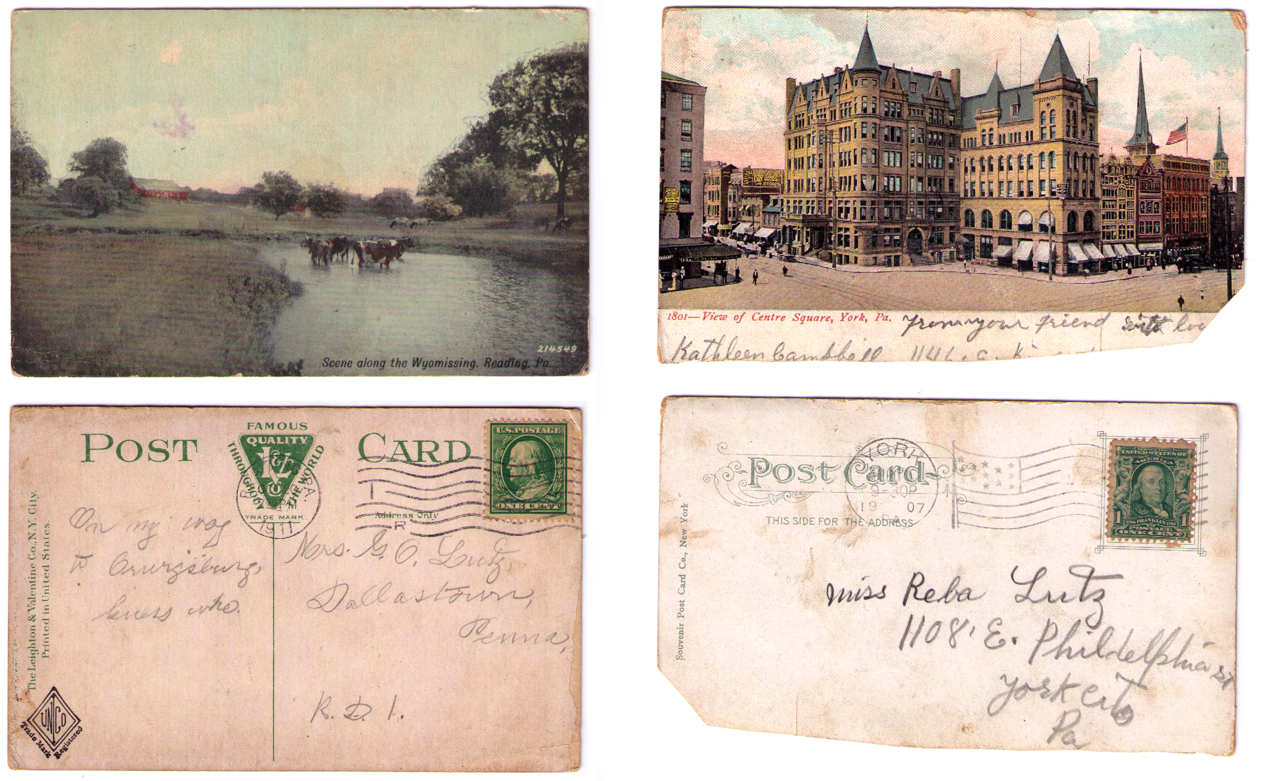
What see above are scans of two century-old postcards. The scans were sent to me by PermaRec reader Charlene Dodds, and they're part of a project she's planning. I'll let her explain in her own words:

While going through some of my deceased father’s belongings, I recently came across dozens of old postcards from 1910s-1940s, written to and from my great aunt, grandmother, and their friends. These women loved to travel, and back then it was mostly by car, but occasionally by train or bus. Their postcards from across America have pictures of long-gone tourist attractions and hotels. I’ve spent many afternoons reading a handful of them at a time, picturing these adventurous women expanding their horizons.

Some of the postcards are crammed with info and others leave much to the imagination, just like your report cards from the Manhattan Trade School for Girls. When reading your articles, I imagined some of the Manhattan Trade students taking the trips with my great aunt and grandmother. Tracing their routes and finding out what happened to some of these once-famous landmarks has always seemed like time travel to me, much in the same way that your Permanent Record project is a kind of time travel.

When I have time, I'm thinking of mapping out the places shown on the postcards and going on a "then and now" road trip. Permanent Record traces people; my project would trace what happened to old landmarks and the communities around them.

Charlene's project will be a great opportunity for rephotography, which is basically before-and-after photography (more info here). One of my favorite examples of rephotography is the wonderful book Wisconsin Then and Now. Another is the excellent web site Dear Photograph, which is now the basis of a new book. My research partner Kirsten Hively and I engaged in some rephotography of our own a few years ago when producing a museum show about some very cool fiberglass structures in Queens (for more on that project, look here). It'll be interesting to see if Charlene's project develops along a similar trajectory.

Tuesday, May 1, 2012

Screen shot 2012-05-01 at 9.34.10 AM.png

My thanks to everyone for all the positive feedback on the Rose Vrana article -- greatly appreciated.

One interesting phenomenon is that an overwhelming percentage of the feedback that the article has generated -- whether in the form of comments posted on Slate, e-mails sent to me, or requests to be added to the Permanent Record mailing list -- has come from women. This continues a trend that began last fall, when responses to the first five Slate articles also came primarily from female readers, by a ratio of about five or six to one.

Part of the reason for this, I'm sure, is that Manhattan Trade was a girls' school, so the stories I'm telling are women's stories. But I think there's more to it than that: As my research and reporting have continued, I've found that the de facto family historians for most of the families I've contacted have been women. Sometimes I'll track down a Manhattan Trade student's son, for example, and he'll say something like, "Sure, you can interview me, but the one you should really talk to is my sister. She's the one who keeps all the old records and photo albums." This has now happened so often that it can't simply be a coincidence. For whatever reason, women seem more connected to their family histories -- and, if the response to Permanent Record is any indication, to the concept of family history in general.

This has come as a bit of a surprise to me. For reasons not worth explaining here, nobody in my own family has been particularly interested in genealogy or family trees, so I didn't realize that there's a gender gap when it comes to this stuff. I mean, I'm certainly not trying to write the material with any kind of targeted gender appeal. And hey, I'm really into Permanent Record and I'm a guy!

Of course, just because most of the people responding to the articles are women, that doesn't necessarily mean that most of the people reading the articles are women. Maybe female readers are simply more likely to engage with the project in the form of comments, e-mails, etc.

I'd be interested in hearing what other folks have to say about this. Feel free to post your comments, whatever your gender.

Saturday, April 28, 2012

Screen shot 2012-04-27 at 6.49.07 PM.png
Photo by Linda Cadovius

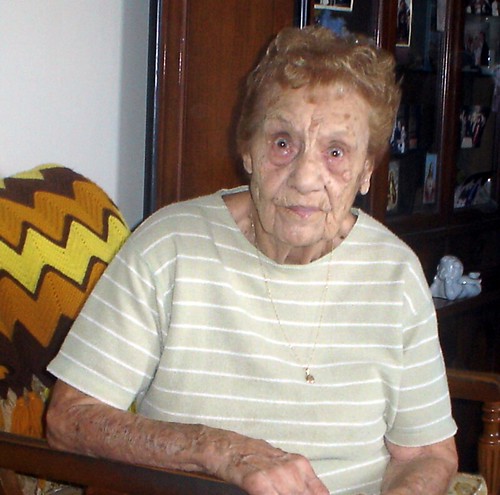
Here we have another photo of Rose Vrana, the only living link to Permanent Record, taken at her home in Florida. I told Rose's story in an article that was published yesterday on Slate.

Several readers singled out this passage from the article:

[Rose] has four grandchildren but isn't in contact with them. "They know where I live, but I don't know where they live," she said. "It's sad, but what can you do. That's life."

One commenter on Slate wrote, "How sad that her grandkids are not in contact with her! ... Call your Grandmother, visit her!" Several other readers posted similar comments, and a few people sent expressed these same sentiments to me via e-mail.

The situation regarding Rose's grandchildren was a tricky one. I assume there's a lot more to that story than simply "They know where I live, but I don't know where they live," but Rose didn't seem inclined to elaborate and I didn't want to push her. At one point I sort of circled back to the subject, but she didn't want to go there, so I backed off.

Little old ladies make for inherently sympathetic figures, and the notion of cutting off contact with a 95-year-old grandmother seems hard to fathom, so it's easy to paint the grandchildren as being in the wrong here. But who am I to say? I don't know the backstory. As most of us have experienced in one way or another, family dynamics can be very complicated affairs.

But here's the kicker: Rose may not know where her grandchildren are, but I do. The same research that led me to her turned up two grandsons living in New York. If I wanted, I could hop on the subway and be knocking on their doors in less than an hour.

That's a tempting idea, but I won't be doing it. One of my guiding principles with Permanent Record has been to avoid reopening anyone's old wounds. Likewise, I considered telling Rose what I know, but I decided it isn't my place to do that. (She doesn't use a computer, so I don't have to worry about her seeing this blog post.) Maybe her grandchildren will see the Slate article and decide they want to contact her, or maybe not. Like Rose said, that's life.

Friday, April 27, 2012

Screen shot 2012-04-27 at 8.28.01 AM.png

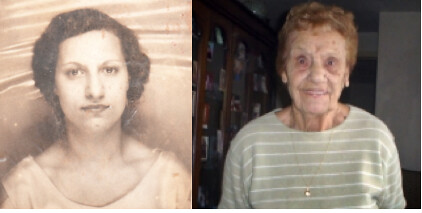
My article about 95-year-old Rose Vrana (shown above in her report card portrait and in a recent snapshot) has finally been published on Slate. You can check it out here. Enjoy.

Tuesday, April 24, 2012

me charles bridge crop.JPG
photo 09-2011.jpg

If you've been reading this blog for the past few months, you've no doubt noticed my repeated mentions of two research volunteers -- Samantha Bulgerin and Catherine Bloomquist. They're both much, much better researchers than I am, and it's no exaggeration to say that the latest phase of the Permanent Record project would not have been possible without them.

So today I'm giving Sam (that's her at the top of the page) and Cate (that's her beneath Sam) a well-deserved shout-out. I've also been wondering what inspired them to devote so much time and energy to my little project, so I invited them both to write a little something about that, and they both agreed. First up is Sam:

I’m a twenty-something college student in Wisconsin, studying anthropology and information studies. My father was an ancient history major, so I grew up in a house full of old books and artifacts. When I was about 12 or so, my grandmother introduced me to genealogy and I became fascinated by old records and what people leave behind. I started buying old photographs at rummage sales and trying to track down the people in them, wanting to know their stories. Letters, diaries, newspapers, and yearbooks soon joined the photographs. I also work at a local historical society and run two history-based blogs (one of which is about vintage fashion, which is a good fit with all the dressmaking students whose report cards Paul found; the other is about old newspaper clippings and such), so it would be fair to say I'm very interested in the past.

I came across Permanent Record randomly, shortly after Paul had written his first articles for Slate last fall. When I saw his request for research help, I got very excited, so I got in touch with him and have been helping out with the project when time allows.

I cannot put into words how amazing it is to see my research help Paul uncover the stories of these extraordinary women. The Permanent Record project, to me, is a perfect example of how history isn’t just battles and names and dates -- it’s people. People who lived full and fascinating lives. People who deserve to be remembered.

Thanks, Sam. I literally couldn't do this without you!

Now here's Cate:

I owe my introduction to Permanent Record to my brother, who read the series on Slate and thought I would enjoy it. He was right! New York City immigrant culture of the early 1900s has always fascinated me, so these students' stories really spoke to me.

I wanted to help with the project because I love the idea of connecting these report cards to the students' families. And since I have a background in professional genealogical research/heir-searching (particularly NYC research), I felt I had some specific skills to offer. Discovering "Miss Kotter's" identity has been the biggest thrill so far, and I hope we'll hear more about her. Thanks for letting me be part of Permanent Record!

Thank you, Cate -- you and Sam are the best.

Seriously, at the risk of getting too sappy here, Sam and Cate exemplify the incredible generosity of spirit that I've encountered throughout the Permanent Record project. That applies to the families I've interviewed, the historians who've helped me connect the various dots, and the many readers who've chimed in with observations and tips along the way. I'm grateful all these people -- but especially to Sam and Cate. I hope I get to meet them in person one day. First round will definitely be on me.

+ + + + +

Slate update: Been wondering when the next full-length PermaRec article would finally appear on Slate? I'm happy to report that the article has finally been put into the editorial pipeline and is now scheduled to be published either later this week or early next.

My editor says he wants to run additional PermaRec articles on Slate roughly every month, so I should finally be able to start telling the full stories that I've only hinted at here on the blog. Stay tuned.

Meanwhile, I'm starting a Permanent Record e-mail list, which I'll use to let people know about new Slate articles and other new developments regarding the project. (Don't worry, I won't be sending out daily spam or anything like that.) If you'd like to be added to the list, contact me.

Sunday, April 15, 2012

Last month I posted the audio of my appearance on WFMU's excellent Seven Second Delay radio show, which was broadcast live from a theater in Manhattan. Now, as you can see above, it turns out that there's video of the show as well.

My segment begins at about the 11:45 mark. They began by asking me about some of my other projects, but we finally get around to talking about Permanent Record at 14:35. Unfortunately, the discussion only lasts one minute from that point (it actually lasted much longer on the radio show, but the video has been heavily edited). If you want to hear the full interview segment, go back and check out the archived audio of the show.

As I noted when posting a photo from the radio broadcast a while back, the guy up on the cross is co-host Andy, who had promised to be crucified if the show met its pledge drive goal, which it did. He was mortified that he actually had to follow through on his promise and spent a good portion of the show apologizing to anyone who might be offended.

Special thanks to WFMU producer Mike Noble, who booked me on the show, let me know about the video, and is generally a swell guy.

Tuesday, April 10, 2012

birthday.jpg
Photo from forgottenbookmarks.com; click to enlarge

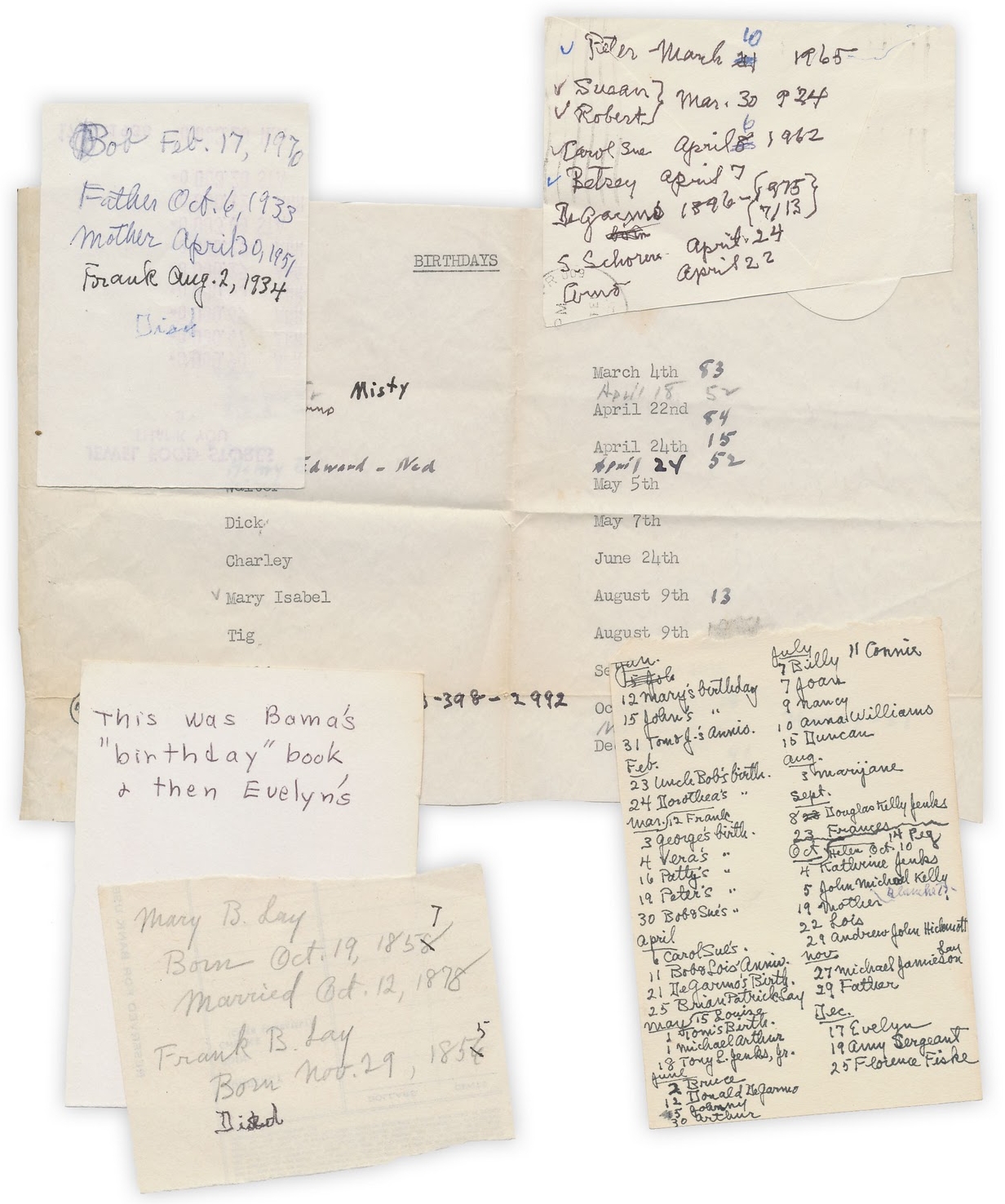
No, I didn't find the lists of birthdays and death dates that are shown above. A guy named Michael Popek found them. He runs a used book store and often discovers things tucked away inside of old books, which he chronicles on his blog, Forgotten Bookmarks. Last fall he published a book by that same title. (As for the lists shown above, Popek found them inside a book of Shakespeare.)

As you may recall, about a month ago I ran an item about a 49-year-old note found inside a book. The guy who found that note successfully tracked down the fellow who'd written it. But Michael Popek doesn't try to connect the dots or reconstruct the stories of behind the objects he finds -- he just lets them speak for themselves.

And that's fine, because he finds a lot of them. He's been blogging about this stuff since 2007, during which time he's amassed over 1000 entries. If he tried to trace the backstory of each one, he'd end up so far down the rabbit hole that he'd never get back out.

So what does he find besides lists of dates? A small sampling: Snapshots. ... Recipes. ... Magazine clippings. ... Bus tickets. ... Postcards. ... Receipts (I really like that one). ... Letters -- sometimes handwritten, sometimes typewritten. ... Legal documents. ... Drawings (that's another of my favorites). ... Four-leaf clovers. ... Maps. ... And yes, as the blog's name implies, bookmarks (and what a beauty that one is!).

Sorry about all those links, but Forgotten Bookmarks is kind of addictive, so it's easy to get carried away. Frankly, I'm a little embarrassed not to have known about Popek's project until Kirsten Hively told me about it a few days ago. Just poke around anywhere on his site -- you're bound to find interesting stuff. (He also does used book giveaways on a regular basis, which is very nice.)

I haven't yet gotten my hands on a copy of Popek's book, but I plan to find a used copy. And I'm going to be seriously bummed if there's nothing lurking inside of it.

Saturday, April 7, 2012

7048160255_09cc418962_o.jpg
Click to enlarge

I collect lots of vintage meat-related ephemera -- old butchery catalogs, old butcher shop photos, old recipe booklets with the word "Meat" in the title (I have about 60 of those), and so on. So when I recently came across an eBay listing for an old looseleaf binder filled with assorted Armour Meat Products brochures, I pounced.

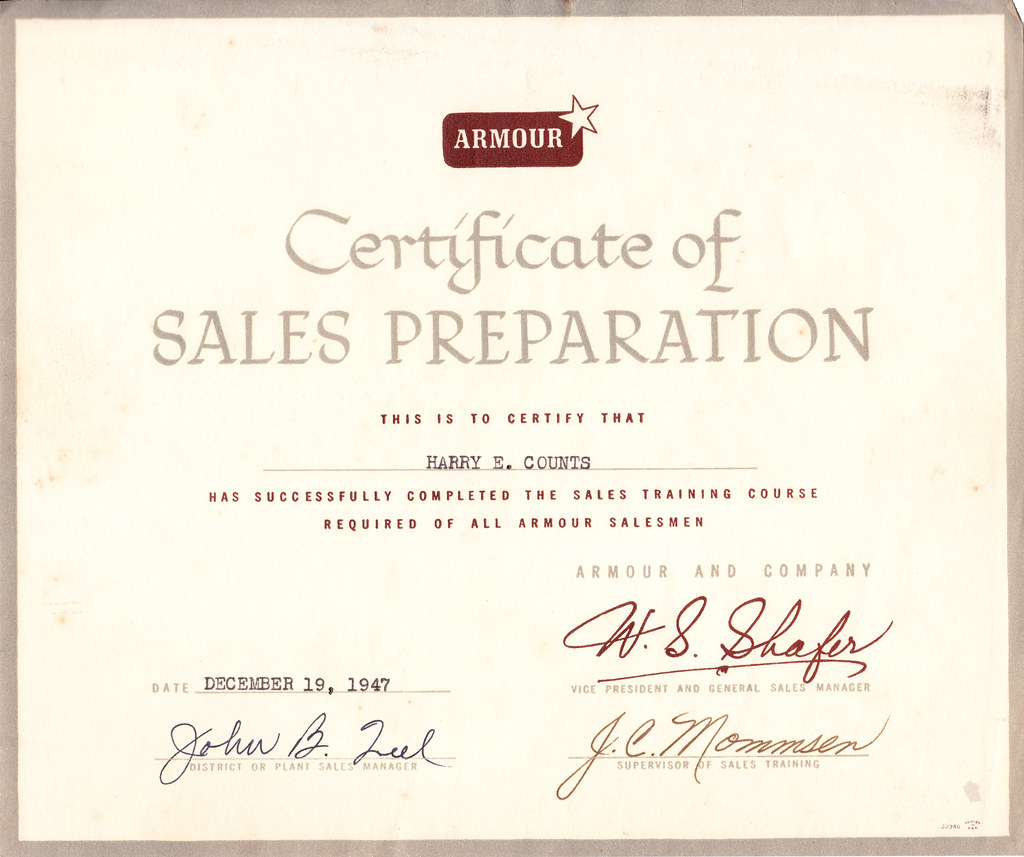
But what I didn't realize, because the eBay seller didn't mention it in the auction listing, was that the materials in the binder had been used by an Armour sales trainee in 1947. His name was Harry E. Counts, and his certificate for having completed his sales training, which I found buried in the back of the binder, is shown above.

The binder also included more than 80 pages of notes, all in pencil, presumably taken down by Harry during his training -- very Permanent Record! The notes are actually much more interesting than the printed brochures. Much like the case of the vintage coat with the bounced check and shopping lists in the pocket, I once again bought something that I thought was pretty cool and ended up with something else even cooler.
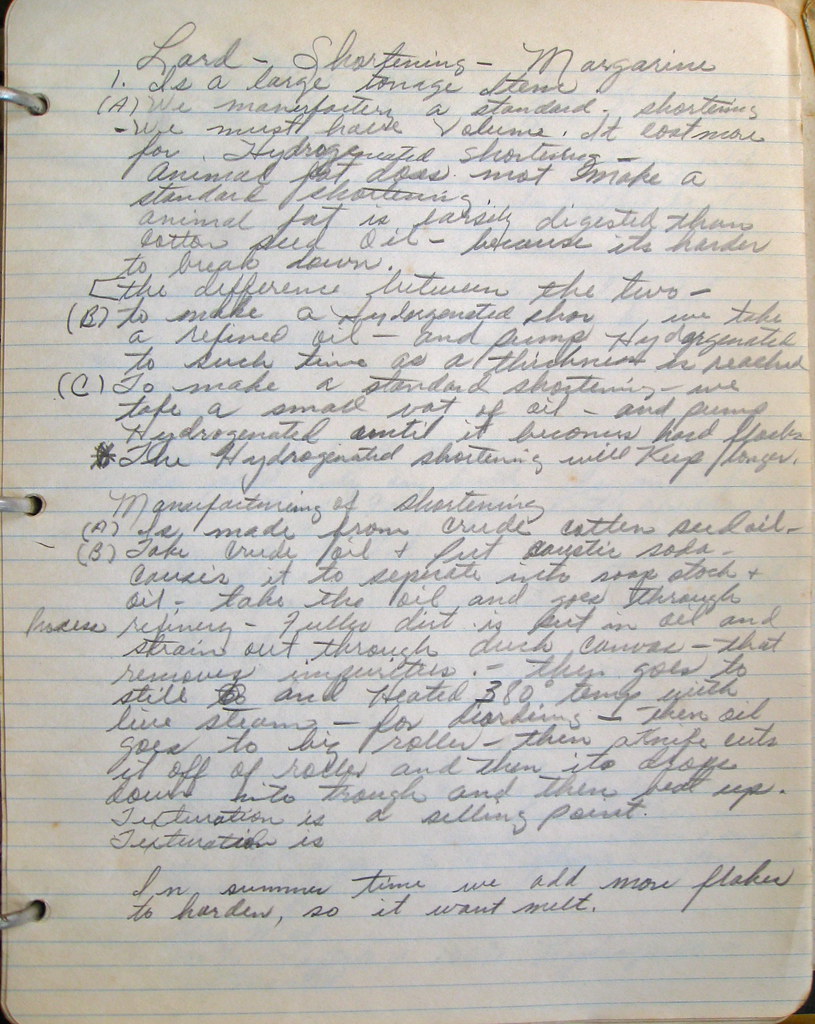
Harry didn't have the best handwriting, but it's good enough to get a sense of the sales class he was taking, which was apparently geared toward giving the trainees a grounding in modern butchery practices and Armour's product line. Given the volume of the notes, the class must have taken at least a week.

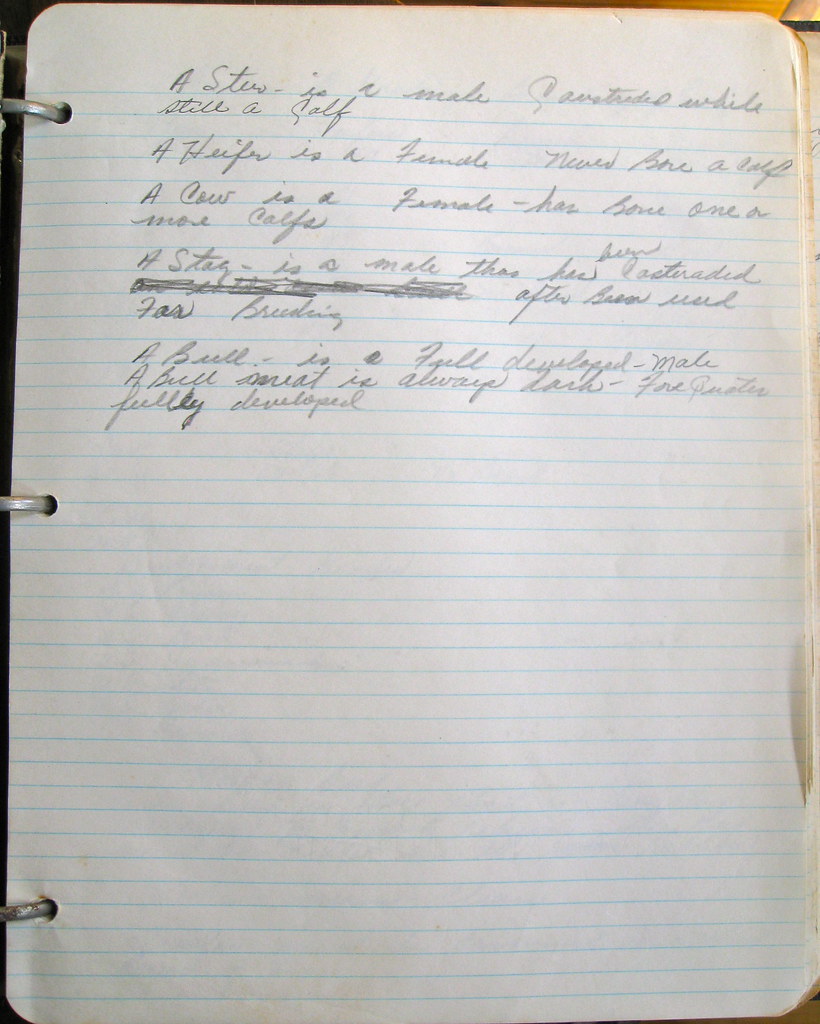
A lot of Harry's notes read like Livestock 101. Here's a page explaining the difference between a steer, a heifer, a cow, a stag, and a bull (note Harry's spelling of "castraded"; you can click on all of these photos to see larger versions):

IMG_1459.jpg

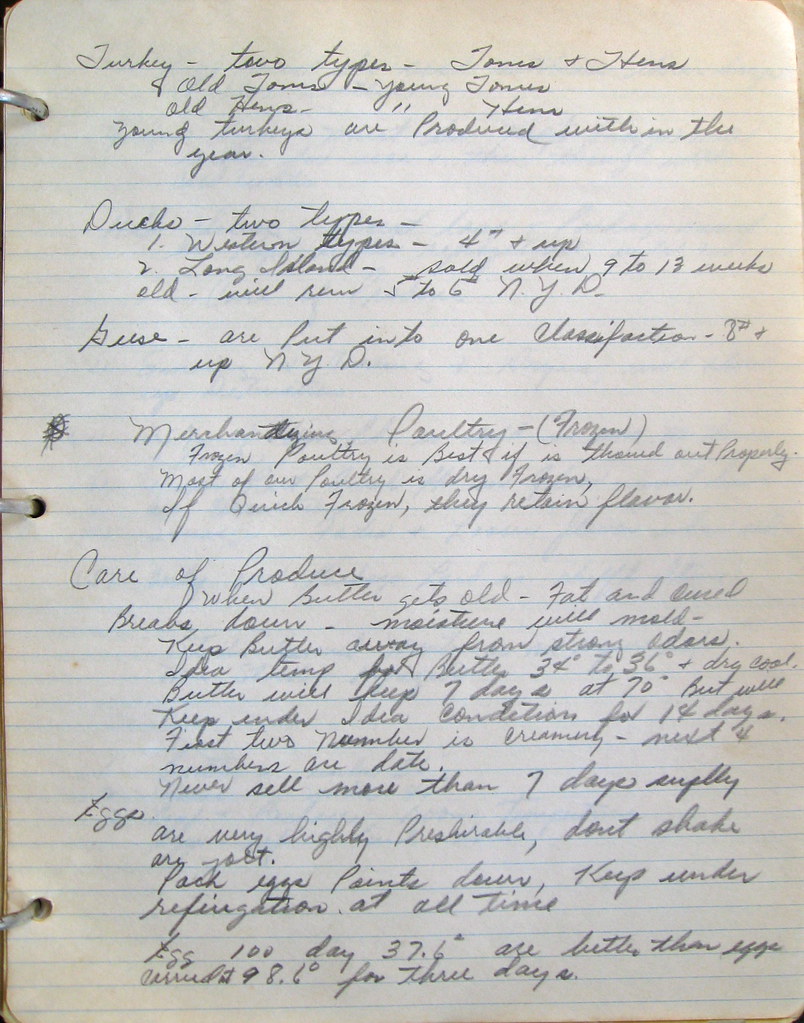
And here's one describing the various types of turkeys, ducks, and geese:

IMG_1491.JPG

Here's some good info on fresh and smoked sausages (I especially like the designation toward the bottom of the second page -- "Loaf Goods"):

IMG_1479.JPG IMG_1480.JPG

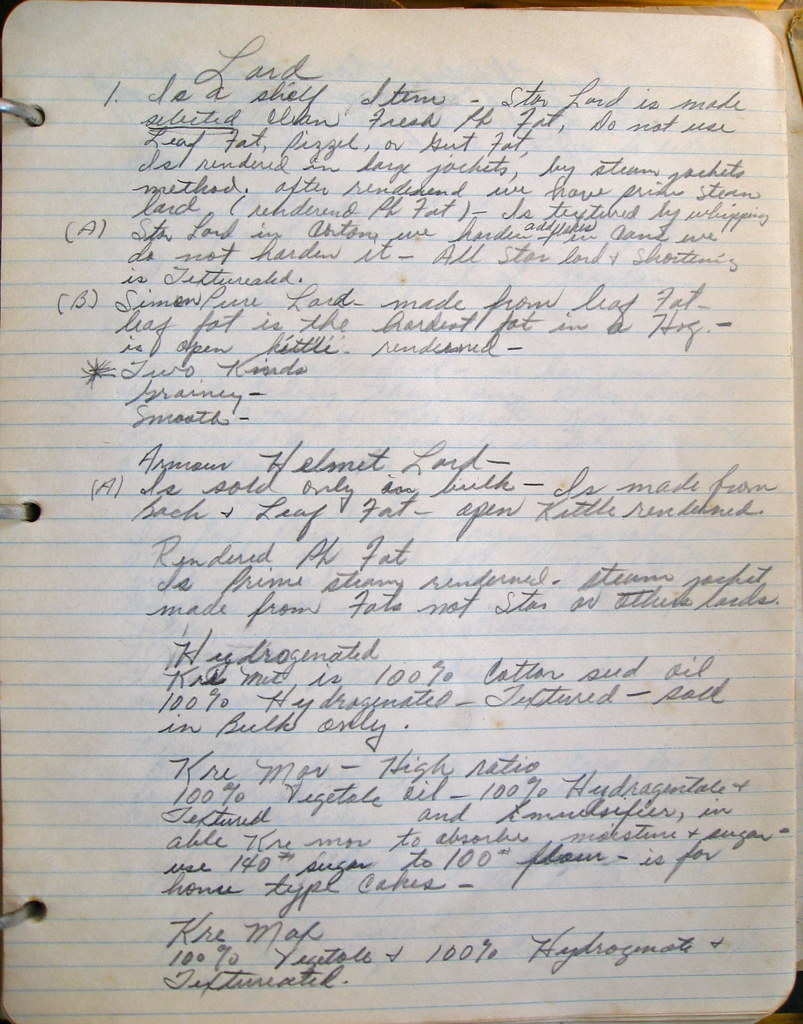
Fun facts -- no, really! -- about lard:

IMG_1483.JPG IMG_1484.JPG

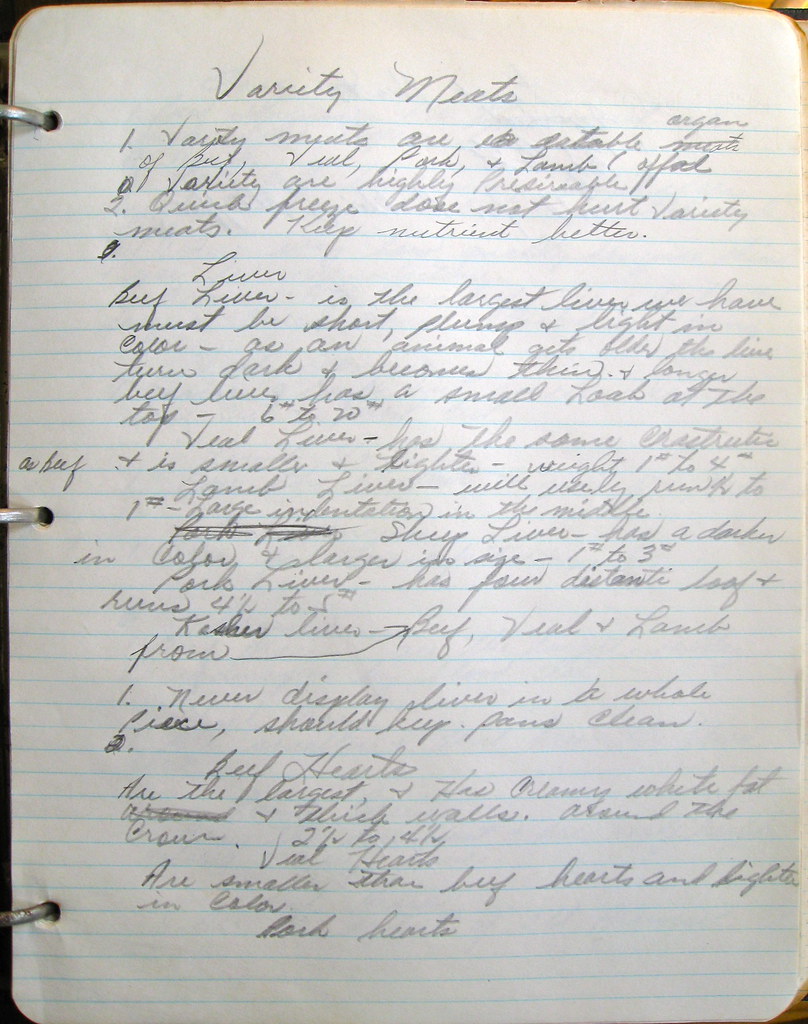
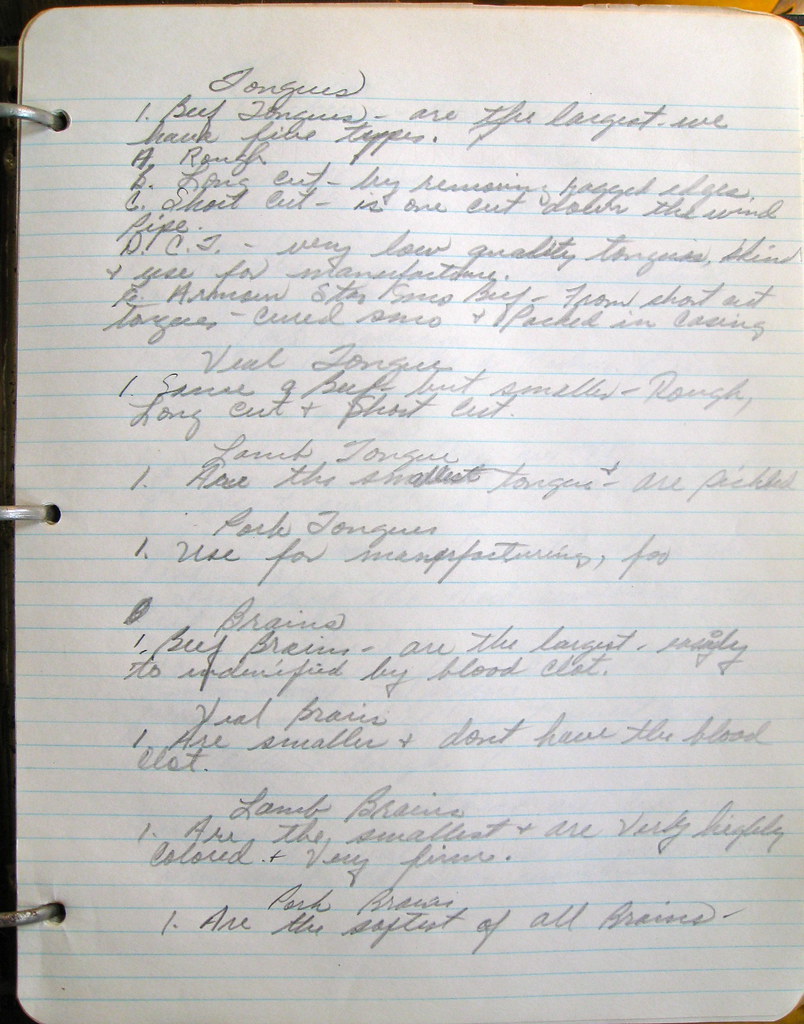
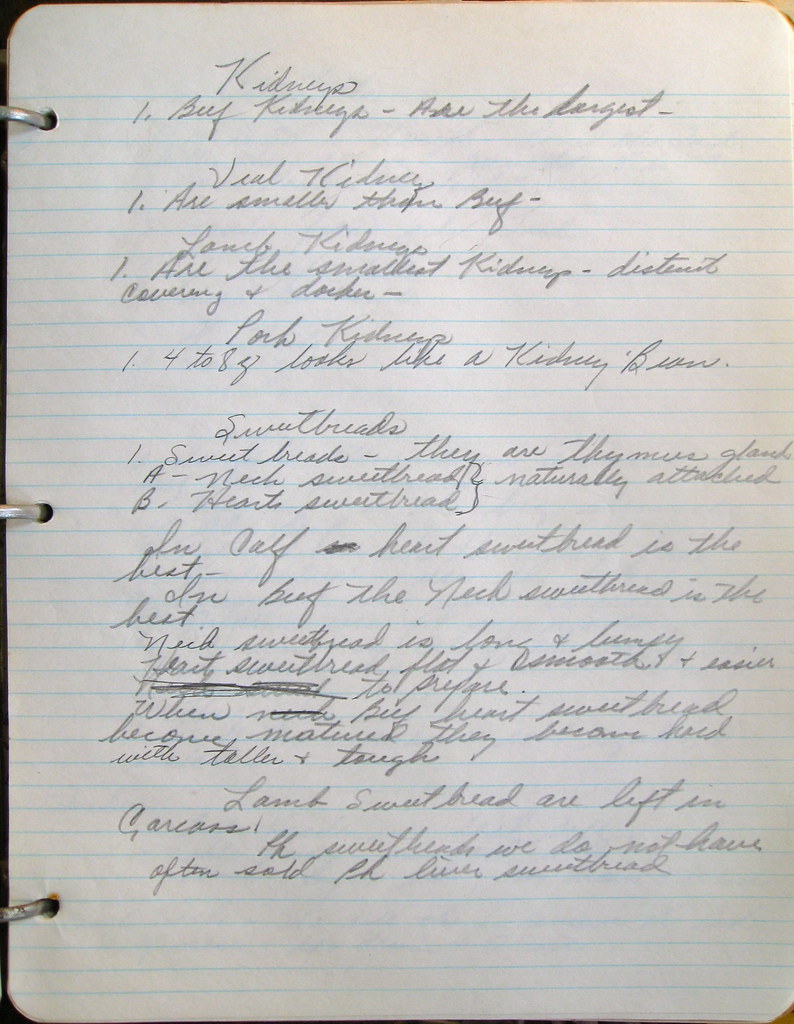
I'm sure it would have been interesting to have sat in the back of the room on the day the class learned about variety meats, tongues, kidneys, ox tails, and "fries" (i.e., testicles -- or as Harry spelled it, "testicals"):

IMG_1471.jpg IMG_1472.jpg IMG_1473.JPG IMG_1474.JPG IMG_1475.JPG

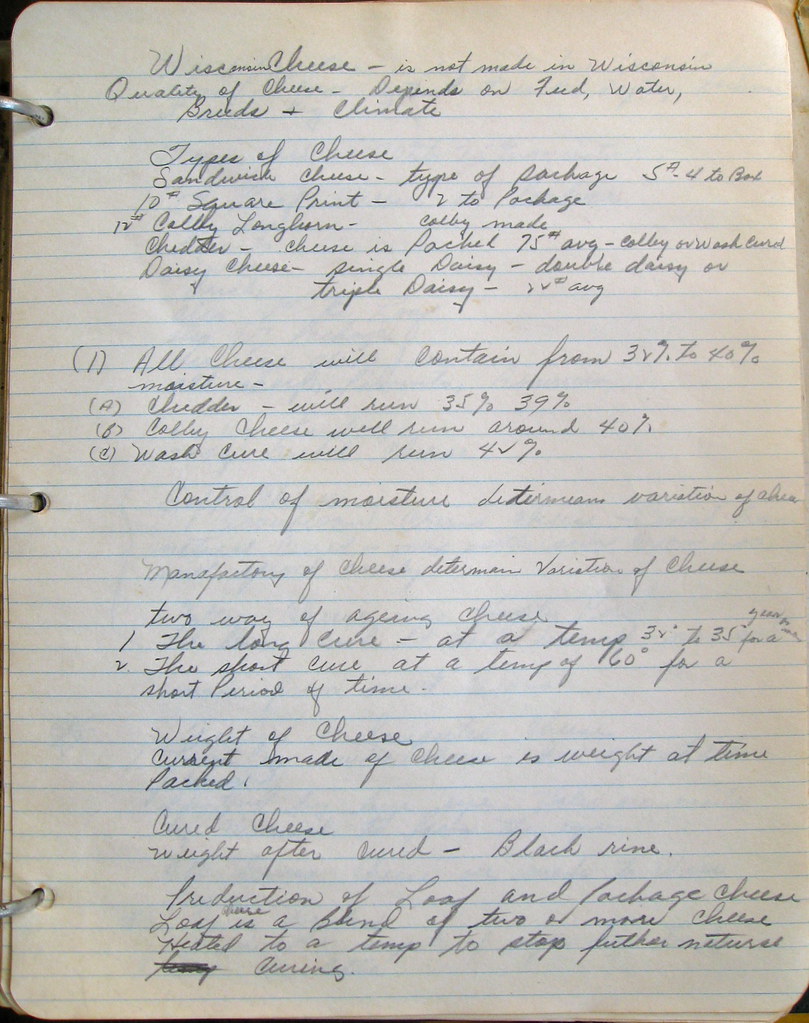
One of my favorite notes is on this page, which begins with "Wisconsin Cheese -- Is not made in Wisconsin":

IMG_1489.jpg

And who was all of this knowledge and expertise aimed at? Why, Mrs. Consumer, of course:

IMG_1496.JPG

And so on. If you want more, I photographed over 50 of the pages and gathered them into this set.

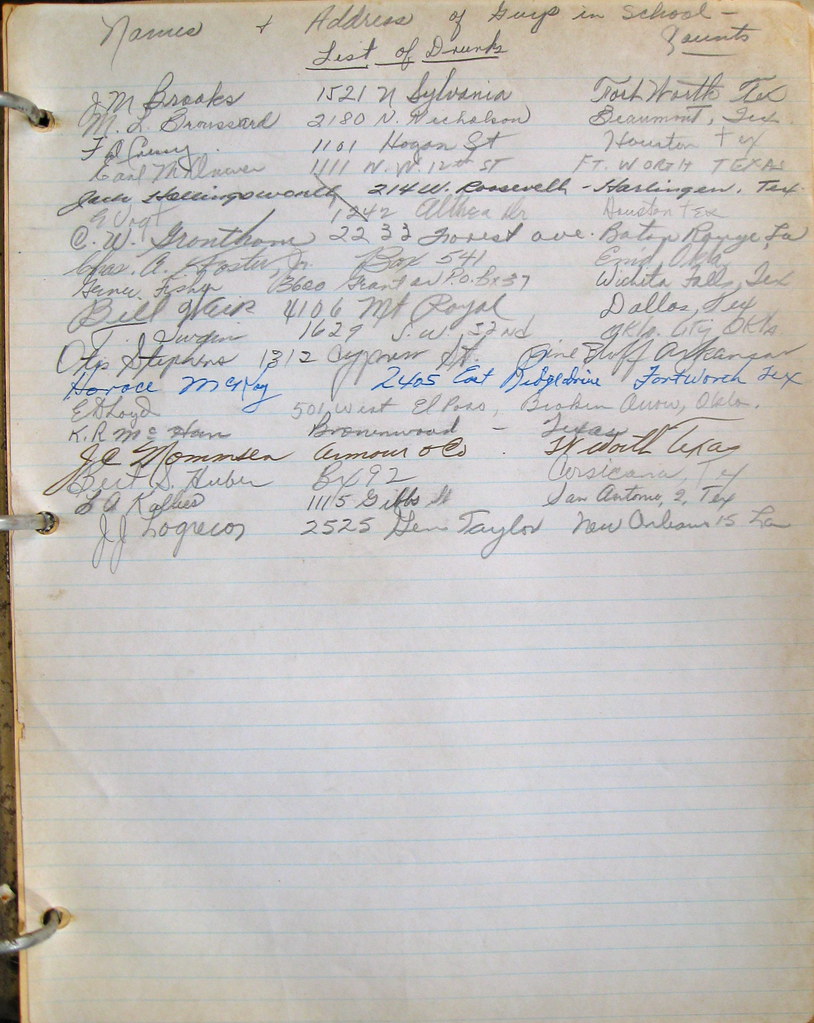
Toward the end of the binder is a list of the names and addresses of the "guys in school," also described as "List of Drunks" -- presumably Harry's fellow trainees. As you can see, they're all from Texas, Oklahoma, Louisiana, and Arkansas:

IMG_1500.JPG

And here's the oddest thing of all: The very last page in the notebook has instructions for a pyramid scheme fueled by a chain letter, purporting to "bring you and your friends a sizable nest egg in a very short time. Take a look:

IMG_1509.JPG

Interestingly, the last person in the chain -- O.D. Stephens of 1312 Cypress St. in Pine Bluff, Arkansas -- was also one of Harry's classmates. Was Harry playing his friends for suckers? And why was something like this in his sales training notebook?

Nearly all the chain mail addresses are from Pine Bluff, so I'm assuming Harry was probably from there as well. And of course we know he worked for Armour. Unfortunately, some quick Googling based on those parameters failed to turn up anything, and I don't have time right now to go digging through census records and other resources. But if anyone reading this wants to track down Harry, I'd like to know more about him.

Wednesday, April 4, 2012

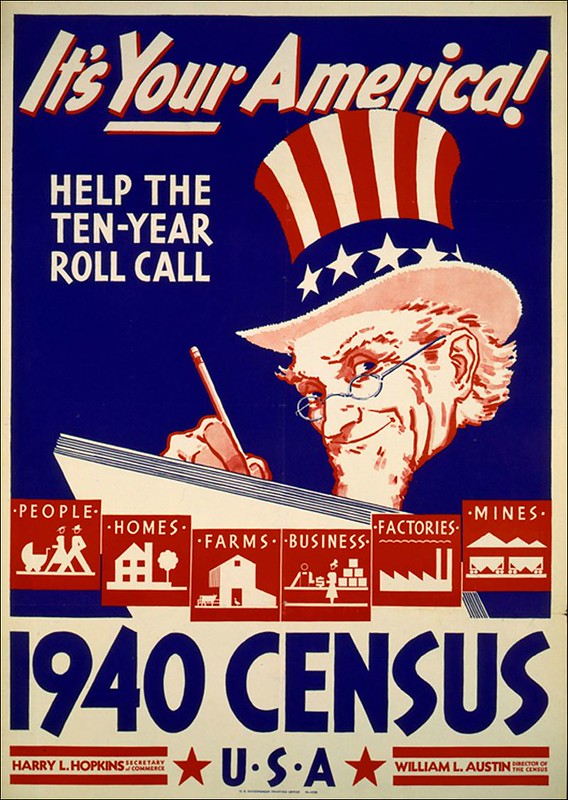
1940-Census-poster-library-of-congress.jpg

As you've probably heard, the 1940 census was released to the public earlier this week, and the response was so great that the National Archives' web site crashed on Monday.

One of the people trying to access the site that day was Cate Bloomquist, one of the volunteer researchers who've been helping me with PermaRec 2.0. She thinks the newly available data in the 1940 census may be very helpful to Permanent Record, so I asked her to talk a bit about how the census fit into her research:

Censuses are extremely important to genealogical research in general, but particularly to the Permanent Record project, because the census provides us with the names of other family members to trace forward. Since the Manhattan Trade students were female and many of them married, tracing them forward has been difficult. The censuses provide us with branches to trace forward, with the hope of locating a living person off that branch who can lead us back to the branch we're looking for. Censuses also provide valuable information regarding dates/places of birth, immigration dates, naturalization dates, how many years married, how many children died vs. lived, occupation, etc.

My piece of advice for people doing census research: Whether you're using the index compiled by Ancestry.com or the more traditional soundex, never trust a "nil" result in the index. People were often incorrectly indexed -- and it's not always the fault of the indexer. Have you ever looked at some of the census handwriting?! So if you don't find your family in a search of the census index, always, always try an alternative way of finding them. It involves a little more work -- you might have to look up a known address manually or perhaps look up a neighbor from a previous census to see if they are still neighbors -- but I would say I am able to locate someone by one of these alternative searches at least 50% of the time, even if they did not show up in the index.

And that's why Cate is such a great researcher (and maybe why I'm such a poor researcher, because I get frustrated easily when I don't find what I'm looking for).

The census is an interesting decennial ritual. Although there's no law requiring a person to respond to the census, the actual taking of the census by the federal government is mandated by Article 1, Section 2 of the U.S. Constitution, which states, "The actual Enumeration shall be made within three Years after the first Meeting of the Congress of the United States, and within every subsequent Term of ten Years, in such Manner as they shall by Law direct." (Do other countries have similar protocols?)

And why is the data from the 1940 census being revealed now? According to a Census Bureau spokeswoman quoted in this article, "In 1952, the director of the Census Bureau and the National Archivist agreed that keeping census records private for 72 years balanced public release of federal records with the tradition of confidentiality." So the 1940 census has come out from under the 72-year umbrella this year, the 1950 census will become available in 2022, and so on -- another decennial ritual. It creates a cyclical rhythm for genealogists and researchers (and, presumably, for Ancestry.com's subscriber patterns).

All of which brings us back to Cate Bloomquist, who turns out to have a very personal reason for being interested in the 1940 census: "I'm looking forward to looking up my dad. He was six years old in 1940, so this is the first census I will be able to see him in. He is currently suffering from Alzheimer's but is mostly sharp enough still that he can appreciate the census, and I look forward to sharing it with him."

+ + + + +

I'll get back to report cards soon, but first I'm excited to report that I've just acquired some amazing old documents that have Permanent Record written all over them: a stack of New York City real estate paperwork (mortgages, deeds, etc.) from the 1850s and ’60s! It's amazing stuff. I just need to find time to go through all of it. More details soon.

Sunday, April 1, 2012

Screen shot 2012-04-01 at 11.54.42 AM.png Screen shot 2011-07-24 at 2.50.42 PM.png

Sometimes I'll be talking or e-mailing with someone about Permanent Record, and I'll mention some specific aspect of the project and then say, "You know, like in the movie." And the other person will often say, "What movie?"

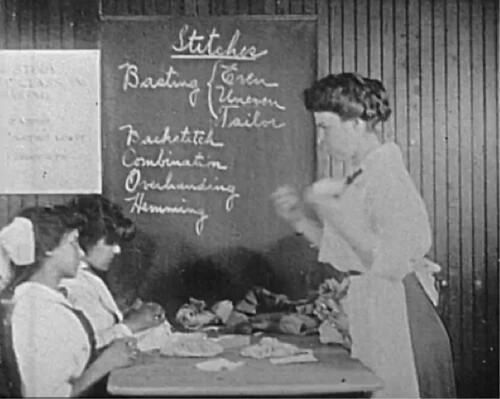
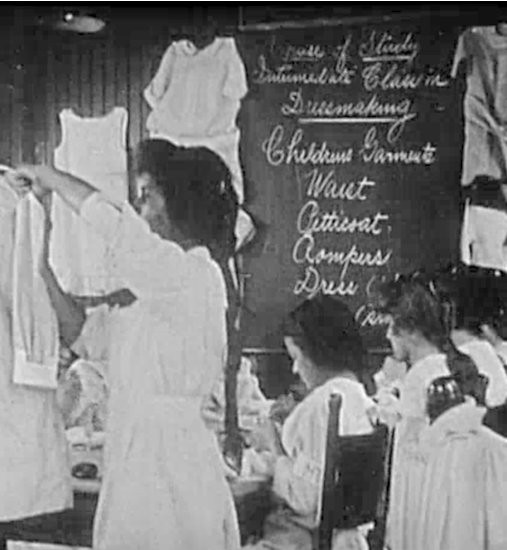
The movie I'm referring to in these situations is Manhattan Trade School for Girls, a 16-minute silent film that was shot in 1911. It's a remarkable document of the school where my report collection came from. As you can see in screen shots shown above, in some scenes you can actually read what's written on the blackboard! (Here's my favorite example of that.) It's another example of how incredibly lucky I was to have found report cards from such a special, well-documented school, instead of just any old school.

I described the movie and linked to it in the third article from last year's Slate series. But when I mention it to fans of the series, they're usually unfamiliar with it. Maybe they didn't bother to click on the link to the movie, or maybe they meant to come back to it and watch it later but never got around to it. Either way, anyone interested in PermaRec should definitely see this film, so I've decided to link to it again (there's no way to embed it, unfortunately) -- check it out.

A few notes:

• As you'll see on the page where the movie hosted, you have a choice of watching the film with commentary or without. The commentary, from a cinema professor, is interesting and provides some good insights, but it also contains some factual errors. I recommend watching the comment-free version first.

• It's not clear why the film was made -- maybe just for promotional purposes, or perhaps to assist in soliciting donations.

• The background music heard in the video version of the film was added in 2006. The original film was silent.

• The film follows the progress of several Manhattan Trade students. Unfortunately, none of those girls is represented in my report card collection.

• In 1911, when the film was shot, Manhattan Trade was at the second of its three locations, at 209-213 East 23rd Street. It had moved to this address from its original location -- a townhouse on West 14th Street -- in 1906. About 40% of the students in my report card collection attended Manhattan Trade while it was at the location shown in the film. (In 1918 the school would move again, to the northwest corner of Lexington Avenue and 22nd Street. That building is still in use today as a high school, with its original "Manhattan Trade School for Girls" lettering chiseled into the façade.)

• The very end of the film shows customers at a retail boutique. Although it isn't explained in the film, this was an outlet shop just off the school's lobby where students could earn extra money by selling the clothing they'd made for class assignments.

Okay, enough of my chatter -- enjoy the film.