Friday, September 12, 2014

I've featured many stories about lost class rings being found. But the story of the ring you see above stands out for at least three reasons:

1. The ring was lost in 1970 and found this year -- a 44-year gap!

2. The ring was successfully reunited with its original owner.

3. The ring was found by a St. Louis sewer crew, which found it while cleaning a clogged sewer line. The ring (which was not the source of the clog) had apparently been there for four decades. Hmmm, would you wear a ring that had spent that long in a sewer, or even want to own it?

You can read more about this here.

(Big thanks to James Poisso for pointing me toward this one.)

The ring you see above is more than 100 years old. The little design on the top, or what remains of it, is the crest of the Roosevelt family. Yes, that Roosevelt family.

The ring is currently owned by Theodore Roosevelt V — the 38-year-old great-great-grandson of America's 26th president. He inherited the ring, along with some other jewelry (cuff links, tie tacks, etc.), when his grandfather died in 2001. He assumed the ring was important to his grandfather but didn't know anything else about its history.

As you may be aware, PBS is about to begin airing a seven-part Ken Burns series about the Roosevelts. TR V, as one of family's living heirs, got to see an advance version of it during the summer. And during one scene, he spotted a familiar piece of jewelry on his great-great-grandfather's left pinky (click to enlarge):

A bit of additional research confirmed that TR V's ring was indeed the same ring that had been worn by his famous ancestor. He'd had no idea.

You can read more about all of this here.

Friday, May 30, 2014

The photo blog Humans of New York, which launched in 2010, consists of portraits of NYC residents, accompanied by short quotes and stories. It's a relatively popular site and has been spun off into a best-selling book, so maybe you already know about it.

The site recently featured the photo you see above. It was accompanied by a short, cryptic quote — "I was Defensive Player of the Year" — and prompted a lot of interesting comments from Humans of New York readers, who read all sorts of things into the man's life just based on that one image and the simple statement.

That was enough to intrigue Sports Illustrated writer Greg Bishop, who became fixated on the question of how the guy in the photo had transitioned from some sort of athletic glory to a construction job. Bishop had nothing to work with except the photo itself, so he began using every tool and technique he could think of to track down the man's identity.

The result turned out to be a very PermaRec-ish little project, which you can read about here — highly recommended.

(Big thanks to reader Jeff Ash for letting me know about this one.)

Thursday, May 29, 2014

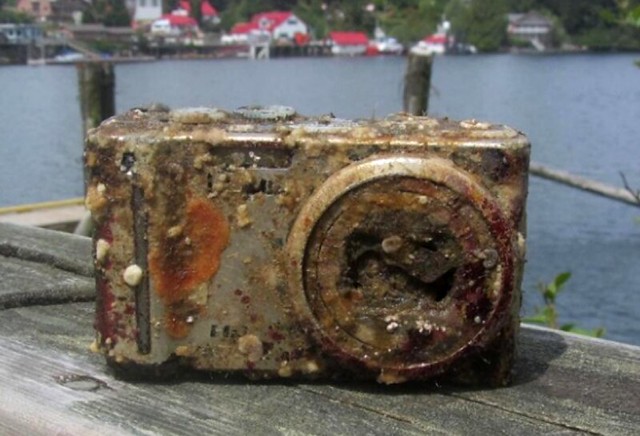
camera

The camera shown above was recently found in 40 feet of water — and with quite a few aquatic creatures living on it and in it — by marine science students who were doing research dives off of British Columbia, Canada. The divers were able to remove the camera's memory card and access the photos and video that, rather amazingly, were still preserved and intact.

One of the photos appeared to be a family portrait, so the students' professor posted it on Twitter in the hopes that someone would recognize the people in the photo. A local coast guard official saw the photo and recognized one of the family members as a shipwreck victim that the coast guard had rescued two years earlier. The camera apparently went down with that wreck and remained in the sea until the student divers found it.

The camera and memory card are now being returned to their owner. You can read more about the story here, and here's a TV news report on the camera's discovery.

Tuesday, May 27, 2014

I've written several times this spring about old employee photo I.D. badges. Now PermaRec reader Kirsten Hively has found one of those badges in an unusual place: the familiar "Rosie the Riveter" poster, shown above.

See that little pin on Rosie's collar? Looks like an employee I.D. badge, right? I've looked at that illustration a gazillion times but had never noticed the badge until Kirsten pointed it out to me the other day. Let's take a closer look at it:

It's a Westinghouse Electric employee I.D. badge! That makes sense, because the Rosie illustration was commissioned by Westinghouse's War Production Coordinating Committee, which was looking to inspire the company's female workforce. You can learn more about that here and here. (Those links also explain why the it's actually a misnomer to refer to the poster as "Rosie the Riveter," but I'm going to keep calling it that for now, because it's a convenient, easily understood shorthand.)

The Rosie image has been adapted, copied, and repurposed countless times over the years. Some women taking inspiration from the image make a point of including the I.D. badge while others don't bother with it. Maybe those in the latter category were using this "How to look like Rosie" guide, which doesn't include the badge.

And here's someone who flopped the original orientation of the Rosie image and then Photoshopped her own face onto it, apparently not realizing (or caring) that the "Westinghouse Electric" lettering on the original badge would appear backwards on her flopped version.

Did Westinghouse Electric really have badges like the one shown in the illustration? They sure did. Not only that, but some enterprising soul on Etsy has used that badge design as the basis for a replica Rosie I.D. badge. (They also offer the same design as a zipper pull, but come on — that's cheating.)

Anyway: Employee photo I.D. badges — endlessly fascinating!

(Big thanks to Kirsten Hively for spotting Rosie's badge.)

Saturday, May 24, 2014

IMG_3713

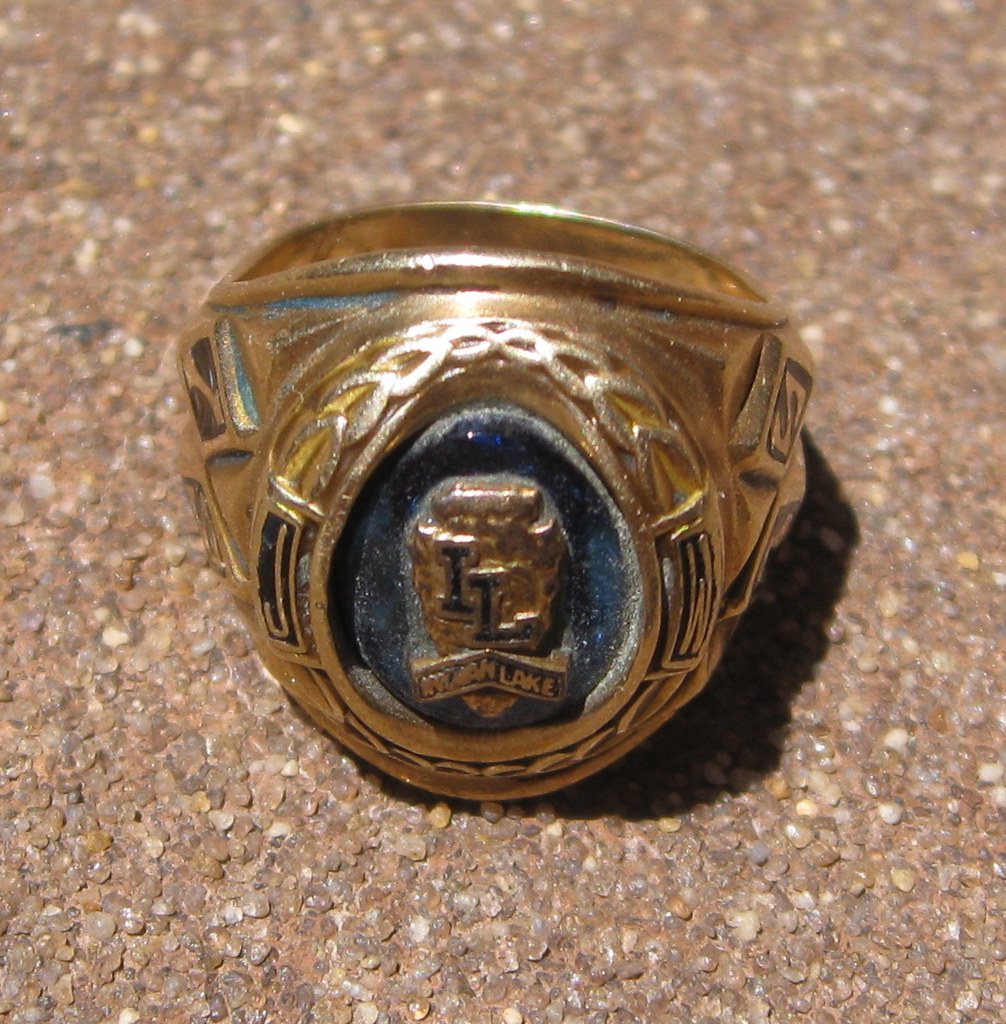
Last week I wrote about a 1975 high school ring that PermaRec reader Frank Bitzer recently discovered while going through his late mother's belongings. There's been a new development on that front.

First, a quick recap: As you may recall, Frank's mother found the ring on the side of a highway in 1984 but apparently never attempted to locate its owner. Frank had trouble reading the school's name on the ring, so he sent it to me, hoping I could find the owner. I determined that the ring had belonged to Jeff Weeks, who had graduated in 1975 from Indian Lake High School in Ohio. I had two short conversations with Jeff's brother, Todd Weeks, and traded a few awkward voicemails with Jeff, but Jeff never actually gave me his shipping address for returning the ring. For that matter, he didn't seem particularly interested in the ring at all. Then he stopped responding to my calls.

For the next few days, every time the phone rang, I thought to myself, "That's gotta be Jeff Weeks." But it never was. And whenever I received a voicemail, I thought to myself, "That's gotta be Jeff Weeks." But it never was.

Then I came home one day to find a voicemail from Todd Weeks — Jeff's brother. The message, which was spoken in a very slow, almost disinterested-sounding voice, went like so:

Hello, this is Todd Weeks. My brother said you keep missing each other. You wanted the story on the ring, but he doesn't even remember — it was 30 years ago. [Long pause.] He doesn’t even know. I was thinkin' you might wanna mail him the ring. It's Jeff Weeks, [address redacted]. That's Jeff Weeks, [address redacted]. [Long pause.] He doesn't remember anything about the ring. [Long pause.] Thank you. Bye.

There was an additional long pause — about seven seconds — between "Bye" and the official end of the voicemail. Very odd. Even odder, if Todd and Jeff discussed my attempts to return the ring, as appears to be the case, why did Todd call me back instead of Jeff? Those Weeks brothers — such inscrutable characters!

And just to be clear, I never asked Jeff or Todd for "the story on the ring." Rather, I thought Jeff might be interested in hearing the story of the rather circuitous route the ring had taken on its way back to him. But I guess he doesn't care, which of course is his prerogative.

Anyway: Since Todd gave me Jeff's address, I dropped the ring in the mail. I included a note with my phone number, just in case he wants to get in touch and provide a bit of closure, but I don't expect to hear from him. If I do, though, I'll provide an update here.

Monday, May 19, 2014

IMG_3592.JPG
For all photos, click to enlarge

I've written several times now about lost class rings being found. But the ring shown above is different — it's been found twice, in two different contexts. And it doesn't seem to want to go home.

The story begins with an email I recently received from reader Frank Bitzer, as follows:

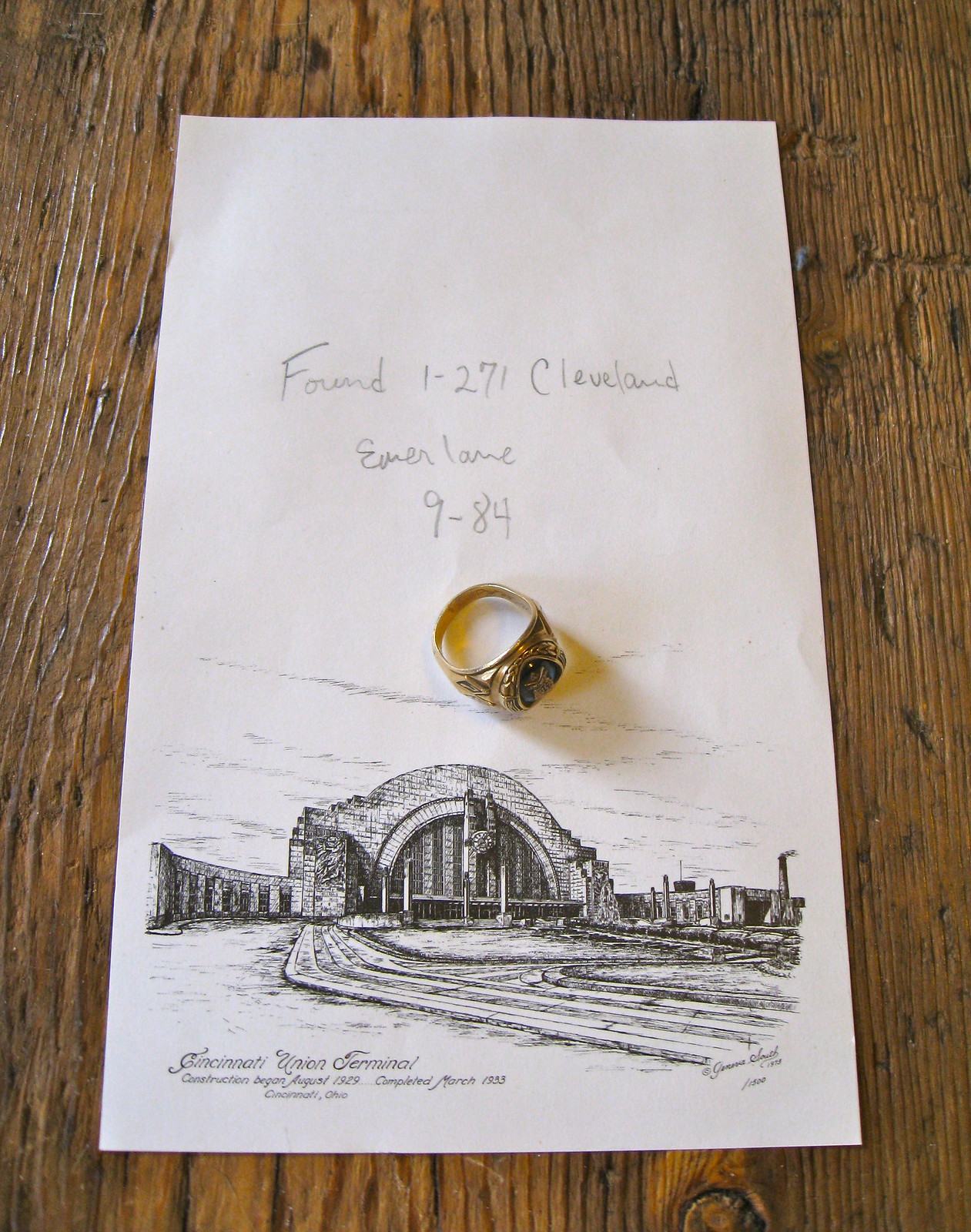
I recently rummaged through my now-deceased mom's old cedar chest, where she kept a lifetime's worth of keepsakes. I came across something odd: a 1975 class ring. My mom had it in a plastic baggie with a note saying she found it in the emergency lane on Interstate 271 east of Cleveland in September of 1984. (She was moving my kid brother to college; they made an emergency stop.) Mom died in 2005 and I just discovered the ring now.

My eyesight isn't good enough to make out the school's name on the ring. But if possible, I would like to see it returned to its rightful owner.

So the ring was first discovered by Frank's mother and then again, nearly 30 years later, by Frank himself. I told Frank I'd be happy to look into the situation, so he sent me the ring, along with his mother's note, which is shown above.

Frank wasn't kidding about the school's name on the ring being hard to read. The lettering is teeny-tiny and a bit weathered. I couldn't make it out with the naked eye, so I took a close-up photograph of it and then enlarged the photo, at which point the words "Indian Lake" became apparent:

IMG_3713

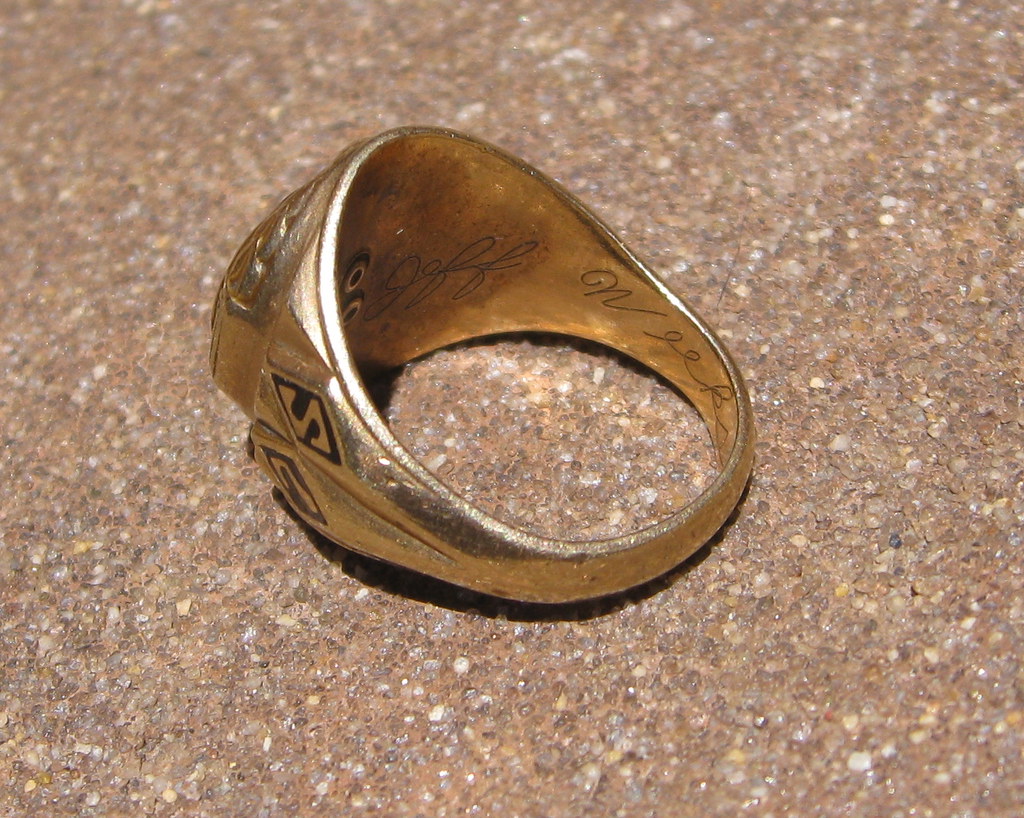
School rings are often marked with owner's initials, but this one has something much better. The owner's name, Jeff Weeks, has been engraved on the inner shank:

IMG_3707

Some quick Googling revealed that there's an Indian Lake High School in Lewistown, Ohio (about 170 miles from Cleveland), and that the school's class of 1975 included a Jeff Weeks. So I contacted the school, where a helpful staffer agreed to post something about the ring to school's alumni group on Facebook.

About two weeks later I received a call from a gentleman named Todd Weeks — Jeff Weeks's brother. He had seen the Facebook post and wanted to know more. I explained the situation and he said he'd pass my contact info along to Jeff.

About 10 days went by with no further developments, so I called Todd Weeks and told him I hadn't heard from Jeff. He sounded surprised, and then he gave me Jeff's number and encouraged me to contact him myself. I called the number, left a voicemail about the ring, and went out to run some errands.

When I came back, there was a message waiting for me. The voice sounded rather distracted: "Um, yeah, this is Jeff Weeks, just returning your call. [Pause.] Thank you." That was it — no mention of the ring, no curiosity about how I came to be in possession of it, no nothing.

That was five days ago. I've called Jeff twice more since then and have left messages, but no response. Maybe he doesn't want his ring back..? Could be — I can imagine all sorts of scenarios in which the ring might be a bad reminder of unpleasant times.

I'll post an update if I ever hear back from Jeff. For now, though, this story remains frustratingly unresolved.

Friday, May 16, 2014

Scan 10
For all images in this entry, you can click to enlarge

I periodically receive inquiries from people who stumble across Permanent Record while researching their family histories and want to know if I have the Manhattan Trade School report card for their mother or great-aunt or whatever.

One such inquiry recently came my way from a woman named Carol Chadwick. Carol's mother, Margaret Nagy, attended the school from roughly 1939 through 1942, when her name was Margaret Sabo. Unfortunately, Margaret's report card isn't part of my collection (almost all of my report cards are for students who attended the school from the 1910s up through the mid-1930s), but Carol asked if I'd be interested in seeing Margaret's yearbook. I said sure.

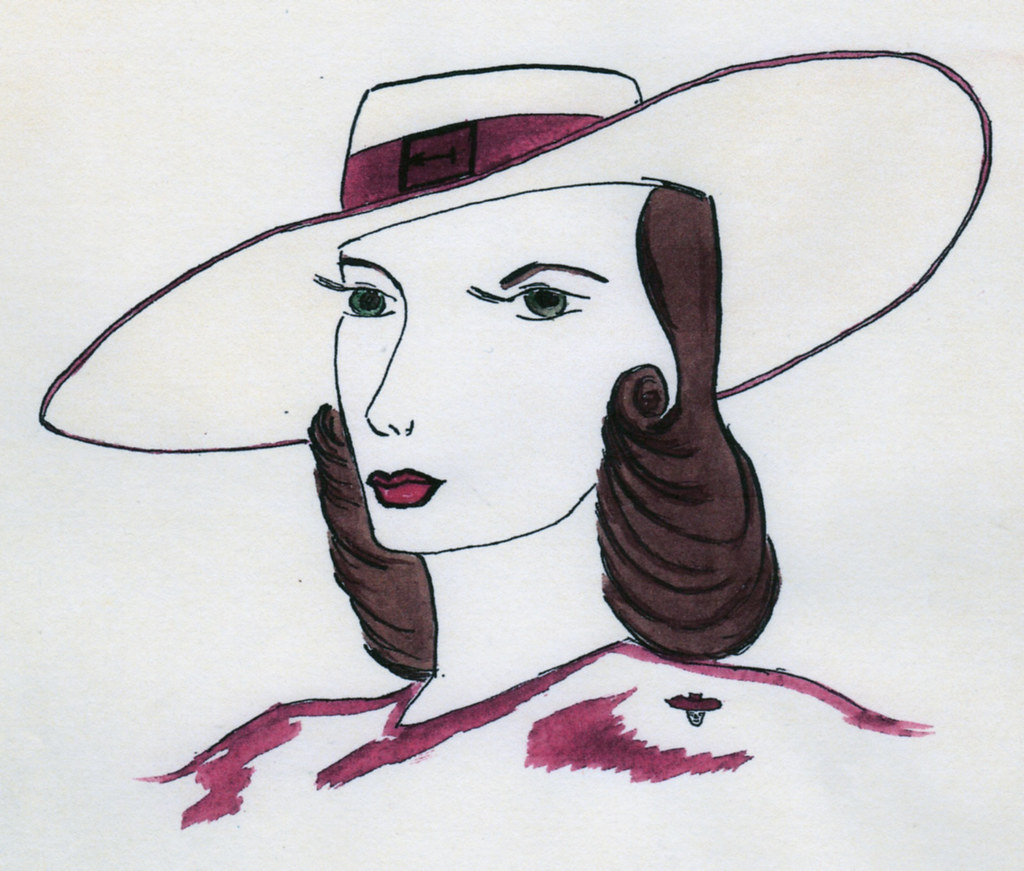
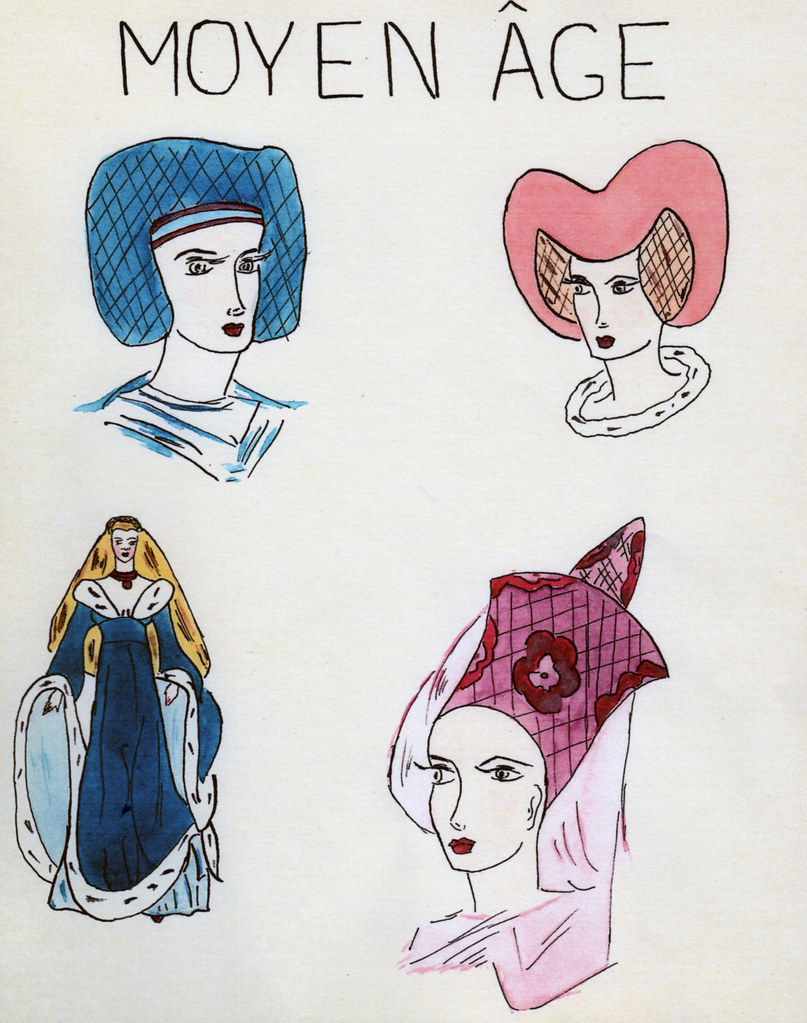
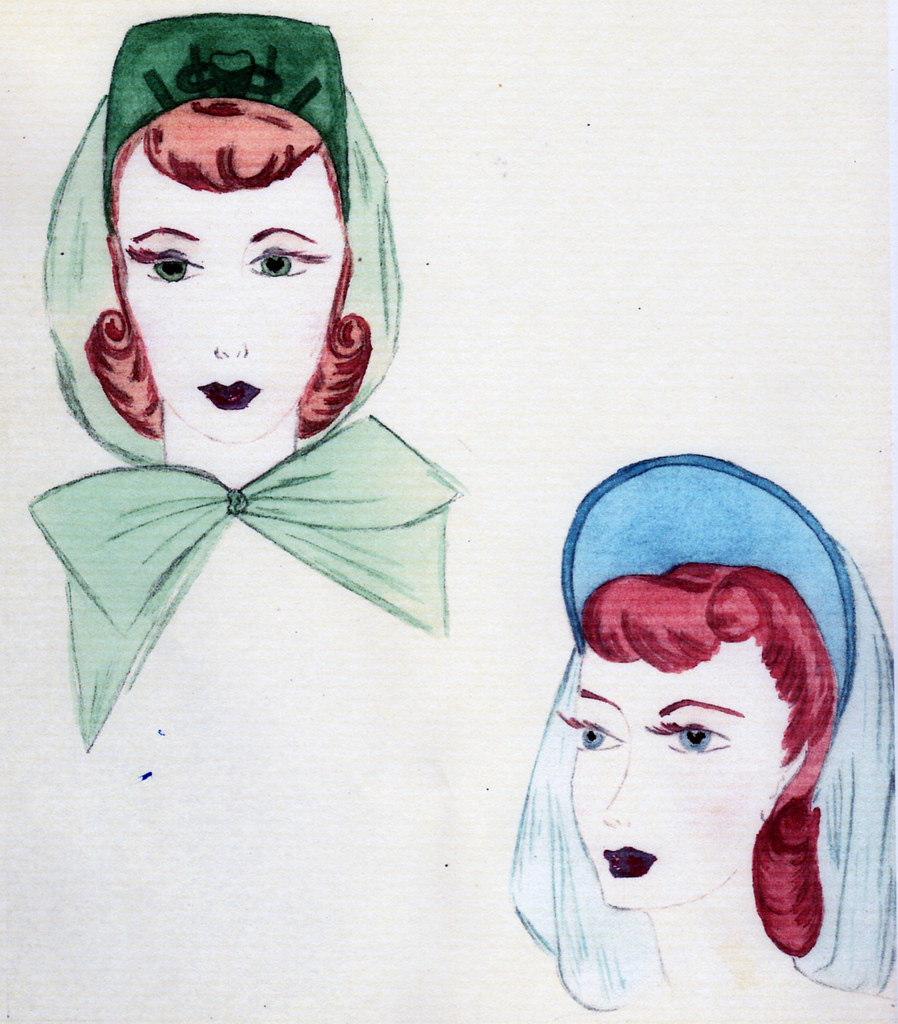
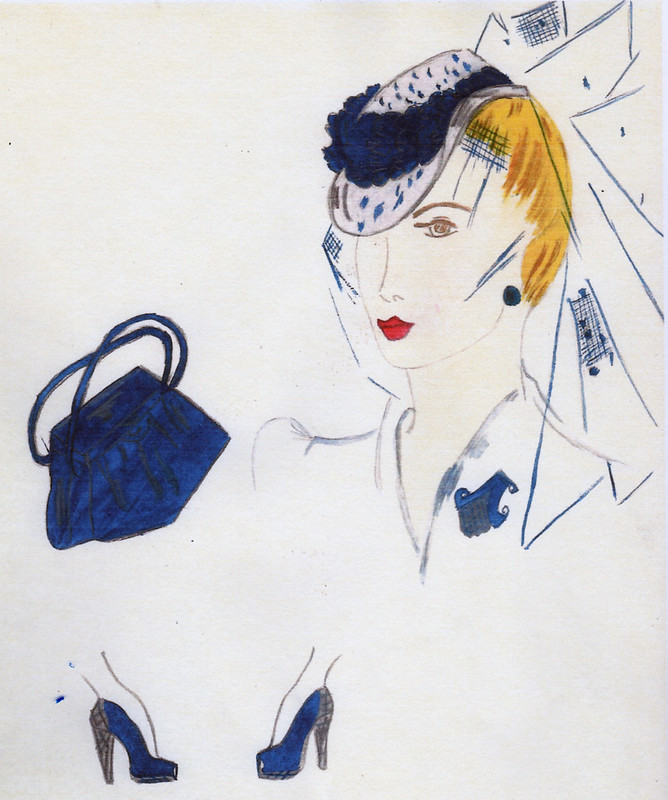
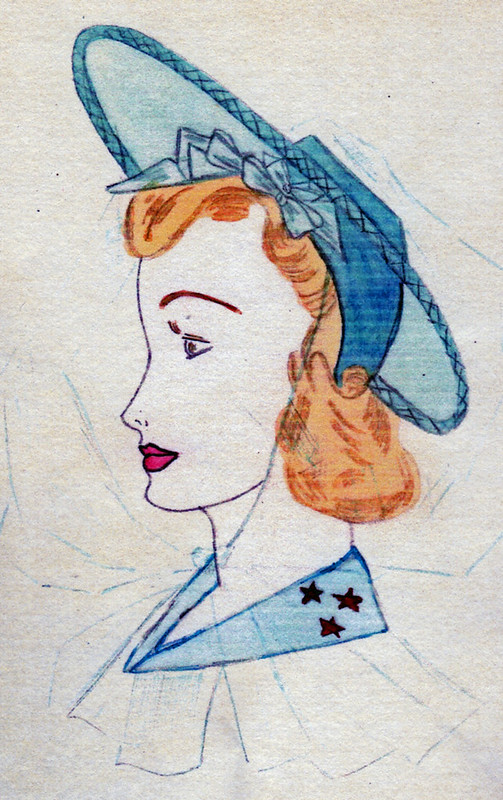
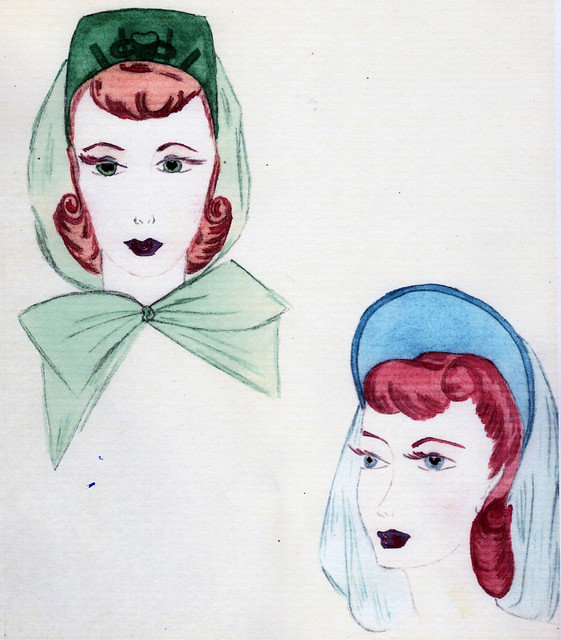
As it turned out, Carol wasn't able to locate Margaret's yearbook, but she offered me two very good consolation prizes. First, she found Margaret's art class portfolio and made printouts of some of the pages for me (you can see a few of them distributed throughout this entry). Even better, she arranged to have me do a phone interview with Margaret, who's now 90 years old.
Scan 9

Throughout the course of the Permanent Record project, I have interviewed only one person who attended the school as far back as the 1930s. That was Rose Vrana, who was 95 when I interviewed and wrote about her two years ago.

In Rose's case, I had her report card — she's the only living student I've found from my report card collection. But although I don't have Margaret's report card, she's still a living link to the school's PermaRec era (okay, a few years after the PermaRec era), so I jumped at the chance to interview her. We ended up speaking on the phone for about 40 minutes a few weeks ago. Here's how it went.

Permanent Record: I hope you can forgive me for beginning with this question: When were you born?

Margaret Nagy: I am 90 years old. I was born Jan. 10, 1924.

PR: You grew up in New York City, right?

MN: Yes, in Manhattan, downtown. Fifth St. between Aves. A and B. Later we moved to 7th St., across from Ave. A. Do you remember Tompkins Square Park?

PR: It's still there.

MN: I lived right across the street from there.

PR: Nowadays that neighborhood is called the East Village. But back then, did you call it the Lower East Side?

MN: We just called it downtown.

PR: Where were your parents from, and what did they do?

MN: My parents were both born and raised in Hungary. My father was in World War I. He was stationed in China, of all places. How he got here, I don't know. They didn't give us much information.

PR: When you say he was in World War I, do you mean he was fighting for Hungary?

MN: No no no, for the United States.

PR: So he was already in the States by then. And you were born in the States.

MN: Yes, I was born in Connecticut. Warren, Connecticut. And then my parents moved down to Manhattan before I was one year old. I have no idea why, or who brought them here, or why.

PR: What did you parents do for work?

MN: My father worked for the First National Bank on Wall Street. He was an elevator operator. You know, the ones you ran by hand.

PR: And did your mother work?

MN: Yes, after she had both of us — me and my sister — she went to work on Long Island making, of all things, corsets. Of course, she didn't talk good English.

PR: So was Hungarian spoken in your parents' home?

MN: Oh, yes. That's how I learned to speak Hungarian. My father spoke perfect English — I think he learned that in the Army — but not my mother.

PR: And you mentioned that you had a sister?

MN: Yes. She's dead now. She was exactly a year younger than me. Born on the same day, but a year later.
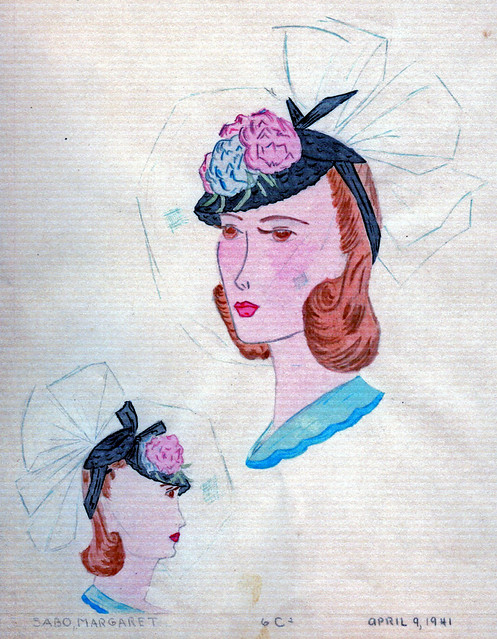
Scan 11

PR: How did you end up attending the Manhattan Trade School?

MN: My father was a funny bugger. When he learned that I liked cooking — he had a funny idea that if you liked that, and you took it up, you became a waitress. To him, there was no such thing as learning how to cook, or being trained to be a chef...

PR: You mean because you were a woman?

MN: Right. And he saw how waitresses worked. Because every day at work he ate breakfast at Schraft's, and he saw how hard they worked. So that was it — I wasn't allowed to go to any other high school.

PR: So he decided you would go to the Manhattan Trade School to learn a sewing trade?

MN: When he heard about it, yup.

PR: I keep calling it Manhattan Trade School, but it probably had a different name by the time you were there, right?

MN: Yes. It was the Manhattan School of Women's Garment Trades.

PR: Right, they changed names several times during that period. [The school was also known as Manhattan Industrial High School at one point. — PL]

PR: The school was on Lexington Avenue and 22nd St., right?

MN: Right, right.

PR: The building is still there, and it still has "Manhattan Trade School for Girls" chiseled into the façade. But it's a regular high school now.

MN: Uh-huh.

PR: Were you excited to be going there?

MN: My cousin had gone there, and she had everything good to say about it, so I figured oh well, I might as well try it. And I did.

PR: What trade did you choose to study?

MN: I had to choose millinery, because, like I said, my father wouldn't let me choose cafeteria.

PR: Oh, right, by that time they were offering cafeteria management as a trade course of study. [The school had previously offered only the needle trades (dressmaking, millinery, and etc.) and the glue trades (lampshade making, decorative box making, etc.) but began expanding its offerings around the time Margaret attended. — PL]

MN: Right. But my father wouldn't allow that. So I picked millinery. I figured I already knew how to sew.

PR: You already sewed at home?

MN: Oh yeah, I was good at it.

PR: Your mother taught you?

MN: Yeah. And my sister was good at it.

PR: And you said your mother was making corsets, so she was already in a sewing field.

MN: Right. But I wasn't crazy about it. I had to choose millinery because I didn't like garments.

PR: Oh, so you didn't want to do dressmaking or sewing machine operation.

MN: No. My sister did dressmaking, a year later.

PR: Oh, so she attended the school too?

MN: Yeah.

PR: What didn't you like about garments?

MN: I didn't like sewing. So I figured doing something hats was okay. And I learned to like it.
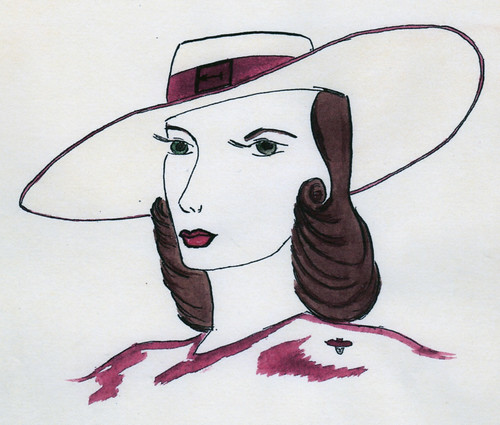
Scan 5

PR: And how long did you attend the school — one year? Two?

MN: I think three.

PR: What do you remember about your time at the school. Did you like your teachers?

MN: Oh, yeah. I remember that juniors, we had to wear smocks. A tan-colored smock that you pulled over your head. When you became a senior you were given blue smocks with buttons, and that's how everybody knew you were a senior.

PR: So these were the uniforms.

MN: Yeah. I don't think they wanted anyone to look like they could outdo someone else.

PR: And of course this was during the Depression, so that was a big concern, that everyone appeared equal and nobody looked like they were doing worse than the others.

MN: That's right.

PR: Were there other students from Hungarian families, and did you bond with them in any way?

MN: No, no. For that matter, most of the girls came, believe it or not, from Long Island and Brooklyn. Nobody came from Manhattan.

PR: So these other students, they all had much longer commutes to school than you did.

MN: Oh, yeah. They came on trains. Yup.

PR: How did you get to school?

MN: If it was a nice day, I'd walk. If not, I'd take a bus. There was a bus on Ave. A.

PR: Did you make friends with the other students?

MN: Oh, yes. That's why I don't know what became of that yearbook I had. It's in this apartment somewhere, but I can't find it.

PR: Did you stay friends with any of them later on in your life?

MN: Yes, after I graduated. There were one ... two ... three from the Bronx that I stayed friends with. And then there was one from the way, way Upper East Side, the hotsy-totsy side, where they had homes. And even after we got married, we stayed friends.

PR: What did you particularly like about the school?

MN: What I liked at the school, I loved their cafeteria.

PR [laughing]: So even if you weren't allowed to study that, you were still interested in it.

MN: Yes. When I went to eat there, I loved sweet potatoes. And when sold sweet potatoes for five cents a plate, I always saved money to buy that.

PR: The cafeteria was staffed by students, right?

MN: No, there were women there. There were women there. [The school had employed students in the cafeteria in its earlier years. — PL]

PR: By the time you attended the school, it was pretty well established and had been around for a while. But it was actually a very important school when it was founded, because it was the first girls' vocational school in America. Did they make you aware of the school's historical importance?

MN: No. Nothing about their history. Except that the war was going on.

PR: How did that affect things?

MN: Well, on Armistice Day, wherever we were — in the hall or wherever — we'd get very quiet and there'd be a bugle blowin'.

PR: You mean on the 11th hour of the 11th day, and so on, right?

MN: Right.

PR: Were there any male staffers at the school?

MN: No. Well, the young man who ran the elevator. And the janitor. But that was it.

PR: All the teachers and administrators were women?

MN: Yeah. That I remember.

PR: Did you take any class trips?

MN: Just one, for an art class. The teacher — I wish I could remember her name — I always looked forward to that. She took us out in the spring to some place, I think it was around the Central Park area. It was the first iced tea I ever had, and she showed us that if you put milk into the iced tea, she said, "Watch the milk as it goes in, and see the design and pattern it makes in the tea." She was always art-conscious.

PR: So did you do that, with the milk?

MN: Yeah!

PR: And was that eye-opening for you?

MN: Yeah. I says, "Oh, yeah, look at that!" That was different, that was something new. I mean, I lived way downtown. I didn't get any of that stuff.
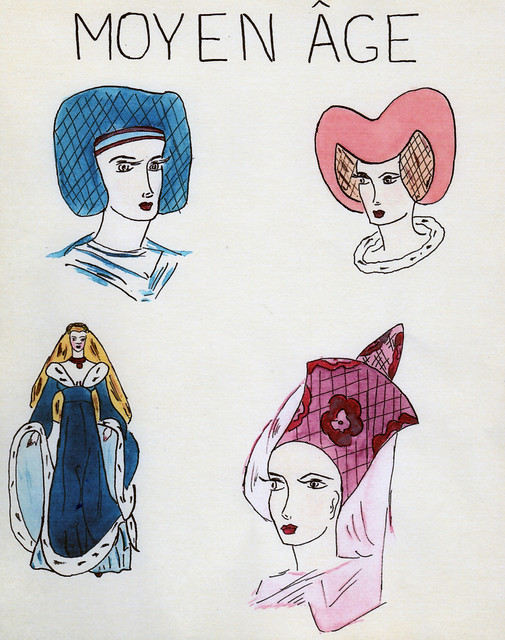
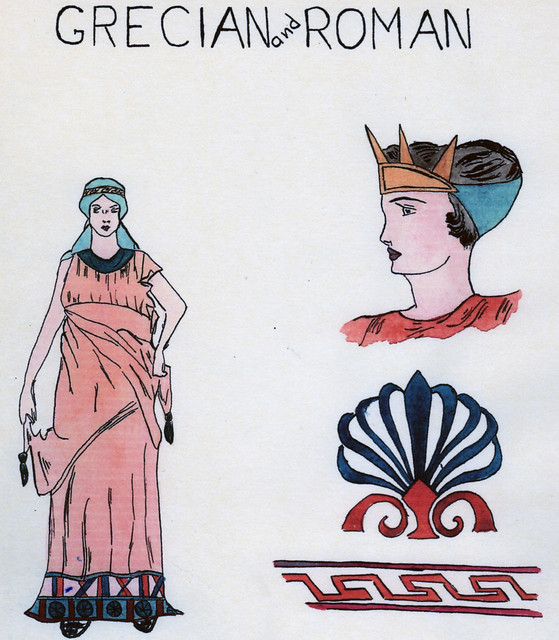
Scan 4 Scan 3 Scan 2

PR: Your daughter made copies of your portfolio drawings for me. What class was that for?

MN: That was art class.

PR: The same one with the teacher who showed you the milk in the iced tea?

MN: Yes, yes.

PR: Your daughter also told me that some of your drawings were displayed at the Brooklyn Museum. Can you tell me about that?

MN: I was surprised. This was part of our studies. And when we finished them, she picked some of them to go to the Brooklyn Museum of Art. Not only from us, but also from other high schools. They were displayed, to show what each school had to offer. I was really surprised, and happy.

PR: Well, sure you were — your teacher chose your work!

MN: Not only mine, there were some others, too.

PR: Right, but you were one of the ones who whose drawings were chosen.

MN: Yeah. I never saw them — I never got to go to the museum.

PR: Really? Did you mean to, and you just never got around to it?

MN: I — yeah.

PR: But hey, you've been exhibited in a fine art museum. That's more than most people can say.

MN [chuckling]: Yeah.

PR: The school had a job-placement office that arranged jobs for the students. Did they do that for you?

MN: Yes, they did.

PR: What sorts of jobs did they arrange for you?

MN: Believe it or not, nothing in millinery.

PR: Because there was nothing available..?

MN: I'm sure there was. But they gave me a job with a power sewing machine. Remember the chevrons on the [military] uniforms that the men wore? It was sewin' those things.

PR: You mean sewing sergeants' stripes and things like that onto military uniforms?

MN: Right.

PR: And that was precisely the kind of garment work you had wanted to avoid.

MN: Right! I didn't like machines. Oh, I quit that. I couldn’t do that. And it was piece work — you know what that means?

PR: You get paid by the piece, instead of by the hour.

MN: Right. How many chevrons you finished.

PR: These were Army uniforms?

MN: Yes, yes. I remember corporals' stripes, sergeants' stripes. And power machines? Why give that to me when I wasn't even used to a power machine? We didn't have that in millinery.

PR: Where was this job?

MN: Oh, it was downtown, in a crummy place, really. When I walked into the hallway, I says, "My god, what am I gettin' into?" Dark, damp. And when you went into the sewing area, a whole mess of machines, and then older women already workin' there.

PR: So you felt out of place.

MN: Yes, yes.

PR: How long did you work there before you quit?

MN: No more than two weeks.

PR: And did you go back to the school and ask for another job?

MN: No. I figure I'm out of school, that's it, I'll find one on my own.

PR: So you never made use of that office, the job placement office, again.

MN: No.
Scan 6

PR: What kind of job did you eventually find for yourself?

MN: I went around to different places, and believe it or not I got a job doin', again, on the sewing machine. That's what was available. But on this job I did better, so I stayed a while.

PR: And who were you working for?

MN: The Durlacher company. Durlacher — D-U-R-L-A-C-H-E-R. It was the man who, I guess, owned the place, it was his name. And it was half and half: Half was sewing machines, and the other half was shipping, packing, and stuff like that.

PR: And what did you sew there?

MN: Remember the bandoliers that the soldiers would wear? They were canvas, and they'd put bullets in them. We'd make those. And then we stopped makin' those, when I guess they ran out of their contract. And then they put me on the other side, with the shipping and everything, and I worked on packaging monograms. No more machines. But then! The airplane scarves — remember how the pilots wore these long white scarves?

PR: Yes.

MN: Okay. They gave me the job of stamping "U.S. Navy" or "U.S. Army" or "USA" onto the scarves.

PR: Stamping with what?

MN: Just a regular ink pad. But it had to be just right, just so. That was another contract, but then that fizzled out too. And before you know it, my husband was coming home from overseas.

PR: Wait, when had you gotten married in the middle of all this?

MN: I didn't. I waited for him to come home.

PR: Oh. So how did you meet him?

MN: Oh, my lord, I met him at a sweet 16 party.

PR: Your sweet 16 party?

MN: No. My cousin's, in New Brunswick, New Jersey.

PR: How old were you at the time?

MN: Oh god — not 16 yet.

PR: And how old was he?

MN: About 17, 18.

PR: Oh, a much older man!

MN: I know.

PR: Did he live in New York, like you did?

MN: No. He lived in New Brunswick.

PR: So the two of you courted while you were living in different states?

MN: Yes. He'd come in on weekends. Then he was drafted, went into the Army, stayed in England about three years. And then when he came home, he couldn't wait — within 15 days, we were married.

PR: So he wrote to you while he was away?

MN: Yes, I have all of them saved. But he was not allowed to send a letter he wrote. They took the letters and scratched out the parts they didn't want in there.

PR: Once you got married, did you keep working?

MN: Yeah, I started working pretty soon after we got married. I worked for Maidenform, which was in New Jersey.

PR: So after you got married, the two of you moved to New Jersey?

MN: Oh, yes, and was I glad. I hated New York.

PR: Really?

MN: Oh, yeah. I still do!

PR: And what happened to your job at Durlacher?

MN: I got a phone call, on Durlacher's phone, from my husband. He'd just got off the boat! He didn't even go home first — he got to a phone and called the number. And I looked at Mr. Durlacher — he was standin' there, along with Mr. Smith, another one — and I says, "That was my boyfriend from overseas. His boat just got in." And to this day, I'm sorry I said this. I says, "To hell with this job. I'm goin' home, I'm gettin' married."

PR: Oh, wow.

MN: Which I did. I never saw them again.

PR: How long had you been working there at that point?

MN: Mmmm, I'd say a good two years.

PR: Why do you regret having said that?

MN: It was a nice place to work, and I didn't want to say that type of thing — "To hell with the job."

PR: So even if you were going to leave, you didn't have to leave that way.

MN: That's right. But I don't think they cared, really.

PR: So then you moved to New Jersey with your husband. What was his name?

MN: Frank Nagy.

PR: And then you got the job with Maidenform?

MN: Yes.

PR: What did you do for them?

MN: Would you believe machine work again? Oh, yeah. But on this one I was better. And I got pregnant, and then I left.

PR: Maidenform is a brassiere company. Is that what you were making?

MN: Yeah.

PR: That's pretty funny — your mom made corsets and you made brassieres!

MN: Right, right.

PR: What about Frank, what did he do?

MN: He worked for the Army at the Raritan Arsenal, in Raritan, New Jersey, before he was drafted. They had a condition there — if he was inducted, his job would be waiting for him when he was discharged. And that's just what happened. He went back to work there.

PR: What did he do there?

MN: Oh, brother. Before he left, he worked with explosives. But after he came home he was a heavy equipment operator. Big trucks and all that. And then he retired from there. It was the only job he ever had.

PR: Did you ever go back to work?

MN: Yes — at another sewing machine job.

PR: Sewing what?

MN: Making pajamas. I was good at it. I don't remember the name of the company. I enjoyed it because I was good at it. I did that as a night job for about a year.

PR: When did you stop working?

MN: By the time I was in my 30s, because I had three girls by then.

PR: Even when you weren't working, did you continue to sew, like at home?

MN [laughing]: No! I mean, I'd sew buttons or stuff like that, but that's all. I did not enjoy it.

PR: And did you ever get to use your millinery training?

MN: No, not for work. I did stuff like that at home, for my own pleasure — I made hats and turbans. But never for work. And that was a shame. I knew enough. They could have stuck me in.

PR: Do you have anything you want to add about the school, or about anything else?

MN: Well, it was a nice school to go to. And there was a little old lady there who taught you how to iron. And the iron was a flatiron that you put on a coal stove — not electric. And naturally, cafeteria, I enjoyed that. And my millinery teacher, when we started, she was a maiden. And then she got married, so she had two names. And then there was another millinery teacher, and whoa, she was a whoop-de-do.

PR [laughing]: A whoop-de-do? What does that mean?

MN: The clothes that that woman wore, and the earrings! She had heavy earrings. She was some dresser, with some hairdo. The art teacher, she was lovely. I remember the arithmetic teacher — she lived on Ave. A, of all places.

PR: Oh, right near you!

MN: Yeah, but not the same — how should I say it? Not the same people. It was a big difference. I lived across the street from a doctor, but you would never have known it by looking at the place where I lived.

PR: Tell me about your place.

MN: It was a tenement. A kitchen, a dining room, and two bedrooms, without windows. In the summer, you nearly died. Across the street, the doctor's building — what a difference. And there was a dentist across the street. You would never know that I lived in that area.

PR: How long did your parents live there?

MN: Until we moved to 7th St., when I was about 17. Whaaat a difference. We had a dentist's office on the main floor, and we had a dining room, a parlor, a big bedroom, and two other bedrooms. So there was a biiiig difference. On 5th St., the first place, it was, to me, a slum. It was not what we liked.

PR: What about your sister — did she stay in New York?

MN: She lived in New York until she bought a home out in Jersey.

PR: Did she end up using her trade skills that she learned at the school?

MN: Ooooh, yes, I give her that much. She knew how to make patterns, how to design clothes, how to sew clothes, and she had a little business of her own.

PR: A sewing business?

MN: Yes. And she worked for a designer, a clothing designer. She used what she learned there.

PR: So it sounds like you didn't get to use your millinery skills because they didn't send you to the right jobs. But I guess they sent her to the right jobs.

MN: Yes, they did. They did. I can't think of the designer's name who she worked for — Rosen-something.

PR: Oh! You mean Nettie Rosenstein?

MN: That sounds familiar, yes. A famous dress designer.

PR: Wow. It turns out that another student from the school, whose report card I happen to have, ended up working for her and became her sister-in-law. I wrote a story about her a few years ago. That's pretty amazing, that another student from the school went to work for her.

MN: It's too bad my sister is dead. She could have told you lots more about it.

———————

At this point I sensed that Margaret's energy was fading a bit, so I thanked her for her time and her recollections and wrapped things up. She said, "I don't know what you possibly got out of this," but I assured her that I'd gotten plenty from our discussion.

As I look over the transcript of our chat, I now find myself thinking of dozens of additional questions I wish I'd asked her, especially regarding her portfolio drawings. Hmmmm — maybe I'll try to arrange a follow-up call.

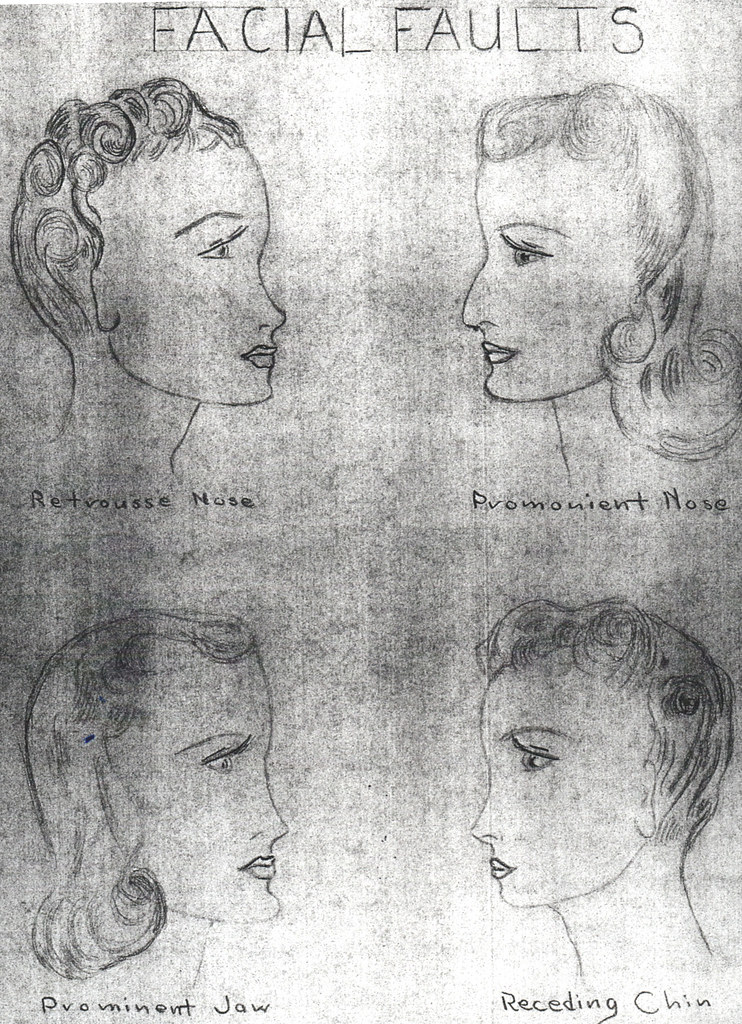
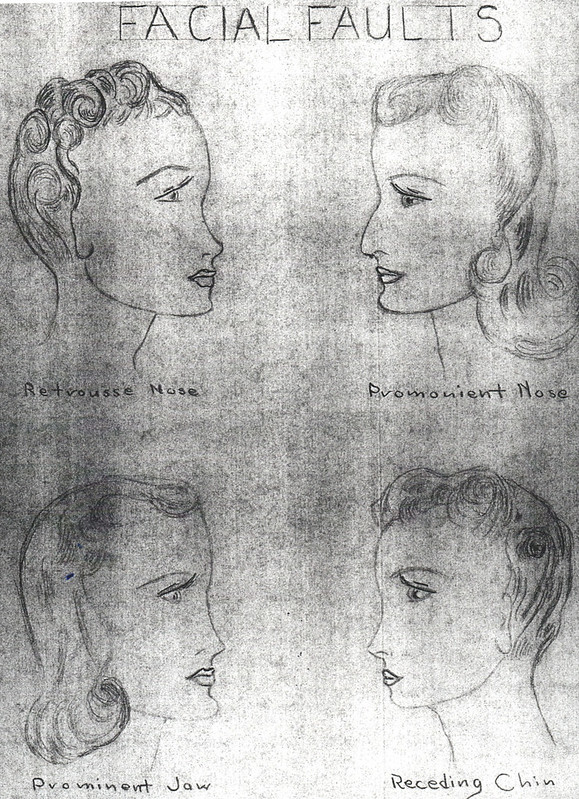
I want to conclude with one more sampling from Margaret's portfolio. I left it for the end because the quality of the image is poor, but in some ways it's my favorite page of the bunch. Apparently millinery students had to be aware of people's "facial faults":
Scan 8

(Extra-special thanks to Margaret Nagy for sharing her story with me, and to her daughter, Carol Chadwick, for making all of this possible.)

Wednesday, May 14, 2014

Click to enlarge

This carousel operator's license, which recently sold on eBay for $30, has several different levels of PermaRec interest. Let's take them one at a time:

1. Fascinating to see that carousel operators' licenses came under the jurisdiction of the NYC Building Department's Elevator Division!

2. You don't see many municipal licenses with photos anymore, at least not here in New York. Taxi drivers? Yes. And maybe barbers and some food handlers, too. But carousel operators? No way.

3. A bit surprising that the licensee, Howard Clayton, wore a jacket and tie for his mug shot. Not the typical disreputable-carny stereotype.

4. Here's where it gets really interesting: The carousel's address is listed on the license as 1000 Surf Ave. That's in Coney Island, and it was the location of Feltman's Carousel. "Feltman's" refers to Charles Feltman, the man who, according to most accounts, created the Coney Island hot dog around 1867. (Nathan Handwerker, who later founded Nathan's, actually got his start as one of Feltman's employees and slept on Feltman's kitchen floor.)

Anyway: Feltman eventually branched out from hot dogs and created a boardwalk empire of sorts at Coney Island, opening nine restaurants, a hotel, a beer garden, and several amusement rides — including a series of carousels. The biggest and best one, which opened in 1903, remained at 1000 Surf Ave. long after Feltman's death and was still there when Howard Clayton applied for that operator's license in 1962.

But it wasn't there for much longer. Feltman's Carousel was one of two Coney Island merry-go-rounds that were dismantled and then combined to create a new carousel for the 1964 World's Fair. That carousel, which includes 24 horses from the Feltman's ride, still operates today in Flushing Meadows Corona Park in Queens.

Feltman's Carousel's last year before being shut down and taken apart was 1963 — one year after Howard Clayton's license was granted. So Clayton was probably one of the last people to operate this historic ride, at least in its original incarnation.

That's a lot of info and history embodied in one random document from eBay, no?

(Big thanks to reader David Gratt for pointing me toward this one.)

Tuesday, May 13, 2014

When I was a kid, if I had contraband items that I didn't want my parents to see (dirty magazines, firecrackers, booze, etc.), I hid it in a secret spot in our garage. But why hide something in a garage when you can hide it a tree?

That's what someone apparently did in Vermont, where a crew of Earth Week clean-up volunteers recently found an old VHS cassette hidden inside the hollow of a tree. Inside the cassette were several military medals (shown above), along with some commemorative coins and a Civil War pay stub. As you can see, the medals were attached to little price cards, which suggests that they were stolen from a dealer.

The volunteers who found the medals turned them over to the local police, who in turn contacted the group Purple Hearts Reunited, which is devoted to returning lost military medals to their rightful owners. They were able to return one of the medals — Robert Gene Woody’s 1945 Good Conduct Medal — to Woody's son, Myron Gene Woody. It turns out that that Myron had a complicated relationship with his father and knows very little about his military service, so the medal will help provide a more tangible connection to that part of his life. You can get the full story here.

(My thanks to James Poisso for letting me know about this one.)

Monday, May 12, 2014

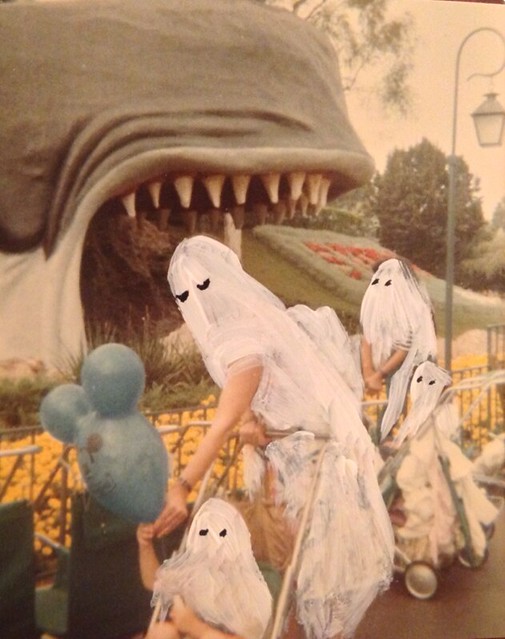
Last month I wrote about the artist Angela Deane, who acquires found snapshots and paints over the people in them to turn them into ghosts. Now I've become aware of another artist who repurposes found snapshots: Vik Muniz, a Brazilian who cuts up old photos and, as you can see above, creates new collage-based images out of them.

Muniz just had a gallery show here in New York, where I live. Unfortunately, I found out about it two days after the show ended — dang. You can learn more about Muniz at his website and at his Artsy page. Several more of his collage images are shown below (for all of these, you can click to enlarge):

(Special thanks to Heather McCabe for letting me know about this one.)

Wednesday, April 30, 2014

Photos by Chuck Miller; click to enlarge

The camera you see above is a Kodak Vest Pocket Autographic, a model that was produced from 1912 through 1926. Blogger and PermaRec reader Chuck Miller recently acquired it on eBay.

As you can see, the camera was inscribed with a series of etched notations. That's because the each Vest Pocket Autographic came with its own engraving pencil. The pencils were supposed to be used to write notes on the film, allowing the users to annotate their photos, but most people didn't bother with that and instead wrote notes directly on the camera case. You can see the pencil mounted at the bottom of the camera in this next photo, which also shows lots of additional inscriptions (click to enlarge):

If you look near the top of that last photo, you'll see the name "Frank D. Row" surrounded by a series of military locations. Miller (the guy who acquired the camera) figured Row must have had some sort of military connection and had charted his travels on the camera, sort of like a vacationer slapping place-themed decals on a suitcase.

Miller wanted to know more about Row and his travels with the camera, so he did some research and learned that Row served in the Red Cross during World War I and helped to establish a military hospital in France, among other things. Miller's research on Row and his unit turned up evidence that matches up with most of the places etched into the camera. You can read the full story here.

Row died in 1966, but the Red Cross chapter that he belonged to still exists, and Miller plans to return the camera to them shortly — a nice way for the camera to return home.

Miller sounds like a very PermaRec kind of guy. "For years, I've been trying to acquire cameras that have undeveloped film in them — maybe half a roll before the previous owner stopped taking pictures and the camera was lost," he says. "Unfortunately, in most cases the film is so deteriorated that it's undevelopable, or the company I sent it to that promised to develop rare film simply took my money and never gave anything back. So this Vest Pocket Autographic is the first time I've actually been able to get a camera that can tell its story."

Friday, April 25, 2014

Click to enlarge

As you can see above, a 1922 high school sophomore named Jennings Keffer liked to doodle. Those scribblings — and many more, as I'll show you in a minute — appear in an old Shakespeare text that was recently found at a bookstore by a music blogger who calls himself Devil Dick. Although the Shakespeare book has nothing to do with music, Devil Dick found the doodles so enticing that he decided to post them on his blog and try to find out more about Jennings Keffer.

So what sort of doodles did a high school fella create in 1922? Pictures of girls, for starters. And what kinds of girls would be of interest in 1922? Take a look (for all of these images, you can click to enlarge):

It's hard to express how much I love that. I particularly like the cigarette and the bells — scandalous! It's worth noting that while flappers were just becoming a pop-cultural phenomenon in the early 1920s, the term "flapper" has much deeper roots and was long associated with prostitutes, so the word may have had an extra forbidden-fruit quotient or with young Jennings.

Here's another set of doodles from the book:

The most interesting thing here, at least to me, is the pair of baseball drawings on the left side, because Jennings was coming of age at just the right time to be swept up in the national mania surrounding Babe Ruth. The Babe had set a single-season record by hitting 29 home runs in 1919 (the previous record of 27 had stood since 1884) and then completely changed the sport by hitting 54 homers in 1920 and 59 more in 1921. When Jennings was making these doodles in the spring of 1922, Ruth was at the peak of his larger-than-life celebrity arc, and baseball was coming into its own as a powerful cultural and economic engine. Even without televised games, it all must have been a very exciting time to be a teen-aged baseball fan.

If Jennings was a high school sophomore in 1922, that means he was probably born around 1906. Sure enough, Devil Dick did some research and determined that Sidney Jennings Keffer was born in 1906 in West Virginia and died in 1995 in Ohio. You can see Devil Dick's post about all this, including several more pages of doodles, here.

(My thanks to reader Jeff Ash for letting me know about this one.)

Thursday, April 24, 2014

On the left is a snapshot from 1933, showing a boy and girl hugging on a sunny day in Syracuse; on the right, a tissue paper collage based on that photo. The collage was done by the children's book author Eric Carle, who also happens to have been the boy in the original photo.

Carle, who's now in his 80s, was three years old when the photo was taken. Last November he told USA Today that he couldn't recall her name — only that she had been his friend and was the daughter of Italian immigrants. He said he had frequently looked at the photo over the years and wondered what had happened to her, so he created the collage based on the photo and used it as the cover illustration for his latest children's book, Friends.

That USA Today article from last November caught the attention of Syracuse Post-Standard writer Sean Kirst, who decided to see if he could track down the little girl in the photo. And now, thanks to some persistent research and a few lucky breaks, he's succeeded. (You can get more info on how he connected the dots here.) Not only has the little girl been identified, but she's still alive. She and Carle spoke on the phone last Sunday, and there's talk of a face-to-face meeting. Great stuff.

(My thanks to reader Anne McNelis for letting me know about this one.)

Friday, April 18, 2014

Photos from JillSobule.com

About a dozen years ago, the singer/songwriter Jill Sobule received a vintage charm bracelet as a birthday gift. She had no interest in wearing the bracelet ("not really my style," she would later comment) but nonetheless became obsessed with it. As she wrote on her website in 2012:

Who was the original owner? What did she do? I do know her name was Dottie, as there is a round engraved "Dottie" charm. ... She was not from a wealthy family — the 22 charms are pewter as opposed to silver or gold. She traveled domestically, gathering mementos from Florida to Mackinac Island to New York City. She played piano. She liked big, sculpted poodles. She liked cowboys. She was a working girl; there is an ABWA union (American Woman Business Association) charm and an office chair. She was Jewish — a mezuzah. I keep saying “was” [but] maybe Dottie is still alive. Who knows?

Totally Permanent Record, right? Sobule decided to use the charm bracelet as the organizing theme for a concept album: a dozen songs, each relating to one of the charms on the bracelet, forming a fictional (but plausible) composite view of Dottie's life. But she didn't write the lyrics herself. Instead, she enlisted a bunch of writers — mostly novelists and academics like Jonathan Lethem, Luc Sante, and Rick Moody — and had each of them write a set of charm-based lyrics. She then added the music. The resulting album, Dottie's Charms, is being released on vinyl this weekend (in conjunction with Record Store Day) and will be available digitally on May 5.

Interestingly, Sobule had already been contemplating a similar project before she hit upon the charm bracelet idea. At one point she had considered purchasing a random old high school yearbook on eBay and constructing a concept album around that. But the charm bracelet idea ended up working out better.

The collaborative nature of Dottie's Charms has echoes of the Significant Objects project, in which the writers (and my friends) Rob Walker and Josh Glenn acquired about 200 cheap thrift store items, assigned a writer to create a short story about each of them, and then auctioned off the objects and the stories on eBay. (The stories were later packaged into an excellent book.)

You can learn more about Dottie's Charms in this article, and Sobule will be playing a record-release party for the album on April 24 at City Winery in New York. As she recently wrote on her blog, "Maybe Dottie will show up."

Incidentally, a few years ago I considered writing a song about the Manhattan Trade School report cards that formed the basis of the Permanent Record project. I figured I'd write some lyrics (something I'd never done before), and I asked my friend Lianne Smith — a great singer/songwriter who also happens to be a big PermaRec fan — if she'd be willing to come up with the music and then add the song to her repertoire. She was agreeable, but I never came up with a full set of lyrics. Only managed to do the chorus, the bridge, and part of a verse. This is all a good reminder that I need to dust off that project.

Monday, April 14, 2014

I'm a big fan of prewar country blues, and of course I'm also a fan of artifacts with hidden stories to tell. So I was super-excited when I saw The New York Times Magazine’s cover story this past Sunday: a long-form account of writer John Jeremiah Sullivan's extended research-based attempts to find out something — anything — about Geeshie Wiley and Elvie Thomas, two female blues singers who cut six sides for Paramount in 1930. One of those six songs, "Last Kind Words Blues" (credited to Wiley, as you can see on the label, but with Thomas accompanying her on guitar), is embedded above. If you're not familiar with it, go ahead and give it a listen.

The six Wiley/Thomas sides have long enjoyed a fairly rarefied status among blues connoisseurs and scholars. But those same scholars have failed to turn up any information about Wiley or Thomas. The mystery surrounding the two women is underscored by how rare their recordings are. In the case of one of their records, "Motherless Child Blues" with "Over to My House" on the flip side, only two copies are known to exist.

Many researchers and scholars over the years have loved Wiley and Thomas's music and wanted to know more about them. But Sullivan — the author of the NYT Mag article — seems to have been particularly smitten with them after first hearing their music in 1994. His article details his increasingly obsessive attempts to unlock the stories of these women's lives, and I don't think it's giving too much away to say he ends up hitting a certain degree of paydirt by the article's end.

While the two blueswomen are the article's protagonists, there's another significant character worth mentioning: Mack McCormick (shown at right; click to enlarge), a Houston-based 85-year-old who is said to have the world's largest archive of original blues research content — interview tapes, transcripts, photographs, record company ledgers, birth certificates, death certificates, you name it. I qualified that with "is said to" because McCormick's archive is so massive and unruly (he calls it "the Monster") that even he isn't sure of what he has anymore, which has led some skeptical rival scholars to question whether he really has all that much to begin with. The fact that McCormick is afflicted with bipolar disorder hasn't helped either his reputation or his attempts to organize his archive while he's still alive.

McCormick, who I'd heard of before but didn't really know that much about, comes off as the most fascinating character in the article. Part field researcher, part folklorist, part cultural historian, and part nosybody, he's a white man who was born into a very segregated era and has devoted most of his life to investigating and documenting the history of early-20th-century black American music. At one point he took a job with the census and specifically asked to be assigned to a particular black precinct where he thought (correctly) he'd find lots of old musicians and old records.

But McCormick has become paralyzed by (or maybe victimized by, or even captured by) the scope and depth of his work. He supposedly knows more than anyone has ever known about the most famous country blues singer of all, Robert Johnson, but has been unable to write a book on Johnson — in part, one suspects, because of his mental illness, but also because he got in so deep that he can't create a coherent narrative. And the Johnson situation serves as a metaphor for the rest of his archive, which is uncatalogued and is likely filled with untold stories that could add to our understanding of blues history.

Sullivan's article spends a lot of time discussing McCormick. It seems clear that the two men have a complicated relationship that veers from mentor/acolyte to rivalry, and I wonder if Sullivan envisions — or worries — that one day he'll end up like McCormick, an old man who got so immersed in his life's work that he neglected to shape it into a functional legacy. It raises a question I've often thought about while working on Permanent Record: At what point do we devote so much time and energy to investigating past lives that we lose sight of our own? Or, maybe more to the point, does a fascination with past lives indicate a feeling of emptiness about one's own?

Such introspections notwithstanding, Sullivan's article is superb. Like all stories about the blues, it's also a story about race in America, and a really good one. It's also very, very Permanent Record. It's long — about 14,000 words — but it's absolutely worth your time. Lots of good audio and video content, too. You can check it out here, and there's a follow-up "story behind the story" piece here. Don’t miss.

Tuesday, April 8, 2014

I occasionally look for PermaRec-ish items on eBay and Etsy — old passports, old ledgers, old scrapbooks, that kind of thing. A week or so ago, for reasons I can't fully explain, I found myself thinking, "Hmmm, I wonder if anyone's selling old prescriptions?"

As you can see above, someone certainly was. In fact, as I soon discovered, there are a fair number of people on the internet selling old scripts. The two shown above are from a batch of 25 — all from 1959, mostly from the Kentucky/Tennessee region — that I purchased on Etsy for $3. (If that sounds like a good deal, you can get in on it, because the seller apparently has plenty more.)

Like any old documents, the prescriptions are evocative and feel like they have stories to tell. They've also raised all sorts of issues in my mind. For example:

1. PermaRec has often entailed some ethical concerns about violating people's privacy. I've usually been able to rationalize away those concerns, either because the people involved were likely deceased or because I convinced myself that the pursuit of an artifact's underlying story was worth the risk. But prescriptions feel different — they'd fall under doctor/patient confidentiality, no? And some of the people for whom these prescriptions were written may still be alive. So as you can see, I've blurred out the patients' surnames, which seems like the right approach to take, especially for a prescription like this one:

2. Somewhat related to the above: How did these scripts end up for sale on the internet to begin with? Wouldn't the pharmacy have disposed of them? Or did pharmacies keep paper prescriptions for their recordkeeping in the days before electronic records? The two holes on the left side of each script may indicate that they were all kept in a two-ring binder.

Still, even if the pharmacy kept them around for a bit, it seems surprising (at least to me) that they weren't eventually discarded. So I asked the Etsy seller how she obtained them. Here's how she responded:

The prescriptions came from a Hopkinsville, Kentucky pharmacy. I acquired them some time ago and sadly I don't remember where. However, I buy my inventory from auctions, estate sales, and antique shows, so it was from one of those. ... When I bought them they were in a vintage black pharmacy box with the date and record range on the cover.

I had hoped to pick her brain a bit more in a phone interview, but she declined my request. A pity.

3. Prescriptions are notorious for being rendered illegibly. But the batch I bought ran the gamut from schoolmarm-perfect penmanship to a few that looked like they were written by a caveman with crayon. The worst of the batch was this next one — even with the surname rewritten somewhat more legibly (presumably by someone at the pharmacy), I don't see any need to blur this one out:

4. Leaving aside the legibility factor, prescriptions often feature their own little alphabet of symbols, like the squiggle — which I believe is the symbol for ounces, right? — that appears twice on this one:

(Update: Longtime PermaRec supporter Kirsten Hively has pointed me toward a page that helps decipher old prescription symbology. Thanks, Kirsten!)

5. I was struck by how these 1959 scripts don't have any provision for renewals or generics.

And so on. I'm sure there are some doctors or other medically inclined folks among the the PermaRec readership, so please fill us in on some of the issues I've raised here by posting some info in the comments.

Meanwhile, now that I have the prescriptions, I don't really know what to do with them. Any suggestions?

Saturday, April 5, 2014

Photo by Stephanie Strasburg, Pittsburgh Tribune-Review

Chris Togneri, a writer for The Pittsburgh Tribune-Review, was recently doing some work on his 1890 house. While tearing out an old attic, he found a bunch of items, including the framed display of old century-old baseball cards you see above.

The cards are from the T206 series, which was produced from 1909 to 1911 — the same series that included the famous Honus Wagner card that's generally considered the most valuable baseball card of all time. Unfortunately for Togneri, the cards he found in the attic didn't include a Wagner, although they did feature several other Hall of Fame players. You can read more and see additional photos here.

My favorite part of that article is this passage:

[B]ecause of [the house's] age, it provides countless little treasures. ... While tearing water-stained walls out of the attic, I found old Pittsburgh Press clippings. While digging around in the backyard, I found a tombstone. (It did not come with a body, thankfully. After contacting the family, we were told that Barbara Tremel [the name on the tombstone] was buried in Reserve Township. They could not explain the duplicate tombstone, but were glad to take it off our hands.)

Wow! The baseball cards are cool, but a duplicate tombstone — that's much more PermaRec-ish! Indeed, what is a tombstone if not, literally, a permanent record? I wish Togneri had written more about that instead of relegating it to a parenthetical mention. (Update: For more on the tombstone, scroll down to Taha Jamil's comment below.)

(My thanks to Brian Justman for bringing this one to my attention.)

Thursday, April 3, 2014

MysteryMan1Final.jpg.CROP.original-original.jpg
Click to enlarge

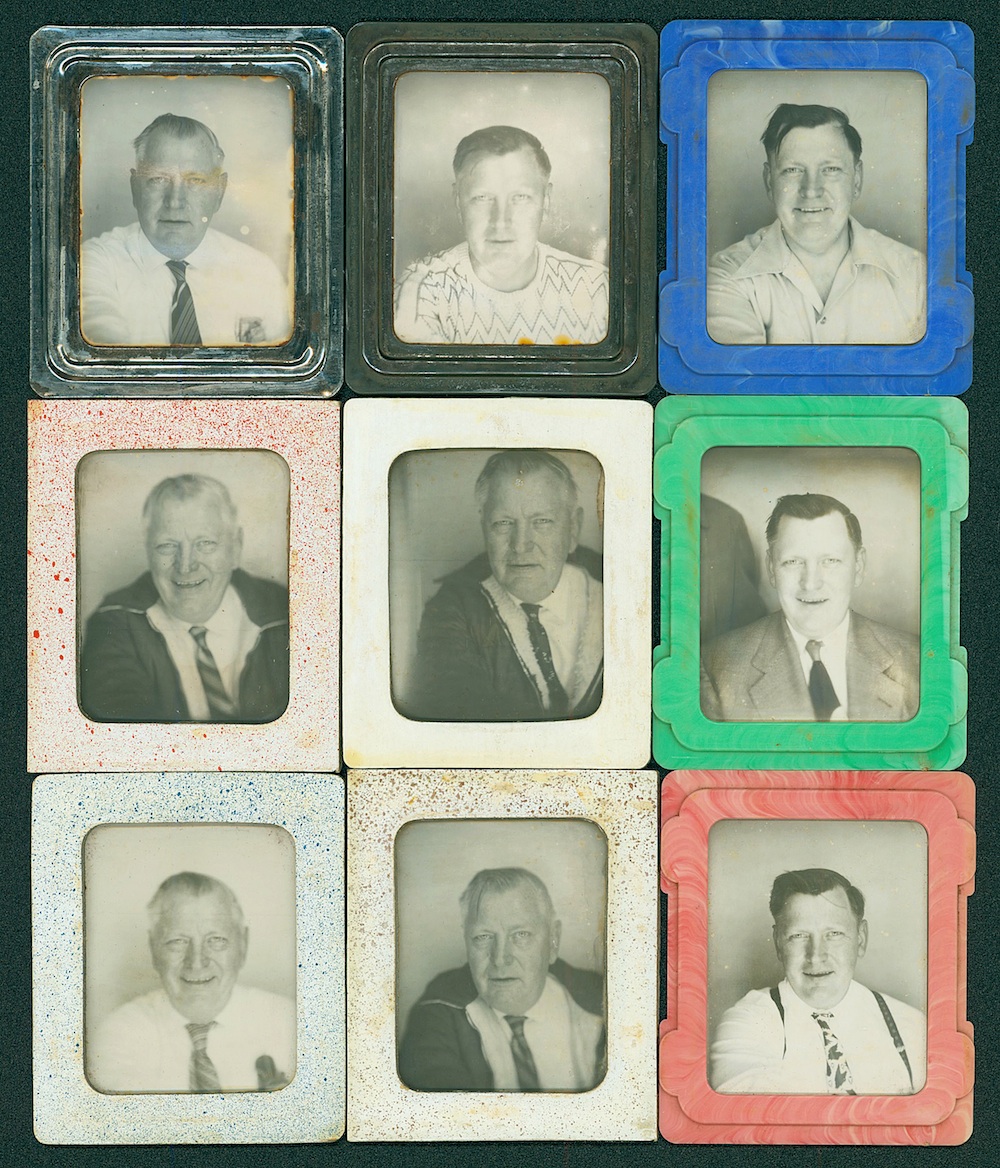
Lots of people this week have been calling my attention to the photobooth self-portraits shown above. They're nine images out of a collection of 445, apparently taken over the course of several decades, all showing the same man. The 445 images are currently being exhibited as part of a new art show about portraiture at Rutgers University.

I'm sure the whole exhibit is worthwhile — I hope to see it at some point this spring — but it's the photobooth images that are currently garnering the most attention. Writing at Slate, the history blogger Rebecca Onion did a good job of capturing their appeal:

The images are undated and unsorted, but you can make a mental game out of guessing how they might be organized chronologically. The man’s hair grows silver; his face gets craggy. In some frames, he smiles broadly — the grin of a kind uncle or grandfather.

The 445 photobooth shots are owned by historian Donald Lokuta, who purchased them from an antiques dealer in 2012. Lokuta has tried — so far unsuccessfully — to determine the subject's identity and why he took and saved so many photos of himself. Were the photos part of an art project? A neurotic obsession? Simple narcissism? It's a good PermaRec-ish puzzle, at least for now. Given the publicity the photos are currently receiving, I have a feeling this mystery will be solved fairly soon. (You can read more about the how Lokuta came to acquire the photos here.)

As an aside, the first person to tell me about the photobooth shots was longtime PermaRec supporter Kirsten Hively, who has a new blog about portraiture and self-portraiture, called Reflectology. She plans to use it as, among other things, a forum for portraits of herself (like many of us, she doesn't like how she looks in photos, so she's hoping all the portraits will help her come to terms with that). So far she's posted a self-silhouette and an x-ray. Not sure if she's planning to make it all the way to 445 or if she'll be content with a smaller number. Either way, it's a good start.

Tuesday, April 1, 2014

ghost.png
Click to enlarge

Permanent Record is all about uncovering the stories lurking within found objects. It's a determinedly fact-based approach, employing archival research to determine what really happened.

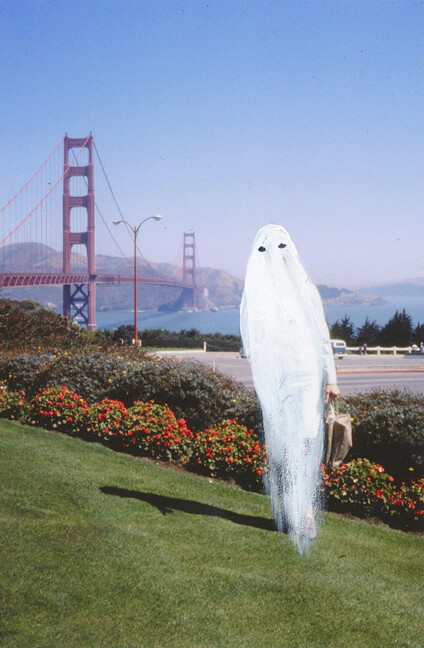
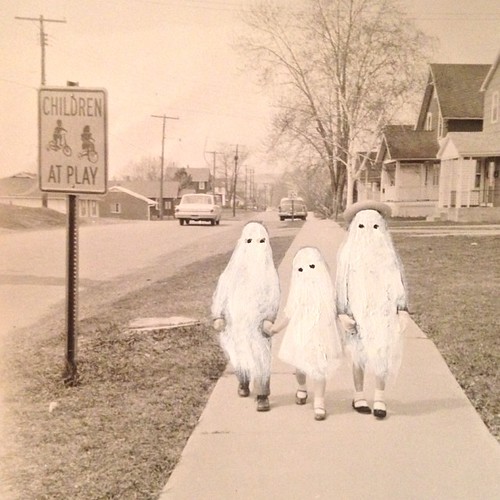
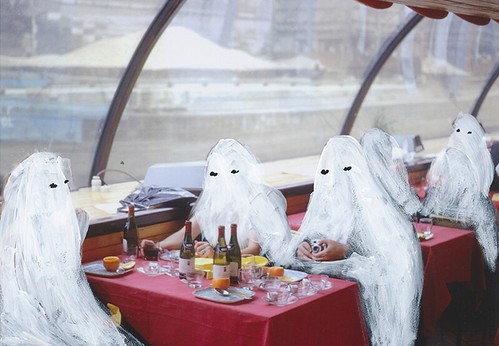
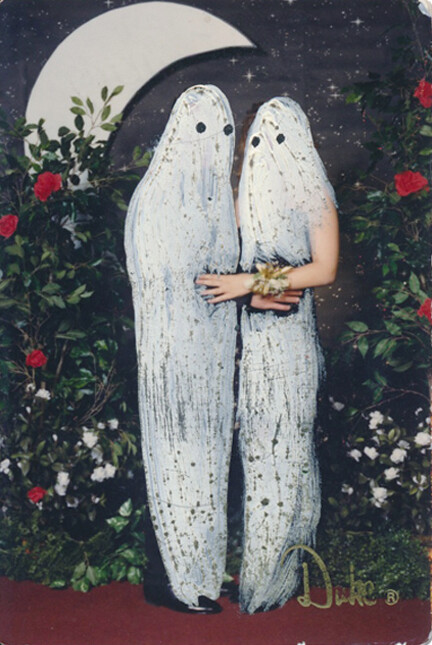
But found objects also provide lots of opportunities to spin fantasies about what might have been, or to project ourselves into other people's stories, or just to mess around with our perceptions of reality. That's the approach taken by the Florida-based artist Angela Deane, who has a very interesting specialty: She procures old snapshots and paints over most of the people in those photos, transforming them into ghosts. The resulting images, which she calls ghost photographs, can be seen on her Tumblr site (from which all the images in this PermaRec entry were taken).

Deane's response to found objects is obviously very different from mine, which is precisely why I find her project so interesting. It would never even occur to me to modify or alter an artifact like she does. But hey, that's why she's an artist and I'm a journalist, right?

In any case, Deane and I both find inspiration in found objects, so I wanted to learn more about her project. She recently agreed to answer a bunch of my questions via email:

Permanent Record: When and how did you decide to start this project? What was the impetus?

Angela Deane: I started it by a happy accident, really. In the fall of 2012 I had an artist residency in New Mexico. I had bought a bunch of photographs on eBay and at thrift stores, which I planned to use to create collages. When I spread out the photos in my studio, I started wondering what would it be like/mean/look like to paint a ghost over a photograph, to erase the particular of an identity or the ownership of an experience. And so I launched in.

Hours later I sat back and stared down at about 40 or so "ghosted" pictures and was blown away. I knew I was on to something.

ghost3

PR: Roughly how many ghost photos have you made? Have you posted all of them on your Tumblr site? If not, how many more have you done besides the ones on the site, and how do you decide which ones go on the site and which ones don't?

AD: I'm on about number 325. Only a handful are on the Tumblr site. Being fairly new to it, I'm taking my time and picking and choosing mostly on whim. Recently I've been sourcing photos based on themes (embraces, birthday parties, parades), so they may post in waves of these moods for some time to come.

PR: Where do you get the found photos? Like, do you hunt for them at flea markets? Did you already have a big stash of them when you started this project?

AD: My initial stash was probably about 100, sourced mostly from eBay and from some from thrift stores in Miami and other places in Florida. In New Mexico I met this guy who had a whole garage full of photos — he even had a deal with all the local thrift stores to give him any of the photos they received first — so I struck a deal with him and got to go through a lot of boxes out there. Got some great ones. I'm back south for the spring and summer, so I'll definitely be hitting up some flea markets! I'll be looking for some good vacation photos, I think.

ghost2

PR: How do you decide if a photo is "good enough" or "right" for being painted? Is there a particular type of scene (or feel, or whatever) that you look for?

AD: Mmmm, it remains much of a mystery why I choose the ones I do. In general I'd say I look more for color photos (black and whites make it a little more morbid; more about death, which isn't really how I think of them). I like snapshots. In essence they're just these little moments, generally when people are feeling good, are engaged with one another or with nature. I like those moments where you can feel a pulse in the inattention of what's taking place. Does that make sense?

PR: Why ghosts?

AD: There's a line from a Band of Horses song that goes, "We are the ever-living ghost of what once was." I think of these ghosts not as of people that have passed but each and every one of own experiences that has passed. How to hold memories has always been something that has provoked me to create lots of my art in life. Can we retain them as experiences or do they just turn into anecdotes?

These are intended as ghosts of moments. And in painting away the specificity of the people experiencing them, I like to think it opens things up for any of us to place or project ourselves into that space. They could be our memories now. Of course, that is what a life ends up to be — a collection of moments, experiences, memory — so ultimately I suppose it does grapple with mortality. But I don't think of them morbidly.

And I notice that the ghost photos make most people smile or laugh, which is great. I think the choice of the snapshots contributes to this. A writer on Flavorwire the other day described them as "ghosts having fun" and then did a riff on the whole celebrity mag thing and said, "Ghosts: They're just like us!" I loved it.

ghost4

PR: What paint (or white-out, or whatever) do you use to paint the ghosts?

AD: Mostly acrylic, sometimes gouache.

PR: How long does one of the photo paintings typically take you?

AD: Most of them take only about 30 minutes or so, but lately I've been doing some with upwards of 100 or 200 ghosts in them, and I spend a few hours with those.

PR: At first I thought you turned every person in each photo into a ghost. But then I saw you sometimes leave some people un-ghosted (like the people in the background of this shot). Is there a rule or system you use when deciding who gets ghosted and who doesn't?

AD: Not really; just a gut feeling. Sometimes I imagine myself as the un-ghosted people, looking on at the "ghosts" and "spaces to project other people in" and want to keep them intact so they can be more concrete witnesses to something magical happening. It gives a different focus to the ghosted characters. And once in awhile it's just as simple as finding their face simpatico, or liking their stance, and therefore wanting to leave them intact.

ghost6

PR: Do people send found photos to you to paint, either for commissions or just as a "I thought you'd like to have this" kind of thing?

AD: Yeah, I have a few commissions under my belt. I love doing them. This past December I had a show with F.L.A. Gallery and was put in touch with Amy Sedaris, who is crazy for ghosts and commissioned me to paint a bunch of family photos to gift to her siblings. Very cool!

PR: Have you had any other ghost photo gallery shows besides that one?

AD: Yeah, I've had a couple. The last was in Los Angeles at a friend's spot called "Matters of Space" in Highland Park. It was well-received and has brought me a couple projects in the works, which I can't get into yet but are very exciting. The F.L.A. Gallery show was also terrific and was so beneficial, as it was the first time I'd seen so many of the photos framed in a group rather than just in my studio.

PR: Have you ever tried to find any of the people in any of these photos, and/or has anyone ever told you, "Hey, I recognize that photo"?

AD: Only once, out in New Mexico! And actually I never painted over that photo because it's so great — an older man out in his front lawn, standing proud. Sometimes there are names written on the back of the photos, but I've never thought to Google anyone. Maybe I should..? Hope they'd be cool with being turned into spirits.

I also haven't done any personal photos of my own yet. But may do a few soon. Some goofy ones from junior high or something, maybe my softball team portrait.

PR: How long do you think this project will keep going?

AD: I keep getting nervous that I'm not "over" it yet. But I gotta tell you, my curiosity remains piqued with each one that I make. And they're just beginning to get out into the world to such a nice reception, which makes me feel okay for wanting to paint maybe 3,000 of these guys. These last few years I've been bouncing around cities (Miami, New York, Seattle, Gainesville), so the fact that these are so portable — very different from my larger-scale paintings — is pretty addictive.

PR: Any other thoughts about found objects?

AD: Just that I love them. Much of my décor is second-hand. I love the hunt of it, I love the slow meandering and contemplation of the hunt — it's never speedy. Stories that are embedded yet unknown, endless mystery in objects and a reminder that time just continues on.

ghost5

My thanks to Angela for answering all my questions. I was particularly struck by this passage from one of her responses: "How to hold memories has always been something that has provoked me to create lots of my art in life. Can we retain them as experiences or do they just turn into anecdotes?"

I totally relate to this notion of experience morphing into anecdotes. You start by experiencing something, and then proceed to remembering that experience. But if it's a memory that you tell or explain to others, sometimes the memory gets superceded by the telling and retelling of the memory, until you no longer remember the original experience — you just remember how you've told the story, like a script that you've internalized. Or at least that's what I've often found to be the case. Even the experience that gave birth to the Permanent Record project — the night I found the old Manhattan Trade School report cards at my friend Gina's birthday party in 1996 — falls into this category. I don't really remember much about that night anymore; what I remember is the countless times I've told the story about that night. That troubles me a bit, because it feels like the original experience has gotten lost along the way.

For those who want to see and hear more about Angela's work, here's a good video interview with her, which was produced in conjunction with one of her recent gallery shows:

(Extra-special thanks to Heather McCabe for bringing Angela's Tumblr site to my attention.)