Showing posts with label Licenses and Other Government Documents. Show all posts
Showing posts with label Licenses and Other Government Documents. Show all posts
Wednesday, May 14, 2014
Click to enlarge
This carousel operator's license, which recently sold on eBay for $30, has several different levels of PermaRec interest. Let's take them one at a time:
1. Fascinating to see that carousel operators' licenses came under the jurisdiction of the NYC Building Department's Elevator Division!
2. You don't see many municipal licenses with photos anymore, at least not here in New York. Taxi drivers? Yes. And maybe barbers and some food handlers, too. But carousel operators? No way.
3. A bit surprising that the licensee, Howard Clayton, wore a jacket and tie for his mug shot. Not the typical disreputable-carny stereotype.
4. Here's where it gets really interesting: The carousel's address is listed on the license as 1000 Surf Ave. That's in Coney Island, and it was the location of Feltman's Carousel. "Feltman's" refers to Charles Feltman, the man who, according to most accounts, created the Coney Island hot dog around 1867. (Nathan Handwerker, who later founded Nathan's, actually got his start as one of Feltman's employees and slept on Feltman's kitchen floor.)
Anyway: Feltman eventually branched out from hot dogs and created a boardwalk empire of sorts at Coney Island, opening nine restaurants, a hotel, a beer garden, and several amusement rides — including a series of carousels. The biggest and best one, which opened in 1903, remained at 1000 Surf Ave. long after Feltman's death and was still there when Howard Clayton applied for that operator's license in 1962.
But it wasn't there for much longer. Feltman's Carousel was one of two Coney Island merry-go-rounds that were dismantled and then combined to create a new carousel for the 1964 World's Fair. That carousel, which includes 24 horses from the Feltman's ride, still operates today in Flushing Meadows Corona Park in Queens.
Feltman's Carousel's last year before being shut down and taken apart was 1963 — one year after Howard Clayton's license was granted. So Clayton was probably one of the last people to operate this historic ride, at least in its original incarnation.
That's a lot of info and history embodied in one random document from eBay, no?
(Big thanks to reader David Gratt for pointing me toward this one.)
Tuesday, February 4, 2014
The passport you see above belonged to Marvin Gaye. Yes, that Marvin Gaye. It was found in an old LP that was recently purchased for 50 cents at a Detroit estate sale. It's not clear how or why Gaye's passport ended up in an old LP at someone else's house, but it's the score of a lifetime, the kind we all dream about finding at yard sales or flea markets.
Here, check out the full scoop in this short clip from a recent installment of PBS's Antqiues Roadshow program:
It's a little frustrating that the guy says the LP had been owned by "a Motown musician [who] had passed" and mentions that the musician had worked with Gaye, but he doesn't identify who the musician was. I realize this was probably out of respect for the deceased's family's privacy, but it still seems like a big piece of the story to leave out.
I was intrigued to hear the appraiser mention that passports represent a big collecting niche. I hadn't been aware of that, although it's not surprising once you take a second to think about it. So I went to eBay and searched on "expired passport" and "vintage passport" — pretty fascinating-looking stuff, right? As the Antiques Roadshow appraiser mentioned, the particularly appealing thing about a passport is that it tells you where its owner traveled, so you can construct a bit of a narrative. Seems very Permanent Record. I might need pick up a few of those and see where they lead.
Friday, May 18, 2012
Click images to enlarge
Sorry not to have posted anything in a while -- I've been busy working on the next Slate article. I'll have more to say about that in a minute, but first I want to tell you about a new batch of material I recently acquired.
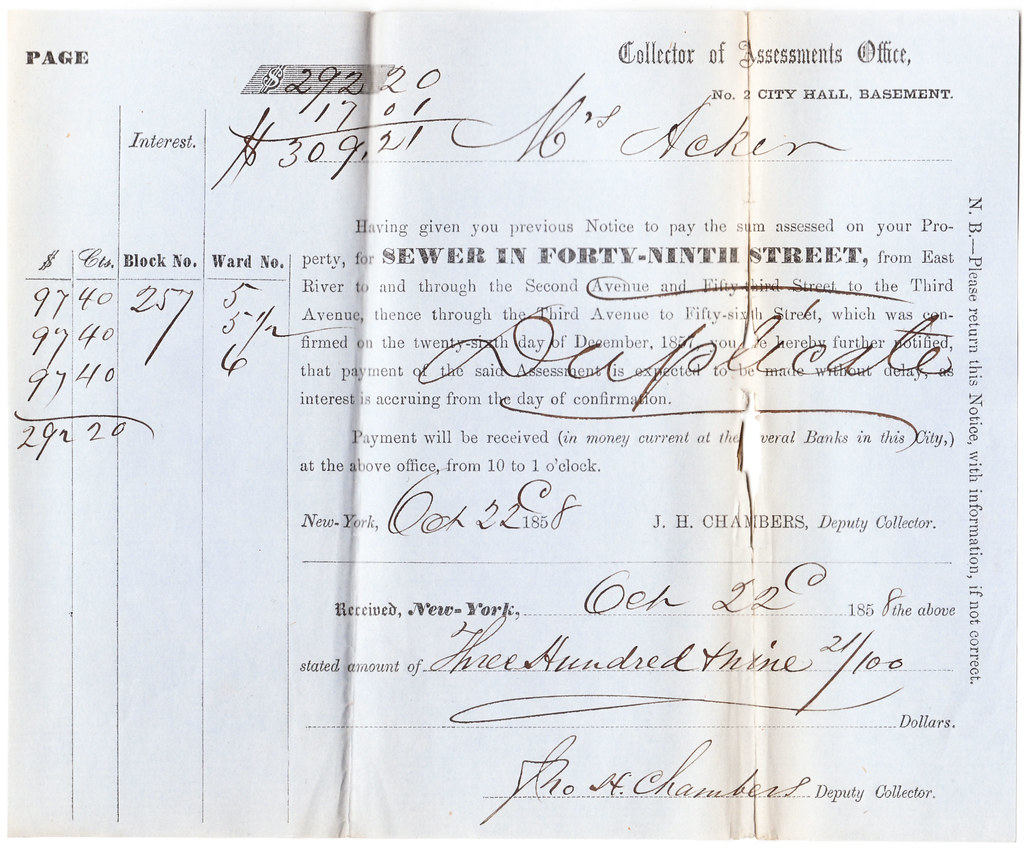
What you see above is a receipt for a New York City sewer assessment payment from 1858 and a New York City process server's affidavit from 1854. They're part of a big stash of mid-1800s legal documents, most of them pertaining to New York real estate, that my friend Amy Fritch recently gave me. Much like the old Manhattan Trade report cards, they're utterly compelling artifacts.
Amy found the documents some years ago while attending a party at a friend's offices in Chinatown (sound familiar?). "The office was in an old building that was in terrible shape and there was an entire room filled with old papers," she says. "Seriously -- floor to ceiling. Definitely a fire hazard."
Some of the papers looked interesting, so Amy took a few handfuls of them but didn't really know what to with them (again, sound familiar?), so she just kept them under her bed. Back in early 2010, when I was just getting started on the Permanent Record project, she brought out the papers to show me, and we spent a night oohing and ahhing over each other's artifacts -- me with my report cards, she with her legal papers, both of us saying, "These are amazing!" But I had forgotten about her papers until last month, when Amy moved away from New York and bequeathed the papers to me on her way out of town.
The papers are primarily from the 1840s, ’50, and ’60s.
The documents include deeds, titles, mortgages, receipts, invoices, legal opinions, etc. They're all rendered in beautiful fountain pen script, and some have raised and/or colored seals.
All of the documents were folded; after 150 years, the folds and creases are pretty strong, and a few of the folds have cracked. Aside from that, though, the documents are in surprisingly good condition. They had clearly been protected from light, and many of them look and feel almost like new, the folds notwithstanding.
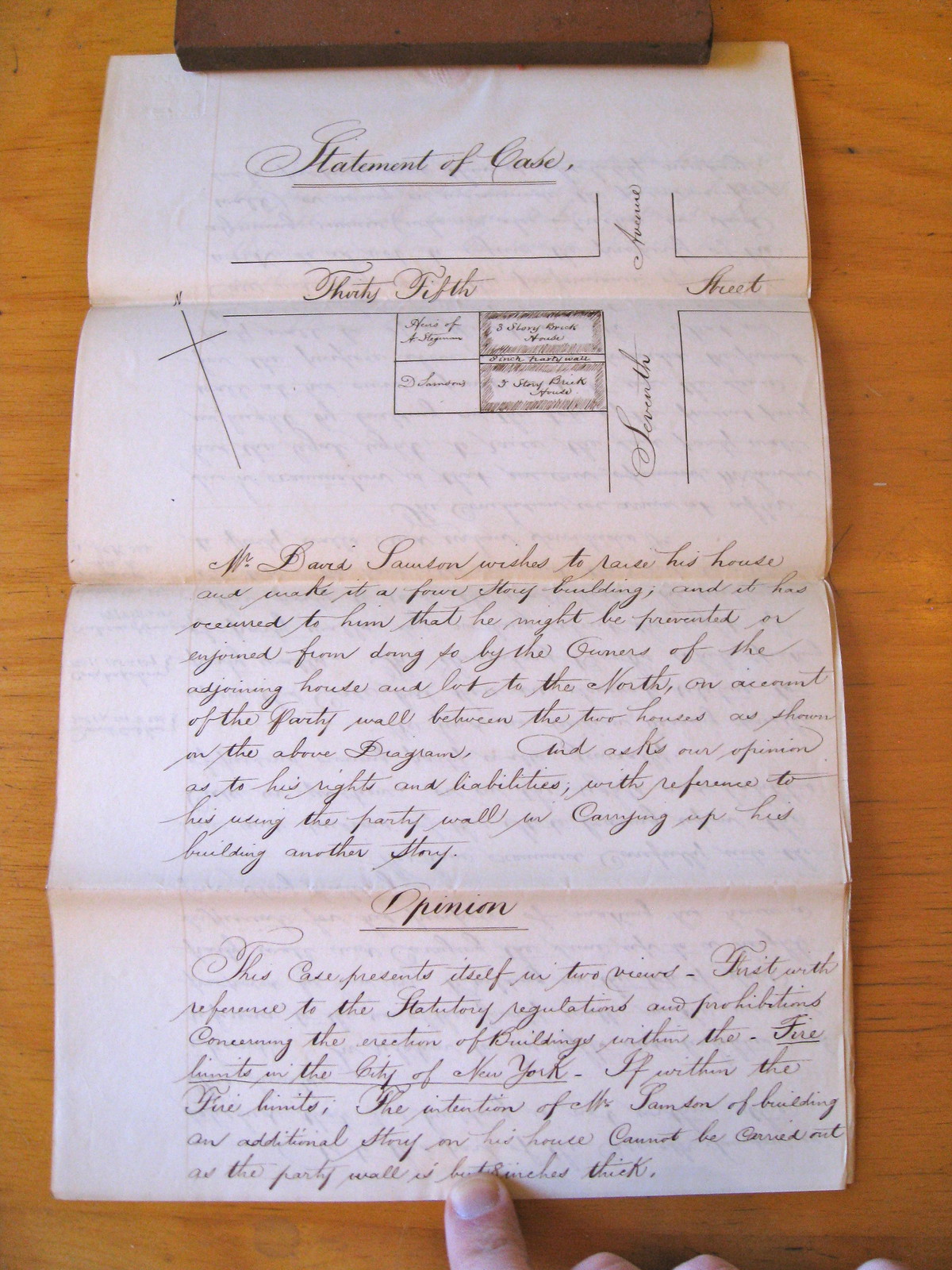
A few of the documents include little maps or diagrams showing the property being discussed. Here's a good example (click to enlarge):
In case you're having a hard time reading the handwriting, here's the opening paragraph:
Mr. David Samson wishes to raise his house and make it a four-story building, and it has occurred to him that he might be prevented or enjoined from doing so by the Owners of the adjoining house and lot to the North, on account of the party wall between the two houses as shown on the above diagram. And asks our opinion as to his rights and liabilities, with reference to his using the party wall in carrying up his building another story.
The full opinion goes on for several pages. Interestingly, if you look closely at the diagram, it indicates that the house north of David Samson's house -- the one with whom Samson shares the "party wall" -- is labeled, "Heirs of A. Stagman." And if you go back and look at the process server's document at the top of this blog entry, you'll see that the summons was served on behalf of David Samson, and that two of summons recipients were Andrew Stegman and Metta Stegman. (Perhaps the "Stagman" label on the diagram was a misspelling.) So the legal opinion iwht the diagram relates directly to the process server's document. I assume there are lots of other commonalities and groupings running through Amy's papers, but I haven't spent enough time with them yet to suss everything out.
I took some not-very good photos of some of the papers, which you can see in the slideshow below (or you can click here to see the slideshow at a larger size in its own window):
I hope to be able to tell some of the stories behind these papers, just as I've done with the report cards. But assessing legal documents is a lot trickier than assessing report cards (at least for me, since I have zero legal training). If anyone out there has the background, expertise, and enthusiasm to assist me with this, let's talk. Thanks.
+ + + + +
Slate update: The next Slate article should be published in a week or so (maybe right before Memorial Day weekend, or maybe right after), and I don't mind saying it's a doozy. It's about two Manhattan Trade students who lived remarkably parallel lives, from their childhoods on New York's Lower East Side to their careers in the fashion world -- careers that both included a significant brush with celebrity and an enduring impact on apparel design that's still being felt today.
Meanwhile, in another development, it's possible that Permanent Record may soon have a theme song. Can't tell you anything more than that for now, but I'll have further details soon, I hope.
To keep up to speed on all things relating to the project, sign up for the Permanent Record mailing list. You can join by sending me a note here.