Last year I wrote several times about old employee photo I.D. badges. That led to a very generous offer from PermaRec reader Karen Becker, who recently got in touch and offered to send me the I.D. badge shown above. It dates back to the late 1940s and belonged to a man named John Bobofchak, who was the husband of Karen's mother's aunt. I was extremely humbled by Karen's offer to share this family artifact with me — an offer that I happily accepted.
Karen provided some background on John Babofchak, as follows:
He lived at 3613 Cecelia Ave. in Cleveland, Ohio. He was married to Anna Tarnovsky. They had four children:
• George Bobofchak is about 92 and is living in Westlake, Ohio. His wife was Vicki (deceased March 20, 2008), and they had one son, John, who lives in Fairview Park, Ohio.
• Anne Agnes Gilak (nee Bobofchak) died on May 11, 2008, at the age of 81. She and her husband, Albert (deceased), had two children, Ron and Vickie.
• Edward Joseph Bobofchak died on Dec. 13, 2008, at the age of 76.
• Mildred M. Bobofchak, 77, is a retired schoolteacher living in Westlake, Ohio.
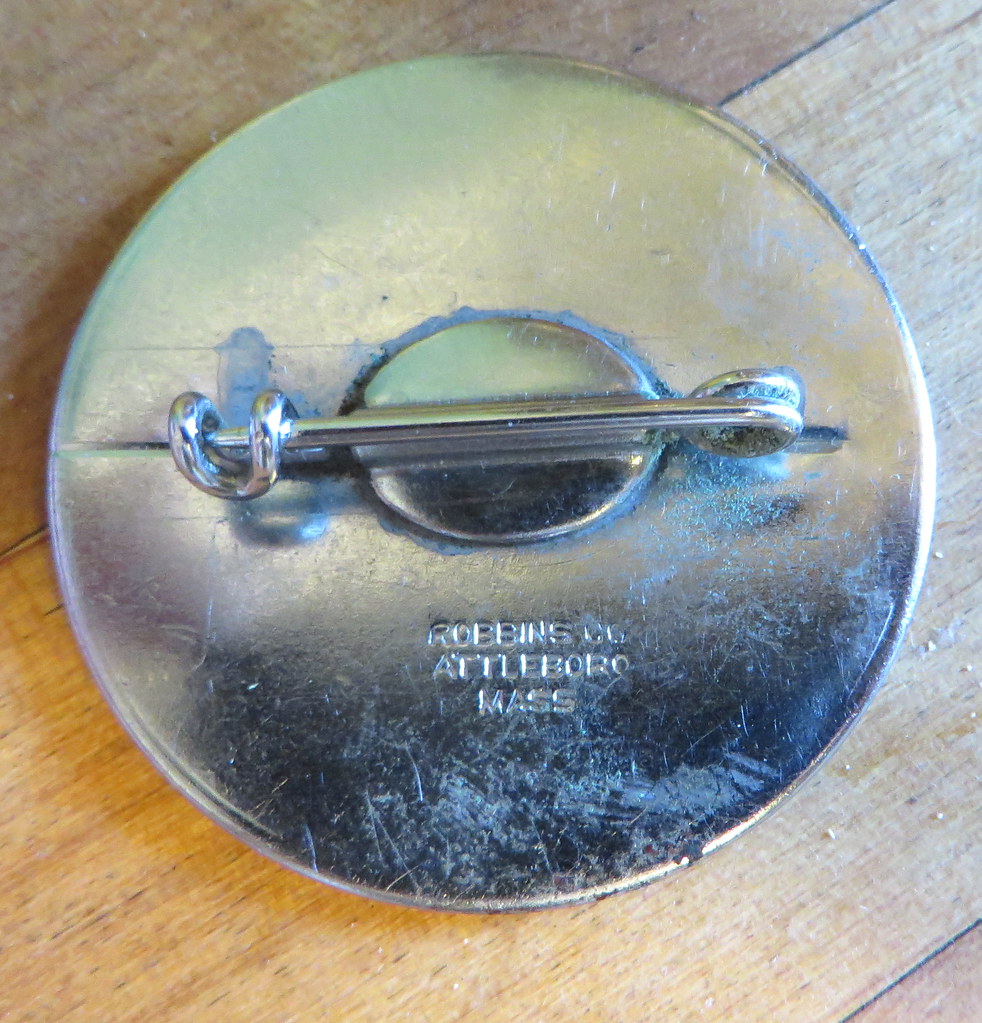
I acquired a few old photo badges last year and received a few more as a birthday gift, but this one is by far the nicest and in the best shape, and it's also the first one in my small collection with the raised metallic lettering. Badges of this style tend to fetch over $100 on eBay, which is too pricey for me, so I probably would never have held one in my hand if Karen hadn't sent me this one. It's an inch and three-quarters in diameter and weighs half an ounce -- a very satisfying little object.
The badge's manufacturer is stamped onto the back (click to enlarge):
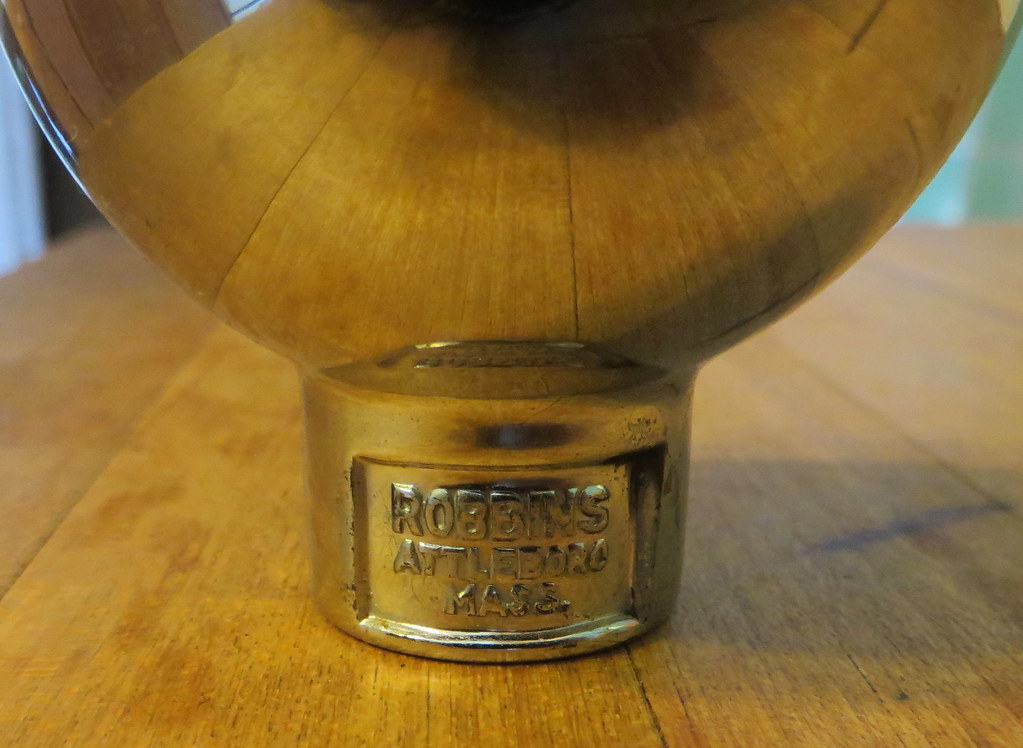
As it happens, I'm familiar with the Robbins Co. of Attleboro, Mass., because they used to manufacture another item that I collect: a particular style of beer tap heads (click to enlarge):
These tap heads, which are called "ball knobs," became popular in taverns across America in the 1940s. Much like the photo badges, they're very collectible and fairly pricey. The Robbins name typically appears on the rear-neck area (click to enlarge):
Robbins still exists today as a component of TharpeRobbins, a company specializing in employee-recognition awards. The original Robbins Company, which merged with Tharpe in 2007, apparently had a very colorful history that went way beyond producing employee photo badges and beer tap knobs. According to the company's corporate history page, Robbins also manufactured the medals for the 1932 Lake Placid Winter Olympics, the official Lindbergh Medal commemorating Charles Lindbergh's trans-oceanic flight, medallions used on NASA space missions, and more.
All of which leads to a question: Did Robbins employees wear photo I.D. badges back in the 1940s? If so, Robbins presumably manufactured those, right? That's now my holy grail: a vintage employee badge with "Robbins" handsomely spelled out on the front and stamped into the back.
(Extra-special thanks to Karen Becker for entrusting me with John Bobofchak's badge.)
Tuesday, May 27, 2014
I've written several times this spring about old employee photo I.D. badges. Now PermaRec reader Kirsten Hively has found one of those badges in an unusual place: the familiar "Rosie the Riveter" poster, shown above.
See that little pin on Rosie's collar? Looks like an employee I.D. badge, right? I've looked at that illustration a gazillion times but had never noticed the badge until Kirsten pointed it out to me the other day. Let's take a closer look at it:
It's a Westinghouse Electric employee I.D. badge! That makes sense, because the Rosie illustration was commissioned by Westinghouse's War Production Coordinating Committee, which was looking to inspire the company's female workforce. You can learn more about that here and here. (Those links also explain why the it's actually a misnomer to refer to the poster as "Rosie the Riveter," but I'm going to keep calling it that for now, because it's a convenient, easily understood shorthand.)
The Rosie image has been adapted, copied, and repurposed countless times over the years. Some women taking inspiration from the image make a point of including the I.D. badge while others don't bother with it. Maybe those in the latter category were using this "How to look like Rosie" guide, which doesn't include the badge.
And here's someone who flopped the original orientation of the Rosie image and then Photoshopped her own face onto it, apparently not realizing (or caring) that the "Westinghouse Electric" lettering on the original badge would appear backwards on her flopped version.
Did Westinghouse Electric really have badges like the one shown in the illustration? They sure did. Not only that, but some enterprising soul on Etsy has used that badge design as the basis for a replica Rosie I.D. badge. (They also offer the same design as a zipper pull, but come on — that's cheating.)
(Big thanks to Kirsten Hively for spotting Rosie's badge.)
Thursday, March 27, 2014
Researcher extraordinaire Bill Maselunas has once again tracked down the details on a photo I.D. badge employee. This time it's Fred H. Talbot, whose badge is shown above. (If you're new to the photo I.D. badge scene, you can see how I first became fascinated by the badges here, and you can see the results of Bill's two previous badge research efforts here and here.)
Here's what Bill managed to find regarding Fred Talbot:
This guy proved to be somewhat enigmatic in his adult life. Also, the research was complicated by the fact that Googling for "Fred Talbot" yields a lot of hits for the Major League Baseball pitcher of the same name and a British weatherman who was recently rung up on some unfortunate charges. Finding our Fred Talbot means eliminating a lot of results for these two guys, which can be tiresome.
I've patched together bits and pieces from a bunch of sources, including user-created family trees from Ancestry.com, which are hit-and-miss in the accuracy department. So, lacking other rock-solid sources, I took people at their word and made a couple of guesses based on hunches below, which seem to be correct, but it's hard to be sure. Here we go:
• Born Fred (or Frederick) Parker, March 31, 1912, to John P. Parker and Maria Hortensia "Hortense" Quesada (1893-1994), also known as Maria Hortensia Quesada Aguirre Velton. Her secondary name, taken when her mother remarried, turned out to be a clue in finding Fred's place of birth (see next point).
• Fred's place of birth on census records is always listed as California. In California birth records on Ancestry, there's an entry for March 31, 1912, in Orange County under "Jno. P. Parker," with the mother's name listed as "Felton." It's not uncommon for the father to be listed in birth records of that era, and the misspelling of his mother's name would seem to be an easy one to make. That was hunch No. 1.
• Hortense married Clyde Edwin Talbot (1895-1992) on Sept. 12, 1917, in Ray, Arizona.
• Fred's middle name and initial are listed inconsistently, depending on the source. Sometimes he is "Fred E." and sometimes "Fred H." The 1945 Tacoma City Directory lists his occupation twice, once as "artist" and once as "draftsman TPS." I suspect "TPS" was for "Todd Pacific Shipyards," as shown on his badge. That was hunch No. 2.
• Sibling Lorraine H. (Parker) Talbot was born about 1915 in Ray, Arizona, and June 1978 in Washington. Unknown if she was married or had children.
• Half-sibling Clydelle Rae Talbot was born on Aug 16, 1918. in Ray, Arizona, and died on Nov. 27, 1989, in Tacoma, Washington. Married Hugo Smith (1914-2000) on May 10, 1938, in Port Orchard, Washington. Three children: Sharon Rae Smith, William T. Smith, James J. Smith.
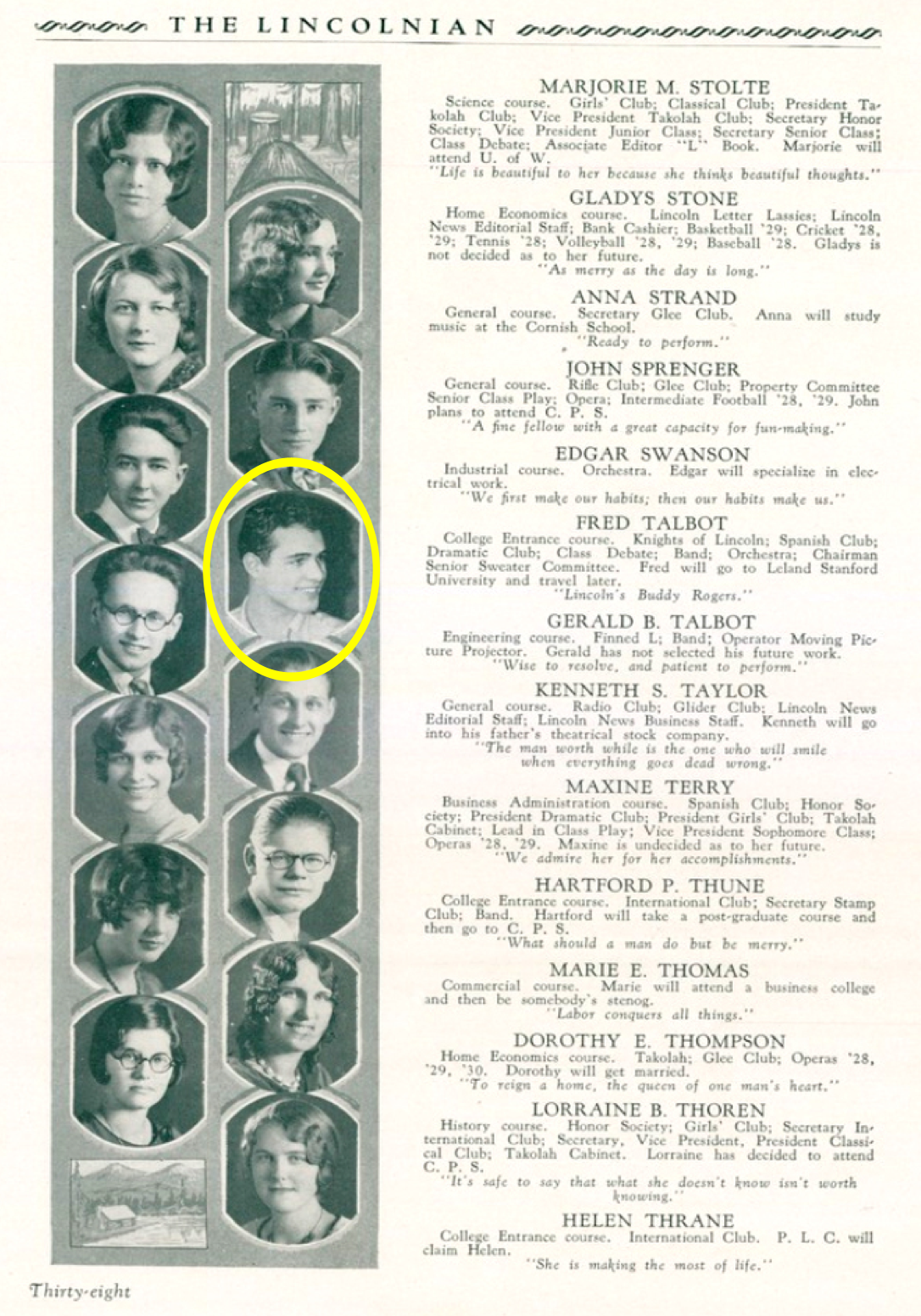
• Fred attended Tacoma Lincoln High School, class of 1930, as seen in this yearbook page [click to enlarge]:
• His yearbook entry said he was planning to attend "Leland Stanford" University, but a search of the 1934 Stanford yearbook shows no Fred Talbot. Did he not actually go? Did he go but not graduate?
• His yearbook entry hints at his artistic side, calling him "Lincoln's Buddy Rogers." This is backed up by a clipping from The Tacoma Times that describes his furniture making and designing of theater sets:
• Unknown if he ever married or had children. Searches have turned up no obituary, though I have a request in with the Tacoma Pierce Genealogical Society to see if they can find one. Stay tuned.
• Died July 14, 1994 in Seattle. Burial unknown.
• I identified one living relative: Sharon R. Housiaux, a niece, in Puyallup, Washington. I attempted to contact her by U.S. mail but never heard back.
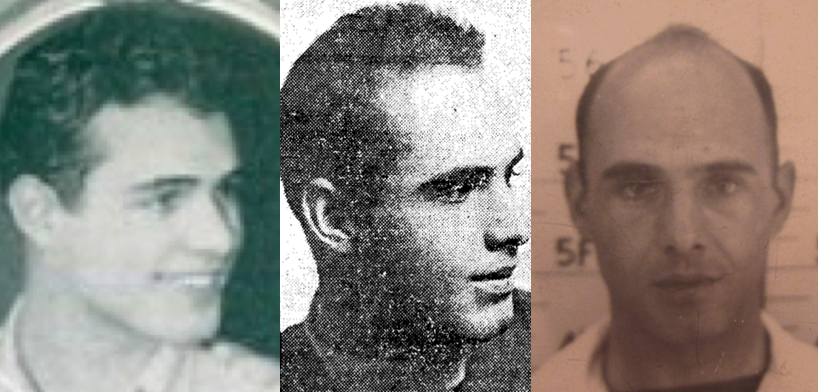
Great work again, Bill. I like how we can see the progression of Fred's facial development from yearbook to newspaper article to employee badge (click to enlarge):
But dang -- yet another badge employee for whom we can't find a living relative. Maybe next time.
Saturday, March 22, 2014
About a week ago I posted about how reader Bill Maselunas had tracked down the history of the person shown in one of the photo I.D. badges I've recently been obsessing over. He's now done the same for the badge you see above. (If you missed the entry in which I introduced the topic of employee photo badges and want to get caught up on that, look here.)
Bill did all the heavy lifting here, so I'll turn this over to him:
I'm fairly certain the person shown on this badge is Alyce Katheryne Stephenson of West Chester, Ohio. The unusual spelling of Alyce's name made the research somewhat easier than it might otherwise have been (although in some places it was recorded as "Alice"). Here's what I discovered about her:
• She was born Alyce Katheryne Stephenson on Jan. 10, 1910, in Butler County, Ohio, to Samuel James (1883-1956) and Anna Katheryne (Dietiker) Stephenson (1890-1948).
• Sibling Samuel Wilbur "Bud" Stephenson was born on Sept. 30, 1914, West Chester, Ohio; died on June 26, 1935, in West Chester, Ohio; buried in West Chester, Ohio. Appears to have died tragically from an accidental, self-inflicted gunshot wound on his farm. Never married.
• Alice resided in Butler County, Ohio, for most of her life and lived in Sharonville (the location of the facility that issued her employee badge) at the time of her mother's death in 1948.
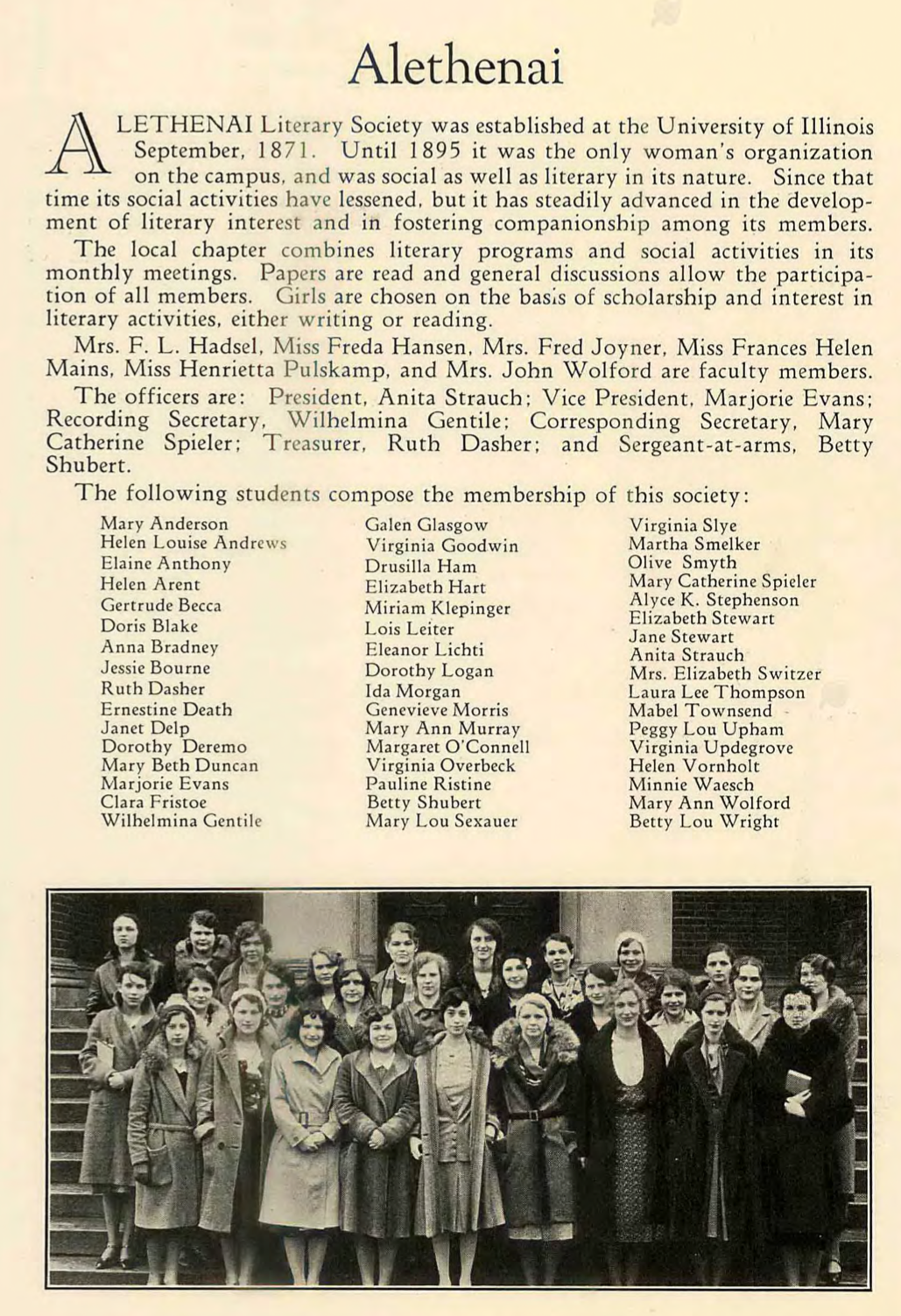
• She attended Miami University of Ohio, Class of 1931. She's shown at the bottom-left corner of this page from the school's 1931 yearbook [click to enlarge]:
As you can see, that yearbook page used an unusual variant of the spelling of her first name. But the spelling shown on her employee badge was used on this next page, where she's listed as a member of a campus women's organization. She may also be among the students shown in the group photo at the bottom of the page [click to enlarge]:
Although her employee badge was issued by the Sharonville Engineer Depot, her primary career appears to have been as a teacher and educator. She was teaching at Princeton High School in Cincinnati in 1960, and her Ohio Death Record lists her occupation as an elementary school teacher. She is cited as a contributor in this course guide.
• She died on July 21, 1996, in Mongomery, Ohio, apparently without having married or having had children. No survivors were listed in her obituary:
• Her father, Samuel, worked for various railroads, which may explain Alyce's apparently temporary employment at the Sharonville Engineer Depot, a major railroad and industrial center. It's a little hard to figure out when she worked there and why. Was it during her college summers? Part of the war effort? Given that she worked in academia all her life, it's a bit baffling to me that she would have worked there at all.
Speaking of the Sharonville Engineer Depot, it was built in 1942 by the U.S. Army Corps of Engineers to stockpile strategic metals (magnesium, titanium, zinc, etc.). The site was occupied from 1942 to 1949 by the Air Force. Of the original 603 acres, approximately 50 comprise the current Sharonville Engineer Depot, now occupied by the Defense Logistics Agency, which operates a facility known as the Sharonville Depot Defense National Stockpile Zone. The site was investigated by the EPA in the 1980s and 1990s for contaminated soil and water, but no remedial actions were taken. Some further information about the facility is available in this discussion board thread.
Research thanks to Samantha Loopstra from Ohio's amazing "Know It Now" program, available at Ohio public libraries, and to Jennifer Rusche, Reference Librarian at the Public Library of Cincinnati & Hamilton County.
Another great research job. The only downer is that Alyce doesn't appear to have any descendants we can contact. The same was true of Martha L. Cannaday, the previous badge employee Bill had researched. I'm hoping we'll eventually be able to track down a living relative of one of the badge subjects. And with that in mind, I'm happy to report that Bill is already working on another badge history — stay tuned.
Sunday, March 16, 2014
Click to enlarge
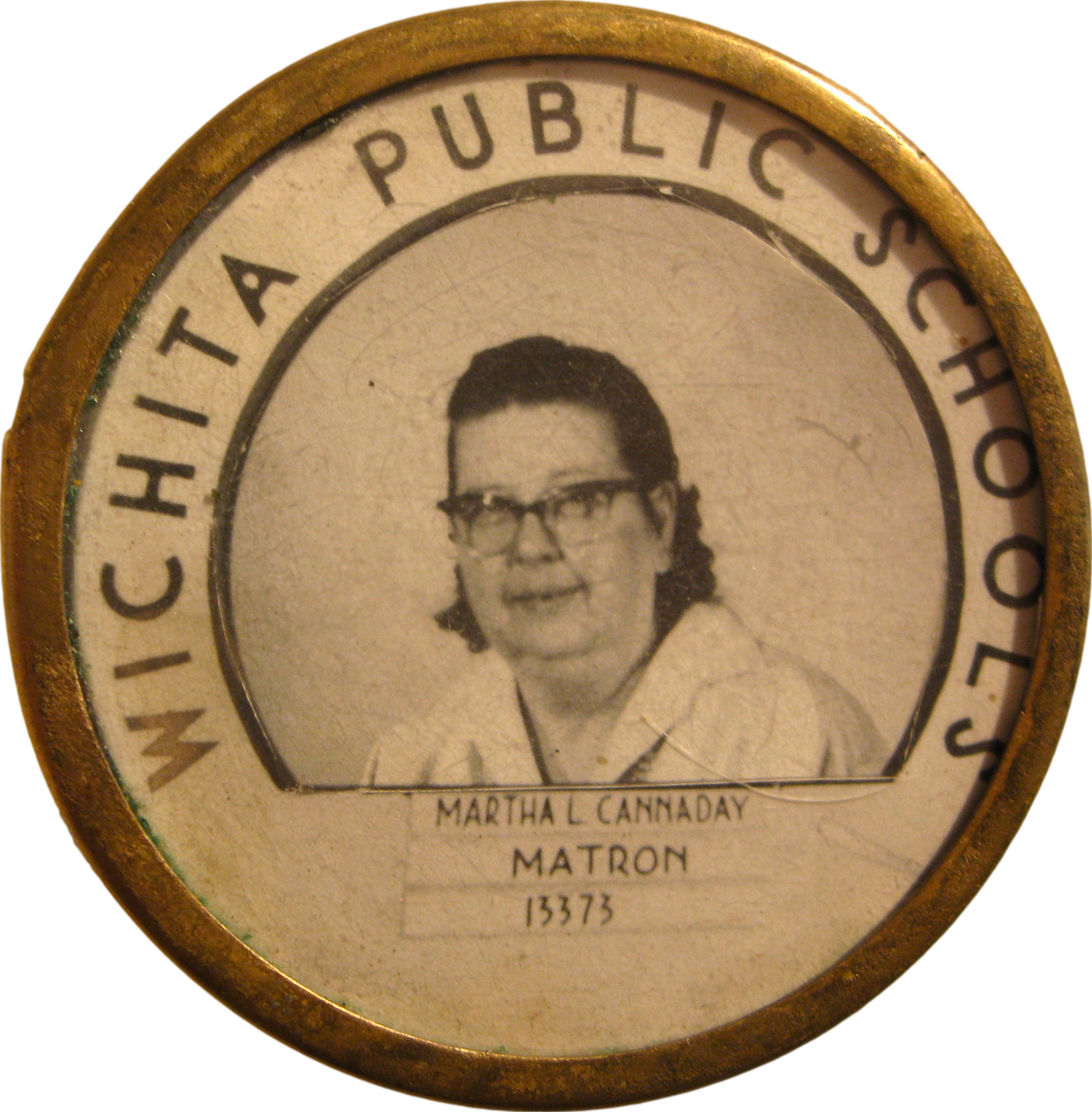
I recently posted an entry about my newfound interestfascination obsession with old photo employee I.D. badges. At the end of that entry, I invited PermaRec readers to contact me if they wanted to try to suss out the stories behind any of the badges. Reader Bill Maselunas promptly volunteered to work on the one shown above, for a Wichita school matron named Martha L. Cannaday. Her badge is among the 250 that were recently exhibited at the Ricco Maresca Gallery in New York.
Before we get to Bill's findings, I should mention that Martha's badge was one of my favorites from the gallery show, and I wasn't alone in that regard — several PermaRec readers mentioned it as one of their favorites when I first wrote about the badges earlier this month. At the risk of being disrespectful to Martha, it seems pretty obvious that a big part of her badge's power is the pathos in her portrait and the way her job title — "Matron" — mirrors her matronly appearance. The discomfort I felt when writing that sentence (which you may also be feeling now that you've read it) is the karmic payback that comes with examining artifacts like the badges: We get a little voyeuristic thrill from these glimpses into other people's lives, but we also feel a bit of shame for violating their privacy and making superficial and sometimes condescending judgments about them.
So I was happy when Bill chose Martha's badge as his volunteer research project, because I wanted to be able to know more about her as a human being, not just as a mug shot on a badge. Here's Bill's report on what he found:
This has been a bit of a challenge, because Kansas has not made a lot of its public records and vital statistics available online. But Martha Cannaday is mentioned by name in this Find A Grave entry. That led me to lots of additional information, which allowed me to piece together the following:
• She was born Martha L. Tomlinson, April 27, 1919, in Kansas, to David Tomlinson Jr. and Mildred Chadbourne Tomlinson.
• Sibling Myrna M. Tomlinson was born March 22 1909, in Kansas. A nurse and a lifelong bachelorette. Died Oct. 1, 1985, and buried in Garfield Cemetery, Garfield, Kansas.
• Sibling Betty Jean Tomlinson was born June 10, 1924, in Garfield, Kansas. Died March 1, 2005, and buried in Garfield Cemetery, Garfield, Kansas. Was married to William Roy Kitchens (1923-1984). No kids that I have been able to find.
• My guess as to the date of her Wichita Public Schools badge is in the 1940s or ’50s. I've reached out to both the Wichita Public Schools and the local school museum, but no luck in tracking down any record of her employment. Her role as "matron" would basically have been that of a head nurse, which makes sense, given that her sister was also a nurse. I've checked the Wichita high school yearbooks that are available online, but again no luck.
• She died on April 19, 2007, in Kansas — likely Wichita. Garfield cemetery sexton Ray Wetzel believes he recalls a simple ceremony, attended by a single relative, with no obituary and no headstone placed. His recollection is that there was talk of buying one, but it never materialized.
• Her last known address was 5111 Funston St. in Wichita, an address shared by her sister Betty Jean, which leads me to believe they may have lived together after the deaths of their husbands.
• Martha and her sister Betty Jean both lived in Colorado at one point, perhaps in the Pueblo area. Their Social Security numbers were both issued there.
• The identity of Martha's husband is a mystery so far. Part of the problem is the inconsistent spelling of the surname. Depending on where one looks, it might be Cannaday (as shown on the badge), Canaday, Cannady, Canady, and others. This makes it somewhat challenging to say with any certainty which Cannaday is which. There are numerous male "Cannadays" of about the right age in Kansas in 1940, when Martha was still unmarried, but none in the immediate vicinity of Garfield, where the Tomlinsons (her family) lived.
• No children yet identified.
This pretty much exhausts the online resources. I have a request in at the Wichita Public Library to scan some old phone books and other records, but that could take some time.
Wow — no headstone, few if any descendants, one sister a spinster and the other a childless widow who became her roommate. If anything, this just adds to the pathos. But we still don't know about Martha's husband or marriage, and I'm hoping those provided some joy in her life.
Huge thanks to Bill Maselunas for his excellent research work (and Bill in turn wants to thank Ed Carlson, the curator of the findagrave.com pages for the Tomlinsons, and Ray Wetzel, the sexton at the Garfield Cemetery, for their assistance). Meanwhile, if anyone from Wichita can help us fill in some of the blanks regarding Martha and her family, please get in touch. Thanks.
Wednesday, March 5, 2014
Photos by Ricco Maresca Gallery
I have a new obsession, and it's very PermaRec-ish. It's going to take a while to tell the whole story, so please settle in and bear with me.
It all started in January, when my friend Jack told me about a cool-sounding exhibit at the Ricco Maresca Gallery in Manhattan. The exhibit featured 250 vintage employee photo I.D. badges, primarily from the 1930s, ’40s, and ’50s. These were badges that many companies used to require their workers to wear for identification purposes, just as many employees nowadays have to wear laminated I.D. cards around their necks.
Vintage photo badges had never been on my radar before, but I immediately saw their appeal. For starters, they're beautiful little objects. They're also a great source of vernacular photography and portraiture. The tiny I.D. head shots offer a rich cast of faces offering a full range of humor, pathos, menace, and more, just like the head shots on the Manhattan Trade School report cards that gave birth to the Permanent Record project.
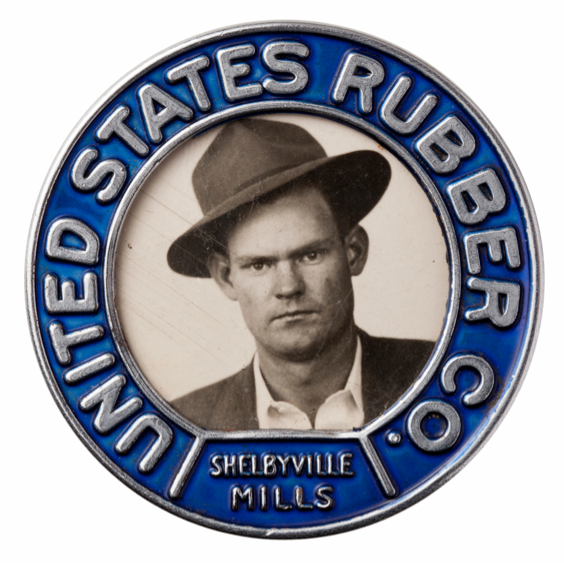
Also, the badges capture and evoke a very industrial, manufacturing-y sense of America's bygone production economy. Part of this is because many of the badges were used by industrial companies, but it's also because the badges themselves feel like industrially produced objects — a very satisfying parallel that you can see in, for example, these two badges:
The badges also reflect certain realities about the American workforce of generations past: The overwhelming majority of the photos show employees who were white and male. This isn't surprising, but it's still interesting to see.
Best of all, though, the badges represent a mother lode of stories waiting to be told. Who were these people? How did they come to be working for these companies? Were the photographers professional studio cameramen, or were they just "the guy who takes the head shots" at each company? What happened to the companies (most of which are now defunct)? Were there certain manufacturers that specialized in making the badges? And how did the badges become available on the collectibles market — like, did the employees keep them when they retired and then the badges became available at estate sales when the employees died, or did the companies keep the badges and then the badges found their way to vintage dealers after the companies went belly-up?
It took about two weeks until I was free to go check out the exhibit. But during those two weeks I became increasingly obsessed with photo I.D. badges. As I quickly discovered, there's a brisk market for them on eBay, where they can usually be found by searching on "employee photo badge" and "worker photo badge." Perfect, I thought — I'll buy a few of them and start a little collection. Unfortunately, as I also discovered, they tend to sell for at least $50, and often for considerably more than that. That was more than I was willing to spend, especially for such small items. (I mentioned this to my friend Robin Edgerton, who's very knowledgeable about various collecting subcultures. "You used to be able to get them for around $10 each," she told me, "but they went through a collector's frenzy the last few years and have gotten pricey." Dang.)
But if I couldn't afford to collect the photo badges, I could at least collect photographs of them. So I spent a few days downloading over 100 badge photos from assorted eBay auctions, just so I could look at them, study them, obsess over them. Here's the gallery I ended up with (if the slideshow below doesn't work for you, or if you'd rather see the photos as a gallery instead of a slideshow, click here):
As I looked at more and more of the badges, one thing that occurred to me (and is probably occurring to you) was that many of the employee photos looked like police mug shots. More specifically, they reminded me of the photos in Least Wanted, Mark Michaelson's amazing 2009 book of vintage police mug shots. It had been a while since I'd poked around Michaelson's Flickr page, where he posts his latest mug shot acquisitions, so I went there and discovered, to my surprise, that he has a set of employee badge photos. As I clicked through them, I saw that in 2010 another Flickr user had asked Michaelson, "Where on earth do you find them all?," to which Michaelson had responded, "I've been getting them from eBay from time to time for years now. I think I have a couple hundred." Well, at least I was on target when I saw the commonality between the mug shots and the badges, but I also started realizing that I was very late to this party.
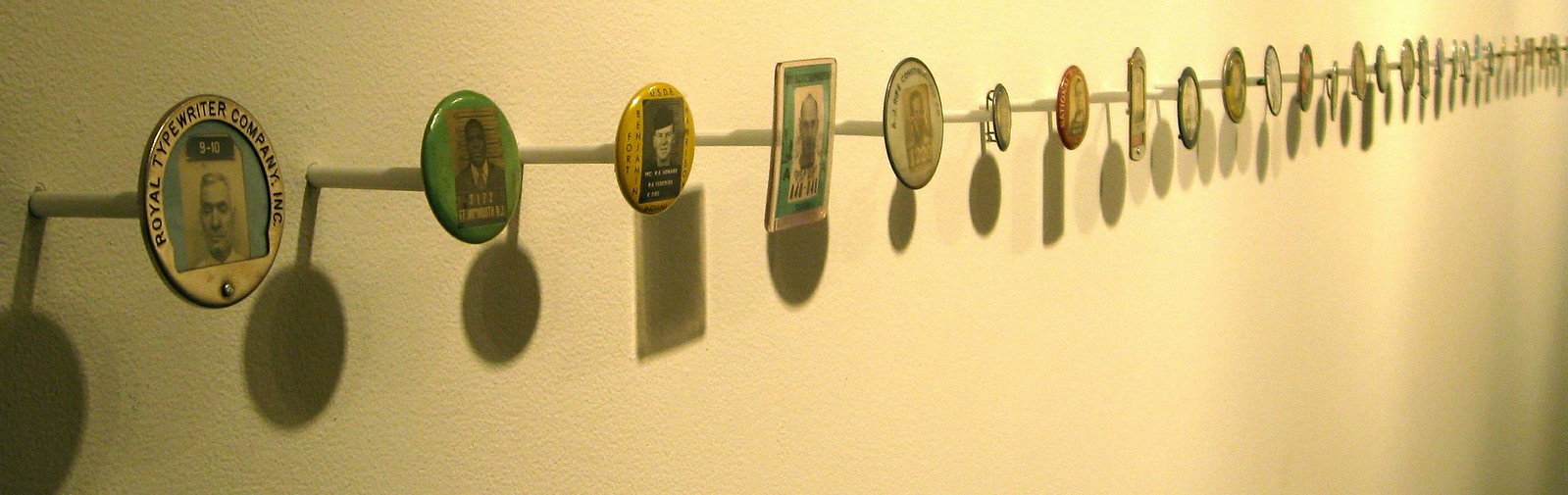
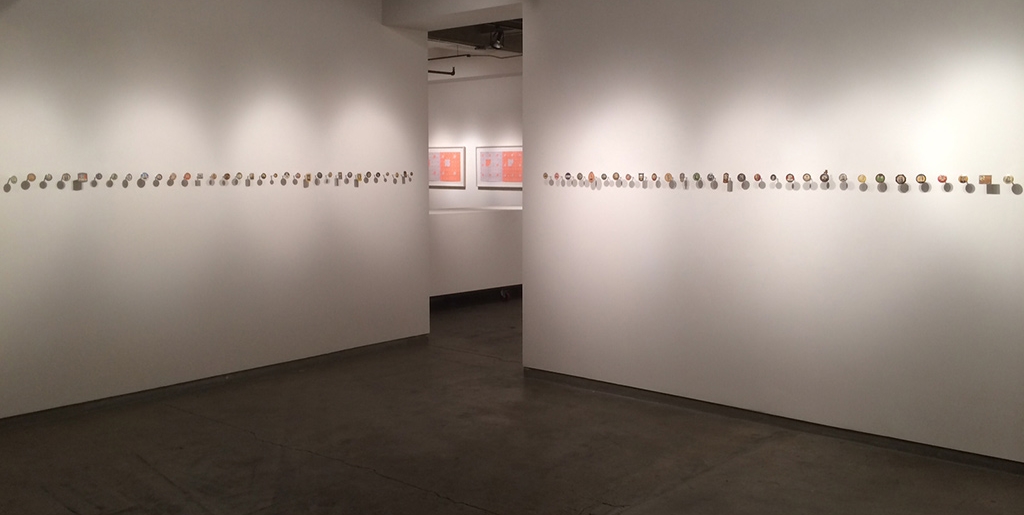
Meanwhile, I still hadn't gone to see the gallery exhibit. I finally did so in mid-February, just before it was taken down (it's now gone, so you can't go see it yourself — sorry). After having spent a few weeks poring over photos of the badges, it was exciting to finally see the real things. They were mounted on a single row of pegs that stretched along the gallery walls (first photo by me, the other two by Ricco Maresca Gallery; click all three images to enlarge):
Most of the badges were about two inches across — a bit larger than I had assumed (it was hard to gauge their size from the eBay photos, most of which had nothing to provide any sense of scale). Seeing hundreds of them lined up one after the other was mesmerizing. So many gorgeous badge designs, so many fascinating faces.
There was very little information about how the badges had been collected or arranged, but I had read that they were all from the collection of one of the gallery's owners, Frank Maresca. As I walked through the exhibit, I noticed someone sitting at a computer in an office off to the side of the gallery space, so I stuck my head in and, on a hunch, asked the guy if he happened to be Frank Maresca. He was.
I explained that I was a journalist interested in the stories behind found objects and asked if he had a few minutes to talk about the badges. He graciously agreed. I didn't record our conversation or take notes, but I've reconstructed as much of our chat as I can remember. All of this recollected dialogue should be considered paraphrasing, not direct quotation:
Permanent Record: How long have you been collecting the badges?
Frank Maresca: About five years. I started collecting them with the specific goal of creating this exhibit.
PR: Did you get most of them on eBay?
FM: A few of them came from eBay, but for the most part I put the word out to vernacular photography dealers, who were able to procure a lot of them for me.
PR: Why did you collect the badges from this particular period (i.e., the 1930s, ’40s, and ’50s)?
FM: It was an incredibly eventful 30-year period — maybe the most eventful 30-year period we'll ever see, what with the Great Depression, World War II, and the rise of the postwar middle class.
PR: Have you tried to research the stories behind any of the employees shown on the badges?
FM: Several people have asked me about that. No, I haven't done anything like that. But I'm going to be doing a small book about the badges, and that kind of research might be a good to include. Maybe I'll put a few interns on that. I assume it would take a fair amount of time, though.
PR: I really like the way you arranged the badges in a single row instead of, say, in a rectangular grid.
FM: Thanks. I laid them out in a very specific sequence. As I'm sure you could see, they form a narrative, almost like frames in a movie.
PR [totally bullshitting]: Yeah, I picked up that.
In fact, I didn't discern any kind of narrative in the badge sequence. After I spoke with Maresca, I went back out in the exhibit room and looked at the badges again — still no narrative or pattern, at least that I could see. Maybe I was too dense to see what he was up to, or maybe he was up to something so esoteric that it only made sense to him. Either way, I was happy to enjoy the badges as a random collection of extremely evocative objects.
But while I wasn't able to find any narratives in Maresca's badge sequence, I'm assuming there are lots of narratives to be found within the individual badges themselves. Most of the badges just show the company's name, a head shot, and an employee I.D. number. But some of them — maybe 25% or so — also include the employee's name. I've gathered a bunch of these name-inclusive badges (some culled from eBay listings, others from the Maresca exhibit) and gathered them into their own photo set.
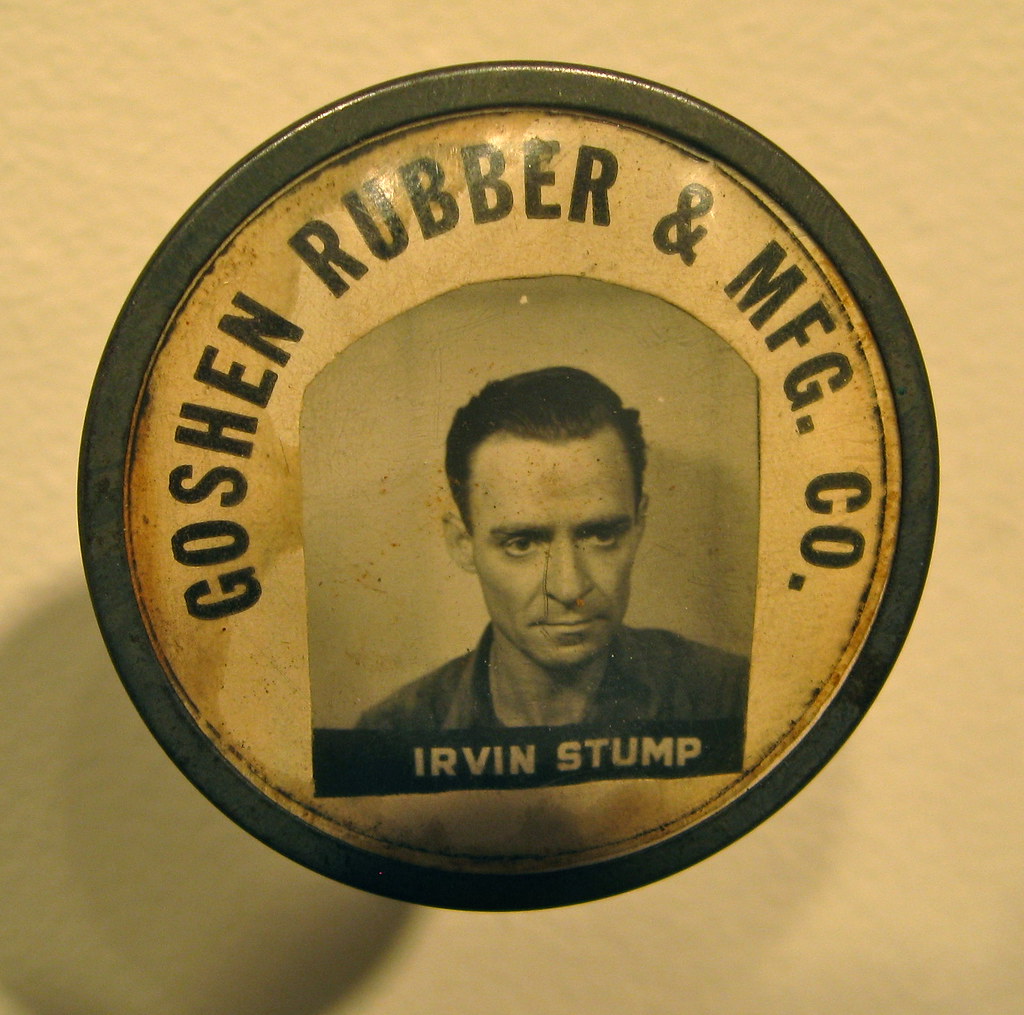
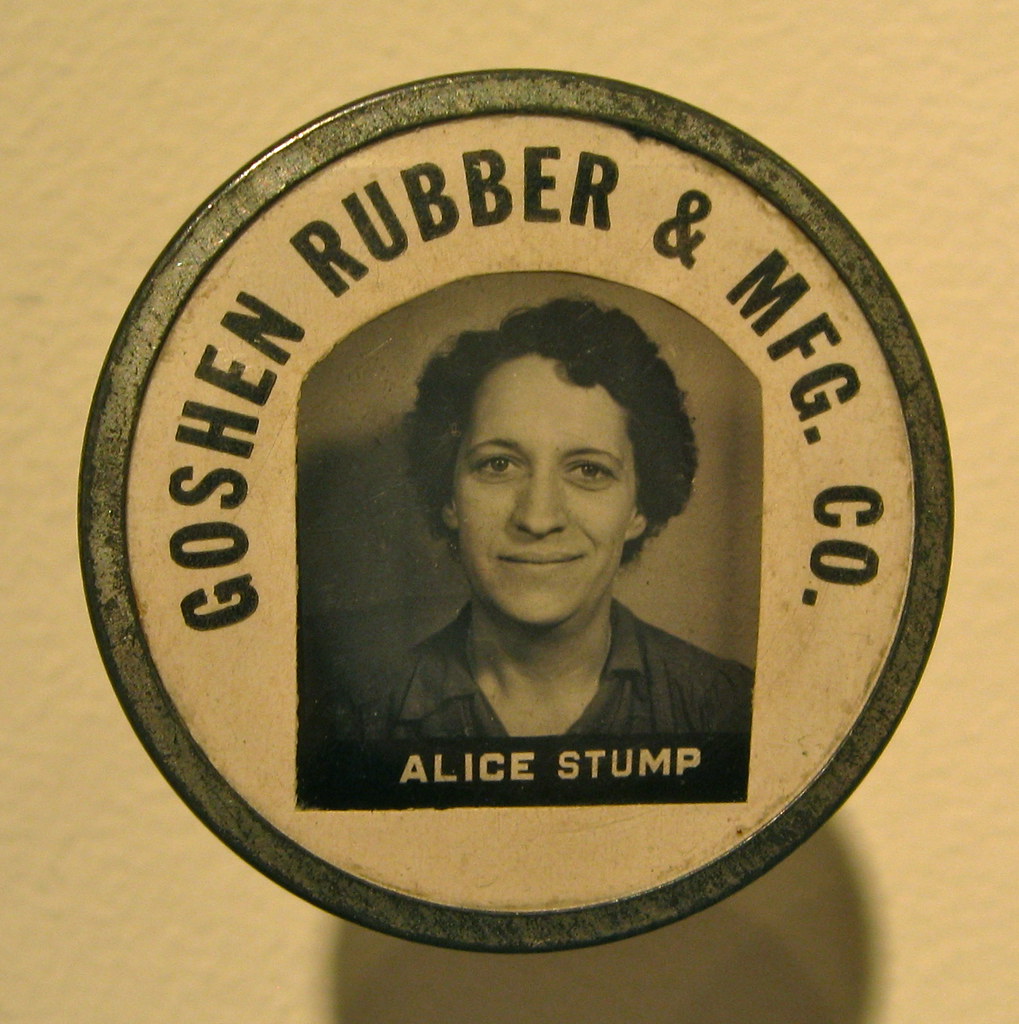
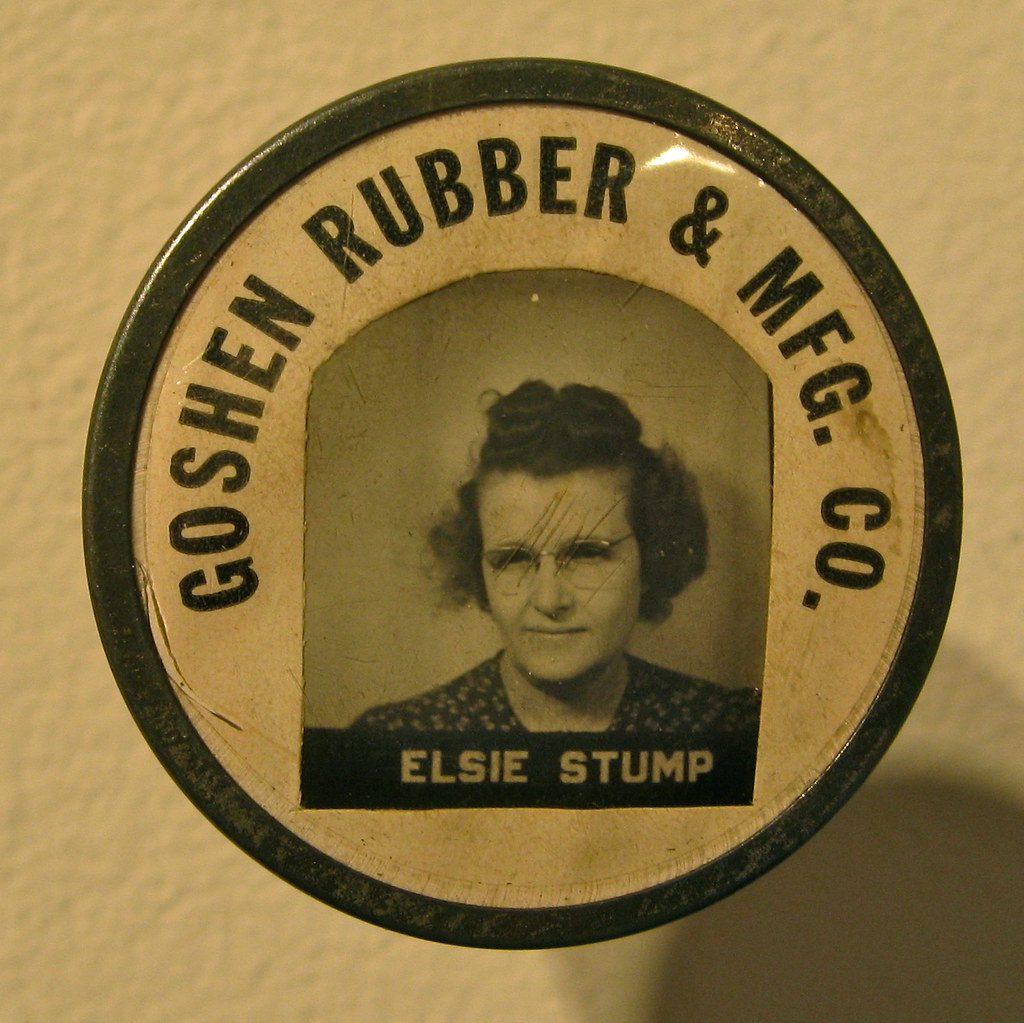
Once you look at the name-inclusive badges, a few interesting things become apparent. For example, it appears that at least three members of the Stump family worked for the Goshen Rubber & Manufacturing Company (click to enlarge):
I was curious about this, so I didn't some quick Googling and learned that Goshen Rubber & Manufacturing was located in Goshen, Indiana. In 1999 it was acquired by Wynn's International, which in turn was acquired the following year by the Parker Hannifin Corporation, a New Jersey engineering company. I made a phone call to Parker Hannifin and confirmed that the Goshen plant still operates today under Parker's ownership.
I didn't know exactly when Irvin, Alice, and Elise Stump's badges were from, or how old the three Stumps were when those badges were made, but it seemed obvious that all three of them were now retired and probably deceased. I'm no whiz at this kind of research, and I don't currently have an active Ancestry.com membership (always helpful for this kind of thing), but here's what I found with some basic Googling:
• An Irvin Stump, residing in Goshen, was listed in the 1940 census. He died in 1964, and his obituary specifically mentioned that he worked at the Goshen Rubber Company.
• An Alice Stump, residing in Goshen, was listed in the 1940 census. I was not able to find an obituary for her, but the census lists her year of birth as 1910, which means she would now be 103 or 104 years old. She's likely deceased.
• Elsie Stump's 1940 census entry notes that her household included a Lloyd Stump — presumably her husband. A Lloyd Stump was also listed in Irvin Stump's obituary as one of Irvin's surviving brothers, and there was another surviving brother named George Stump. Although we don't have employee badges for Lloyd or George, it appears that they worked at Goshen Rubber too, because they're mentioned in the text of the decision from a 1940 lawsuit brought by the National Labor Relations Board against Goshen Rubber. Here are the two pertinent passages:
"On May 12 there appeared in the [Goshen Rubber & Mfg. Co.] plant a petition, prepared by foreman Harold Kintigh, stating opposition to any labor organization 'other than that which might be organized solely among the employees.' It was signed by 40 production employees and 6 foremen. Lloyd Stump (foreman of the trimming department) took it into the trimming room and told the employees therein that 'they could all read it and use their own judgment about signing it,' adding that he 'believed the office might approve of it.'"
"George Stump testified that Hoffman had told him that 'he believed someone caught him smoking.' There was evidence that other workmen had been discharged for smoking."
We've already seen Lloyd listed alongside Elsie in the 1940 census, which said he was born in 1899. He appears to have died in 1978. As for George, he too was listed in the 1940 census, with a birth year of 1897. I was unable to find a death notice for him, but he would now be at least 116, so I think it's safe to say he's deceased.
In short, Goshen Rubber & Manufacturing employed a whole lot of Stumps. As it turns out, the Stumps appear to have been one of the area's pioneer families, which presumably explains why there are so many Stumps currently living in Goshen. (In fact, according to this PDF from two months ago, the current president of the Goshen Redevelopment Commission is Thomas Stump.) So just about any Goshen employer is likely to have its share of Stumps. (Update: Reader Bill Maselunas, who has an Ancestry.com account, did a little Stump family research. And reader Scott Jackson came up with a page from the 1946 Goshen city directory that shows how many Stumps were listed back then. Interestingly, the addresses for several of them are rubber companies!)
That's just the tip of the narrative iceberg that emerged from about two hours' worth of Googling regarding a few randomly chosen badges. I'm sure there's plenty more to learn about the Stumps and about Goshen Rubber, and a whole lot more to learn about the employees and employers shown on the other badges.
I hope to delve into this a bit more, time permitting. If anyone else would like to do some research, please get in touch and we can assign specific badges to specific people. I'm pretty sure there's some good stuff waiting to be discovered here.
(Special thanks to my pal Jack Kirr, who let me know about the gallery exhibit and therefore got this whole ball rolling. See what you've started, Jack?)