Showing posts with label PermaRec-ish Art Projects. Show all posts

Monday, May 12, 2014

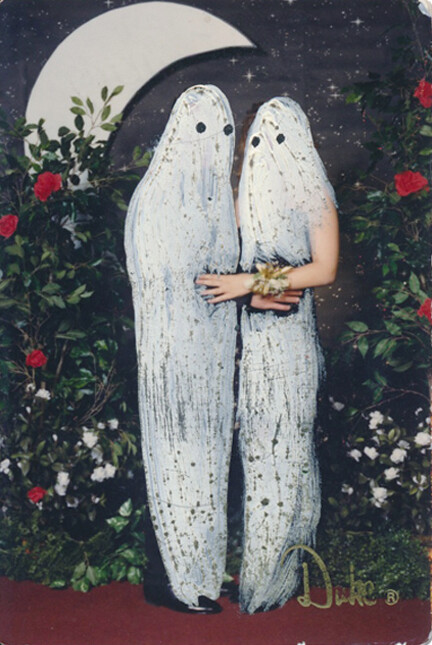
Last month I wrote about the artist Angela Deane, who acquires found snapshots and paints over the people in them to turn them into ghosts. Now I've become aware of another artist who repurposes found snapshots: Vik Muniz, a Brazilian who cuts up old photos and, as you can see above, creates new collage-based images out of them.

Muniz just had a gallery show here in New York, where I live. Unfortunately, I found out about it two days after the show ended — dang. You can learn more about Muniz at his website and at his Artsy page. Several more of his collage images are shown below (for all of these, you can click to enlarge):

(Special thanks to Heather McCabe for letting me know about this one.)

Friday, April 18, 2014

Photos from JillSobule.com

About a dozen years ago, the singer/songwriter Jill Sobule received a vintage charm bracelet as a birthday gift. She had no interest in wearing the bracelet ("not really my style," she would later comment) but nonetheless became obsessed with it. As she wrote on her website in 2012:

Who was the original owner? What did she do? I do know her name was Dottie, as there is a round engraved "Dottie" charm. ... She was not from a wealthy family — the 22 charms are pewter as opposed to silver or gold. She traveled domestically, gathering mementos from Florida to Mackinac Island to New York City. She played piano. She liked big, sculpted poodles. She liked cowboys. She was a working girl; there is an ABWA union (American Woman Business Association) charm and an office chair. She was Jewish — a mezuzah. I keep saying “was” [but] maybe Dottie is still alive. Who knows?

Totally Permanent Record, right? Sobule decided to use the charm bracelet as the organizing theme for a concept album: a dozen songs, each relating to one of the charms on the bracelet, forming a fictional (but plausible) composite view of Dottie's life. But she didn't write the lyrics herself. Instead, she enlisted a bunch of writers — mostly novelists and academics like Jonathan Lethem, Luc Sante, and Rick Moody — and had each of them write a set of charm-based lyrics. She then added the music. The resulting album, Dottie's Charms, is being released on vinyl this weekend (in conjunction with Record Store Day) and will be available digitally on May 5.

Interestingly, Sobule had already been contemplating a similar project before she hit upon the charm bracelet idea. At one point she had considered purchasing a random old high school yearbook on eBay and constructing a concept album around that. But the charm bracelet idea ended up working out better.

The collaborative nature of Dottie's Charms has echoes of the Significant Objects project, in which the writers (and my friends) Rob Walker and Josh Glenn acquired about 200 cheap thrift store items, assigned a writer to create a short story about each of them, and then auctioned off the objects and the stories on eBay. (The stories were later packaged into an excellent book.)

You can learn more about Dottie's Charms in this article, and Sobule will be playing a record-release party for the album on April 24 at City Winery in New York. As she recently wrote on her blog, "Maybe Dottie will show up."

Incidentally, a few years ago I considered writing a song about the Manhattan Trade School report cards that formed the basis of the Permanent Record project. I figured I'd write some lyrics (something I'd never done before), and I asked my friend Lianne Smith — a great singer/songwriter who also happens to be a big PermaRec fan — if she'd be willing to come up with the music and then add the song to her repertoire. She was agreeable, but I never came up with a full set of lyrics. Only managed to do the chorus, the bridge, and part of a verse. This is all a good reminder that I need to dust off that project.

Tuesday, April 1, 2014

ghost.png
Click to enlarge

Permanent Record is all about uncovering the stories lurking within found objects. It's a determinedly fact-based approach, employing archival research to determine what really happened.

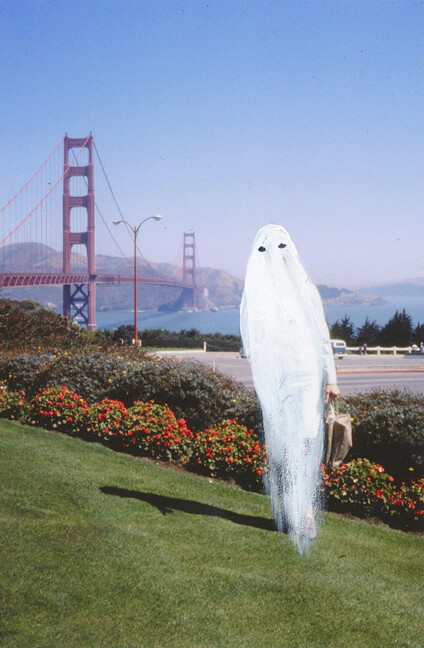
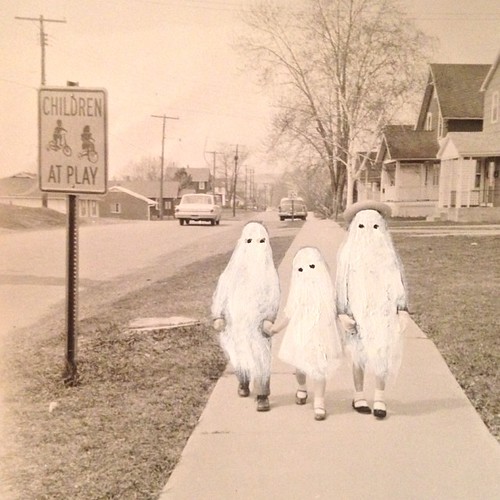
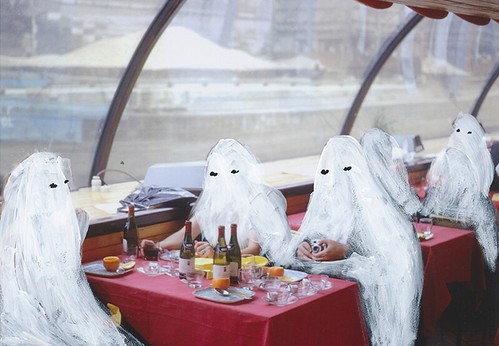
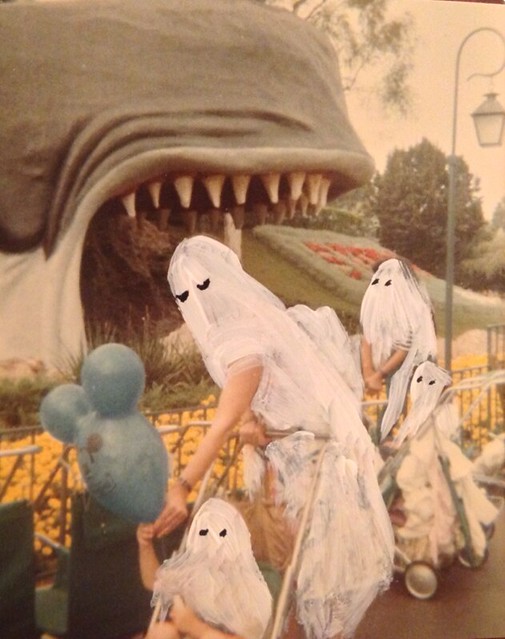
But found objects also provide lots of opportunities to spin fantasies about what might have been, or to project ourselves into other people's stories, or just to mess around with our perceptions of reality. That's the approach taken by the Florida-based artist Angela Deane, who has a very interesting specialty: She procures old snapshots and paints over most of the people in those photos, transforming them into ghosts. The resulting images, which she calls ghost photographs, can be seen on her Tumblr site (from which all the images in this PermaRec entry were taken).

Deane's response to found objects is obviously very different from mine, which is precisely why I find her project so interesting. It would never even occur to me to modify or alter an artifact like she does. But hey, that's why she's an artist and I'm a journalist, right?

In any case, Deane and I both find inspiration in found objects, so I wanted to learn more about her project. She recently agreed to answer a bunch of my questions via email:

Permanent Record: When and how did you decide to start this project? What was the impetus?

Angela Deane: I started it by a happy accident, really. In the fall of 2012 I had an artist residency in New Mexico. I had bought a bunch of photographs on eBay and at thrift stores, which I planned to use to create collages. When I spread out the photos in my studio, I started wondering what would it be like/mean/look like to paint a ghost over a photograph, to erase the particular of an identity or the ownership of an experience. And so I launched in.

Hours later I sat back and stared down at about 40 or so "ghosted" pictures and was blown away. I knew I was on to something.

ghost3

PR: Roughly how many ghost photos have you made? Have you posted all of them on your Tumblr site? If not, how many more have you done besides the ones on the site, and how do you decide which ones go on the site and which ones don't?

AD: I'm on about number 325. Only a handful are on the Tumblr site. Being fairly new to it, I'm taking my time and picking and choosing mostly on whim. Recently I've been sourcing photos based on themes (embraces, birthday parties, parades), so they may post in waves of these moods for some time to come.

PR: Where do you get the found photos? Like, do you hunt for them at flea markets? Did you already have a big stash of them when you started this project?

AD: My initial stash was probably about 100, sourced mostly from eBay and from some from thrift stores in Miami and other places in Florida. In New Mexico I met this guy who had a whole garage full of photos — he even had a deal with all the local thrift stores to give him any of the photos they received first — so I struck a deal with him and got to go through a lot of boxes out there. Got some great ones. I'm back south for the spring and summer, so I'll definitely be hitting up some flea markets! I'll be looking for some good vacation photos, I think.

ghost2

PR: How do you decide if a photo is "good enough" or "right" for being painted? Is there a particular type of scene (or feel, or whatever) that you look for?

AD: Mmmm, it remains much of a mystery why I choose the ones I do. In general I'd say I look more for color photos (black and whites make it a little more morbid; more about death, which isn't really how I think of them). I like snapshots. In essence they're just these little moments, generally when people are feeling good, are engaged with one another or with nature. I like those moments where you can feel a pulse in the inattention of what's taking place. Does that make sense?

PR: Why ghosts?

AD: There's a line from a Band of Horses song that goes, "We are the ever-living ghost of what once was." I think of these ghosts not as of people that have passed but each and every one of own experiences that has passed. How to hold memories has always been something that has provoked me to create lots of my art in life. Can we retain them as experiences or do they just turn into anecdotes?

These are intended as ghosts of moments. And in painting away the specificity of the people experiencing them, I like to think it opens things up for any of us to place or project ourselves into that space. They could be our memories now. Of course, that is what a life ends up to be — a collection of moments, experiences, memory — so ultimately I suppose it does grapple with mortality. But I don't think of them morbidly.

And I notice that the ghost photos make most people smile or laugh, which is great. I think the choice of the snapshots contributes to this. A writer on Flavorwire the other day described them as "ghosts having fun" and then did a riff on the whole celebrity mag thing and said, "Ghosts: They're just like us!" I loved it.

ghost4

PR: What paint (or white-out, or whatever) do you use to paint the ghosts?

AD: Mostly acrylic, sometimes gouache.

PR: How long does one of the photo paintings typically take you?

AD: Most of them take only about 30 minutes or so, but lately I've been doing some with upwards of 100 or 200 ghosts in them, and I spend a few hours with those.

PR: At first I thought you turned every person in each photo into a ghost. But then I saw you sometimes leave some people un-ghosted (like the people in the background of this shot). Is there a rule or system you use when deciding who gets ghosted and who doesn't?

AD: Not really; just a gut feeling. Sometimes I imagine myself as the un-ghosted people, looking on at the "ghosts" and "spaces to project other people in" and want to keep them intact so they can be more concrete witnesses to something magical happening. It gives a different focus to the ghosted characters. And once in awhile it's just as simple as finding their face simpatico, or liking their stance, and therefore wanting to leave them intact.

ghost6

PR: Do people send found photos to you to paint, either for commissions or just as a "I thought you'd like to have this" kind of thing?

AD: Yeah, I have a few commissions under my belt. I love doing them. This past December I had a show with F.L.A. Gallery and was put in touch with Amy Sedaris, who is crazy for ghosts and commissioned me to paint a bunch of family photos to gift to her siblings. Very cool!

PR: Have you had any other ghost photo gallery shows besides that one?

AD: Yeah, I've had a couple. The last was in Los Angeles at a friend's spot called "Matters of Space" in Highland Park. It was well-received and has brought me a couple projects in the works, which I can't get into yet but are very exciting. The F.L.A. Gallery show was also terrific and was so beneficial, as it was the first time I'd seen so many of the photos framed in a group rather than just in my studio.

PR: Have you ever tried to find any of the people in any of these photos, and/or has anyone ever told you, "Hey, I recognize that photo"?

AD: Only once, out in New Mexico! And actually I never painted over that photo because it's so great — an older man out in his front lawn, standing proud. Sometimes there are names written on the back of the photos, but I've never thought to Google anyone. Maybe I should..? Hope they'd be cool with being turned into spirits.

I also haven't done any personal photos of my own yet. But may do a few soon. Some goofy ones from junior high or something, maybe my softball team portrait.

PR: How long do you think this project will keep going?

AD: I keep getting nervous that I'm not "over" it yet. But I gotta tell you, my curiosity remains piqued with each one that I make. And they're just beginning to get out into the world to such a nice reception, which makes me feel okay for wanting to paint maybe 3,000 of these guys. These last few years I've been bouncing around cities (Miami, New York, Seattle, Gainesville), so the fact that these are so portable — very different from my larger-scale paintings — is pretty addictive.

PR: Any other thoughts about found objects?

AD: Just that I love them. Much of my décor is second-hand. I love the hunt of it, I love the slow meandering and contemplation of the hunt — it's never speedy. Stories that are embedded yet unknown, endless mystery in objects and a reminder that time just continues on.

ghost5

My thanks to Angela for answering all my questions. I was particularly struck by this passage from one of her responses: "How to hold memories has always been something that has provoked me to create lots of my art in life. Can we retain them as experiences or do they just turn into anecdotes?"

I totally relate to this notion of experience morphing into anecdotes. You start by experiencing something, and then proceed to remembering that experience. But if it's a memory that you tell or explain to others, sometimes the memory gets superceded by the telling and retelling of the memory, until you no longer remember the original experience — you just remember how you've told the story, like a script that you've internalized. Or at least that's what I've often found to be the case. Even the experience that gave birth to the Permanent Record project — the night I found the old Manhattan Trade School report cards at my friend Gina's birthday party in 1996 — falls into this category. I don't really remember much about that night anymore; what I remember is the countless times I've told the story about that night. That troubles me a bit, because it feels like the original experience has gotten lost along the way.

For those who want to see and hear more about Angela's work, here's a good video interview with her, which was produced in conjunction with one of her recent gallery shows:

(Extra-special thanks to Heather McCabe for bringing Angela's Tumblr site to my attention.)

Monday, January 13, 2014

.
In 1998, a 20-something guy named Jesse Reklaw was doing some Dumpster diving on the campus of an Ivy League university that he'd rather not name when he came across a bunch discarded of Ph.D. applicant files from the mid-1960s through the mid-1970s. Each file included a photo of the applicant, along with assorted paperwork, including feedback from university officials.

Reklaw was smitten with the photos and decided to create a zine that would show several dozen of them, each accompanied by a line of commentary taken from the applicant's file — sometimes a few sentences, sometimes as little as one or two words. You can see some examples above.

Reklaw called the resulting zine Applicant. There was only one issue, which he distributed from 1998 though 2005. The small press Microcosm then picked it up and published Applicant as a tiny book, which remains in print today.

I learned about Applicant only a few weeks ago. I'm not sure what took me so long — I love projects involving found objects, and I was very active in the zine world in the late ’90s, when Reklaw published Applicant. I'm surprised it never came across my radar until now.

Better late than never. Once I saw Applicant, I was struck by its similarities to the original Permanent Record project with the old report cards, and I loved Reklaw's simple photo/caption pairings. Individually, many of them are quite affecting; cumulatively, they tell a series of stories. It's a great project. But it also left me with a lot of questions.

Reklaw is now an artist (you can learn more about him here). Last week I contacted him and asked if he'd be willing to do a phone interview. He readily agreed. Here's how it went:

Permanent Record: How did you come across the Ph.D. applicant files?

Jesse Reklaw: It was 1998, I had just dropped out of grad school myself, and I was feeling very bitter. I didn't really have a job, and I was keeping these weird hours. I would go over to the compost and recycling bins at the school I'd been attending and dig through those to find magazines that I'd tear up and make collages out of and crazy shit like that. And I just found them all right there in the recycling bin.

PR: How many individual files were there?

JR: It was stack three to four feet high. There were well over 100 files — maybe 120. Some of the files were huge, others were incomplete.

PR: What was your original thought in terms of what you'd do with them, and how did you eventually arrive at the decision to publish them?

JR: I am mostly a 2-D artist, and I had gotten a degree in painting. I'd been doing a lot of collage work, and I was really inspired by that notion of grabbing ephemera and sticking it down on a page and then photocopying it, so maybe that's where the impulse came from. It seemed very zine-y — that whole notion of found ephemera and bringing that to light.

PR: After you acquired the files, how long did it take you to decide on the zine approach?

JR: About two weeks. I immediately started reading through them, and as I did that I saw that there was too much information to put in one giant picture or collage, so the zine format made more sense. I'd never made a zine before. Well, I'd made comics zines, but never a zine that wasn't comics-based.

PR: In Applicant, you just show the head shots and a snippet of commentary for each one. Have you ever published any of the other paperwork from the files?

JR: No. I didn't want to get sued, for one thing. I wanted to make the zine to be like a story — I'd been trained in narrative. And by juxtaposing the images and the commentary, I was able to create that. A lot of the additional commentary became very repetitive.

PR: So what did you do with all the other paperwork? Do you still have it?

JR: No. For the first 100 or 200 copies of the zine, I stapled in pages from the original application files.

PR: You mean you threw in an additional page or two as a sort of "bonus treat" in each copy of the zine?

JR: I stapled them in as endpapers. I rotated them about 30 degrees, trimmed them, and stapled them in as endpapers.

PR: How many copies of the zine did you distribute?

JR: I made about 200 with the endpapers made from the original application sheets, and then about 800 more that had facsimile endpapers, because I had run out of the original paperwork from the files. So figure about 1,000 copies over the course of seven years, and most of those were distributed by Microcosm [the same company that published the version of Applicant that's currently in print]. It was getting to be such a pain to assemble the zine and hand if off to Microcosm, and they're such a wonderful company, so I just trusted them to publish it.

PR: And how many copies of the Microcosm edition have there been?

JR: They're on their third printing of 3,000 copies.

PR: Is the Microcosm edition more or less identical to the zine version? Like, in terms of trim size, content, and so on?

JR: Yeah. The cover is a little different, and I insisted on the Microcosm version having a real spine [i.e., with the title, author, and publisher all listed], which the hand-made zine didn't have. And it doesn't have the endpapers. But otherwise it's the same.

PR: With 10,000 copies in circulation, have you ever heard from any of the people whose faces are shown in Applicant, or maybe from someone who recognized one of them?

JR: Yeah, the latter. One woman, who went to the school where I found the files and is now a neuroscientist, one of her professors from when she got her degree is shown in the book.

PR: So did she contact you and say, "Hey, I know this guy!" or what?

JR: You know, it's funny, I knew her through a different project where I draw people's dreams as comic strips, and she was one of the people whose dreams I drew, and then she got a copy of Applicant and recognized the guy.

PR: Wow, that's an amazing coincidence! Did either she or you notify the guy?

JR: No way. No way.

PR: So you asked her not to.

JR: Yeah.

PR: Why?

JR: I just don't want to get sued. There are a lot of famous cases, like when Andy Warhol took what he thought were these random photos of Italian men and put them up in a gallery with adjectives underneath them. But they were real people — you can't just use someone's likeness without asking them.

PR: It's interesting that the files included photos in the first place.

JR: Yeah, that was required back then, just to show them that you could comb your hair or something. And then some of the comments in the files refer to their physical appearance.

PR: Yeah, it seems like it would be better if it were a blind process.

JR: Which is how it is now.

PR: You don't list the names of the people whose head shots are shown, but I assume you know their names, or at least you did at one time. When you found the files, Google and other online search tools didn't yet exist, but now it would be fairly easy for you to find what had happened to these people. Have you done that?

JR: I haven't done that either. Part of it, again, is the legal risk. I might be tempted to contact one of them, and that would be stalking.

PR: Really? One could call it just research, or even curiosity.

JR [laughing]: Yeah, "research." That's what I'm gonna tell the police the next time I'm camped out outside somebody's window.

PR: Well, that would be stalking, but it's not illegal to Google someone's name. But if you don't want to go there, for whatever reason, of course that's totally fine.

JR: Yeah, it just seemed like that wasn't part of the art project.

PR: Have you ever created an online version of Applicant?

JR: No, but I've had plenty of people offer.

PR: Why haven't you done it?

JR: At this point I feel like this project has fulfilled my artistic interests. Also, from a design standpoint, I think it works better as a book than as a website. And if I put it online, I think people will stop getting the book.

PR: Have you ever done anything else with the files or the photos aside from publishing them? Like, have you ever done a gallery exhibit or something like that?

JR: No. I sort of had a manic phase last summer where I was getting rid of all my things, so I was selling them at the Portland Zine Symposium for 10¢ each.

PR: Oh wow, that was my next question, whether you still had the original files.

JR: Well, the application paperwork from the files was recycled into the endpapers. All I had saved were the photos. That's what I was selling for 10¢. I still have some that I saved for myself. I can send you one or two if you want.

PR: No, you don't have to do that. So you had removed the photos from the files, because they had been stapled in or something like that, right?

JR: Yeah. Right from the start, I loved the photos. That's what I was always more interested in.

PR: What size are they? Like, are they little passport-size photos?

JR: Yes, totally. And they're all black-and-white.

PR: In your preface, and also in our discussion here, you've addressed the question of whether it's ethical or even legal to publish this content. How hard did you wrestle with that, and can you describe your thought process?

JR: It did concern me, and I asked a lot of family members and friends, most of whom advised me not to do it.

PR: From a legal standpoint or an ethical standpoint?

JR: Legal. No one cared about the ethics. No way. I was more concerned about the ethics. Like, is it fair to run this guy's photo and say he's best defined by the words "Rather tense"? That's a call I had to make.

PR: Yeah, it's hard to distill something down to a single sentence or phrase. So you had to do a lot of editing.

JR: Yeah. Mostly I went through the three pages of the application written by the student and the three pages written by their referee, and I used a highlighter to mark everything that kinda shocked me. And then I read through them again and sorted them by political theme and took the phrases that best represented each student. I took some of my personal favorites, took the ones that made me laugh, and then tried to tell a story.

PR: And now, years later, how do you feel about the ethical aspect of it? Are you comfortable with the decisions you made?

JR: Yeah, totally. If anything, I think maybe I was being too sensitive then.

PR: Did this whole experience make you feel better about dropping out of grad school?

JR: Oh, yeah, a big part of publishing this, and what kind of kicked me over the line in terms of doing it, was that I decided, "This is my master's thesis." Like, here's what I had to say about grad school.

PR: Once I started writing about the report cards, people started contacting me and saying, "Oh, if you're into old report cards, you'll probably like these old documents I have." And they'd start sending me all sorts of old stuff. Has that happened with you?

JR: Only once. A friend had moved into an old house that had been owned by a literal mad scientist — the guy's last name was Dement, I'm not kidding! He did a lot of work with X-rays for the U.S. government, but he was also an inventor. And in their basement they had, like, piles of X-rays of people's faces and skeletons and stuff, all of which was very striking. And then there were 20 or 30 journals about all his experiments, with crude drawings of all these machines he'd designed. If I'd had two months to spare, I would have made a zine about that.

PR: What would you say you've learned from this project?

JR: To just go with a feeling. I was so mad about grad school, and then suddenly this was in my lap, and it all clicked. Like, you'd think someone who'd just dropped out of school would go looking for a job, but instead of I spent the whole summer tearing through this four-foot pile of other people's lives, and it was a great experience.

Applicant always seems like a singular object. It's a bit impenetrable — I don't know how to do it again. I don't quite know why it was successful. I know I'll never find this kind of treasure trove again. You know, it's not like I did anything — I wasn't the author, I'm just the editor.

————————

Big thanks to Jesse for sharing his thoughts. If you want to purchase a copy of Applicant, it's available from Microcosm and from Amazon.
Wednesday, September 5, 2012

TightSidebySide_01T.jpg
Click to enlarge

On the left is a Victorian-style photo portrait; on the right, an illustration based on the photo, which was done by a Brooklyn artist named Lauren Simkin Berke.

Berke has a very Permanent Record-ish project called To Be Kept, which goes like so: She obsessively collects old photographs from flea markets and antiques shops (some of them Victorian portraits like the one shown above, but also 20th-century snapshots not unlike the ones I recently blogged about) and then creates drawings based on them -- about one per weekday, which she's been posting on her blog since 2006. Some of these pieces ended up in a gallery show last winter, and now she's running a Kickstarter campaign so she can publish a To Be Kept book.

Berke's Kickstarter page has a nicely worded explanation of why she finds these old photos so compelling:

I find it strange that these documents are for sale as part of a consumer marketplace, instead of being in albums on bookshelves in the homes of the families of those in the photos. I find myself at the intersection between a fascinated voyeurism and a determination to know these documents as well as humanly possible in order to give them a new, longer life.

When I learned about Berke's project, I sent her a note and basically said, "Hey, I'm into found artifacts and passive voyeurism too!" She quickly wrote back and mentioned that she'd recently acquired some old report cards from the late 1930s.

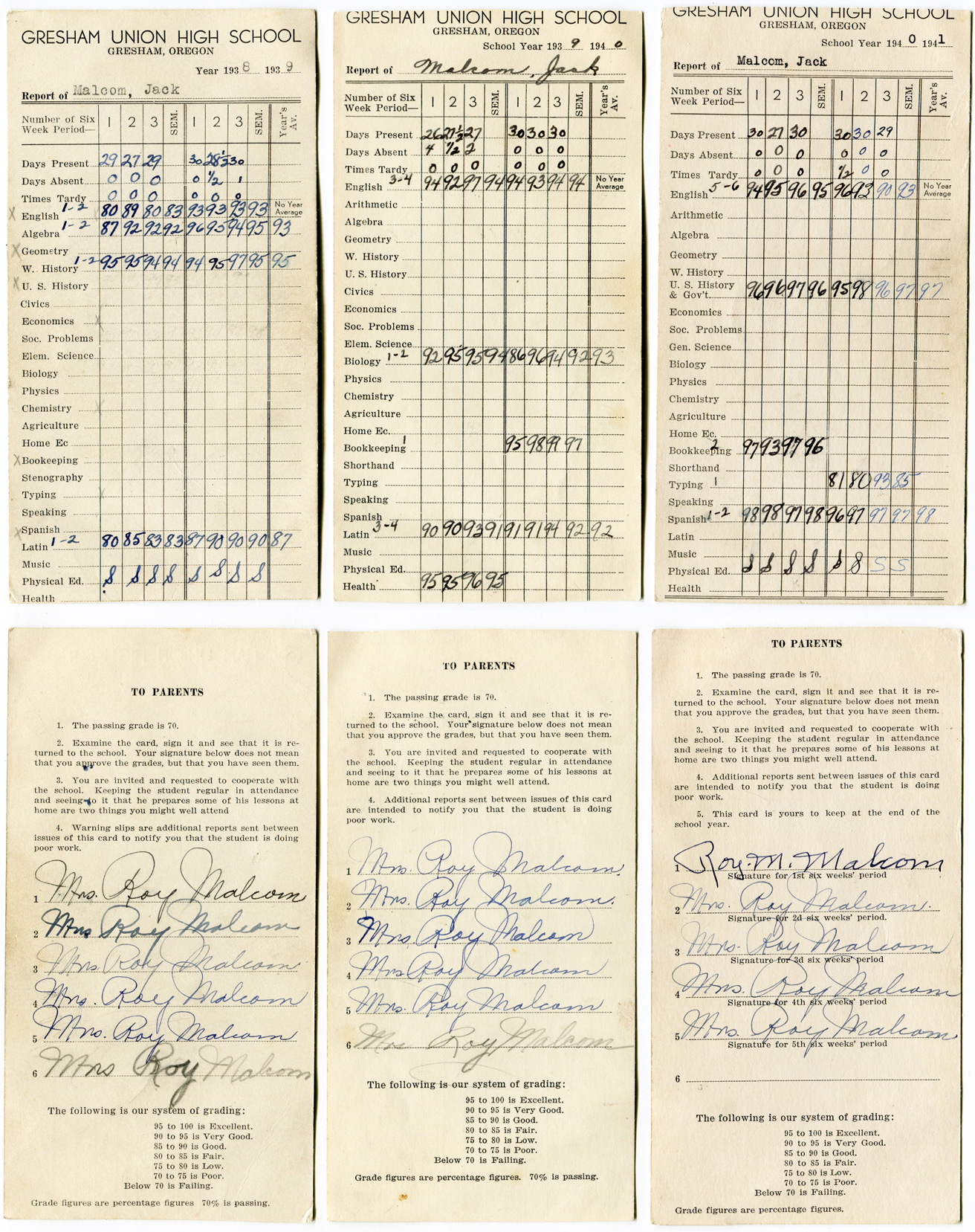
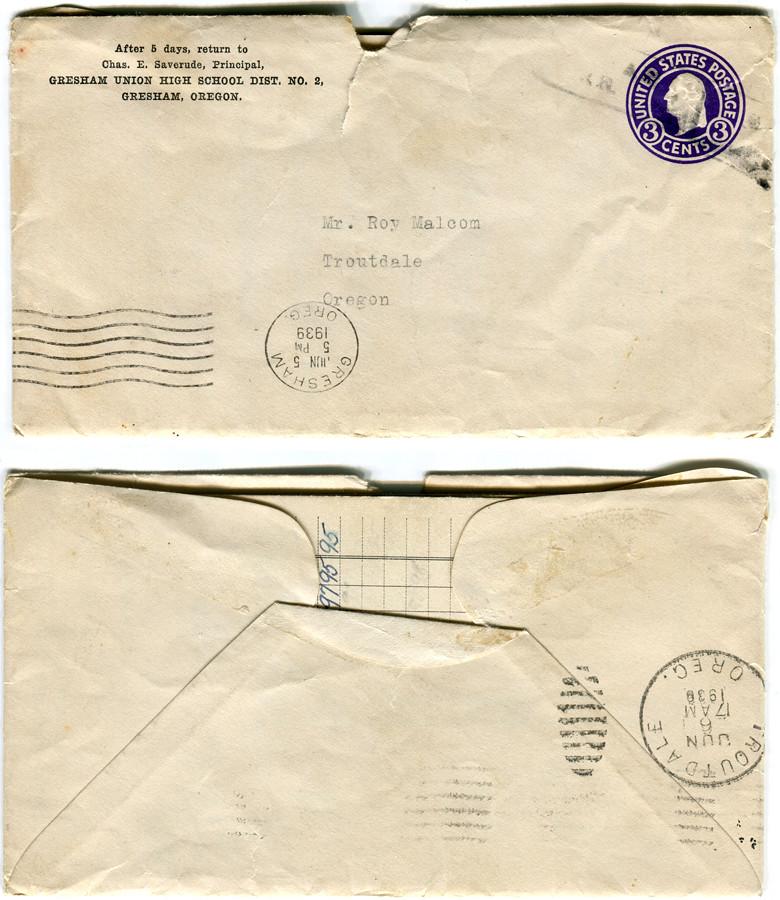
Hmmm, report cards, you say? I asked if I could have a look, and she graciously made the following scans for me (click to enlarge):

OregonReportCards_38-41_2T.jpg OregonReportCardsEnvelope_01T.jpg

As you can see, these are three years' worth of report cards, and the envelope one of them was mailed in, for one Jack Malcom, who attended high school in Gresham, Oregon (which is just outside of Portland). Among the notable details:

• One of the subjects listed on the report cards is "Soc. Problems." Never seen that before.

• The earliest of the three cards -- the one at far left -- has an embarrassing typo, as one of the subjects is listed as "Bookeeping." This was corrected ("bookkeeping," with two k’s) on the subsequent two cards.

• As was common at the time, Jack's mother signed the cards with her husband's first name: "Mrs. Roy Malcom." Her signature has a bit of flair, which I like.

• The Malcoms lived in Troutdale, which is adjacent to Gresham and must have been a very small town at the time, because the person addressing the envelope didn't even bother to include a street address.

"I purchased the cards at a shop in Portland called Ampersand," Berke told me. "I stop in there whenever I'm in Portland, as they keep a well-stocked bin of unsorted vintage snapshots."

I was curious to know if Berke had tried to track down Jack Malcom and/or his family, as I've done with the Manhattan Trade School report cards, so I asked her. She gave a really thoughtful, interesting response, along with an intriguing story about a future project:

I did Google him. He lived in Gresham (it seems for all his life, though I'm assuming he would have served in WWII), where he was a florist. He died in 2009 at age 85. He was on the metropolitan arts commission in Portland, and left a fair amount of money to arts, educational, and historical organizations when he died.

In general, I am not trying to get items back to the family they came from. The assumption is that they are orphaned, and would not be for sale if anyone related to them were alive, or cared. In Jack's case, it seems he had no family.

Most of my work is with photographs, and not text-based ephemera. There are often fragments of text -- or in the case of Victorian studio portraits, there is often a full name and address of the photographer and/or their studio. But I have had very little luck in getting further information, even when I have a full name and address. It would likely take going to historical societies and such. For the most part, I have given up on focusing on finding these details, preferring to focus more on what there is to be seen in the images of the photographs.

When I purchased the report cards, I also purchased an unopened letter from the mid-1940s. The letter was sent from San Francisco to Cambridge, Massachusetts, and I just happened to be on my way to San Francisco myself at the time (and my best friend lives in Boston, near Cambridge). I immediately decided to wait to open the letter until I was in San Fran, and to make a replica of it and the send it to my best friend, re-creating the letter's intended journey. My friend's then-boyfriend (now ex) works at Harvard and thought he could find out if the intended recipient was alive, and if so get an address. Since they broke up, I'm not sure he's going to follow through, but I am going to find someone else who can. If the letter's intended recipient is still alive, I most certainly intend to get him a copy of the letter.

Faaaascinating! My thanks to Berke for sharing all of this and I urge everyone to please consider supporting her Kickstarter project.

(Special thanks to Kirsten Hively, who brought To Be Kept to my attention.)