Showing posts with label Manhattan Trade School Report Cards. Show all posts

Wednesday, May 6, 2015

Student of the Week: Augustina Garcia

1
For all documents, click to enlarge

Today we're going take a look at Augustina Garcia, a dressmaking student who attended the Manhattan Trade School for Girls — or, as it was known at the time, Manhattan Industrial High School — in the mid- to late 1930s.

Augustina's case is particularly interesting because she's one of the very few Hispanic students in my report card collection. On her primary card, shown above, her nationality is listed as "Porto Rican" — an embarrassing misspelling on the part of the school's staff, whose spelling and grammar were usually impeccable. (For more on this, scroll down to the update at the bottom of this entry.)

Next to "Porto Rican" is a partial black dot. As I've explained in previous entries, the black dot was routinely included for black students. It's not clear whether Augustina's partial dot was intentional (a full dot for blacks, a partial dot for Hispanics?) or if the dot sticker simply tore.

What else can we learn from this card? There was some dispute over Augustina's date of birth; neither of her parents worked (keep in mind that this was during the depths of the Great Depression); she was deemed to be 18 pounds underweight; and she took cod liver oil three times a day to combat colds and sore throats.

Now let's take a look at Augustina's grades and teacher comments (as always, E = Excellent; G = Good; F = Fair; P = Poor):

2

Several themes emerge here. First, Augustina's grades were a bit below average. Second, several teachers noted that she was a slow worker. And third, it was repeatedly noted that she was left-handed, which was presumably an impediment (or at least something that had to be accounted for) when working on a sewing machine or following a pattern. This was during the period when lefties were often forced by schools to retrain themselves to be righties, but there's no indication that this was done to Augustina. (As an aside, I'm left-handed myself, so I'm particularly interested in this storyline.)

Augustina's handedness and her slightly below-average ranking are both referenced again on this next card, which was prepared by the school's job placement office in anticipation of finding work for her after she finished her vocational classes:
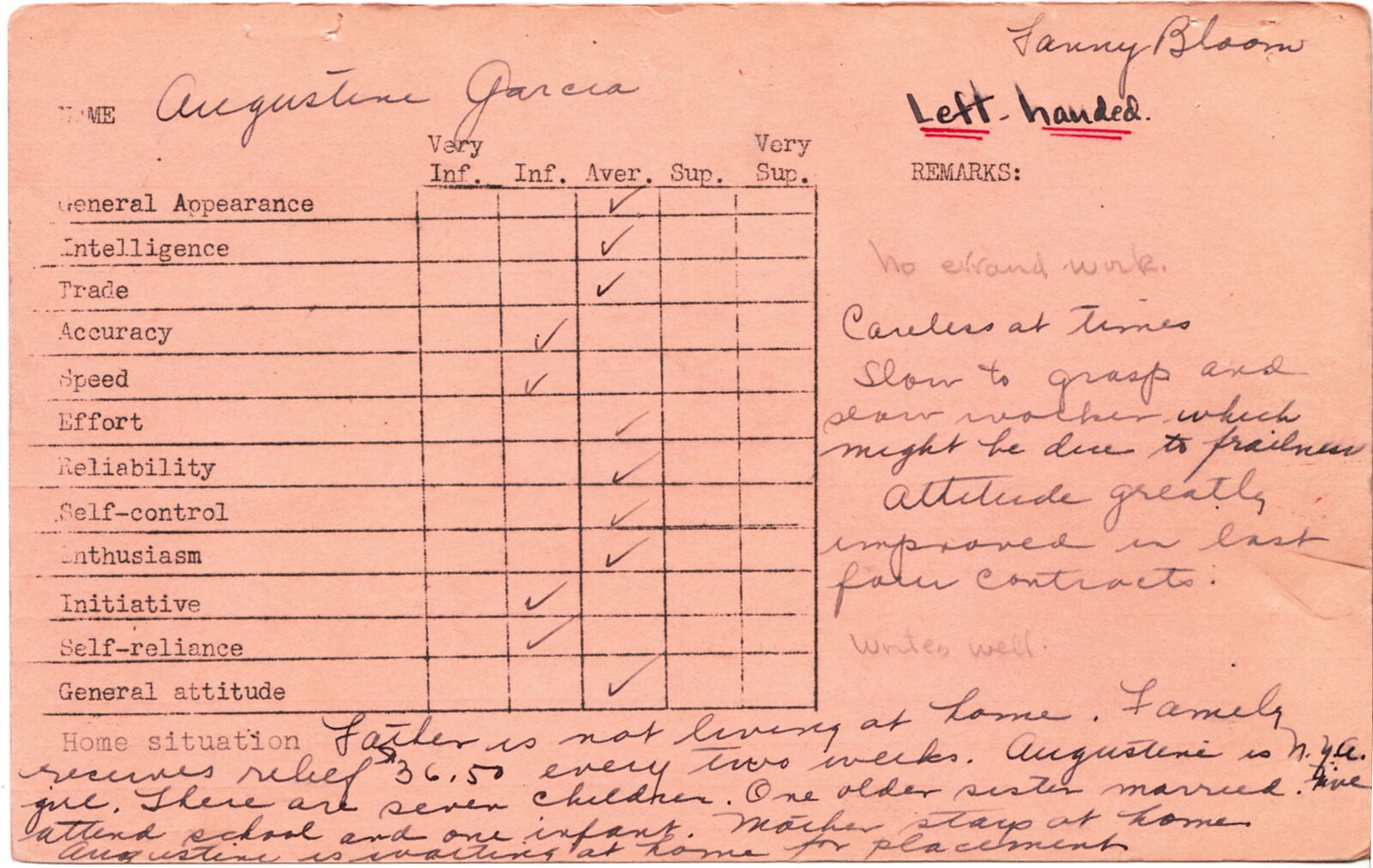
3

Here's a transcription of the handwritten notes:

Careless at times. Slow to grasp and slow worker, which might be due to frailness.

Attitude greatly improved in last fall contracts.

Writes well.

Father is not living at home. Family receives relief [of] $36.50 every two weeks. Augustina is NYA girl. There are seven children. One older sister [is] married. Five attend school and one infant. Mother stays at home. Augustina is waiting at home for placement.

Augustina was eventually sent out to three jobs:

4

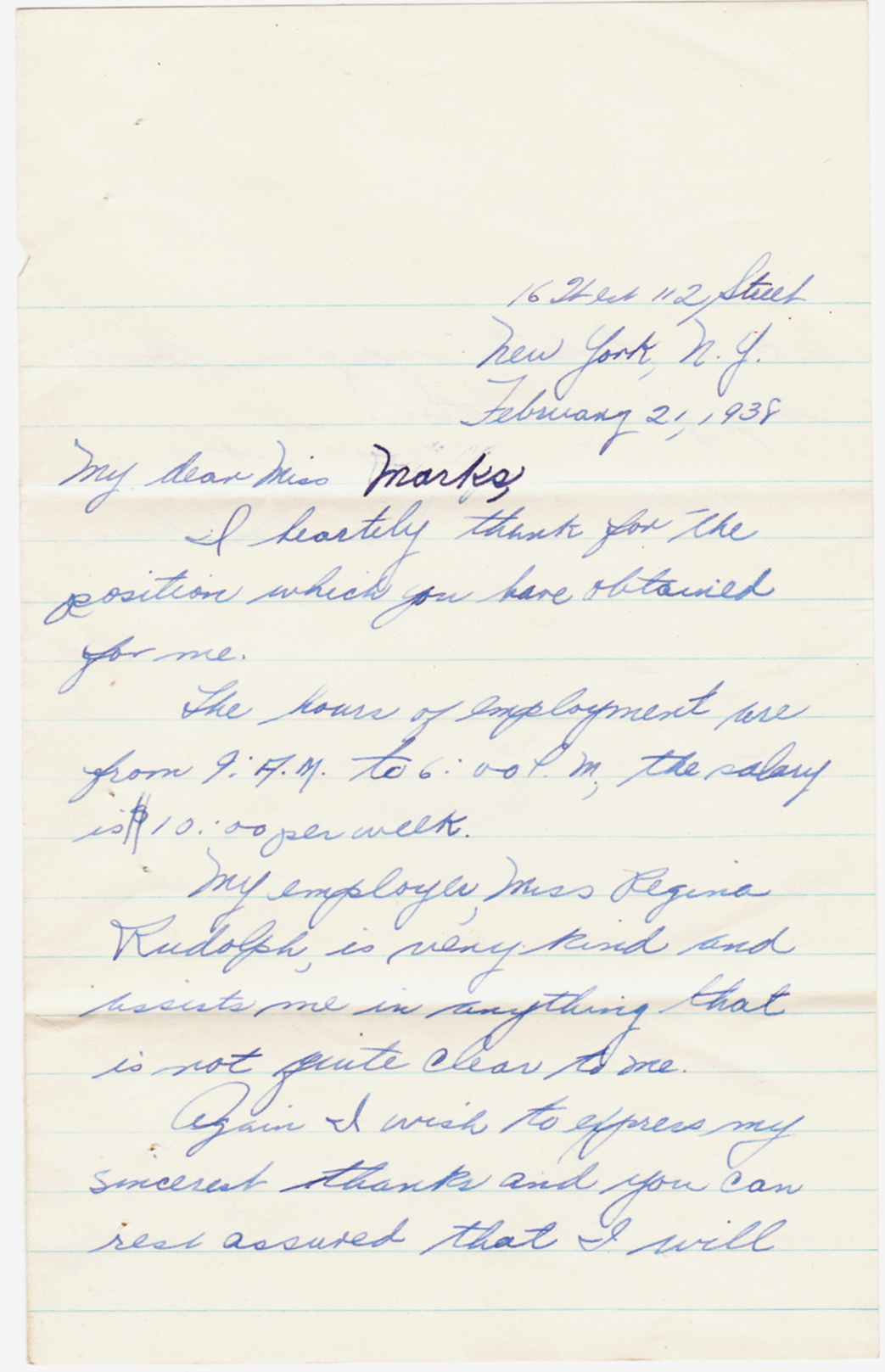
The first job, a five-day stint working for an employer named Regina Rudolph, entailed "errands, to clean, etc." On Feb. 21, 1938 — the fourth of the five days — everything seemed to be going well, as spelled out in this note that Augustina sent to the school:
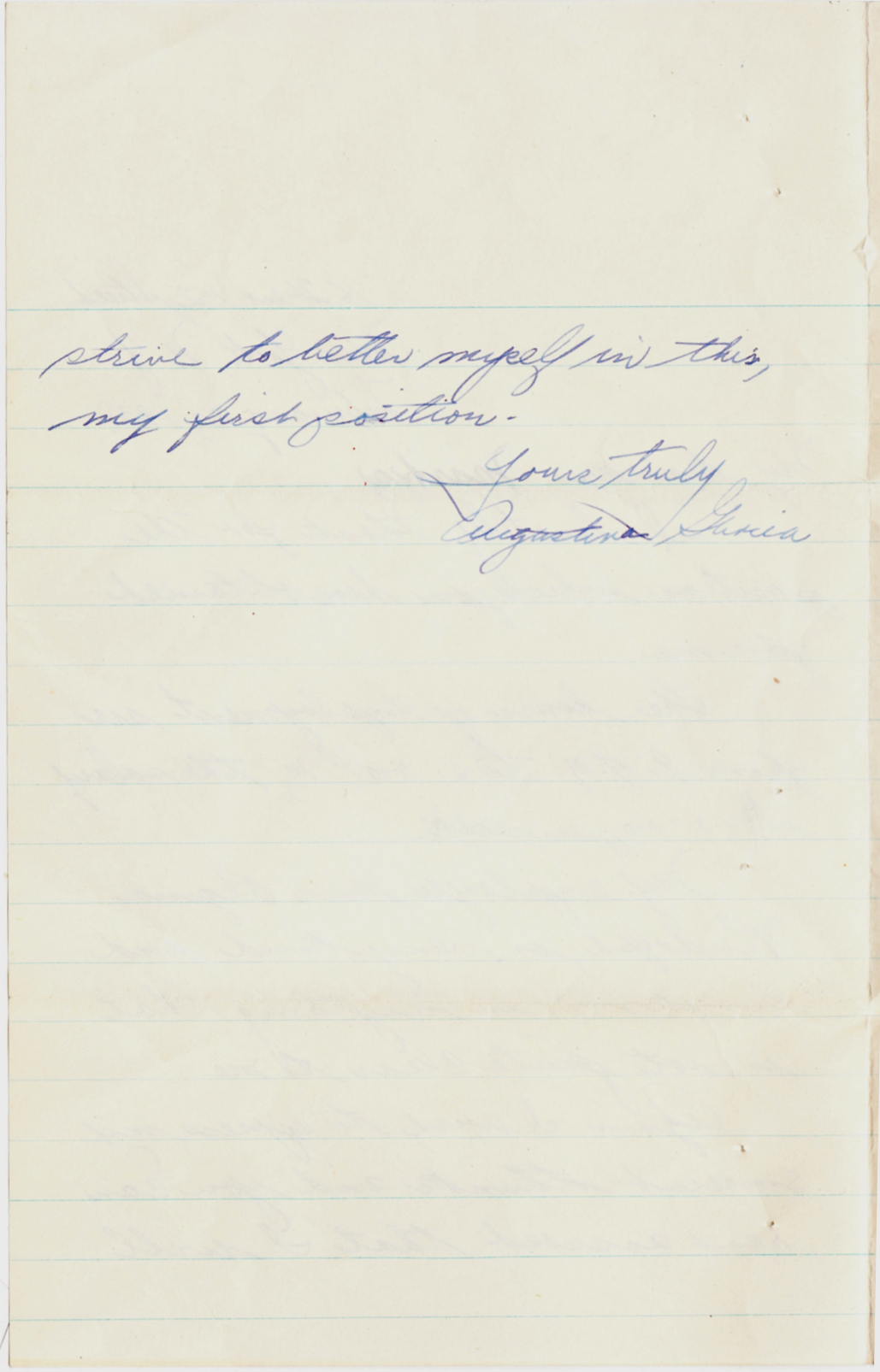
8 9

The letter reads like so:

My Dear Miss Marks,

I heartily thank [you] for the position which you have obtained for me.

The hours of employment are from 9am to 6pm; the salary is $10 per week.

My employer, Miss Regina Rudolph, is very kind and assists me in anything that is not quite clear to me.

Again I wish to express my sincerest thanks and you can rest assured that I will strive to better myself in this, my first position.

Yours truly,
Augustina Garcia

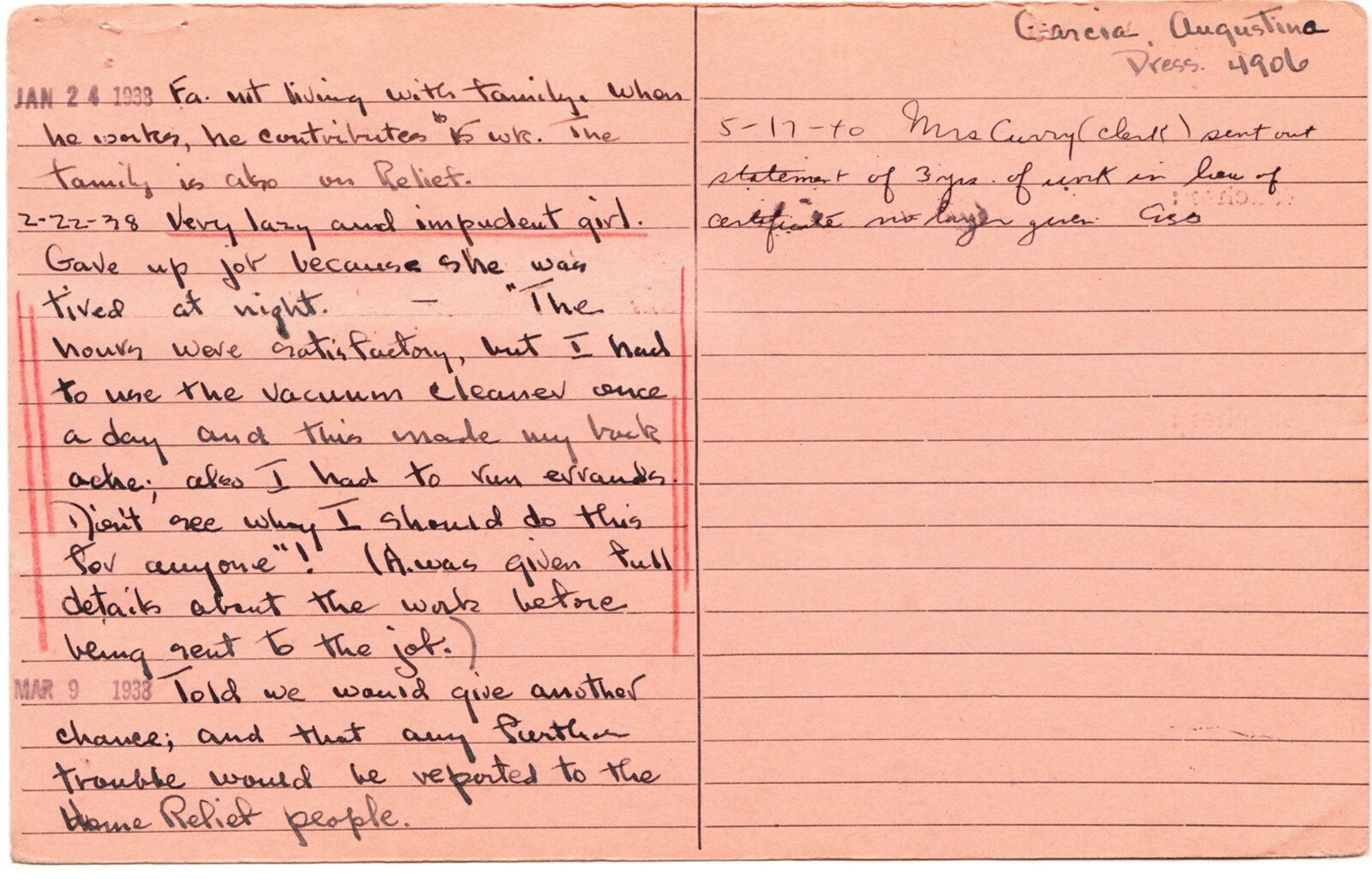
But something must have gone wrong along the way. The day after this letter was written, Augustina left the position. If you scroll back up to the yellow card, you can see that she left because "Work too hard! See note." The note being referred to there can be found on this next card, outlined in red:
5

The note, which is unsigned but is rendered in the telltale handwriting of the school's very demanding job placement secretary, Althea Kotter, reads as follows:

Feb. 22, 1938: Very lazy and impudent girl Gave up job because she was tired at night. "The hours were satisfactory, but I had to use the vacuum cleaner once a day and this made my back ache; also I to to run errands. Don't see why I should do this for anyone"! (Augustina was given full details about the work before being sent to the job.)

March 9, 1938: Told we would give another chance, and that any further trouble would be reported to the Home Relief people.

Yowza. Whatever the specifics of the dispute, it does seem odd that Augustina was sent to vacuum and run errands after having been trained in dressmaking, and one wonders if her ethnicity had anything to do with it. If you scroll back up to the yellow card, you can see that her next two jobs involved hand sewing — in one case at a home for the aged and then for a lampshade manufacturer — but at no point did the school send her out for dressmaking work. Hmmmm.

If anyone knows more about Augustina, please get in touch. Thanks.

• • • • •

Update: Reader Miriam Sicherman informs me that "Porto Rico" was actually an accepted spelling in the early 1900s. That's confirmed by this Wikipedia entry, which includes the following:

In 1932, the U.S. Congress officially corrected what it had been misspelling as Porto Rico back into Puerto Rico. It had been using the former spelling in its legislative and judicial records since it acquired the territory. Patricia Gherovici states that both "Porto Rico" and "Puerto Rico" were used interchangeably in the news media and documentation before, during, and after the U.S. invasion of the island in 1898. The "Porto" spelling, for instance, was used in the Treaty of Paris, but "Puerto" was used by The New York Times that same year. Nancy Morris clarifies that "a curious oversight in the drafting of the Foraker Act caused the name of the island to be officially misspelled."

Augustina enrolled at Manhattan Trade in 1935, so the official spelling had been established as "Puerto" for three years by then. Still, in light of this new information (or at least it's new to me), the "Porto" designation on Augustina's card no longer looks quite so egregious.

Thursday, March 19, 2015

Student of the Week: Madeline Garbarini

1
For all documents, click to enlarge

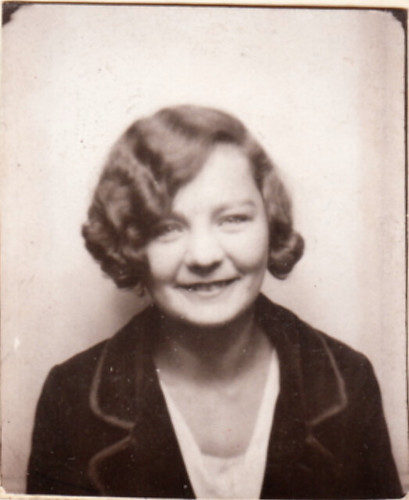
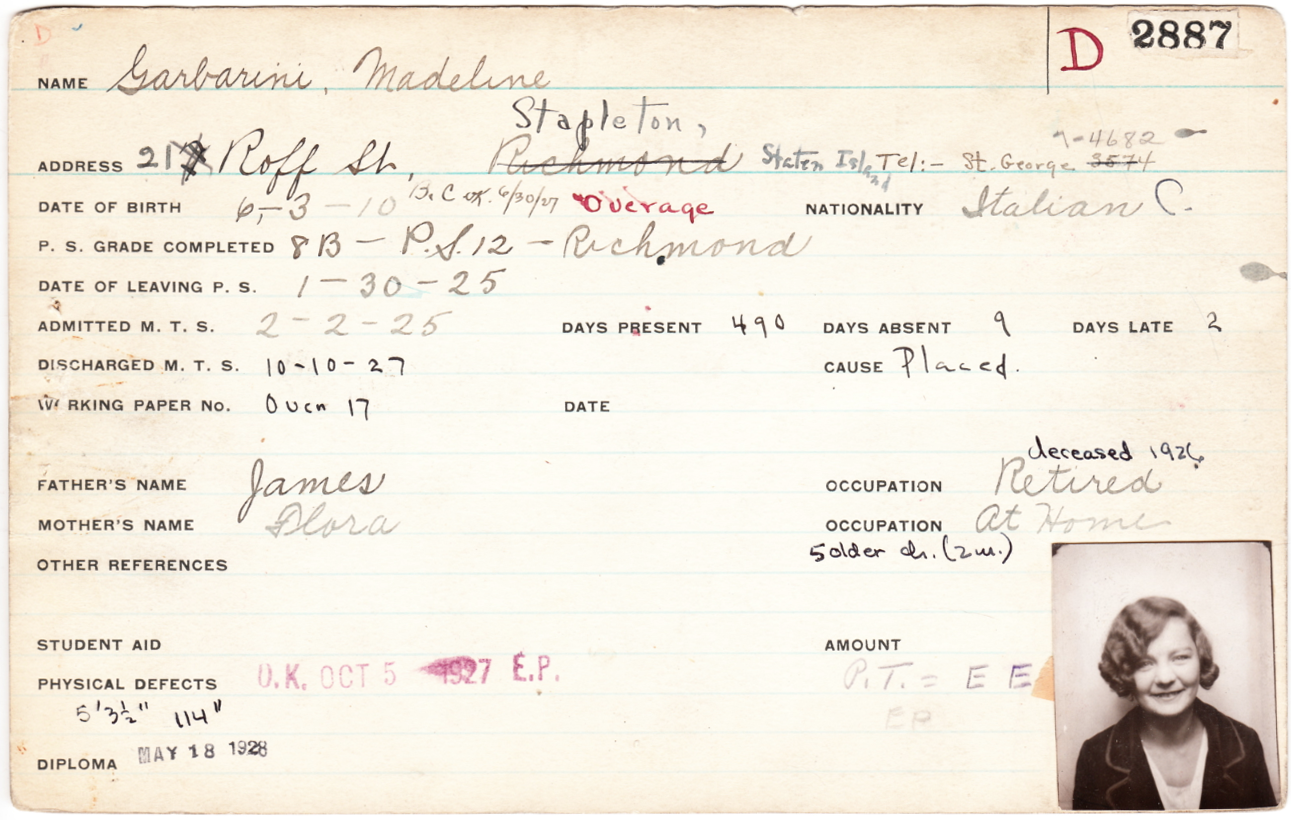
Our latest Manhattan Trade School student is Madeline Garbarini, a dressmaking student from Staten Island whose primary card is shown above. I should admit from the outset that her story is not particularly remarkable, but I was drawn to her student record because of her photo, which is one of the most engaging and likable portraits to be found in my report card collection. Let's take a closer look:

5

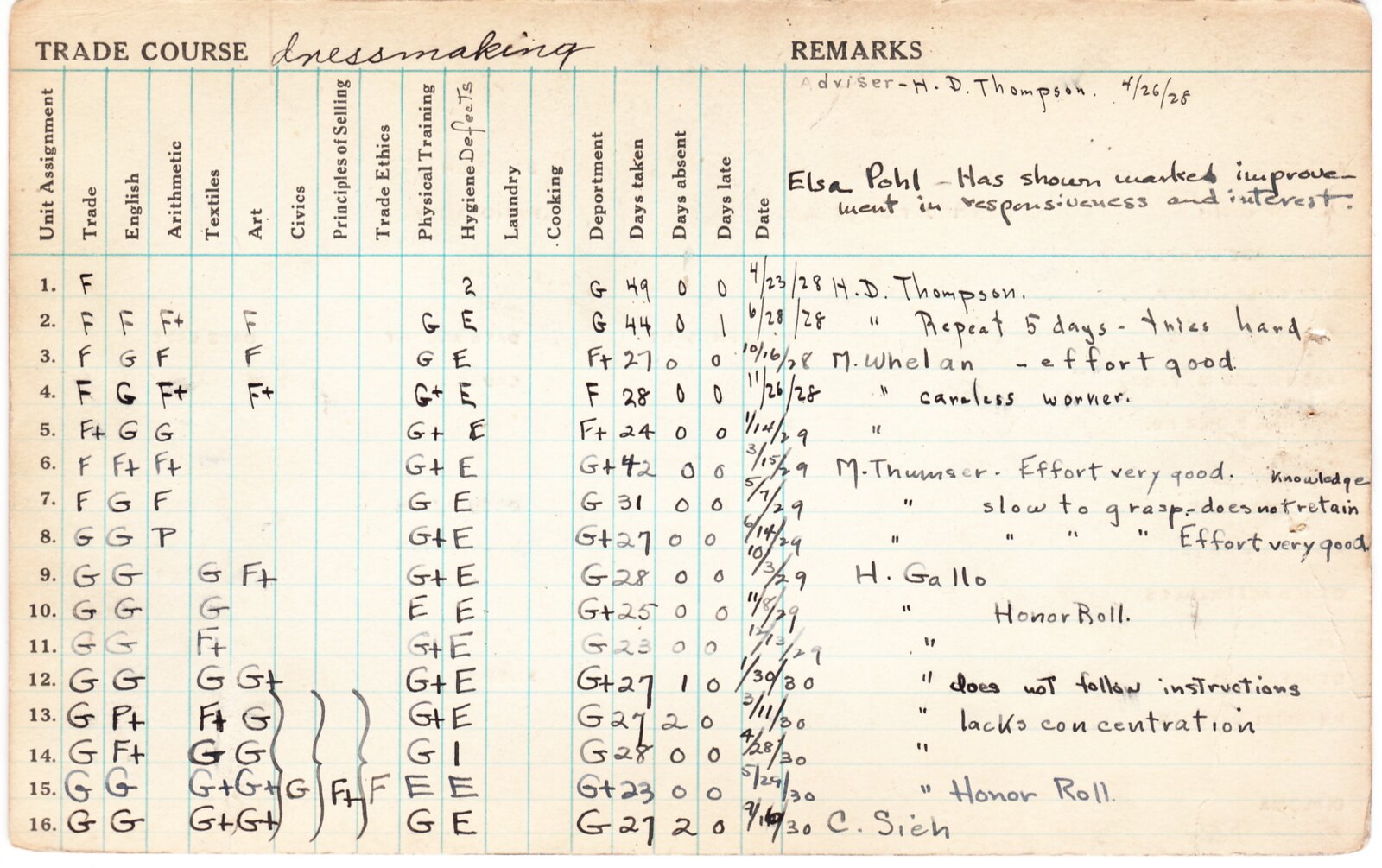
Nice haircut and jacket, right? Here are her grades, which were generally solid if unspectacular:

2

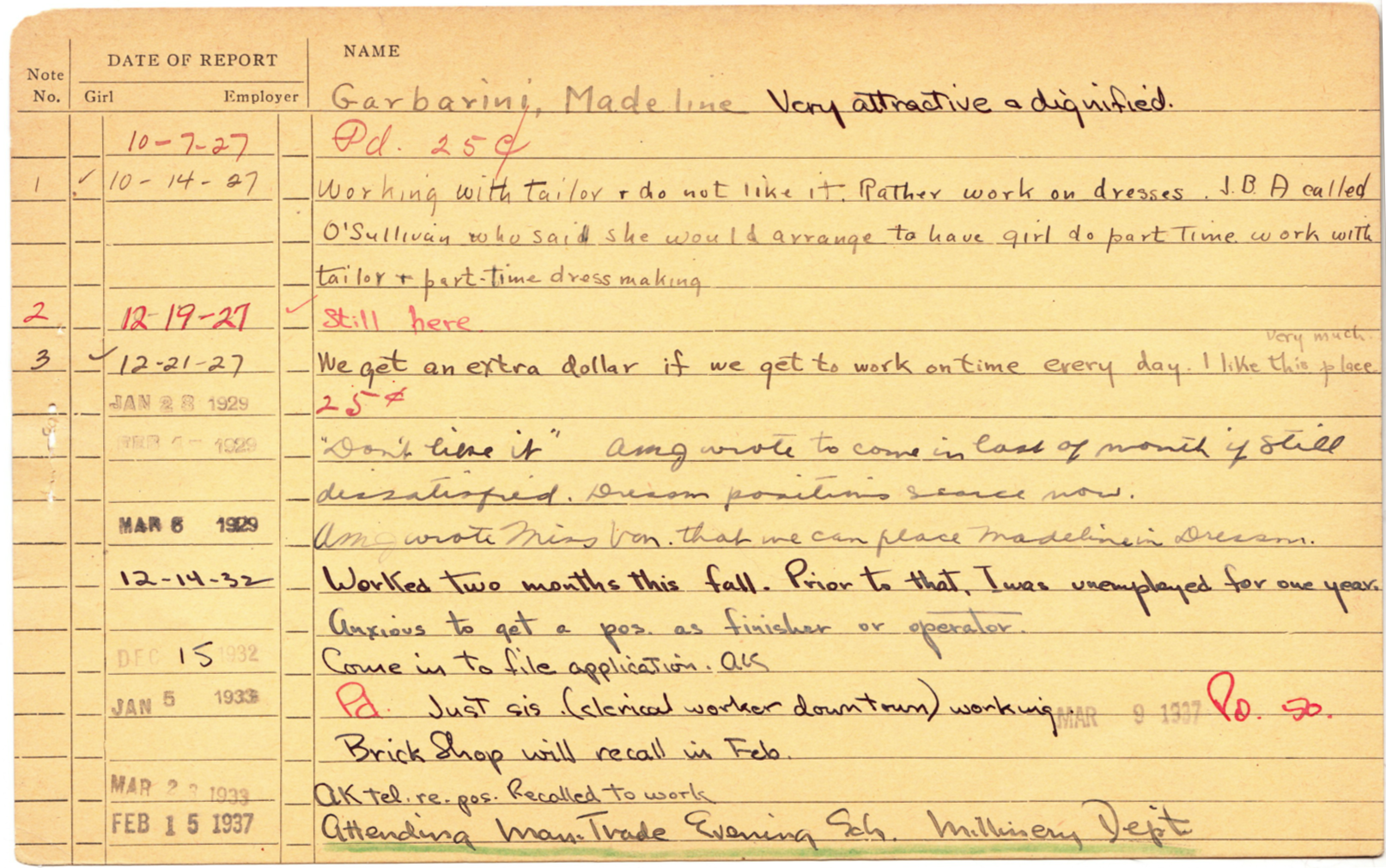
And here is Madeline's work record. The interesting thing here is that she left the school in 1927 but was still taking job referrals from the school in 1937 — another case of the school maintaining a surprisingly long relationship with its students:

3

And here are the comments regarding Madeline's work experiences:

4

Here's a transcript of some of the more interesting commentary (as usual, I've spelled out some abbreviated terms and made other small adjustments for the sake of clarity):

Oct. 14, 1927: Working with tailor and do not like it. Rather work on dresses. JBA [job placement secretary at school] called O'Sullivan [the employer], who said she would arrange to have girl do part-time work with tailor and part-time dressmaking.

Dec. 21, 1927: We get an extra dollar if we get to work on time every day. I like this place very much.

Feb. ??, 1929: "Don't like it." AMG [school official] wrote telling girl to come in last [day] of month if still dissatisfied. Dressmaking positions scarce now.

Dec. 14, 1932: Worked two months this fall. Prior to that, I was unemployed for one year. Anxious to get a position as a finisher or [sewing machine] operator.

Feb. 15, 1937: Attending Manhattan Trade evening School, Millinery Dept.

Very interesting to see that Madeline went back to Manhattan Trade to learn millinery. This was during the Great Depression, of course, and she must have been desperate to increase her employment prospects.

That's all I have for Madeline. If you know more about what became of her, please get in touch.

• • • • •

Every now and then, someone will email me out of the blue and say, "I was doing some genealogical research and spotted a family member on your list of report card students. Could I see her student record?"

I receive only two or three of these emails per year. So it was rather amazing when I received two of them, just a few hours apart, this past Tuesday. In both cases, I've emailed the report card scans to the people who got in touch and am hoping they'll agree to do follow-up interviews with me for Permanent Record. Stay tuned.

Thursday, February 12, 2015

Student of the Week: Virginia Carucci

1
For all documents, click to enlarge

Our latest Manhattan Trade School enrollee is Virginia Carucci, a dressmaking student who took classes at the school from 1928 through 1930. As you can see above, she was part of a large Italian-American family (she had six siblings) that lived in the Bronx, where her father worked as a butcher.

Unfortunately, there's a sad note at the top: "Deceased 9-19-31." Virginia would have been only 19 at the time. We'll learn more about this later in her student record.

Before we get to that, let's take a look at Virginia's grades and teacher comments (as always, E = Excellent; G = Good; F = Fair; P = Poor):

2

As you can see, Virginia's grades were generally quite good. She made the Honor Roll several times but was occasionally called out for carelessness.

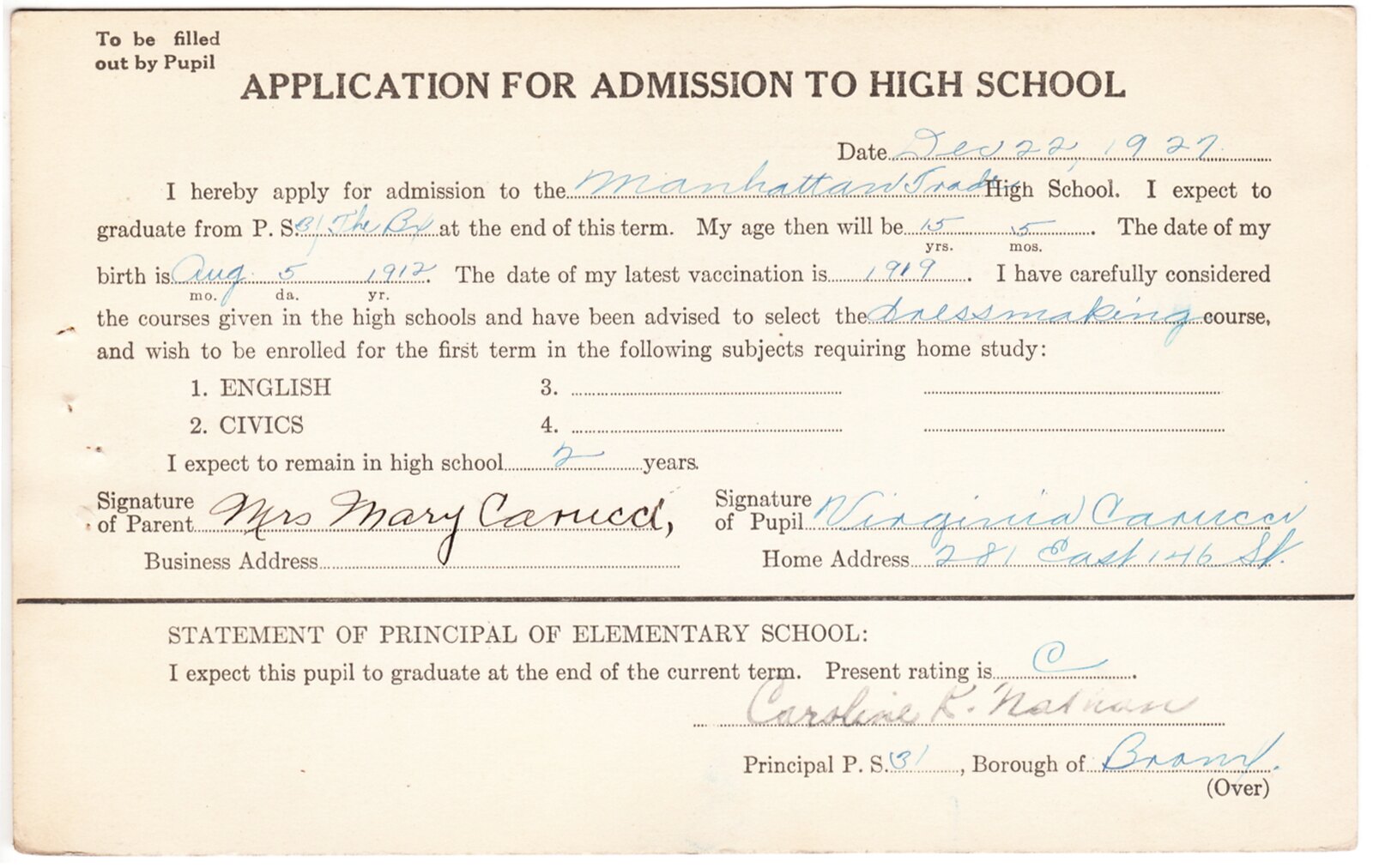
Next up is a document that I don't think I've ever shown before here on the blog: an application for admission to Manhattan Trade. For whatever reason, this card doesn't show up in most of the student records in my collection, but Virginia's was preserved in her file:

3

Next up is Virginia's employment record, showing the jobs to which she was referred by the school's job placement office:

4

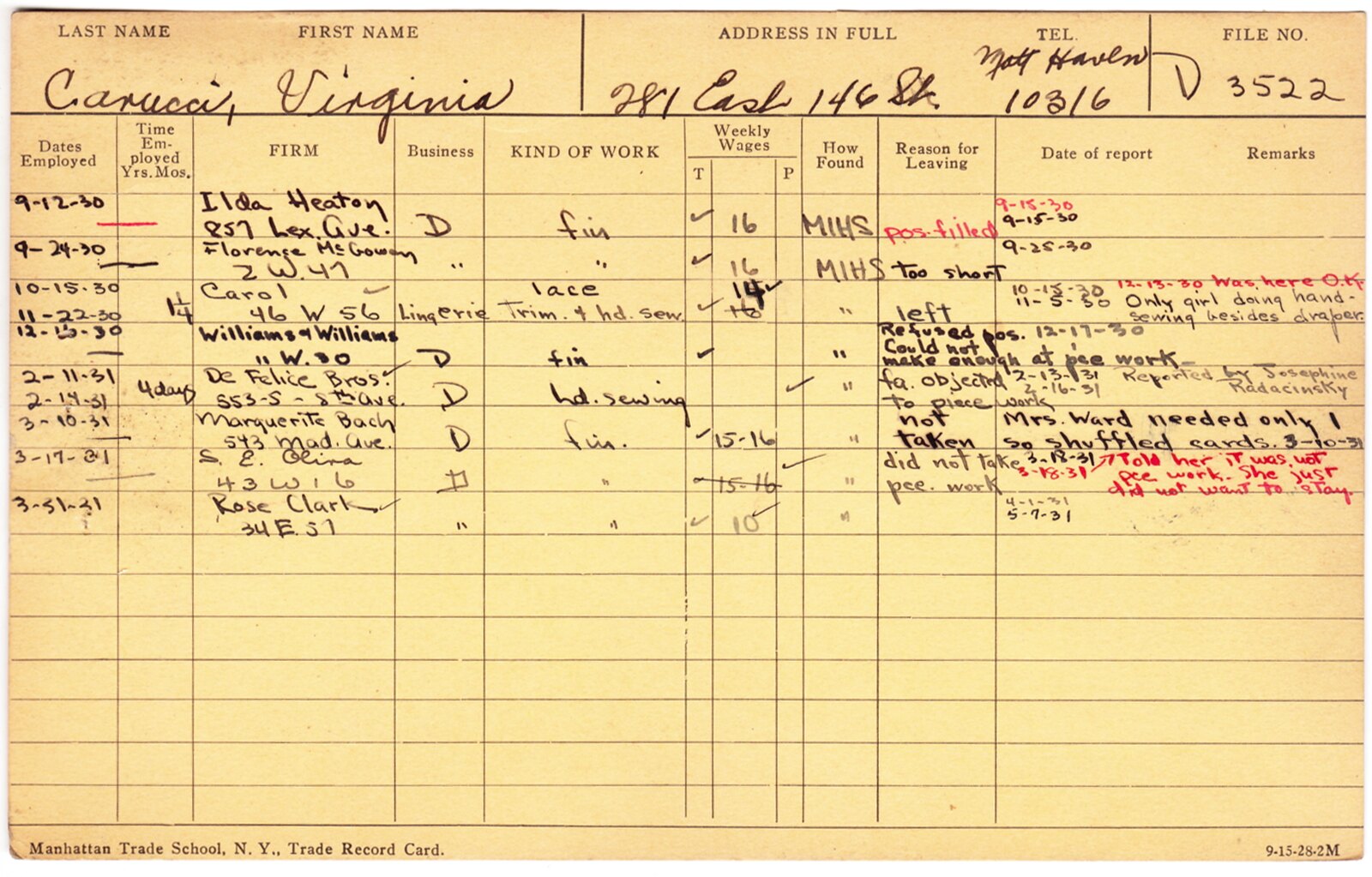
There are a few interesting entries here. For Virginia's second job, for example, her "Reason for Leaving" is listed as "too short." Does this mean that the duration of the job was short, or that Virginia herself was too short to do the tasks required of her? If you scroll back up and look at the lower-left corner of the first card in her file, you can see that she was indeed short — 5'1". Hmmmm.

Virginia also left several jobs because she objected to "piece work" — in other words, being paid by the piece instead of by the week, which is a hard way to make any money for all but the very fastest workers. But in one instance, an employer (whose comment is listed in red) rebutted Virginia's claim: "Told her it was not piece work. She just did not want to stay."

Now we come to the final card in Virginia's file, with comments from the school's job placement staff:

5

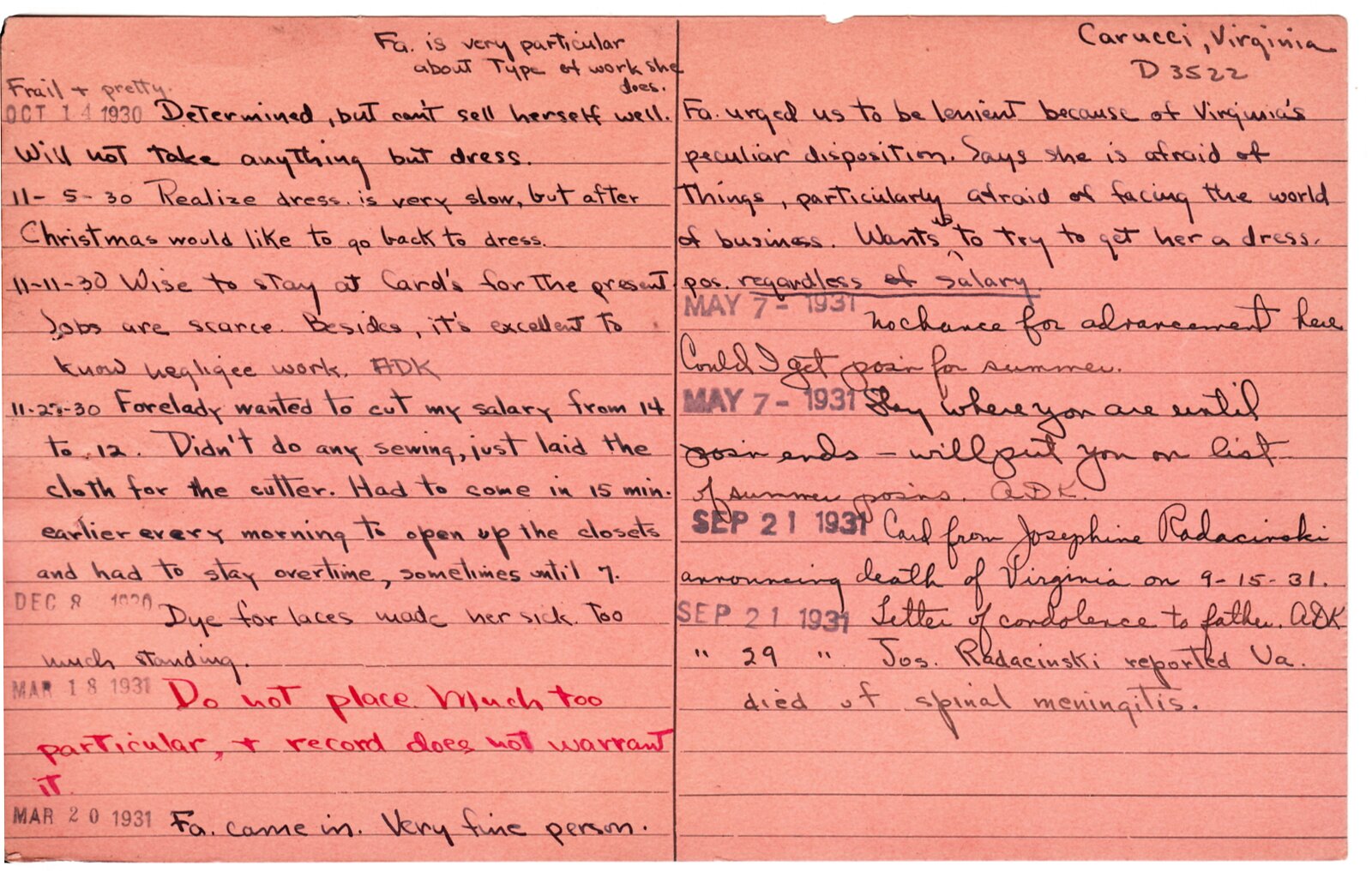
Lots of interesting comments on this card. Here's a transcription of some of the more intriguing bits. As usual, I've spelled out a few abbreviated and omitted terms for the sake of clarity:

Oct. 14, 1930 [comment from Althea Kotter, the placement secretary]: Frail and pretty. Determined, but can't sell herself well. Will not take [any position] but dressmaking.

Nov. 5, 1930 [comment from Virginia, who at the time was working for a lingerie shop called Carol's]: I realize dressmaking is very slow, but after Christmas I would like to go back to dressmaking.

Nov. 11, 1930 [from Ms. Kotter to Virginia]: Wise to stay at Carol's for the present. Jobs are scarce. Besides, it's excellent to know negligee work.

Nov. 28, 1930 [from Virginia]: Forelady wanted to cut my salary from $14/week to $12/week. Didn't do any sewing, just laid the cloth for the cutter. Had to come in 14 mins. earlier every morning to open up the closets. And had to stay overtime, sometimes until 7.

Dec. 8, 1930 [from Ms. Kotter]: Dye from laces made her sick. Too much standing.

March 18, 1931 [from either Ms. Kotter or another school administrator]: Do not place. Much too particular, and her record does not warrant it.

March 20, 1931 [from Ms. Kotter]: Father came in. Very fine person. Father urged us to be lenient because of Virginia's peculiar disposition. Says she is afraid of things, particularly afraid of facing the world of business. Wants us to try to get her a dressmaking position regardless of salary.

May 7, 1931 [from Virginia]: No chance for advancement here. Could I get a position for the summer? [It's not clear what job this was, as Virginia's work record shows no entries after March 31, 1931. — PL]

May 7, 1931 [from Ms. Kotter]: Stay where you are until position ends. Will put you on the list for summer positions.

Sept. 21, 1931: Card from Josephine Radacinski, announcing death of Virginia on Sept. 15, 1931.

Sept. 21, 1931: Letter of condolence sent to father.

Sept. 29, 1931: Josephine Radacinski reported Virginia died of spinal meningitis.

And that's where it ends. Interestingly, there is now a vaccine to help prevent meningitis, which seems particularly relevant given the current controversy regarding childhood vaccinations. Had such a vaccine been available a century ago, Virginia might have lived into adulthood.

• • • • •

Update: Remember Tony Trapani, the 81-year-old Michigan man who found an old letter indicating that he had a son he'd never known about? There's a sad ending to that story: A DNA test has shown that his purported son is not his son after all. Both men are devastated but say they plan to treat each other as family anyway.

(My thanks to John Chapman for alerting me to this updated info.)

Sunday, February 1, 2015

Student of the Week: Kate Abrescia

1
For all documents, click to enlarge

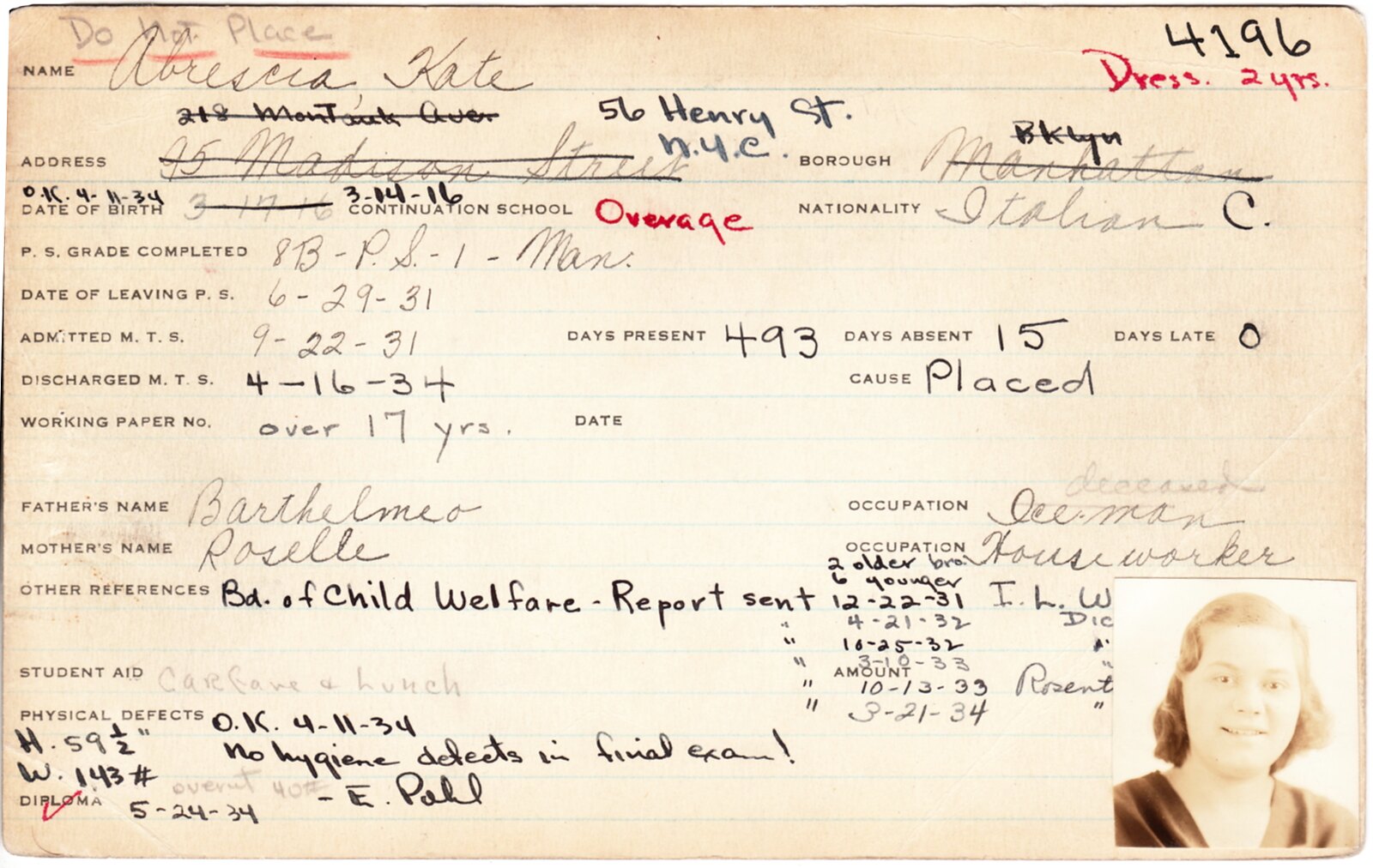
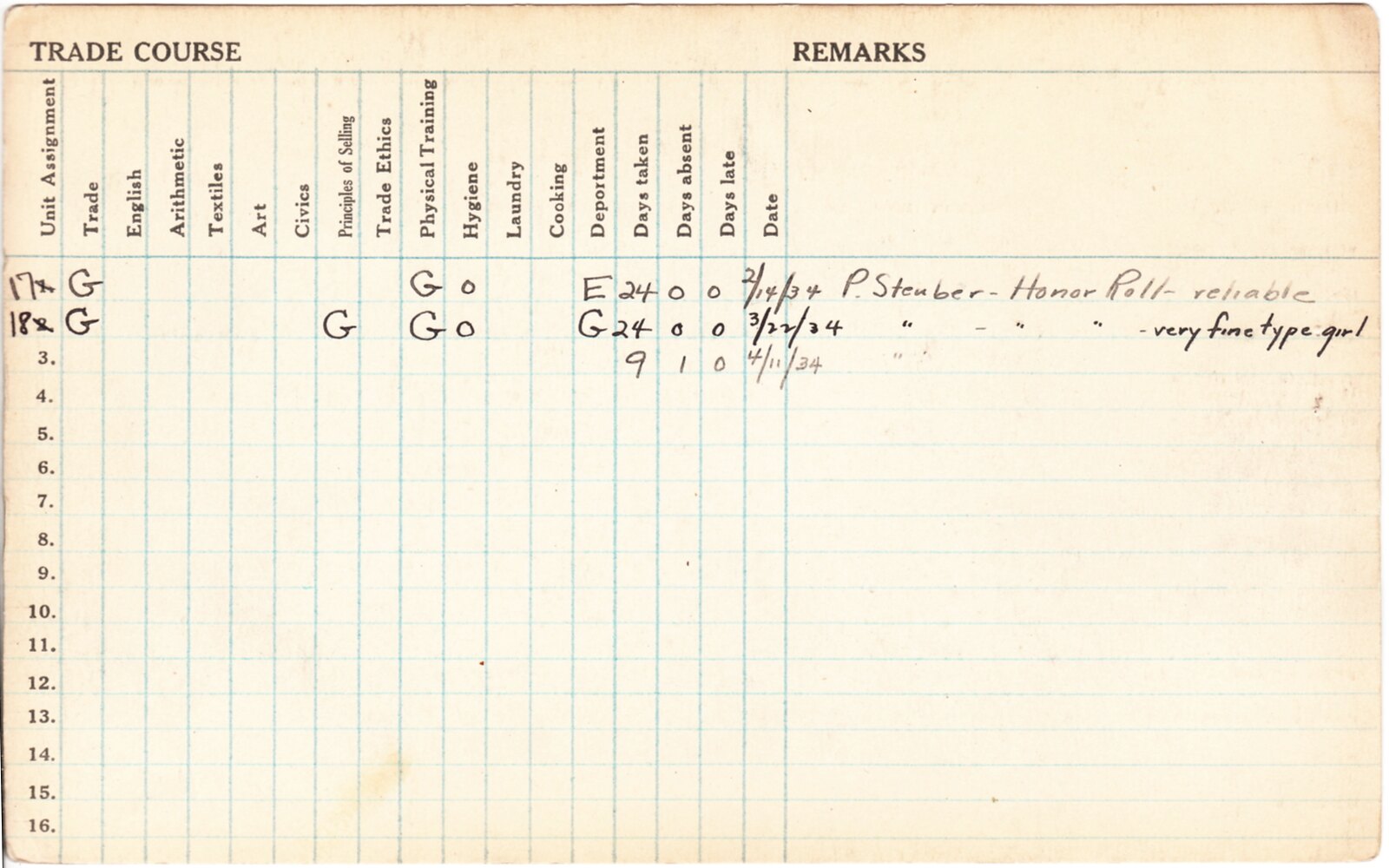
Today we're going to examine the student record of Kate Abrescia, who studied dressmaking at the Manhattan Trade School for Girls in the early 1930s. The most interesting entry on her main card, shown above, is at the top-left corner: "Do Not Place." We will soon find out why.

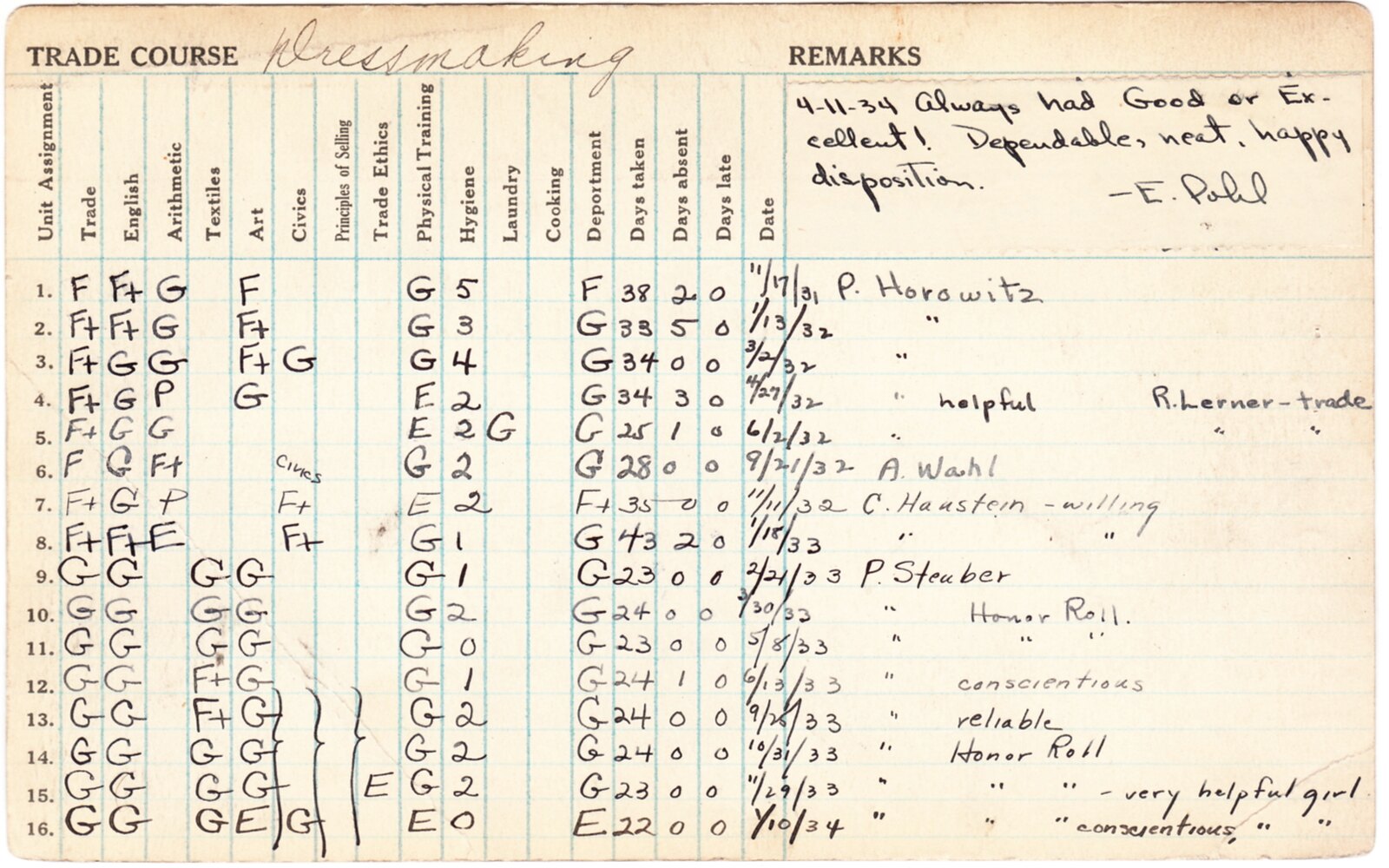
But before we get to that, let's look at Kate's grades and teacher comments, which were generally quite good. Note that she routinely made the Honor Roll, and that she received lots of positive commentary from her teachers (remember, E = Excellent; G = Good; F = Fair; P = Poor):

2 3

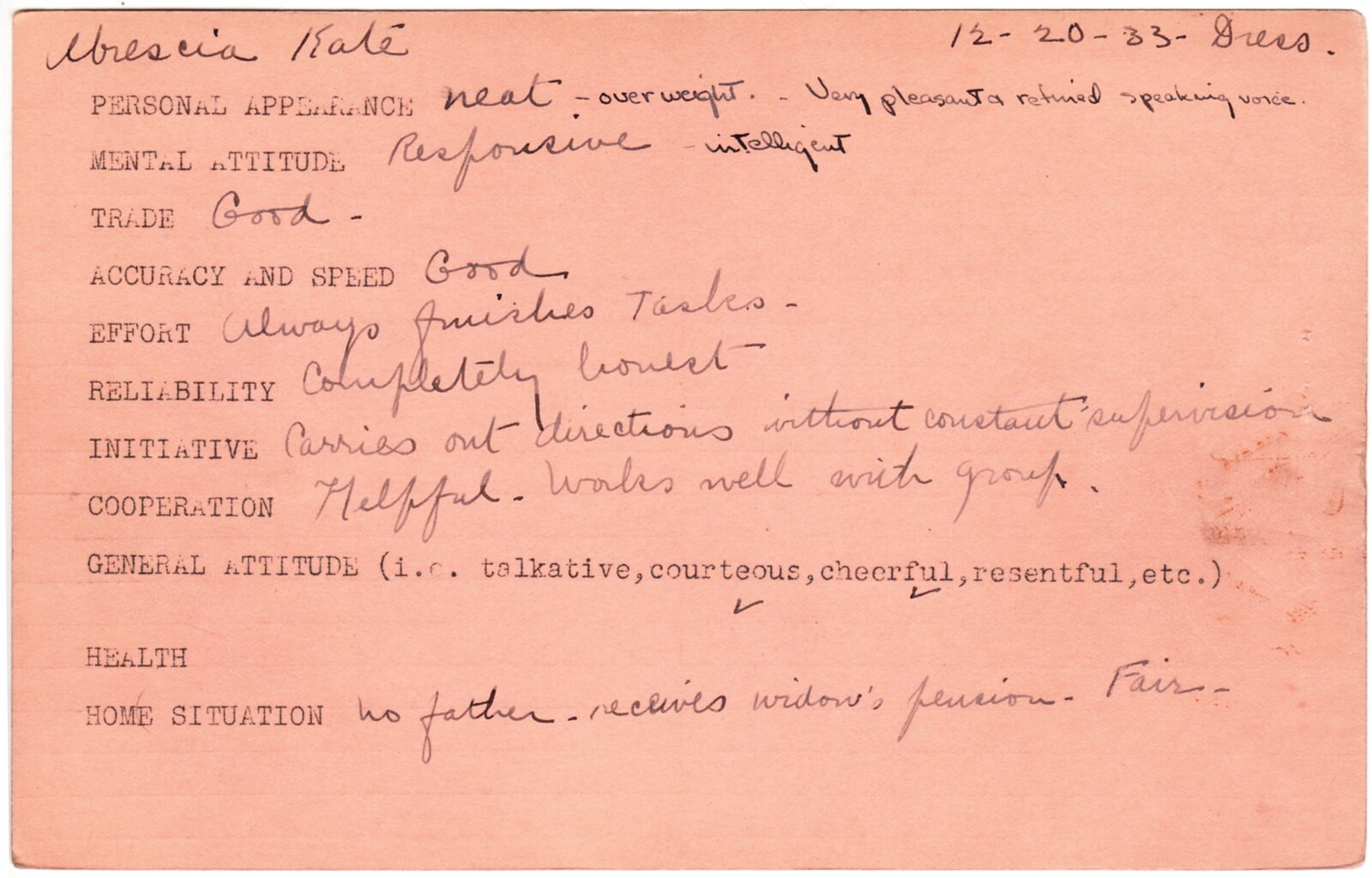
Additional approving commentary can be found on this next card, where Kate is lauded for "[carrying] out directions without constant supervision" and described in an array of glowing terms, including "completely honest":

4

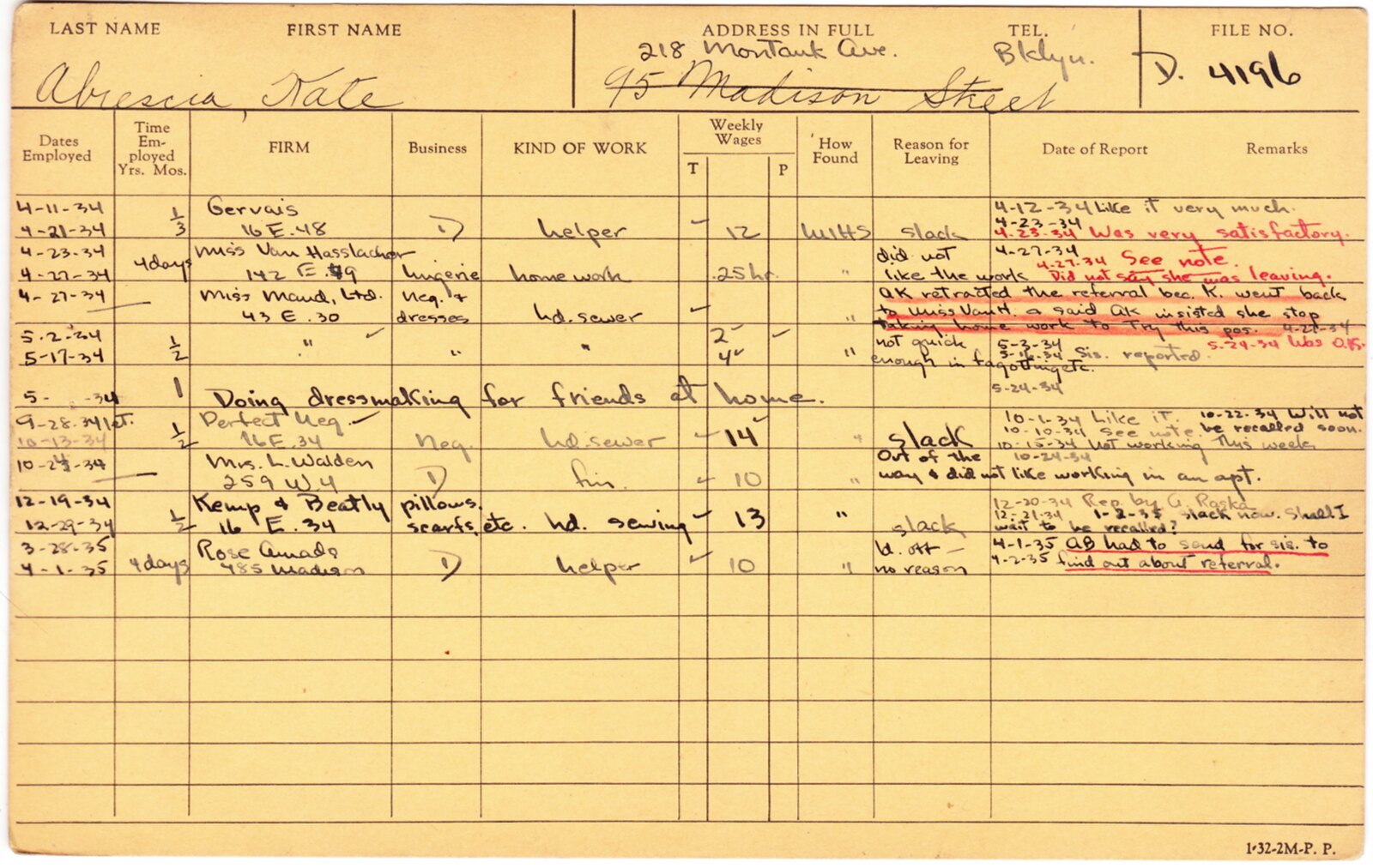
But things apparently began to sour between Kate and school when she was sent out for job referrals. Here's here employment record:

5

The first problem involved a lingerie job in April of 1934 for a Miss Van Hasslacher. According to the "Reason for Leaving" column, Kate left the job because she "did not like the work," but a not in the next column indicates that she left without telling her employer that she was leaving. She apparently left another job because she was "not quick enough in fagotting" (a kind of decorative stitch technique) and left yet another because it was "out of the way and did not like working in an apartment."

Further problems are spelled out on this next card:

6

Here are some of the entries from this card (as usual, I've spelled out some abbreviated terms and filled in a few missing details for the sake of clarity):

April 27, 1934 [comment from employer upon Kate's departure from job]: Does beautiful work but is slow. I thought she would work out nicely. — Miss Van Hasslacher

Dec. 19, 1934: "Hemmed" and "hawed" about going to a job immediately. Wanted to know if she could go the following morning because she had to stay out home [because] mother was out.

April 2, 1935: Independent. Unreliable. Fussy. Uncooperative. AB [Althea Borden, the job placement secretary] refused further placement.

Jan. 10, 1935: Very sorry about her disagreeable attitude. Wouuld like to be placed.

Jan. 14, 1936: RP [apparently a school administrator] wrote that we cannot take the risk of letting you handle one of our jobs. Suggest you watch the New York American ads [this was one of New York City's many daily newspapers at the time] and register with the New York State Employment Service. Best wishes to you.

Wow. And that's how "Do Not Place" ended up at the top of Kate's file. In a few short years she went from teacher's pet to persona non grata and was basically told to fend for herself — in the midst of the Great Depression, no less. I suspect there may be more going on here that is spelled out in Kate's file, but her story nonetheless shows the high standards the school expected when it referred girls for employment.

That's all I have for Kate. If anyone knows what happened to her, please get in touch. Thanks.

Wednesday, January 21, 2015

Student of the Week: Teresa Fantazzo

For all documents, click to enlarge

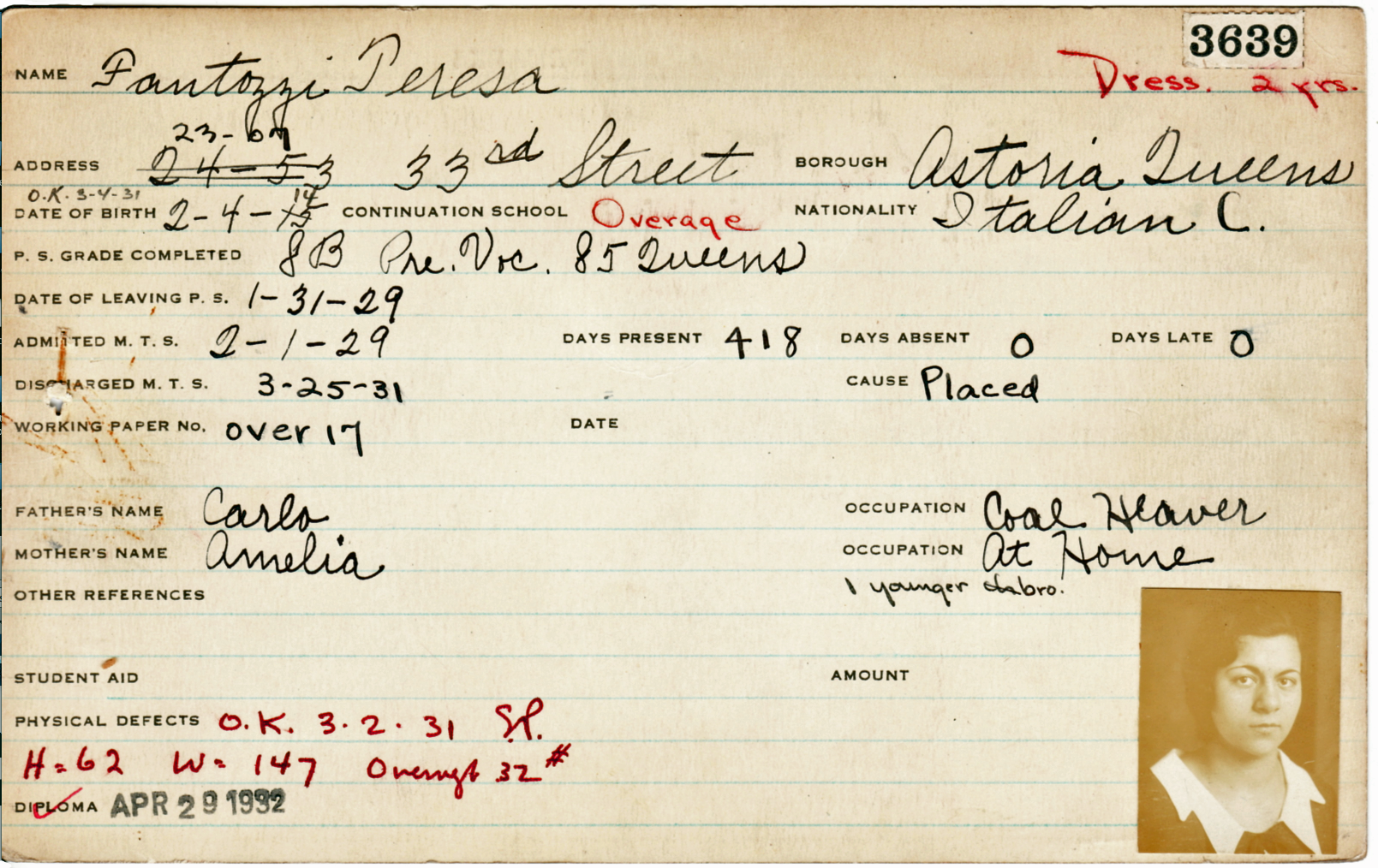
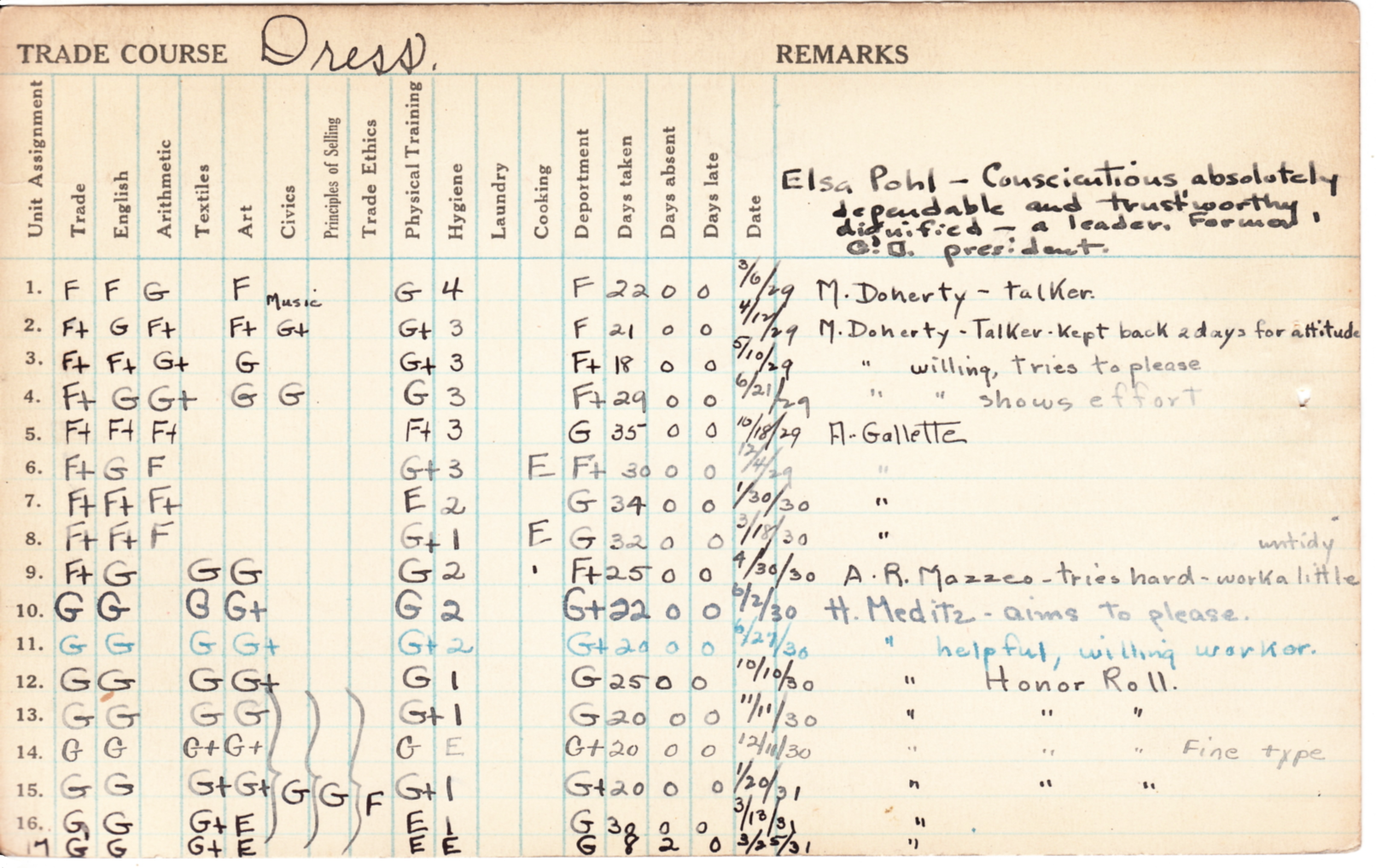
Today we're going to turn our attention to Teresa Fantazzo, a Manhattan Trade School dressmaking student who grew up in Astoria, Queens. Her main card, shown above has two noteworthy items. First, an entry near the bottom notes that she was overweight by 32 pounds. More intriguingly, her father's occupation is listed as "coal heaver," a term I wasn't familiar with, although it seems rather self-explanatory. Some quick Googling produced photos, historical accounts, and more.

Teresa's grade and teach comments were generally good (as always, E = Excellent; G = Good; F = Fair; P = Poor):

2

The comments at top right from Elsa Pohl are particularly strong: "Conscientious, absolutely dependable, and trustworthy, dignified. Former G.O. president." I believe this last comment refers to the school's General Organization, or student body.

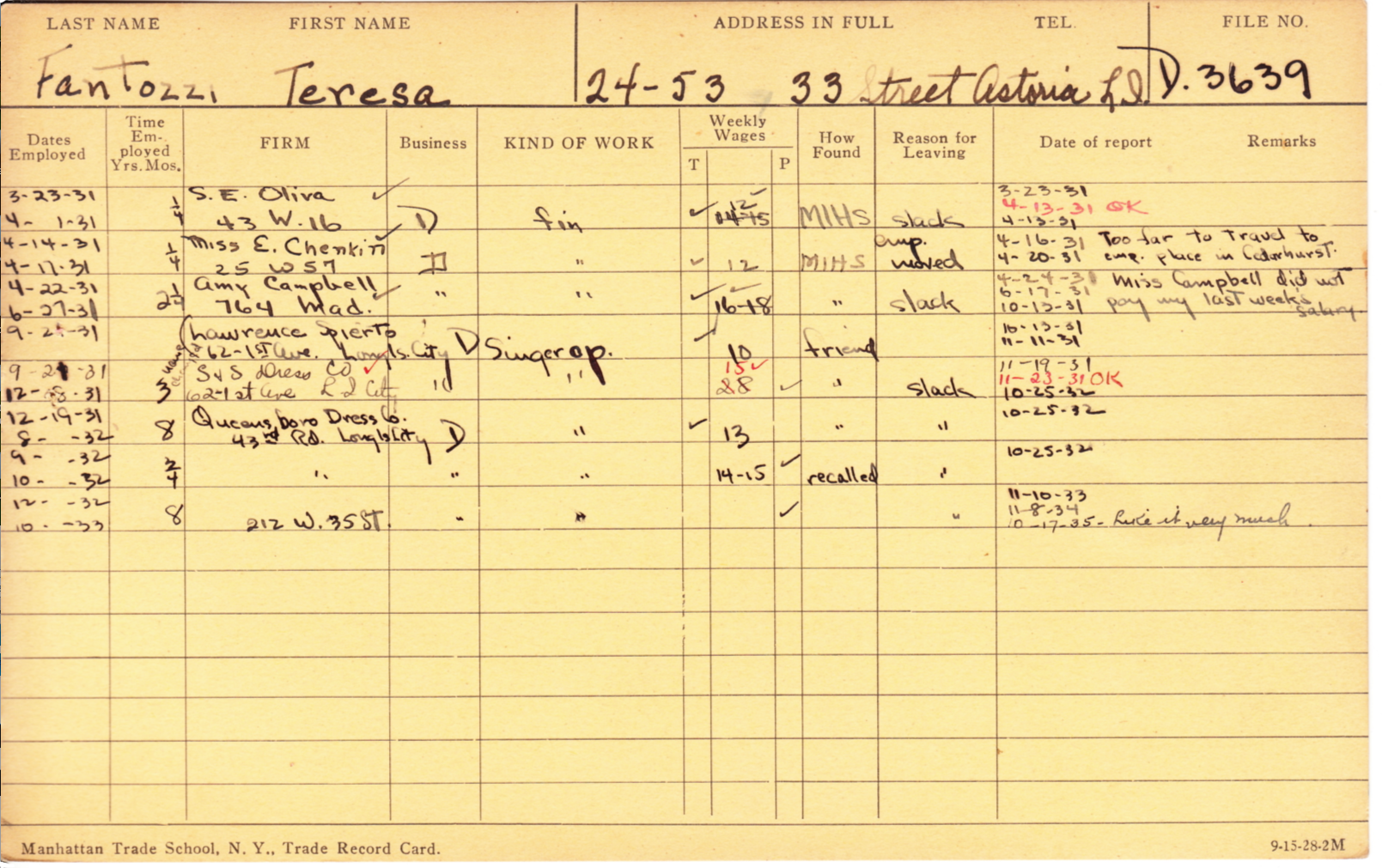
Here's Teresa's employment record, showing an assortment of jobs she had over the course of two and a half years:

3

Note that her first three jobs were as a dress finisher ("fin."), which is in keeping with her chosen trade of dressmarking. But her remaining jobs were spent operating a Singer sewing machine ("Singer op"). Sewing machine skills were a separate course of study at the school, so it's surprising to me that Teresa moved from one trade to another.

The other noteworthy thing here involves Teresa's third job, for a woman named Amy Campbell. A comment in the far-right column reads, "Miss Campbell did not pay my last week's salary."

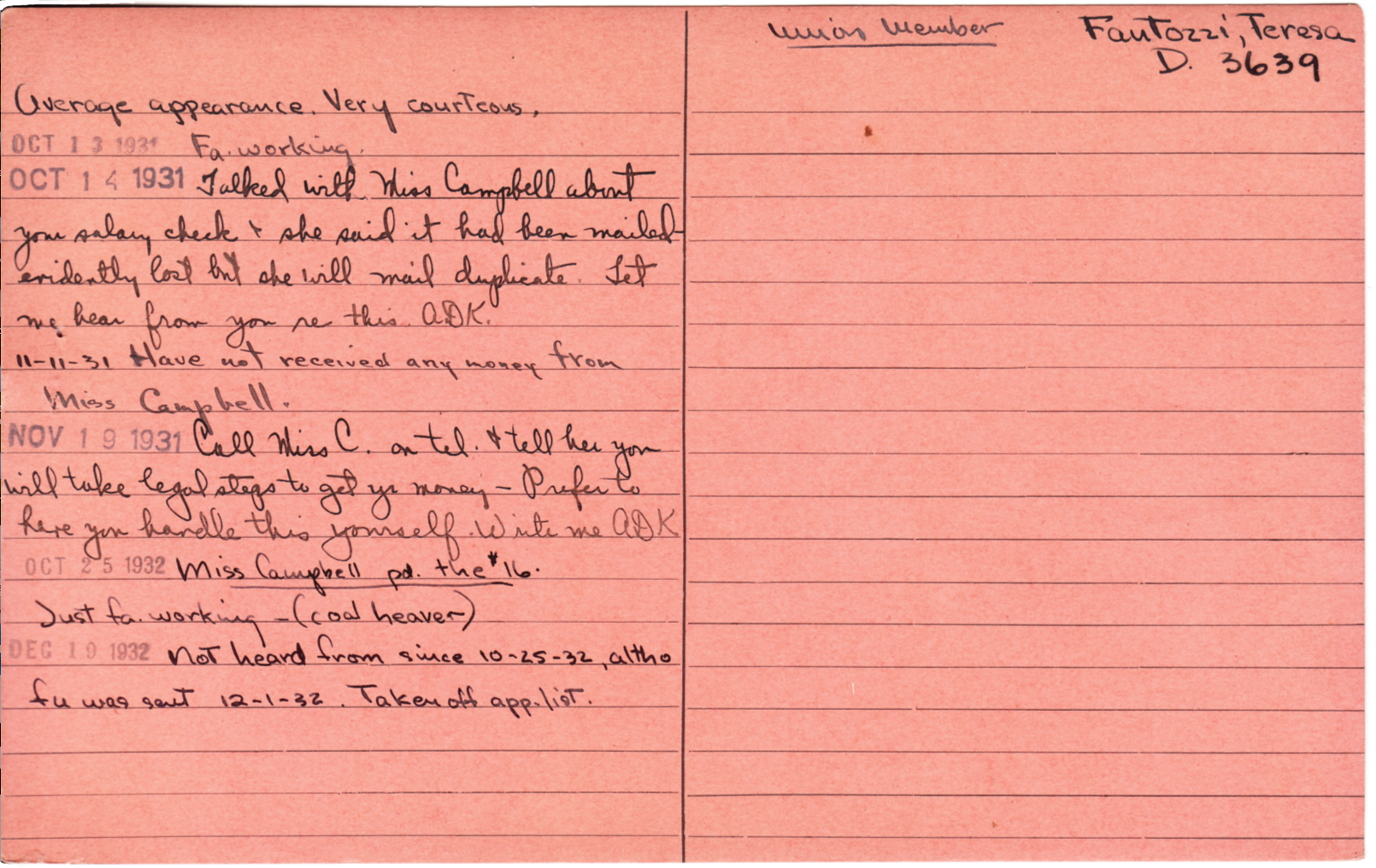
Further information on Teresa's missing wages can be found on this card:

4

The key entries read like so:

Oct. 14, 1931 [comment from job placement secretary, Althea Dreyer Kotter]: Talked with Miss Campbell about your salary check and she said it had been mailed. Evidently lost but she will mail duplicate. Let hear from you about this. — ADK

Nov. 11, 1931 [comment from Teresa]: Have not received any money from Miss Campbell.

Nov. 19, 1931 [comment from Mrs. Kotter]: Call Miss Campbell on the telephone and tell her you will take legal septs to get your money. Prefer to have you handle this yourself. Write me. — ADK

Oct. 25, 1931 [this date is almost certainly wrong and was probably supposed to be Nov. 25}: Miss Campbell paid the $16.

I feel conflicted about the school telling Teresa to handle the situation herself. On the one hand, it's good that they encouraged her to stick up for herself. On the other, this was a job that the school had arranged for Teresa, and she was only 17 years old when this all took place -- pretty young to be threatening employers with legal action. Couldn't the school have interceded on her behalf? In any event, it's good to see that the matter was resolved.

That's all I have for Teresa. If anyone knows more about her, please let me know. Thanks.

Thursday, January 15, 2015

Student of the Week: Marian Fantacone

1
For all documents, click to enlarge

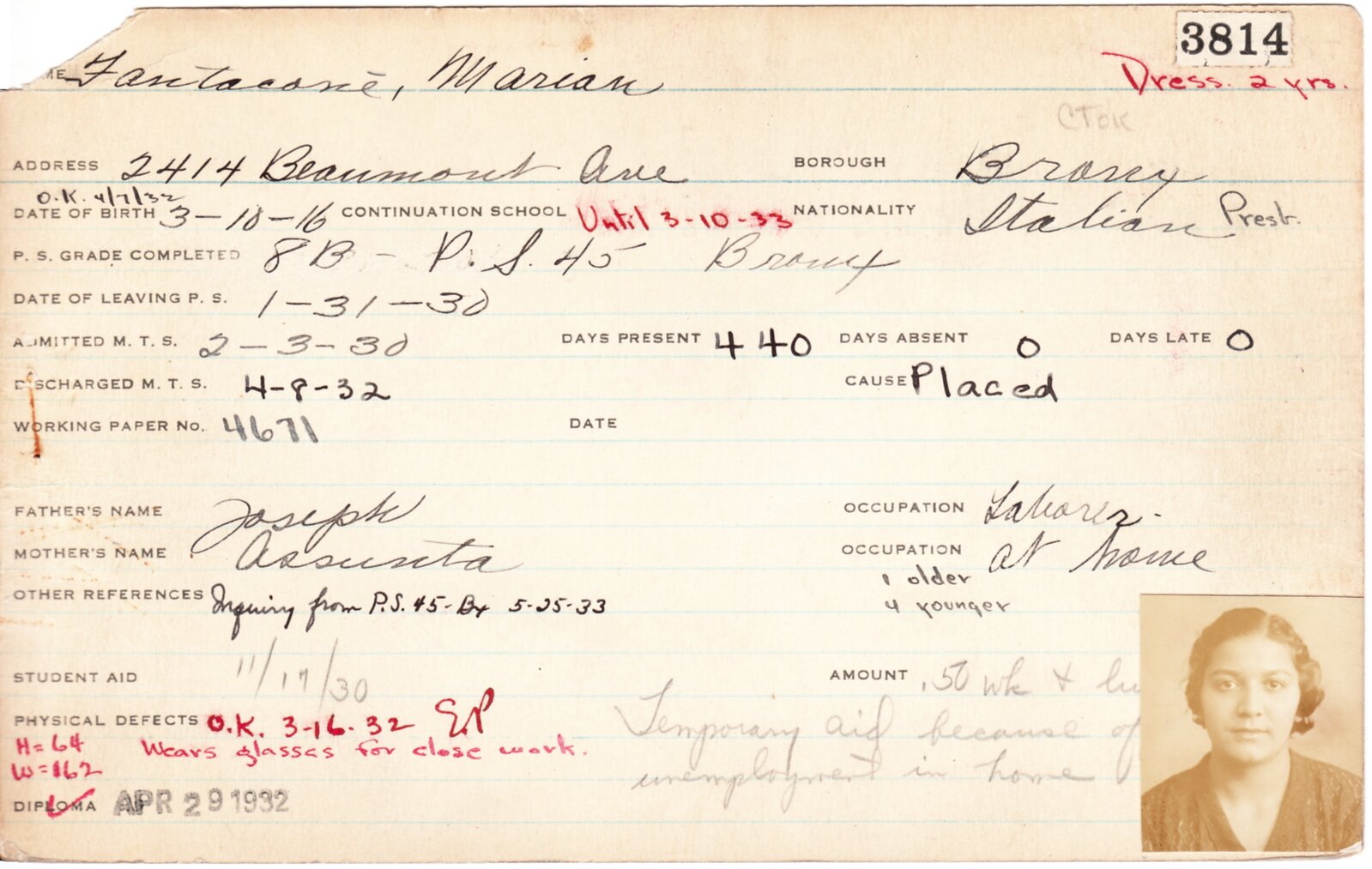
This week we're examining the record of Marian Fantacone, an Italian-American dressmaking student who lived in the Bronx and attended the Manhattan Trade School for Girls in the early 1930s. She was born in March of 1916, which means she's closing in on her 99th birthday if she's still alive. The spelling of her first name keeps switching back and forth between "Marian" and "Marion" in her file, but I'm going to go with Marian, because that's how it's listed on her primary card, which is shown above.

A note next to Marian's photo says, "Temporary aid because of unemployment in home." We'll learn more details about this shortly.

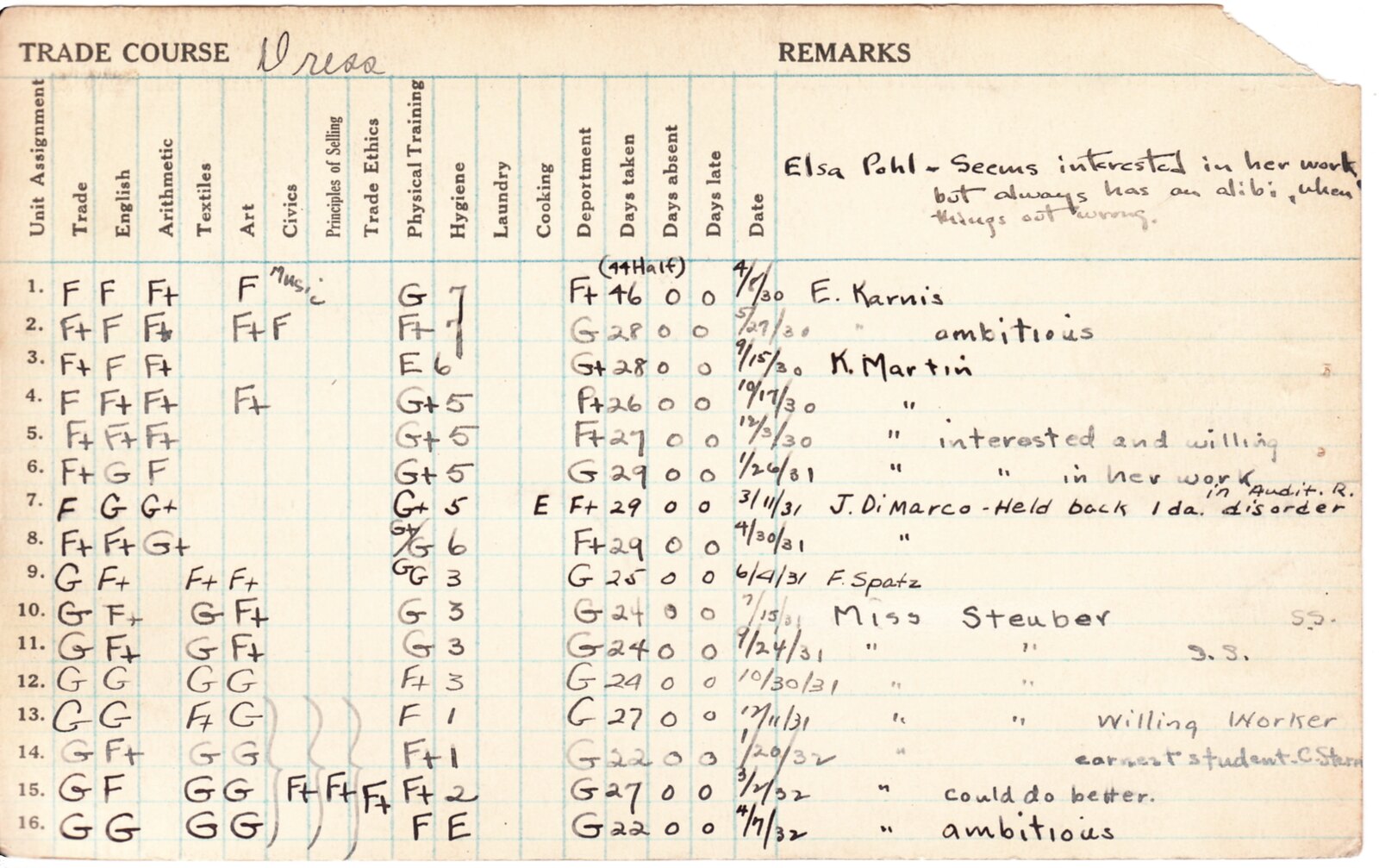
Marian's grades were generally solid, and her teachers' comments were, on the whole, positive (remember, E = Excellent; G = Good; F = Fair; P = Poor):

2

Next we have Marian's financial aid records, beginning with an assessment of her household, which shows that she was the second-oldest of two children and that her father and older brother -- a bricklayer's helper and a painter, respectively -- were both out of work (not surprising, given that this was in the midst of the Great Depression):

5

It was standard procedure for the school to make a visit to the home of any student for whom financial aid had been proposed. Here is a school employee's account of the visit to Marian's home:

6

The report, by a woman named Katherine E. Martin (a name that is not familiar to me from other students' files), reads as follows:

On Wednesday, November 12th, 1930, I visited the home of Marian Fantacone at 2414 Beaumont Ave., Bronx. Mr. Fantacone and his son, who is 19 years old, are out of work. The father has been idle for 2-1/2 months. The son has been doing some painting for the landlord but receives no money for the ob, because two months' rend is owing and the painting is for part payment on the rent, which is $38 per month.

No money is coming into the house. Food is scarce. The grandmother gives what food she can spare.

There are six children, ages 19, 15, 12, 8, 4, 2 years.

The mother is living. Family all in good health.

Their home is very poor and cheerless. They are not receiving any aid from any association.

Marian is in the 5th contract [this refers to the sequence of courses at Manhattan Trade — PL]. Her work is fair, deportment good, has never been absent or tardy.

Her teeth need attention, some to be extracted and cleaned.

Marian was ultimately approved to receive aid for "Carfare and lunches," although the amount of the financial assistance was not specified (that's unusual -- the school was usually meticulous about documenting this type of thing):

7

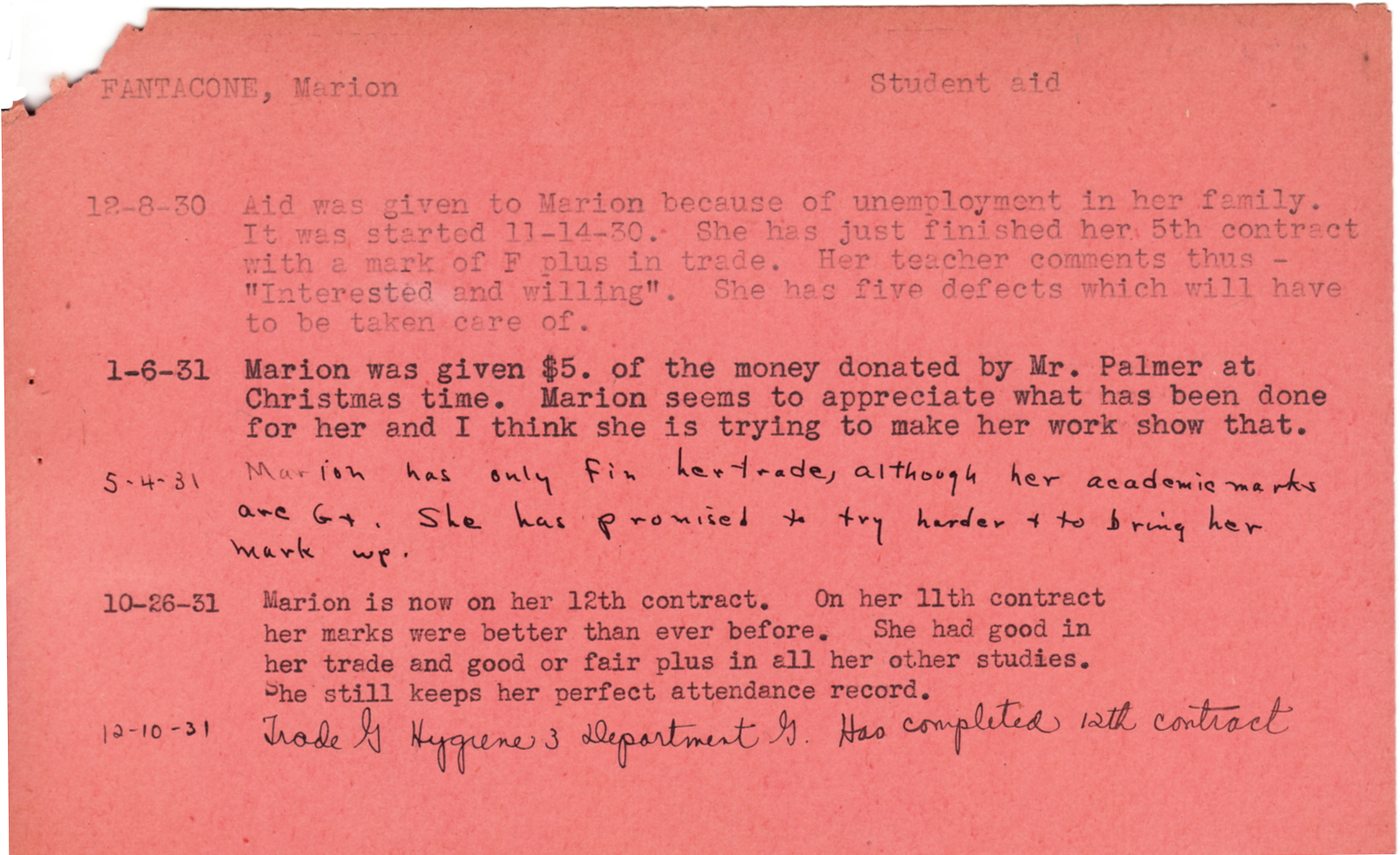
Here are some additional notes from Marian's student aid file. These are typed, so I won't bother transcribing them (you can click on the card to see a larger version of it):

8

The entry from Jan. 6, 1931, referring to a donation from a "Mr. Palmer," is interesting. I'm not sure who this was or what type of donation he made.

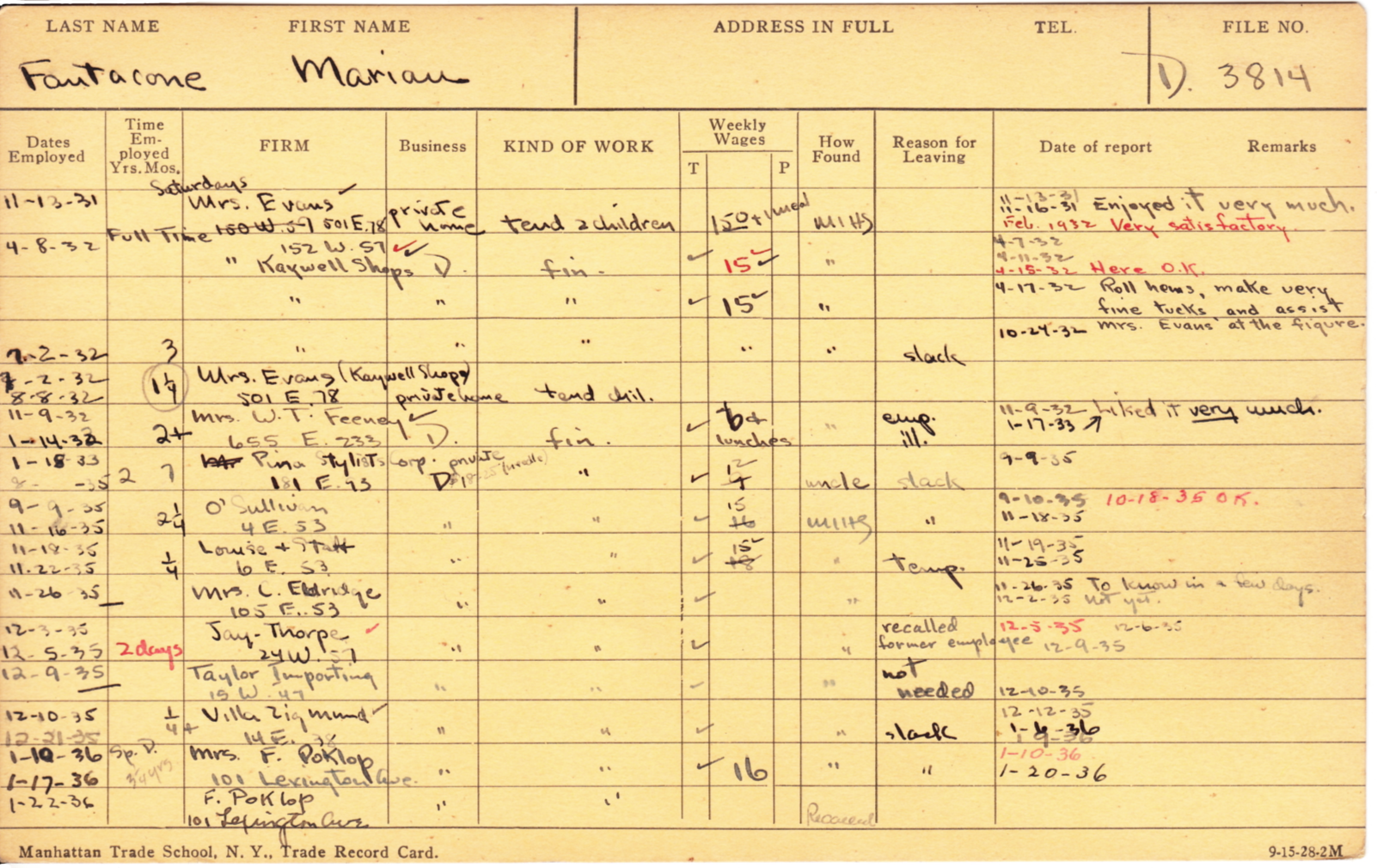
Like all the other Manhattan Trade students, Marian was referred for employment by the school's job placement office. Here's her work record, which shows that the school found jobs for her, primarily as a dress finisher ("fin."), for several years after her 1932 graduation:

9

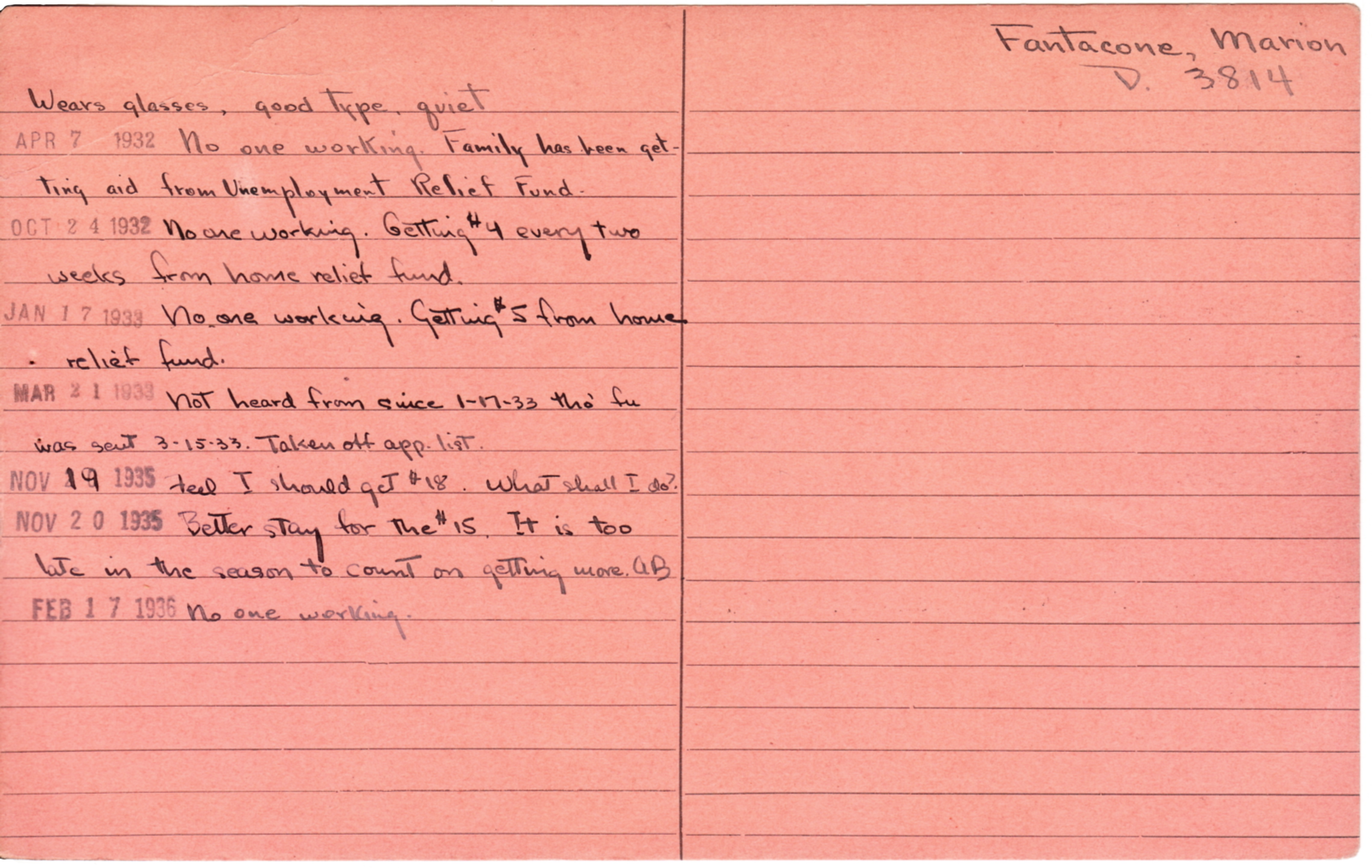
If you look at the job that Marian held from Nov. 19-22, 1935, you can see that her weekly wages were originally listed as $18 and then changed to $15. That was apparently a point of contention, as we can see on this next card:

3

The key entries read like so:

Nov. 19, 1935 [comment from Marian]: Told I should get $18. What shall I do?

Nov. 20, 1935 [response from job placement secretary]: Better stay for the $15. It is too late in the season to count on getting more.

This exchange is characteristic of how such issues were typically handled. Whenever a student balked regarding pay levels or other work-related issues, the school almost always encouraged her to stick with the job, or to at least be patient.

That's all I have for Marian (or Marion, as the case may have been). If anyone knows more about her, please get in touch. Thanks.

Wednesday, January 7, 2015

Student of the Week: Lillian Packer

1
For all documents, click to enlarge

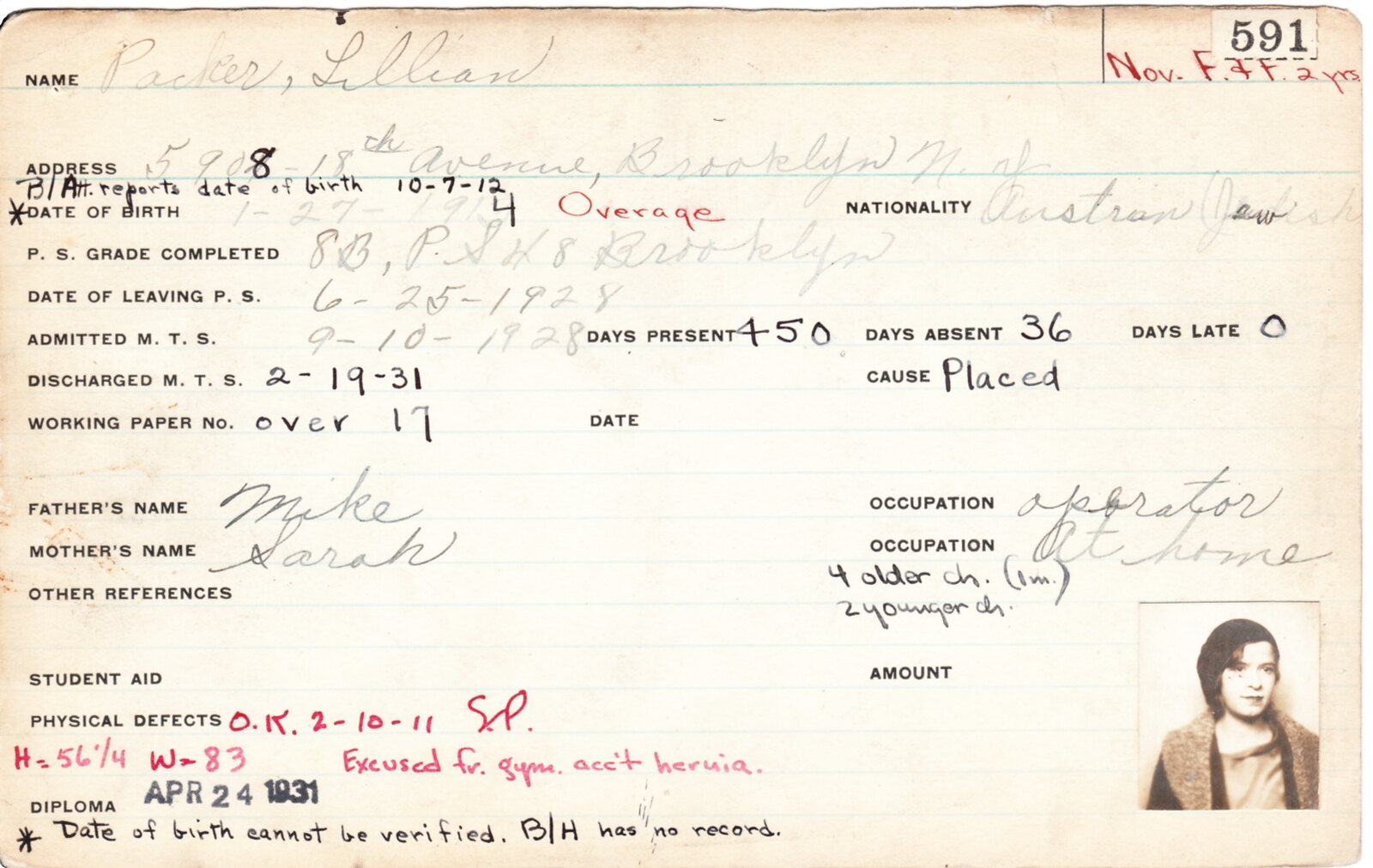
The Manhattan Trade School for Girls was founded and staffed by high-minded reformers — people we would generally consider to be progressives (at least in the cultural dimension of that term, if not necessarily the political one). So it's surprising when a blatantly retrograde comment shows up on one of the Manhattan Trade report cards in my collection. That's the case with Lillian Packer, the student whose primary record card is shown above.

As you can see, Lillian began attending Manhattan Trade in June of 1928, when she was about 15 (it's hard top be certain because her date of birth "[could] not be verified"). She was from a large family of Austrian Jews who lived in Brooklyn. She was a small girl — 4'8¼", 83 pounds — and was excused from gym class due to a hernia. Like many of the students, she took an appealing photo:

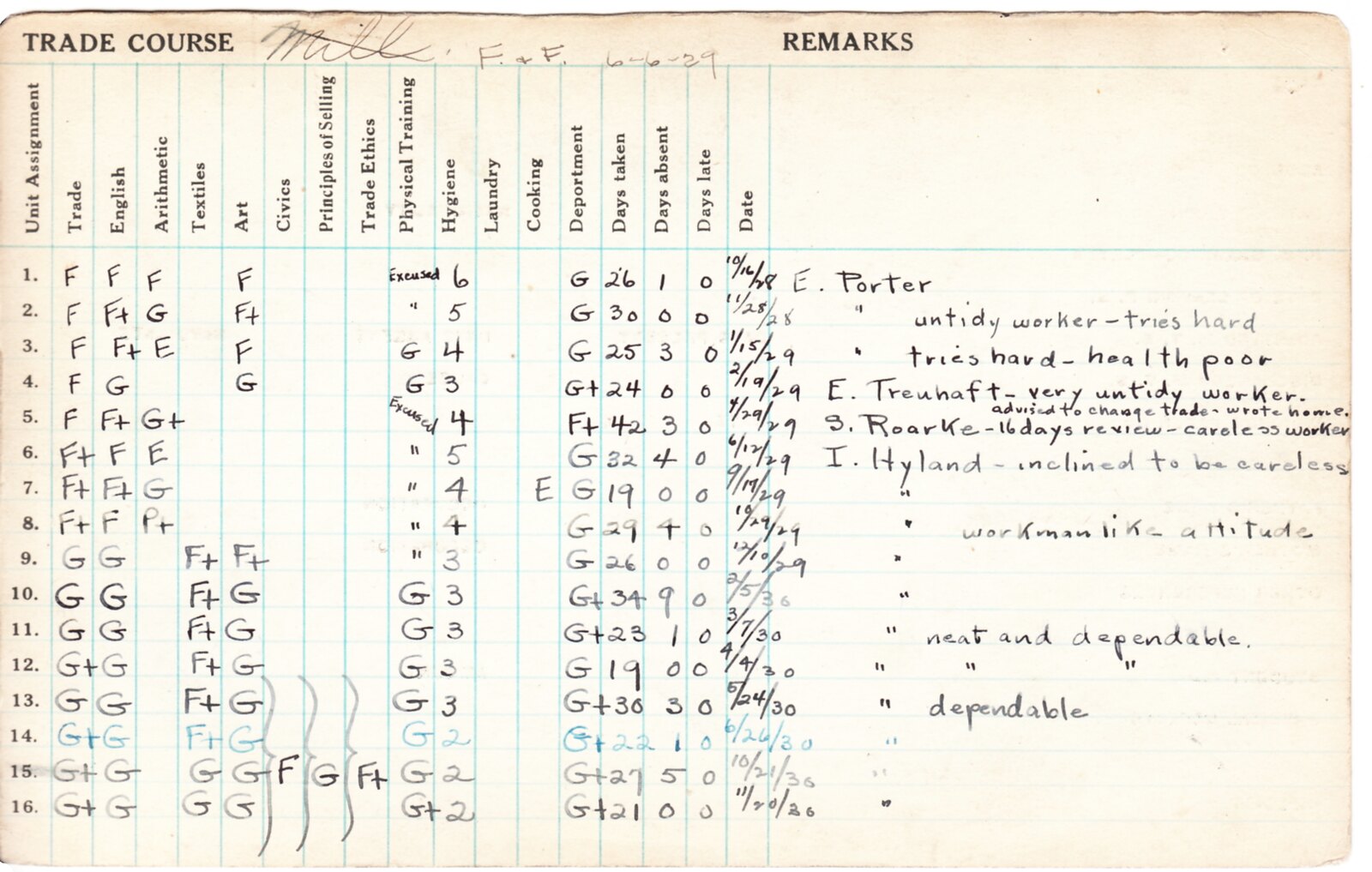
If we turn the card over, we see Lillian's grades, which show that she was a solid if unspectacular student (remember, E = Excellent; G = Good; F = Fair; P = Poor):

2

Interestingly, two of the early comments refer to Lillian being "untidy" and another describes her as "careless," but later on she's described as "neat and dependable." We've seen this same pattern on many of the other report cards we've examined — early critical assessments followed later on by more approving comments. It's unclear whether the students actually improved or if the school had a deliberate strategy of using early criticisms as a form of motivation.

Lillian's employment record was short and unremarkable:

3

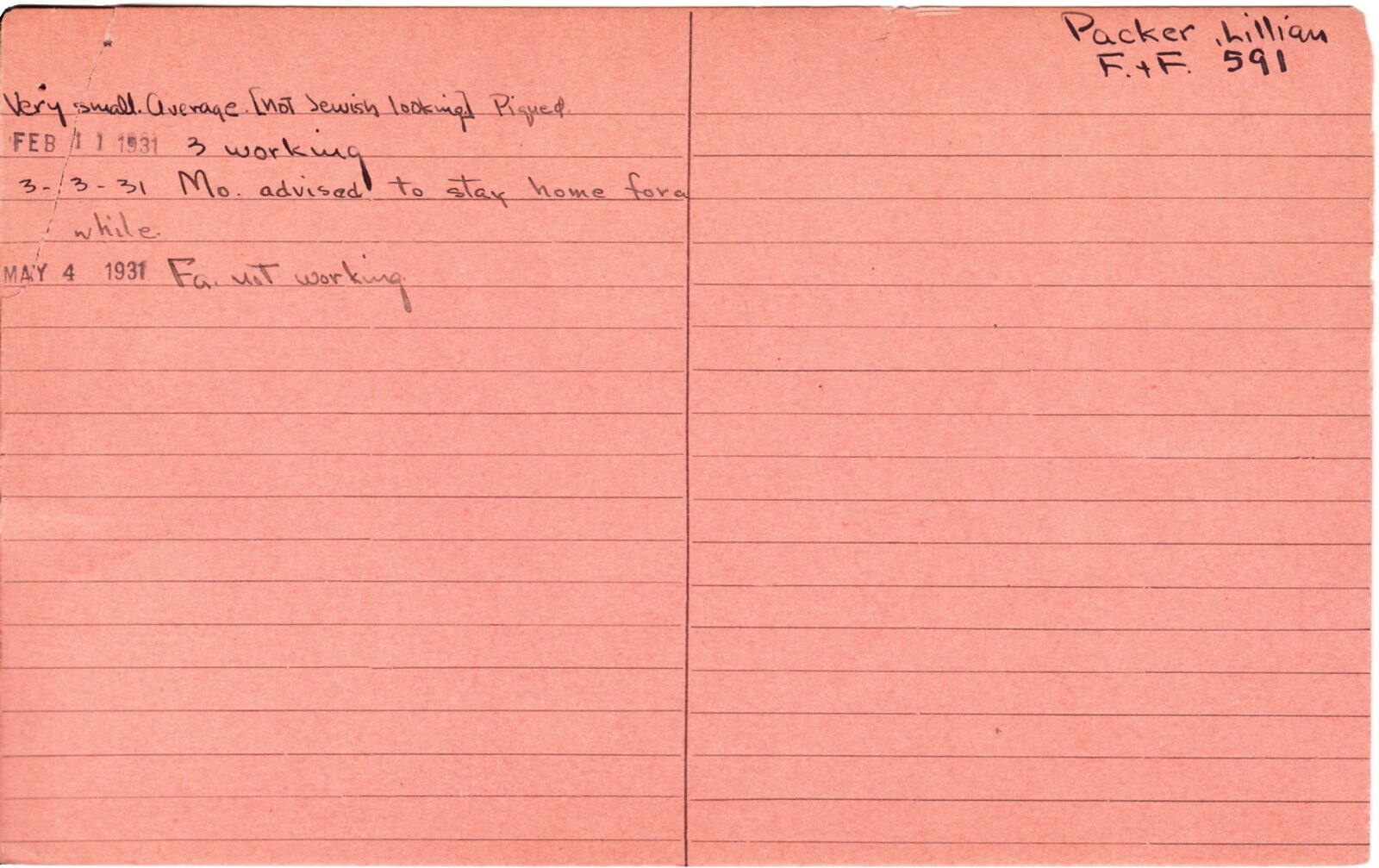
And now we get to the card with the unfortunate comment. Here, take a look:

4

And there it is: "Very small. Average. (Not Jewish looking.) Piqued."

The assessment of Lillian as being "not Jewish looking" echoes the comment about Edna Carrington, the black student whose record includes the line, "Skin not terribly dark." It appears that the school found it particularly noteworthy when a student looked "less ethnic," so to speak. Such comments would never appear in a student's record today, but it's worth noting that many Jews still worry about looking "too Jewish" and many blacks still worry about looking "too black," showing that certain cultural prejudices have been stubbornly difficult to extinguish.

Monday, December 29, 2014

Student of the Week: Frances Sehres

1
For all documents, click to enlarge

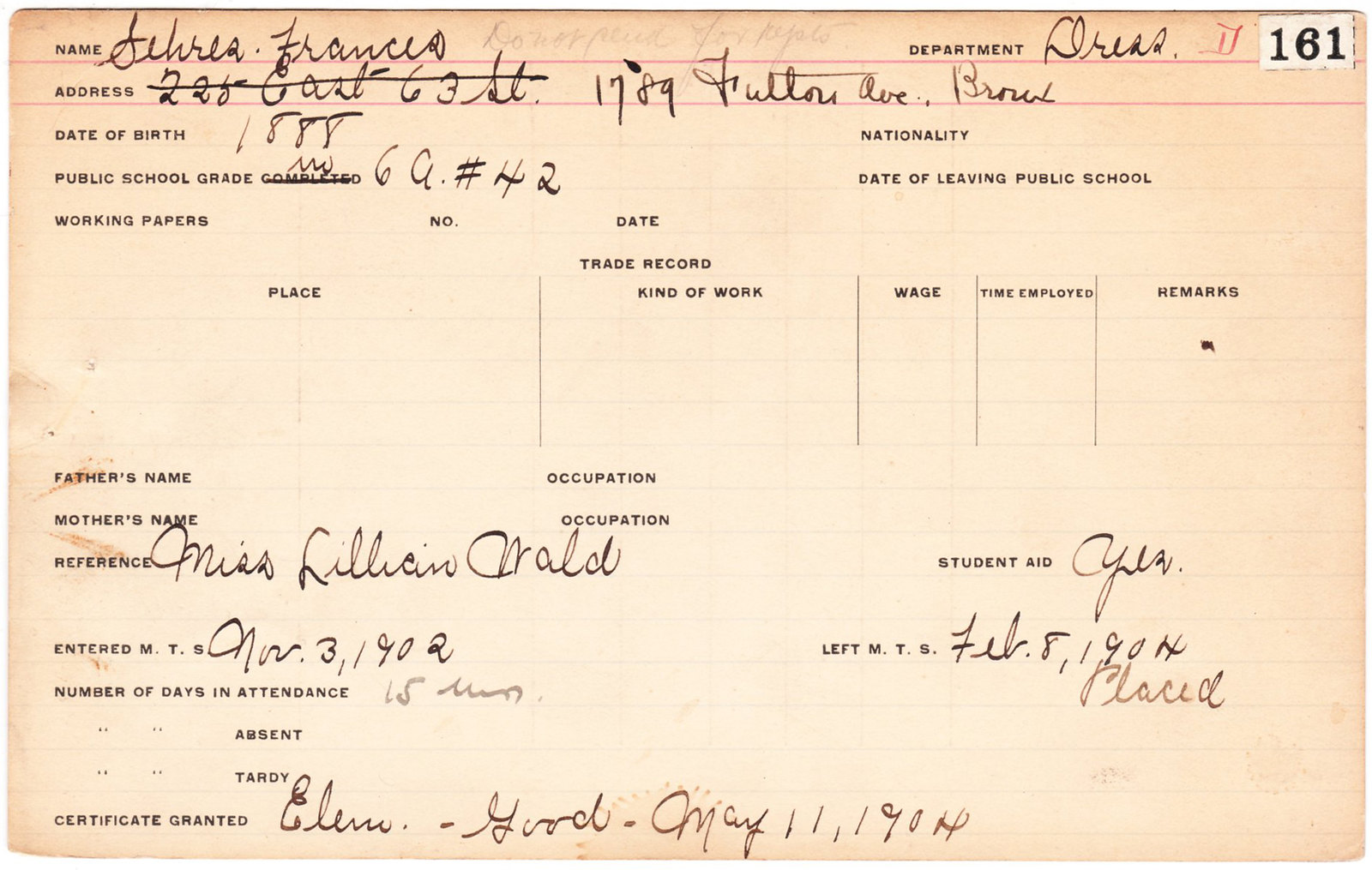
This week we turn our attention to a very special Manhattan Trade School enrollee — Frances Sehres, a dressmaking student whose main card is shown above (with what appears to be a perfect coffee stain splotch preserved at the center of the bottom edge). What's so special about her? This: The Manhattan Trade School for Girls began operations in November of 1902, and Frances's card shows that she was admitted to the school on Nov. 3 of that year, so she was apparently one of the school's very first students.

Interestingly, Frances's birth date is simply listed as "1888." The other Manhattan Trade School cards in my collection show a specific date. But the most intriguing nugget of information on this card is notation that Frances was referred to the school by Miss Lillian Wald. This name meant nothing to me, but longtime PermaRec volunteer researcher Catherine Bloomquist recognized it. It turns out that Wald was a pioneering humanitarian nurse who in 1893 founded the Henry Street Settlement, an important New York City social service agency that still exists today. In the 1940s, the Henry Street Settlement spun off the Visiting Nurse Service, which is also still in operation today.

Wald's original goal was for the Henry Street Settlement to provide services for poor immigrants on Manhattan's Lower East Side. But Frances's card shows that she lived on East 63rd St. and then in the Bronx, both of which are far from Henry Street, so it's not clear to me how Frances's life intersected with Wald. It's possible that the Settlement had expanded its operations throughout the city by 1902, but I'm not sure — a subject for further research.

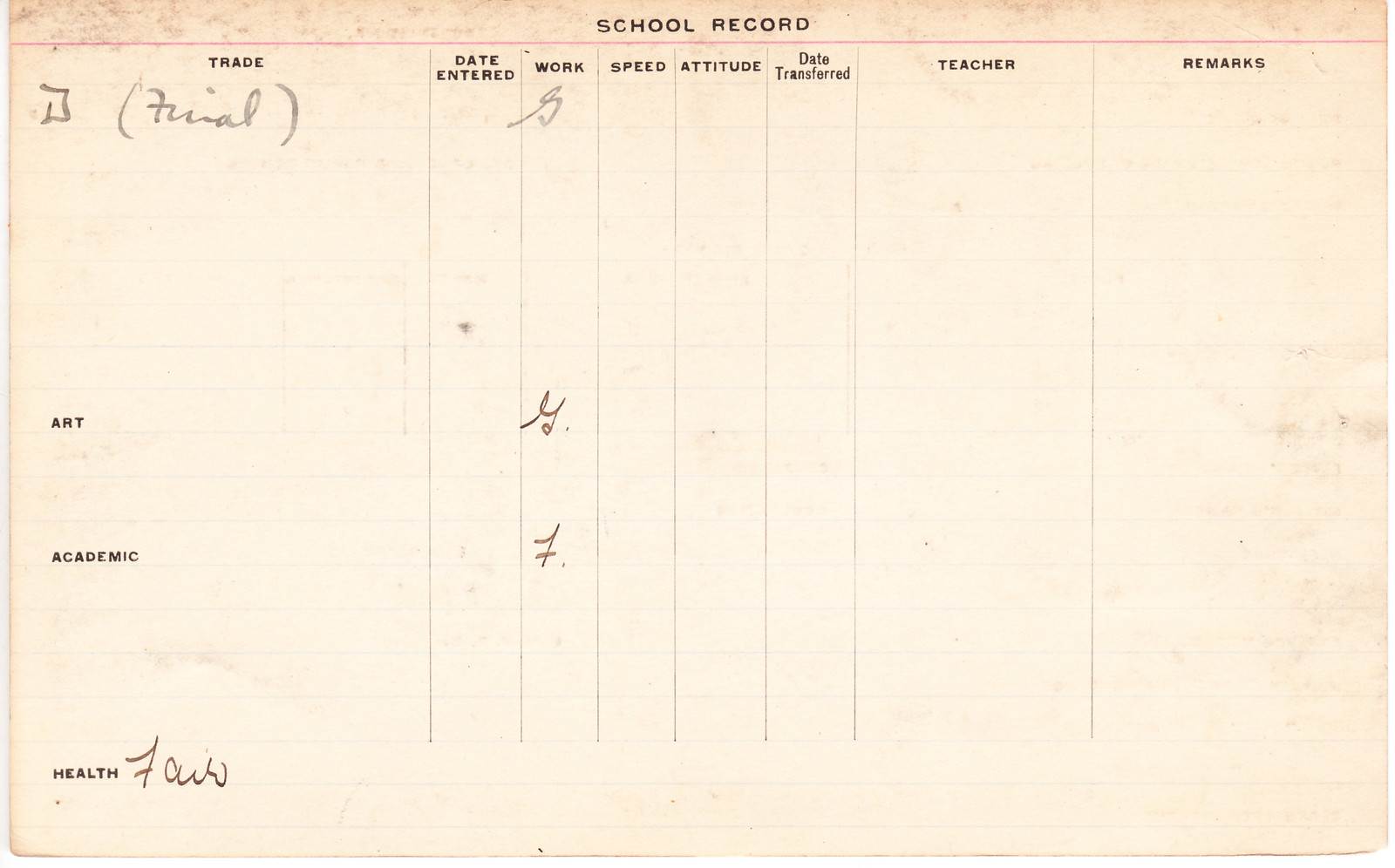
The school's recordkeeping system was apparently a bit of a work in progress at the beginning. The card that would normally show a bevy of grades and teacher comments was barely touched in Frances's case:

2

Of greater interest is Frances's employment record, which is spelled out on the next two cards:

3 4

Lots of interesting stuff here. For starters, Frances's first job, for the "Singer Co." — presumably the Singer Sewing Machine Company — began on Feb. 8, 1904 (in other words, toward the end of her schooling, which would have been standard procedure at the school). She continued working for Singer on and off through 1905 through 1909, then had a series of non-Singer jobs later in 1909, and finally had a bunch of additional jobs in 1913 and ’14. The final job in her employment record is dated Nov. 11, 1914 — nearly a dozen years to the day after she entered Manhattan Trade. This shows that students were maintaining long-term relationships with the school right from the start — a remarkable phenomenon that's also documented in many of the report cards from the 1910s, ’20s, and ’30s.

In addition, look at the "How Found" column. For many of the jobs, the notation is "MTS" (i.e., Manhattan Trade School, meaning the school arranged the job for Frances), but many others have "Self." This means Frances obtained many of these jobs on her own but nonetheless kept the school apprised of her employment activities — another indication of the close bond between the school and its students, right from the start.

And how were Frances's work experiences? Surprisingly, there's no feedback — either from Frances or from her employers — until one of her 1909 gigs. It's possible that the school hadn't yet adopted its eventual system of recording this type of feedback in its early years. Anyway, here are the cards with the employment related commentary:

5

That first entry, which refers to one of Frances's stints at Singer in 1909, indicates that a supervisor was not thrilled with her, and also includes a doozy of a dated put-down (as usual, I've spelled out some abbreviated terms for clarity):

Miss ______, head of the Sample Department, said, "Franny was never very satisfactory. Was not interested in her work. Never tried to advance — unambitious and was insubordinate (insisted on using the front elevator!) and impertinent in manner. Was not dismissed, but we were glad to have her go and never could return."

Imagine — a mere laborer using the front elevator! It's interesting that Singer kept Frances on for so many years despite this apparent dissatisfaction with her. Sounds like sour grapes after she left, no?

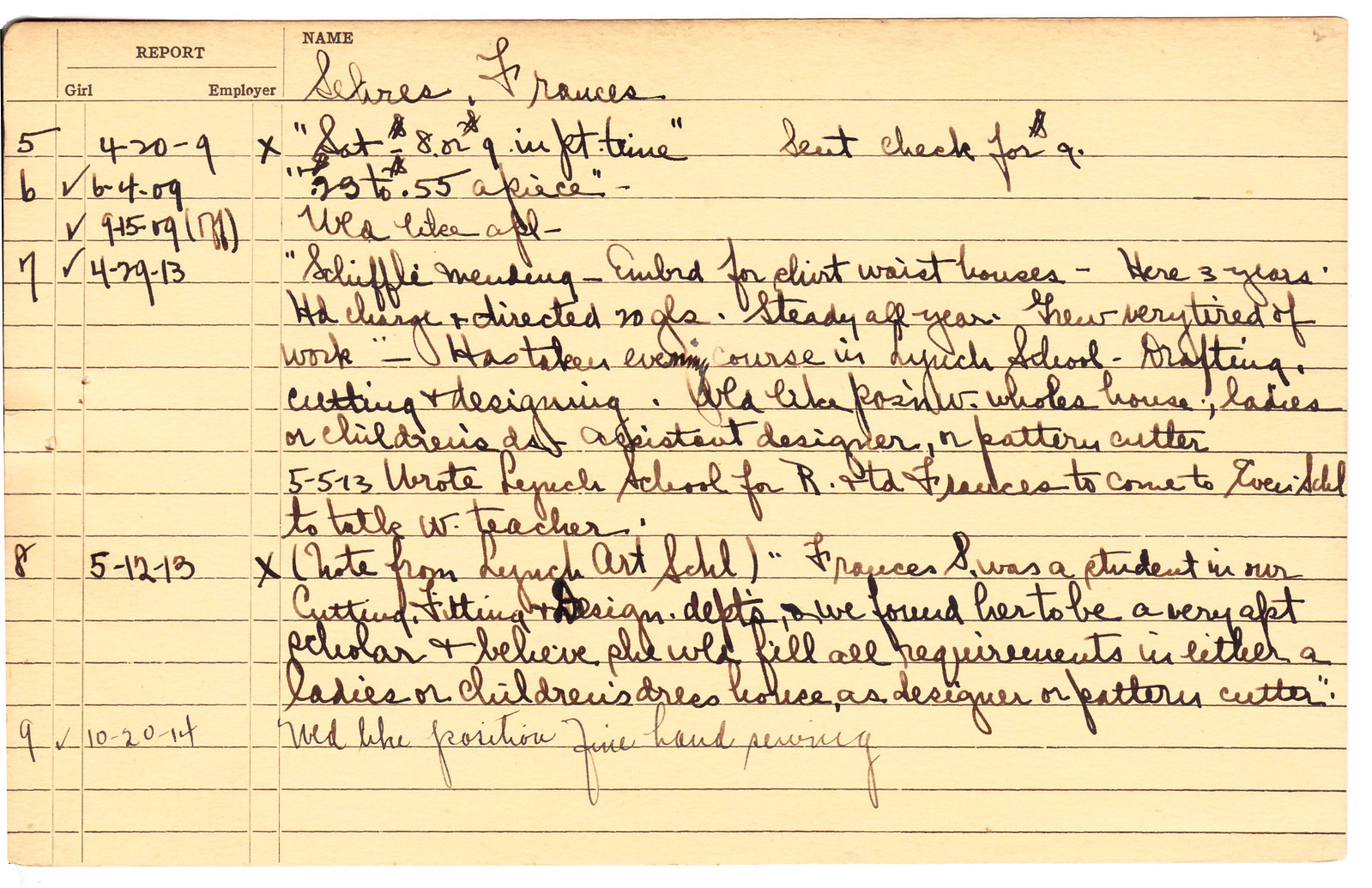
As for the assessment of Frances being "unambitious," that's demonstrably false, as shown in a series of entries on this card:

6

The pertinent passages are as follows:

April 29, 1913: Has taken evening course in Lynch School — drafting, cutting and designing. Would like position with a wholesale house, ladies' or children's [clothing], as an assistant designer or pattern cutter.

May 5, 1913: Wrote [to] Lynch School for reference and told Frances to come to [illegible] School to talk with teacher.

May 12, 1913: Note from Lynch Art School: "Frances S. was a student in our Cutting, Fitting, and Design departments and we found her to be a very apt scholar and believe she would fill all requirements in either a ladies' or children's dress house, as a designer or pattern cutter."

That's all I have for Frances. If anyone knows more about what happened to her, please get in touch. Thanks.

(Special thanks to Catherine Bloomquist for recognizing the importance of Lillian Wald's name in Frances's file.)

• • • • • • • • •

Update: Last week's entry on Fannie Panio prompted PermaRec reader Joe Lombardo to do a bit of research. He found Fannie in the 1940 census, where was listed as being married to a man named John Verdigi. Their household included two children; Fannie's mother, Catherine (this name matches the name listed on Fannie's report card), and another relative from Fannie's side of the family.

Joe also found a death notice indicating that Fannie died in 1997 (she would have been 87) and that she and John had one additional child after 1940. Interestingly, the death notice lists Fannie as "Philomena" and John as "Giovanni," but birth date matches Fannie's report card and the first two children's names match the ones on the 1940 census entry, so I'm fairly certain that this is indeed our Fannie.

Good work, Joe — thank you!

Wednesday, December 24, 2014

Student of the Week: Fannie Panio

1
For all documents, click to enlarge

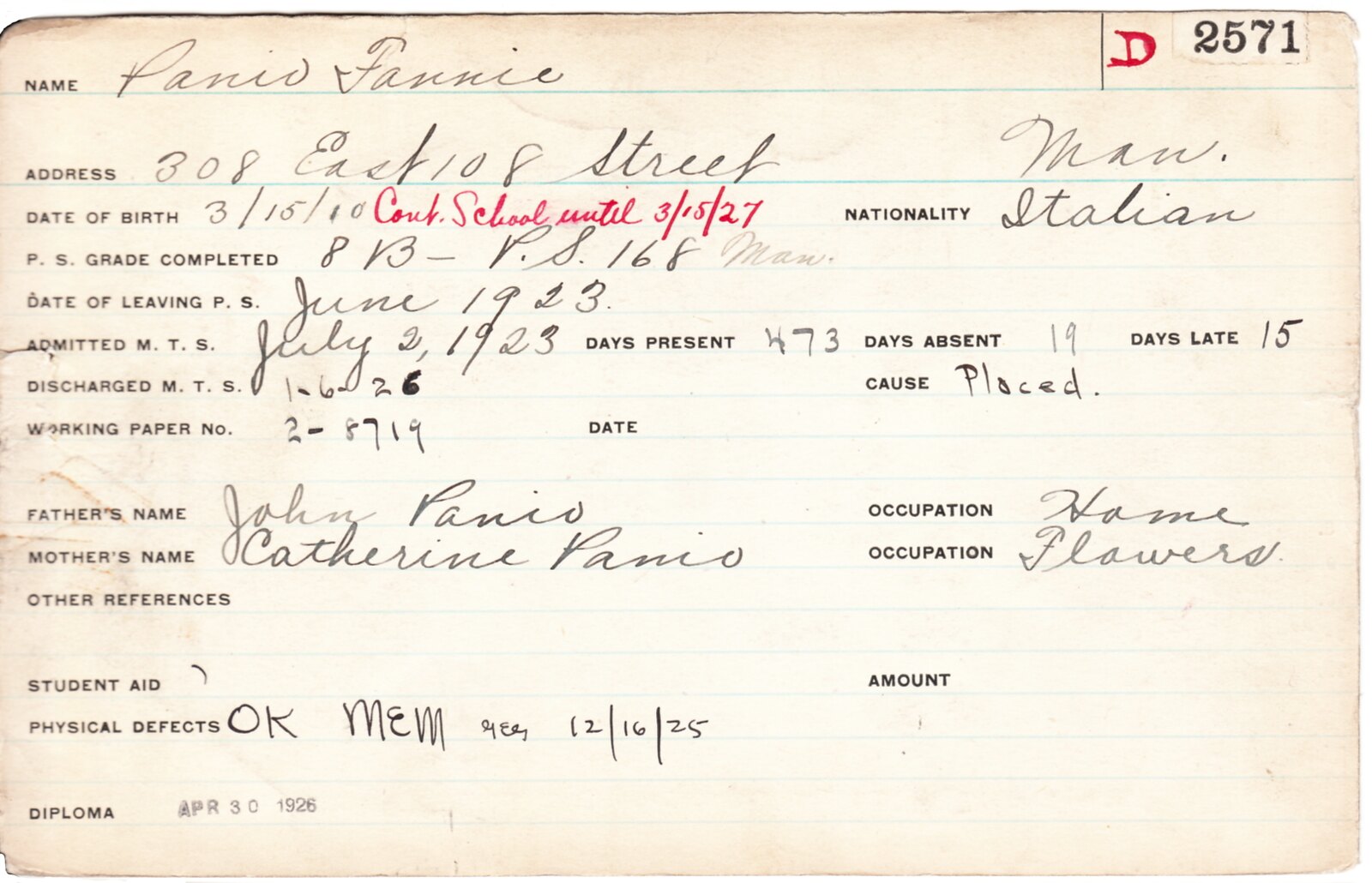
Our latest Manhattan Trade School student is Fannie Panio, who was born in 1910 and attended Manhattan Trade in the mid-1920s. As you can see above, her father did not work (his occupation is simply listed as "Home") and her mother worked with flowers — we'll be referring back to that information shortly, as it relates to a bit of drama that's documented in Fannie's file.

Fannie's student record is particularly interesting because she was was in line to receive financial aid from the school. So her record packet includes the following card, which lists the Panio family's income and expenses:

3

As you can see, the Panios lived in a four-room apartment with a monthly rent of $15 (!). Fannie's brother Sam was the family's biggest breadwinner, earning $15 per week as a bootblack.

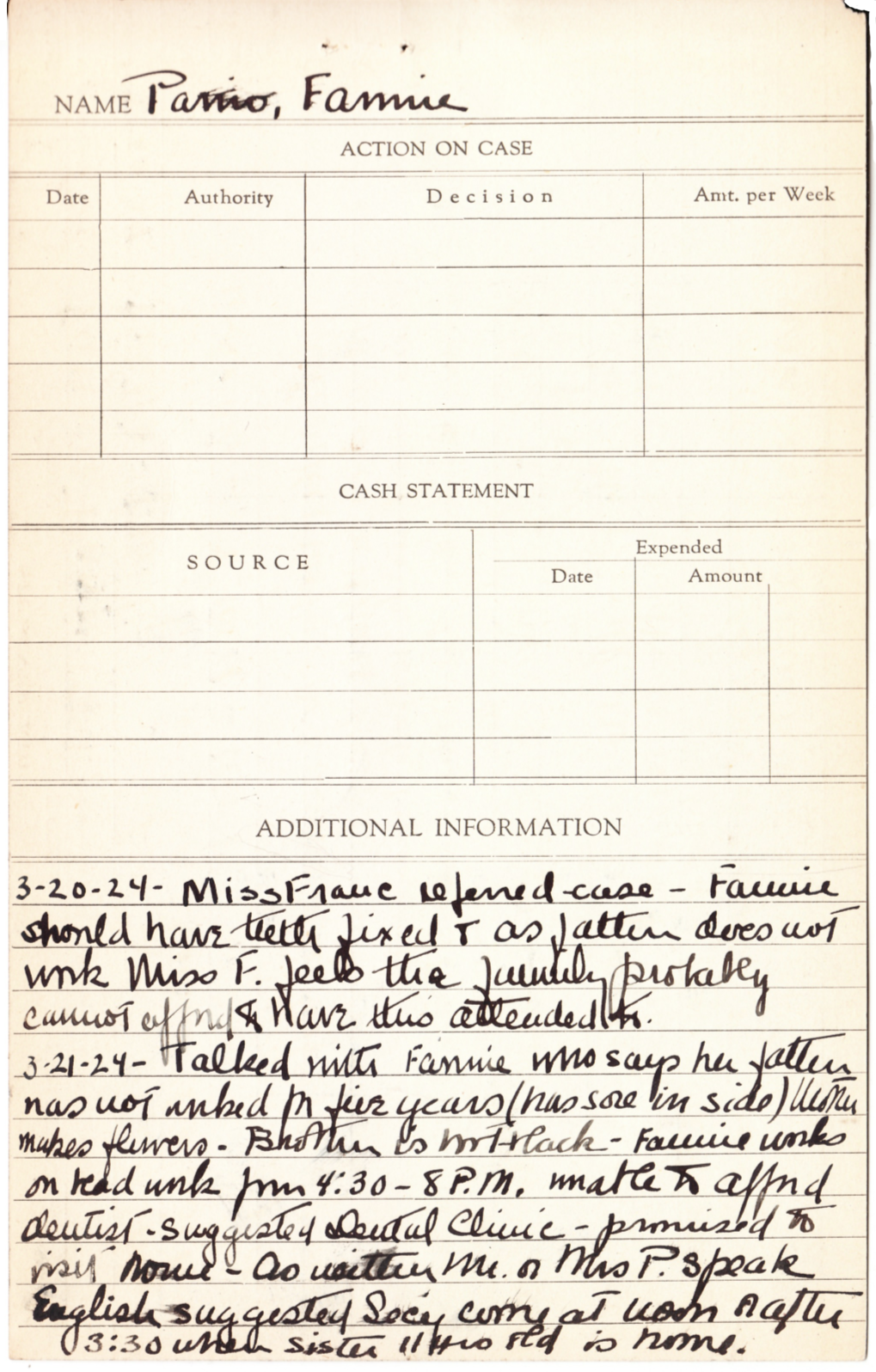
The back of the card explains why Fannie was recommended for financial aid — she needed dental work done and couldn't afford it:

4

Here's a transcription of the notes at the bottom of the card (as usual, I've spelled out some abbreviated terms for clarity):

March 20, 1924: Miss Franc [a teacher] referred the case. Fannie should have teeth fixed, and as father does not work, Miss Franc feels the family probably cannot afford to have this attended to.

March 21, 1924: Talked with Fannie, who says her father has not worked for five years (has sore in side). Mother makes flowers. Brother is bootblack. Fannie works on bead work from 4:30 - 8 p.m. Unable to afford dentist — suggested Dental Clinic. Promised to visit house. As neither Mr. nor Mrs. Panio speak English, suggested Secretary come at noon or after 3:30, when sister, 11 years old, is home.

And sure enough, someone from the school visited the Panio home four days later, on March 25. The next card tells the story of that visit:

5

The card reads as follows:

Visited — family lives on first floor of a shabby Italian tenement house. The rooms themselves were clean and neat. Mr. Panio was playing cards with another man. Mrs. Panio was hanging up the wash on the roof. She showed Secretary the fancy flowers she makes, for which she gets 85¢ a gross, and also some bead work which Fannie does, for which she earns $2 or $3 weekly. The brother works at the bootblack parlor in Grand Central Station. He earns $15 [per week], which he gives to his parents, and tips, which he keeps for himself.

Mrs. Panio would like to have Fannie's teeth fixed but can't afford to do this. Mr. Panio is ill — he has a growth in his side, which he should have removed — he is afraid, however, to have an operation. He has not been able to work for five years.

Secretary said it might be possible for us to send Fannie to the Dental Clinic and pay for this after Committee Meeting. — Reported to Miss Franck [whose surname was spelled "Franc" on the previous card but appears as "Franck" hereafter — PL]

And how did things turn out with Fannie's teeth? The next two cards tell the tale, which includes a new wrinkle regarding the Fannie's and her brother's work activities. Apparently they did not have working papers:

6 7

Those two cards read like so:

April 3, 1924: Committee decision — pay for necessary dental work and refer to proper agency regarding children in family working illegally after school. Reported to Miss Franck — sent for Fannie and told her to go to Miss Cutting [another teacher] on April 7, 1924, regarding a pass for Dental Clinic and to bring estimate of work to Secretary.

April 8, 1924: Consulted Mrs. King [of the] C.O.S. [Charity Organization Society], who advised referring case [regarding the illegal child labor] to Jefferson District Office.

April 9, 1924: Reported case to Jefferson District Office.

April 10, 1924: Miss Spence (Charity Organization Society worker) visited Manhattan Trade School regarding case. Explained situation to her.

April 28, 1924: See letter from Charity Organization Society.

April 29, 1924: Miss Spence (from C.O.S.) at office. Reported to her regarding working papers — child can work Saturday but must stop at five other days.

April 28, 1924 [listed out of chronological sequence, so date may be wrong — PL]: Sent for Fannnie. She will go to dentist the following day.

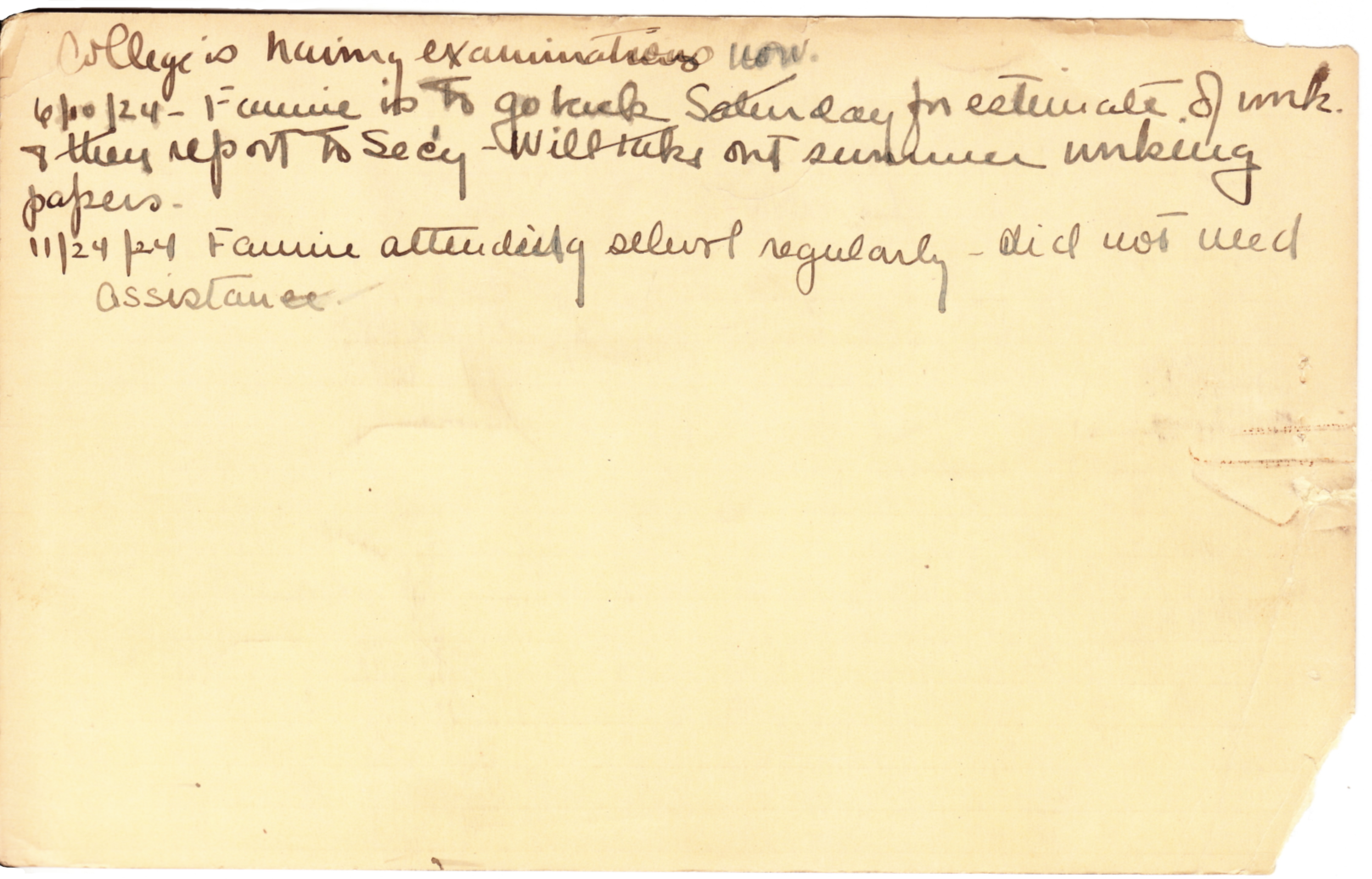
May 12, 1924: Telephoned Miss Franck. Fannie will go after June 1st, as Dental College is having examinations now.

June 10, 1924: Fannie is to go back Saturday for estimate of work and then report to Secretary. Will take out summer working papers.

Nov. 11, 1924: Fannie attending school regularly. Did not need assistance.

Wow — there's a lot to process there. One thing at a time:

1. So the school agreed to pay for Fannie's dental work, but did that even turn out to be necessary? The last entry reads, "Did not need assistance." Hmmmm.

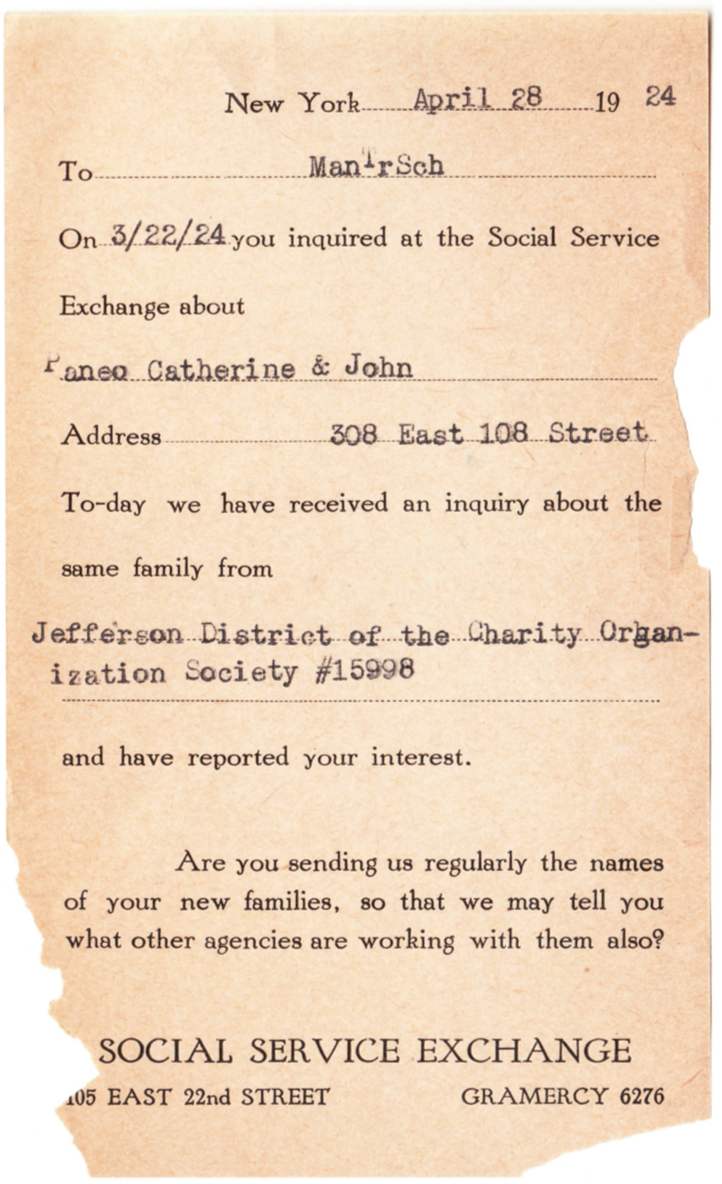
2. The whole bit about the school arranging an intervention because of the children working illegally was interesting and unexpected, no? Here are two documents that appear to be related to this, both involving the school's contact with local social service agencies:

9 8

I haven't seen documents like these in any of the other students' files, so I'm not sure what to make of them or how they fit into the larger storyline of the school and its students.

3. The April 28 entry refers to a letter from the Charity Organization Society. That letter, which was apparently written by the Miss Spence who's referred to in several of the preceding entries, is included in Fannie's file. It's typewritten, so I'm not going to transcribe it. You can just click to make it large enough to read — and it's definitely worth reading:

IMG_0007

Wow. So according to Miss Spence, the family could probably have afforded Fannie's dental work all along, and Fannie was just playing a ruse to avoid going to the dentist! Well, who among us hasn't resorted to semi-desperate measures to avoid the dental chair?

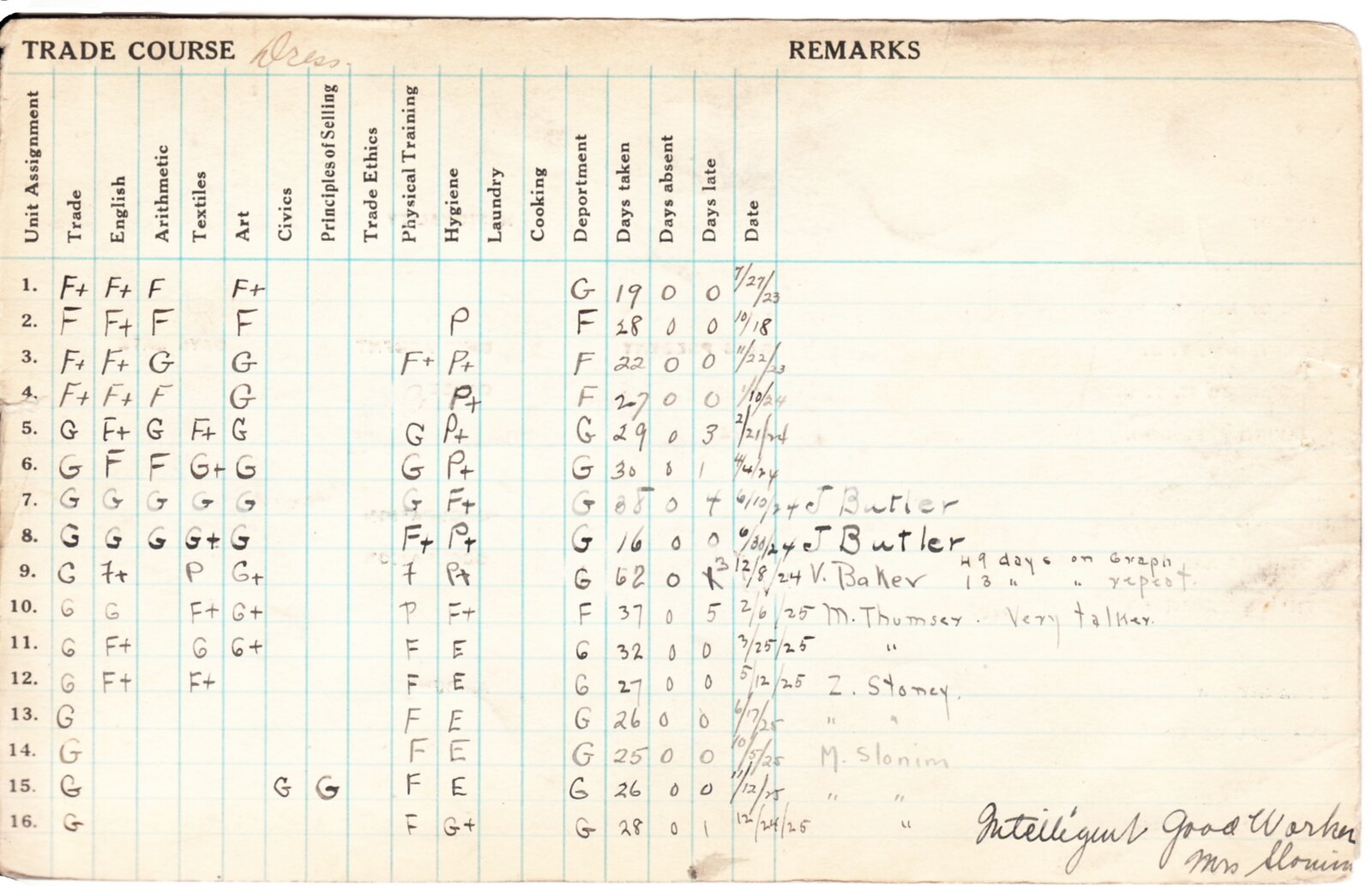
Finally, you may have noticed that I haven't yet included Fannie's grades or employment record. Here they are — I left them for the end because they both unremarkable:

2 11

That's all I have for Fannie. If anyone knows what became of her, please get in touch. Thanks.