Showing posts with label Who Owned This Object?. Show all posts

Saturday, April 4, 2015

Artifacts in Briefcase Reveal Long-Ago Affair

In May of 1969, a 39-year-old German businessman named Günter K. began an affair with his 24-year-old secretary, Margret S. Both were married. Over the next 19 months, they engaged in an extended series of sexual romps while traveling hither and thither. Günter's wife eventually learned of the affair and confronted Margret, who threatened to withhold sex from Günter unless his wife apologized to her — which, incredibly, she did.

We know all this because of a large cache of unusually detailed documentation — photographs, receipts, a journal, snippets of hair, empty birth control packaging (examples of which are shown throughout this blog post) — that was found in a briefcase purchased at a German estate sale 30 years after Günter and Margret's affair. Those items were the subject of a book and gallery exhibition in Germany in 2012, and now the exhibition is making its American debut under the title "Margret: Chronicle of an Affair — May 1969 to December 1970" at the White Columns gallery in New York.

The White Columns web page for the show provides good background info. Here's an excerpt:

The archive [of materials found in the briefcase] consists of hundreds of color and black-and-white photographs showing the same woman (Margret S.) in various places and poses: sitting at a typewriter at the office, traveling, or in hotel rooms, undressing, changing, or getting dressed. In the archive, inscribed with dates, are samples of Margret's hair (from both her head and pubic region), her fingernails, and empty contraception packages, as well as a blood-stained napkin. Receipts from hotels and restaurants, as well as travel documents and tickets from theaters, reveal insights into the places the couple visited as well as acknowledging their preferences and interests. Personal notes and diary entries, mostly written with a typewriter, resemble official records. The focus of virtually all these writings is the sexual act, its frequency, its endurance, etc. — all factually underlined yet at the same time described in a coarse and often obscene language. In its conceptual denseness — resulting partly from the obsessiveness of the documentation — the collection seems to reverberate with the practices of artists such as Sophie Calle, where the viewer often finds themselves in a conflicted space, exposed to their own voyeurism.

Faaaaascinating. I haven't gotten over to White Columns yet to see the exhibit, but I definitely plan to. You can see more photos from the show here.

Based on what I've read so far, it's not clear to me if any attempt has been made to find Günter and Margret (who, if they're still alive, would now be 85 and 70, respectively). I hope to learn more about that when I check out the exhibit.

Saturday, November 8, 2014

The beautiful needlework sampler shown above was recently acquired by the Seattle Art Museum. Its provenance is listed toward the bottom:

Liberated African
Charlotte Turner
Aged 10 years
Bathurst Sierra Leone 1831

Who was Charlotte Turner? Does "Liberated African" mean she was a freed American slave? What was she doing in Sierra Leone? What became of her?

All of these questions are addressed — and most of them answered — in a sensational new article by the art critic Jen Graves, which recently ran in the Seattle alt-weekly The Stranger. It tells the story of British missionary settlements in Sierra Leone, where children rescued from illegal slave ships were often trained to make needlework like Charlotte's, which were then sold to sponsors back in the UK to raise funds. The sponsors were granted the perk of renaming the African children whose needleworks they were purchasing, so "Charlotte Turner" was likely named by a wealthy Britisher she never knew. It's also possible that Charlotte never even existed, and that she was simply fabricated by one of the missionaries to raise money.

All of this, and a lot more, is explained in greater detail in the Stranger article. Check it out here.

Monday, October 13, 2014

Toyota recently launched a new six-commercial ad campaign for the 2015 Camry, and one of the spots (a screen shot from which is shown above) is very PermaRec-ish.

Before you watch the commercial, check out the script, which is delivered as a first-person narrative:

Started my Camry
Went to the auction
Won a storage locker
Found an old guitar
Tracked down the previous owner
Reunited them
Hit the jackpot

Now, if you've ever watched the TV show Storage Wars, you know that the people who bid on abandoned storage lockers tend to be professional salvage dealers, not random Camry owners, so it's rare for a "normal" person to win one of those auctions. It's even rarer for the lockers to contain anything of value. And it's well-nigh impossible for that thing of value to be connected to a famous person such as — here, just watch the commercial and see for yourself:

Pretty cheesy, right? Still, the impulse to reunite an object with its original owner is certainly one I can appreciate. And as aspirational fantasies go, the urge to investigate an item's past is certainly better than car advertising's usual fantasy, which is that the car will give you status and get you laid. Fortunately, as we've demonstrated many times here on Permanent Record, you can turn the "Let's find out who owned this" fantasy into reality without bidding on a storage locker — or driving a Toyota Camry, for that matter.

• • • • •
Site Upgrade: If you look in the right-hand sidebar, you'll see that all of the site's entries are now tagged by category. I hope this will make the site easier and more fun to poke around in — enjoy.

Wednesday, April 30, 2014

Photos by Chuck Miller; click to enlarge

The camera you see above is a Kodak Vest Pocket Autographic, a model that was produced from 1912 through 1926. Blogger and PermaRec reader Chuck Miller recently acquired it on eBay.

As you can see, the camera was inscribed with a series of etched notations. That's because the each Vest Pocket Autographic came with its own engraving pencil. The pencils were supposed to be used to write notes on the film, allowing the users to annotate their photos, but most people didn't bother with that and instead wrote notes directly on the camera case. You can see the pencil mounted at the bottom of the camera in this next photo, which also shows lots of additional inscriptions (click to enlarge):

If you look near the top of that last photo, you'll see the name "Frank D. Row" surrounded by a series of military locations. Miller (the guy who acquired the camera) figured Row must have had some sort of military connection and had charted his travels on the camera, sort of like a vacationer slapping place-themed decals on a suitcase.

Miller wanted to know more about Row and his travels with the camera, so he did some research and learned that Row served in the Red Cross during World War I and helped to establish a military hospital in France, among other things. Miller's research on Row and his unit turned up evidence that matches up with most of the places etched into the camera. You can read the full story here.

Row died in 1966, but the Red Cross chapter that he belonged to still exists, and Miller plans to return the camera to them shortly — a nice way for the camera to return home.

Miller sounds like a very PermaRec kind of guy. "For years, I've been trying to acquire cameras that have undeveloped film in them — maybe half a roll before the previous owner stopped taking pictures and the camera was lost," he says. "Unfortunately, in most cases the film is so deteriorated that it's undevelopable, or the company I sent it to that promised to develop rare film simply took my money and never gave anything back. So this Vest Pocket Autographic is the first time I've actually been able to get a camera that can tell its story."

Friday, April 25, 2014

Click to enlarge

As you can see above, a 1922 high school sophomore named Jennings Keffer liked to doodle. Those scribblings — and many more, as I'll show you in a minute — appear in an old Shakespeare text that was recently found at a bookstore by a music blogger who calls himself Devil Dick. Although the Shakespeare book has nothing to do with music, Devil Dick found the doodles so enticing that he decided to post them on his blog and try to find out more about Jennings Keffer.

So what sort of doodles did a high school fella create in 1922? Pictures of girls, for starters. And what kinds of girls would be of interest in 1922? Take a look (for all of these images, you can click to enlarge):

It's hard to express how much I love that. I particularly like the cigarette and the bells — scandalous! It's worth noting that while flappers were just becoming a pop-cultural phenomenon in the early 1920s, the term "flapper" has much deeper roots and was long associated with prostitutes, so the word may have had an extra forbidden-fruit quotient or with young Jennings.

Here's another set of doodles from the book:

The most interesting thing here, at least to me, is the pair of baseball drawings on the left side, because Jennings was coming of age at just the right time to be swept up in the national mania surrounding Babe Ruth. The Babe had set a single-season record by hitting 29 home runs in 1919 (the previous record of 27 had stood since 1884) and then completely changed the sport by hitting 54 homers in 1920 and 59 more in 1921. When Jennings was making these doodles in the spring of 1922, Ruth was at the peak of his larger-than-life celebrity arc, and baseball was coming into its own as a powerful cultural and economic engine. Even without televised games, it all must have been a very exciting time to be a teen-aged baseball fan.

If Jennings was a high school sophomore in 1922, that means he was probably born around 1906. Sure enough, Devil Dick did some research and determined that Sidney Jennings Keffer was born in 1906 in West Virginia and died in 1995 in Ohio. You can see Devil Dick's post about all this, including several more pages of doodles, here.

(My thanks to reader Jeff Ash for letting me know about this one.)

Friday, April 18, 2014

Photos from JillSobule.com

About a dozen years ago, the singer/songwriter Jill Sobule received a vintage charm bracelet as a birthday gift. She had no interest in wearing the bracelet ("not really my style," she would later comment) but nonetheless became obsessed with it. As she wrote on her website in 2012:

Who was the original owner? What did she do? I do know her name was Dottie, as there is a round engraved "Dottie" charm. ... She was not from a wealthy family — the 22 charms are pewter as opposed to silver or gold. She traveled domestically, gathering mementos from Florida to Mackinac Island to New York City. She played piano. She liked big, sculpted poodles. She liked cowboys. She was a working girl; there is an ABWA union (American Woman Business Association) charm and an office chair. She was Jewish — a mezuzah. I keep saying “was” [but] maybe Dottie is still alive. Who knows?

Totally Permanent Record, right? Sobule decided to use the charm bracelet as the organizing theme for a concept album: a dozen songs, each relating to one of the charms on the bracelet, forming a fictional (but plausible) composite view of Dottie's life. But she didn't write the lyrics herself. Instead, she enlisted a bunch of writers — mostly novelists and academics like Jonathan Lethem, Luc Sante, and Rick Moody — and had each of them write a set of charm-based lyrics. She then added the music. The resulting album, Dottie's Charms, is being released on vinyl this weekend (in conjunction with Record Store Day) and will be available digitally on May 5.

Interestingly, Sobule had already been contemplating a similar project before she hit upon the charm bracelet idea. At one point she had considered purchasing a random old high school yearbook on eBay and constructing a concept album around that. But the charm bracelet idea ended up working out better.

The collaborative nature of Dottie's Charms has echoes of the Significant Objects project, in which the writers (and my friends) Rob Walker and Josh Glenn acquired about 200 cheap thrift store items, assigned a writer to create a short story about each of them, and then auctioned off the objects and the stories on eBay. (The stories were later packaged into an excellent book.)

You can learn more about Dottie's Charms in this article, and Sobule will be playing a record-release party for the album on April 24 at City Winery in New York. As she recently wrote on her blog, "Maybe Dottie will show up."

Incidentally, a few years ago I considered writing a song about the Manhattan Trade School report cards that formed the basis of the Permanent Record project. I figured I'd write some lyrics (something I'd never done before), and I asked my friend Lianne Smith — a great singer/songwriter who also happens to be a big PermaRec fan — if she'd be willing to come up with the music and then add the song to her repertoire. She was agreeable, but I never came up with a full set of lyrics. Only managed to do the chorus, the bridge, and part of a verse. This is all a good reminder that I need to dust off that project.

Wednesday, February 26, 2014

beatles.png

When you were growing up, did you ever write your name on your LPs and 45s, either on the jacket or on the label? I never did this myself (the idea of it always struck me as distasteful, like an act of defacement or vandalism), but I knew plenty of other kids who did, and I'm sure you did too.

One such name-inscribed LP is in the collection of my friend Jeff Ash, who lives in Green Bay, Wisconsin. His copy of the Beatles' self-titled 1968 album, which he purchased at a used record store at some point in the 1980s, bears the signature of one Riffat Kamal (see above). A little over a year ago, Jeff became curious about Riffat and decided it was time to try to track him down. I'm happy to report that he succeeded.

I was surprised that Jeff's story didn't include any mention of the the little "44" beneath Riffat's name, so I asked him about that. "You know, I never asked him what it meant," Jeff replied. So he got back in touch with Riffat, who responded with the following:

That was just part of my numbering system, where I sequentially numbered all my albums from 1 to probably about 300 or so. Between my Minnesotan roommate Steve Portugese and myself, we had a few hundred albums, some of which were the same, so numbering each album was a way of keeping track of it....

Looking at the picture of the White Album again, I just noticed that I don't write "4" the same way anymore. Not sure when I switched to writing "4" the way it is typed here now, but maybe that was part of my becoming Americanized.

I love this story — it gives a whole new dimension to the term "Permanent Record."

But Jeff's experience has gotten me thinking. Back in the 1980s and ’90s, I used to spend a lot of time in used record stores, and I certainly came across plenty of name-inscribed LPs along the way. But I don't think I ever purchased someone else's personalized record. In fact, I went out of my way not to purchase such items. Part of this was due to that thing I mentioned earlier about the record being defaced — I didn't want to purchase a record that had been marred, even superficially.

But there was more to it than that. At the time, I identified quite strongly (read: far too strongly) with my record collection. I wanted it to be about me, not about anyone else. Even a ballpoint-scribbled name from years ago felt like an unacceptably foreign element, a contaminant. How could I make a record fully mine if it carried the reminder of having been someone else's?

The odd thing about this, of course, is that I love artifacts that have stories to tell about their past lives — that's the essence of Permanent Record. But for whatever reason, LPs were their own special category for me, and I never saw the potential in tracking a used record back to its previous owner.

Nowadays, like so many people, I've sold off many of my LPs and consume much of my music via electronic streaming. (I'm listening to the new Beck album on Spotify as I type this, in fact.) But now that Jeff has opened my eyes, I see lots of PermaRec-ish possibilities in name-inscribed records — I may have to start dropping by used record stores again.

Do you have any records with other people's names written on them? Would you like to try to track down those people? Let's discuss.

Thursday, January 30, 2014

Screen shot 2014-01-29 at 1.43.06 PM.png

Heather McCabe runs a great website called Two Buckaroo, which is a running celebration of our most inconspicuous piece of currency: the $2 bill. The site primarily documents her experiences as she spends $2 bills and chronicles the reactions she gets — sometimes amused, sometimes annoyed, always interesting — from cashiers, bartenders, checkout clerks, and so on. But sometimes she'll also run posts under the heading "Twos in the News," rounding up recent news items relating to $2 bills. And one such news item that she recently found, although it dates back to last summer, is right in Permanent Record's wheelhouse.

Here's the deal: Thirty-some years ago, a Milwaukee woman named Nona Diamond acquired a 1928 $2 bill (see above), which she squirreled away in a safe deposit box. Last summer Diamond's daughter saw the bill for the first time and noticed that it was inscribed with the words "USS Chicago," "1941," and three signatures, one of which was legible — "Jesse Linam." She Googled the name and tracked down Mr. Linam, who was still alive at the age of 93. He had served on the USS Chicago during World War II, along with the other men whose signatures appear on the bill. He asked if he could have the bill back, and the Diamonds happily sent it to him.

Tracking currency as it moves in and out of people's lives is not a new phenomenon, of course. You may have seen $1 bills (or occasionally other denominations) stamped by people participating in the "Where's George?" project, which was founded in 1998 and uses serial numbers to track bills as they circulate around the nation (click to enlarge):

I've asked Heather — the $2 bill enthusiast — if she's considered something similar to "Where's George?" specifically for $2 bills, but she says she's not interested in tracking where the notes circulate. She's more interested in people's reactions to them and the stories that get told along the way. (For those who are interested in tracking $2 bills, some of them show up on "Where's George?")

Personally, I've never participated in "Where's George?" (it seems like a dangerously deep rabbit hole for someone as obsessive as I am), but I've always loved the idea of it. Pundits have been predicting a cashless society for decades now, but I'm hoping currency and coins stick around. They are, essentially, artifacts that we all get to share.

Monday, June 24, 2013

IMG_0149.JPG
Photo courtesy of Bryn Mooth; click to enlarge

Last summer, a Cincinnati food writer named Bryn Mooth was poking around in an antiques shop and spotted a bundle of old recipe cards from the 1930s, which she bought for $3.95. That led her on a fun odyssey that recently culminated in her making contact with the original owner of the cards. I've written a short article about this for the food site Grub Street — check it out here.

(Big thanks to Jeff Ash for letting me know about this one.)

Tuesday, June 18, 2013

milwaukee.jpg
Photo by Angela Peterson, JSOnline; click to enlarge

The documents you see above were part of a large stash of old papers, photos, and other ephemera that a Milwaukee woman named Lisa Crum found in the garage rafters of a home that she purchased more than a decade ago. Crum wanted to return the materials to their family of origin, but many of the documents were in German, which complicated her efforts. But she was never gave up. Her family moved to new homes twice after the found the documents, and each time she brought the papers with her.

Now her efforts have finally borne fruit. With the help of a local museum, Crum recently made contact with Lori and Steve Zeitlin, who are descendants of the now-deceased couple that had saved the photos and papers. The connection has extra resonance because, as it turns out, many of the documents track the family's efforts escape the Nazis during World War II.

You can get the full story in this excellent article, which is accompanied by this slideshow. It mentions that Crum always felt that the documents were her "responsibility," and that she and the Zeitlins "call each other family now."

So much of this feels familiar to me. It took me more than a decade before I made contact with anyone connected with the Manhattan Trade School report cards. During that time, I moved to a new apartment but took the cards with me, knowing that they were my responsibility. When I eventually began contacting some of the students' descendants, it forged a series of intense bonds, some of which still remain. It's great to see other people experiencing this same kind of connection via found objects.

(My thanks to Nicole Haase for letting me know about this one.)

Wednesday, May 8, 2013

nicework.jpg "Nice Work If You Can Get It"

thingsarelookinup.jpg "Things Are Looking Up"

Photos by Ted Barron; click photos to enlarge; click song titles to listen
.

My friend Ted Barron, who runs the excellent music website Boogie Woogie Flu, recently purchased a 78-rpm Billie Holliday record from 1937. As you can see in the photos above, both sides of the record's sleeve were inscribed with the word "Cole."

Tucked inside the sleeve was a postcard. Postmarked in Jersey City, N.J., on Feb. 21, 1953, it was addressed to one Max Cole at "Station W.O.V." in New York (click to enlarge):

postcard.front copy.jpg postcard.back copy.jpg

The text of the postcard reads as follows:

Hi, Max,

A bunch of the fellows and myself catch your show from 6:30 to 6:55 every morning on the way to work. Our only regret is that we can't hear your whole show. If you have a chance, we would appreciate a Sinatra record during the time mentioned above. The boys from Continental Can in Paterson would really enjoy this.

Thank you,

Al Russo
Tom Napp
Tony LaManna

Wow, that postcard offers so many potential avenues of investigation! One at a time:

• Max Cole — the postcard's addressee, and whose surname is written on the record sleeve — was a giant of New York City radio, where he worked for 60 continuous years. Prior to that he was an actor, although that chapter of his career was interrupted by his military service in World War II. (You can get further details in this fascinating obituary.) Cole's first radio job after the war was at the New York station WOV — the station to which the postcard was addressed. Which leads us to...

• WOV was a New York radio station with a long and complicated history. It was at 1130 on the AM dial from 1928 through 1941, at which point it moved to 1280. (In 1959, the station was sold and its call letters changed to WADO, which still operates at the 1280 frequency today.) Max Cole worked there from 1946 through 1955. During that period, the station's studios were located at 132 W. 43rd St. — the heart of Times Square — which explains why the postcard was processed by the Times Square Station post office:

tss.jpg

• Continental Can Company, where the men who sent the postcard worked, was one of America's two primary can manufacturing companies in the 20th century. (The other was the American Can Company.) By 1954, one year after the postcard was sent, Continental Can had 81 plants spread out across the country, including the one in Paterson, N.J., where the postcard guys worked. Here are two of the company's ads from the 1950s (click the lower one to enlarge):

1959-Continental-Can-Company-LIFE-.png ccc.png

Although the postcard guys worked at the plant in Paterson, the postcard itself was mailed from Jersey City, so at least one of the three men who sent it presumably lived there. Interestingly, Google Maps shows that the drive from Jersey City to Paterson takes 27 minutes. That matches up perfectly with the postcard's reference to the employees listening to Max Cole's radio show "from 6:30 to 6:55 every morning on the way to work."

In 1959, six years after the postcard was sent, the Paterson plant laid off 200 workers due to a steel strike:

concan.png

Were the postcard guys still working for Continental in 1959? If so, did they get caught in the wave of layoffs?

Changes in the packaging industry eventually led to Continental Can's demise (you can read more about that, and the rest of the company's history, here), although I'm not sure exactly when the Paterson plant closed. The building is listed as a notable sale on the home page of a New Jersey realty company. Details of the sale, which took place in the fall of 2011, are as follows:

cont can.png

• Al Russo, Tom Napp, and Tony LaManna are the three Continental Can employees who sent the postcard. If we assume that they were at least 25 years old when the postcard was mailed in 1953 (and possibly quite a bit older than that), they would now be at least 85 years old. In other words, there's a strong chance that they're now deceased, so I went looking for obituaries. I found this obit for an Alan Russo, who lived in the right place and was about the right age, although there's no mention of whether he worked for Continental Can. I also found a death notice for an Anthony LaManna, again without corroborating details. I was unable to find anything regarding Tom Napp. (There were several death notices for people named Tom Knapp, but they weren't the right age.)

• Frank Sinatra — well, you know who he was. It makes sense that the Continental Can guys would have requested one of his songs, since Sinatra was born in nearby Hoboken. I really like that the postcard refers to him simply as "Sinatra" but that someone — presumably Max Cole — wrote in Sinatra's first initial, just for clarification (click to enlarge):

sinatra.jpg

• "The Song Is You" is a song title written in the lower-left corner of the postcard, and is apparently the Sinatra song that Max Cole chose to play for the Continental Can employees. The tune, which was written in the early 1930s by Jerome Kern and Oscar Hammerstein II, was a favorite of Sinatra's. He recorded it eight times during his career, beginning with a 1942 session for the Bluebird label. That's probably the version Cole played. This one goes out to the boys at Continental Can:

Several of Sinatra's subsequent versions of the tune are available here.

Interestingly, it appears that "The Song Is You" was not Cole's first choice of what to play for the Continental Can employees. If you look closely at the lower-left corner of the postcard, you can see that another song title was written and then erased before "The Song Is You" was written (click to enlarge):

song is you.png

The first song title is tantalizingly close to being legible, but I can't quite make it out. Can anyone else decipher it?

———

One Additional note: Although the postcard was postmarked in Jersey City on Feb. 21, it was processed by the Times Square Station on Feb. 22 (click to enlarge):

feb 21.jpg feb. 22.jpg

This is interesting for a couple of reasons. First, Feb. 22 was a Sunday in 1953. More notably, Feb. 22 is Washington's birthday, which was still a Federal holiday back then. (The default Monday for Presidents Day didn't come into use until 1971.) So the Times Square Station post office was apparently one of those rare branches that are always open, or at least always processing, even on holidays.

I'm more attuned to Feb. 22 than most folks because my parents got married on that date in 1948. The idea was that their anniversary would always be a holiday. Unfortunately, Presidents Day put an end to that.

———

So that's a pretty detailed breakdown of the info on the postcard. But there are still some unanswered questions. For starters, it's odd that the postcard ended up tucked inside a Billie Holiday 78, instead of in a copy of "The Song Is You." More importantly, what happened to Messrs. Cole, Napp, and LaManna? Would anyone like to delve a bit deeper into that research? It would be amazing to reconnect this postcard with the descendants of the guys who sent it.

(Special thanks to Ron Underberg for research assistance on Continental Can.)

Sunday, May 5, 2013

photo (8).JPG photo (10).JPG

The photos shown above are of an old film canister that reader Tim Smith recently acquired. The canister has sent him down an interesting rabbit hole, which I'll let him describe in his own words:

Last weekend I was in an antiques store in Oceanside, California and came across an old film reel canister. It had a label on the front that said, "Surfer Girls" and "Fireball & Brushes." I thought it would make a fun knickknack on the bookshelf. When I got it home and opened it up, I found six small film reels inside:

photo (7).JPG photo (6).JPG

I'm not sure what these are. All the labels say "Fireball" and "Brushes for fireball," so my guess is that these are for a fireball explosion in a movie.

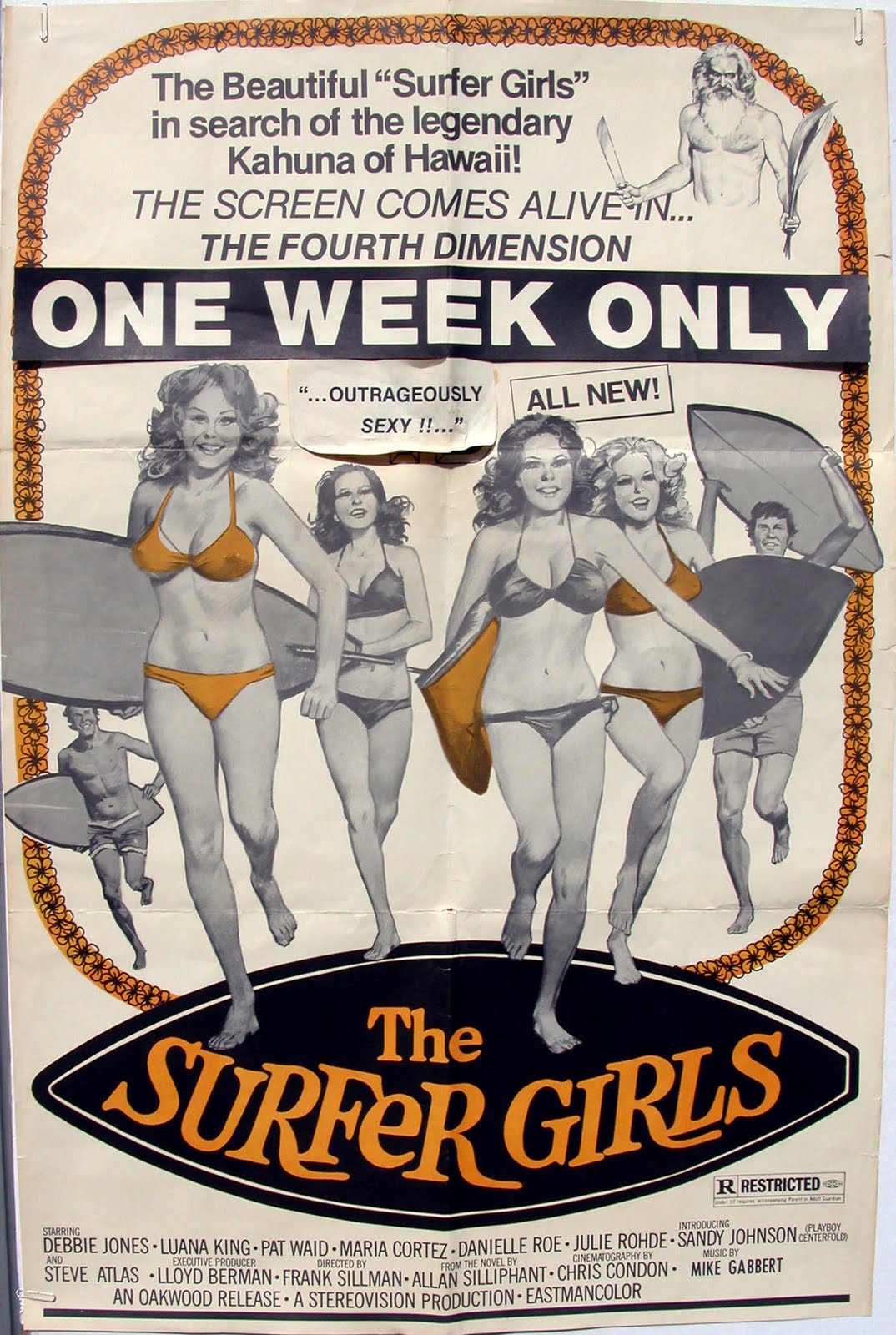
I was intrigued, so I started investigating. Here's the short version of what I found: Back in the late ’70s these two guys Al Silliman Jr. and Chris Condon produced a few movies together -- mostly low-budget grindhouse fare. One film, The Stewardesses, actually did make some money (and is still available on DVD, in a 40th-anniversary edition). The duo also produced, wrote, and directed a tank of a movie called The Surfer Girls -- the same name that's on the canister. Here's a poster for it that I found on the web [click to enlarge]:

Photo D.JPG

What's interesting about this movie is that Al and Chris started a company called Stereovision, which showcased their newly invented 3-D movie-making process. According to IMDB, The Surfer Girls originally came out in 3-D in 1978 and was then retitled Kahuna! in 1981. In 1982 it was retitled once again, as The Senior Snatch, and resissued "flat" (i.e., not in 3-D). I'm guessing this is one bad movie but perhaps a decent story for cocktail parties.

At this point I remembered that the antiques store had another film reel with "Stereovision" written on it. Eureka! I suspected that this might be The Surfer Girls itself (or one of its retitled iterations), so I went back the following morning and bought the reel:

photo (9).JPG

It's a 9-3/4" standard reel, which holds about 1,000 feet of film -- that's 12 to 15 minutes of running time. Most movies at the time were comprised of eight to ten of these reels and sent to theatres in cases of two reels each. Reels that were intended for theatre use had a bunch of markings on them so the projectionist knew when it was time to cue up the next reel. In this case, I have reel No. 7:

photo (5).JPG

Since I don't have the first reel with the opening credits (or a 35mm proector, for that matter), it's impossible to know which movie this is from. But I'm thinking it's probably from The Surfer Girls. And it's almost certainly from one of Al Silliman Jr. and Chris Condon's 3-D movies, because each frame has a double image:

photo (12).JPG

Meanwhile, some additional research reveals that Al Silliman Jr. is actually Allan Silliphant, who went on to create Anachrome -- another company specializing in 3-D technology. He is still around and lives near me in Southern California. I sent him an email telling him what I found and asked if he'd be interested in a little email correspondence for some backstory. No reply so far. (Silliman/Silliphant's partner, Chris Condon, passed away in 2010. After their moviemaking adventures, they founded Sierra Pacific Airlines. Now there are two guys I would like to have had a beer with!)

I'm toying with the idea of trying to either obtain or rent a projector so I can play the reel, or perhaps find a company that can convert it to digital. I'm also wondering what happened to the other reels. An awesome finale would be to have a screening with Allan in attendance, but that is probably a pipe dream. I'm still hoping to hear back from him, but I don't want to be pest or cross over into stalking territory.

I know very little about filmmaking. If any of your readers know more about this and can help fill in any of the gaps, I'd love to hear from them. They can contact me at this address.

---------

Fascinating stuff, right? Big thanks to Tim for sharing the story of his find. If you know more about all this, feel free to contact Tim at the link shown above, and/or post info in the comments. Thanks.

Tuesday, April 30, 2013

Screen shot 2013-04-30 at 1.14.25 PM.png Screen shot 2013-04-30 at 1.15.23 PM.png

The color photos at top are of John Dodds and a vintage World War II bomber jacket that he recently purchased for $17 at a Goodwill store in Washington, DC. The black-and-white photo is of Robert Arand, the man to whom the jacket originally belonged back in the 1940s.

Dodds, a military veteran himself, was able to track down Arand, who's now 90 years old and will soon be reunited with his jacket. You can get the full story in this Stars and Stripes article.

We've had quite a few of these stories about lost military jackets being found and returned to their original owners. Part of it, I'm sure, is that military apparel is reasonably easy to track, at least compared to other vintage clothing. And part of it is no doubt that military garments resonate with strong backstories that seem to compel us to find the item's original owner. In any case, I'll keep featuring these stories as long as they keep coming up.

Wednesday, January 30, 2013

I wear a lot of vintage clothing, and I'm always wondering about the people who owned the clothing before I did. Who were they? What were they doing and experiencing when they wore this sweater (or shirt, or pair of jeans, or whatever)? If the clothing could talk, what stories would it tell? Occasionally I'm able to find out the answers to those questions, as in the case of that vintage skating jacket that I was recently able to trace back to its original owner, but that's pretty rare. Most of the time I'm just left to wonder.

The folks at Racked -- a shopping web site that I just became aware of, although I gather it's fairly popular -- apparently wonder the same thing, and they've taken a novel approach toward addressing it. They recently hired a psychic and turned her loose in a Manhattan vintage store so she could tell the stories behind the clothing. The resulting video -- called, simply enough, "Vintage Store Psychic" -- can be seen above.

Frankly, it's a little disappointing. The psychic mainly comes across as a ditz, and the "revelations" she comes up with aren't particularly interesting or illuminating. But the basic concept of trying to find the stories behind old objects is a good one. And the concept isn't just limited to clothing, of course -- every old object has a history, a story to tell. That's the essence of Permanent Record.

Do you know the stories behind any of your second-hand objects? If so, post them in the comments, or feel free to e-mail them to me.

Wednesday, January 23, 2013

Screen shot 2013-01-23 at 1.07.25 PM.png

The items shown above were recovered from the person of a Guatemalan man whose dead, decomposing body was found in the Sonoran Desert in July of 2010. The man had presumably traveled to Mexico and tried to cross into the United States. Like many people who attempt this border crossing, he died along the way. The few personal effects were not enough to identify him (the I.D. card is fake), and his remains have never been positively identified.

I learned all this in a fascinating article written by Robin Reineke, a cultural anthropologist who's part of a forensics team that tries to identify migrants' bodies found in the Sonoran Desert. The desert heat renders the bodies unrecognizable within a few days, so personal effects are often the only viable clues to the migrants' identities. It's a very powerful example of the Permanent Record ethos of tracking down the stories behind found objects.

The photos accompanying that article were taken by Jonathan Hollingsworth. Turns out he recently published a whole book of similar photos, all showing personal effects from deceased migrants. I haven't gotten a copy yet, but it's on my list.

(Special thanks to Kirsten Hively for letting me know about this one.)

Thursday, January 17, 2013

Screen shot 2013-01-17 at 1.26.43 PM.png
Click to enlarge

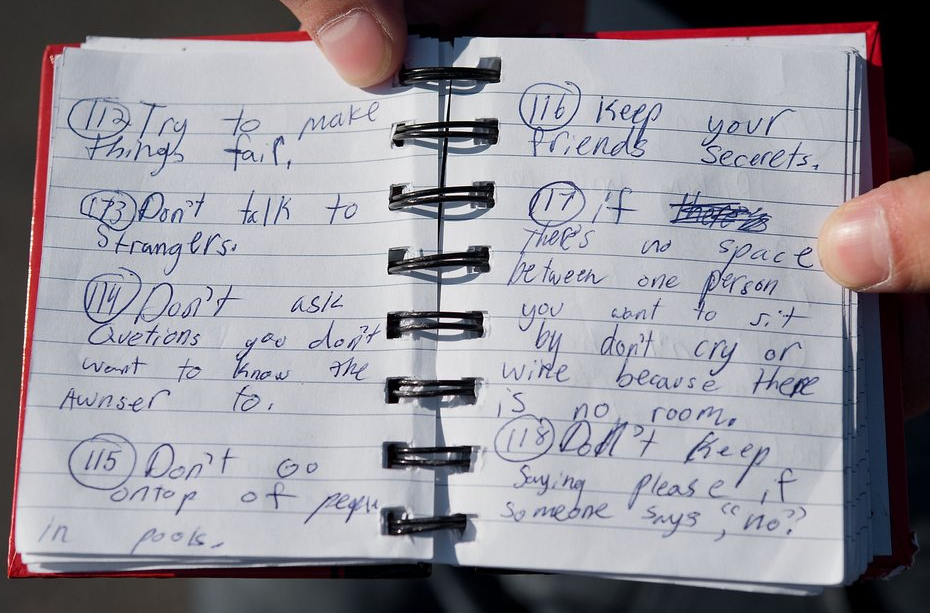
What you see above is a book of "rules to live by," filled out by a child. As you can see, some of the rules are rather endearingly worded: "If there's no space between one person you want to sit by, don't cry or wine [sic] because there is no room," for example, and "Don't ask questions you don't want to know the answer to."

The book, which contains 157 numbered guidelines, was found in the parking lot of a California Walmart by a 20-year-old employee named Raymond Flores. He thought the book was too special to be consigned to the trash, so he contacted local media outlets in an attempt to find its author/owner. It turned out to be the work of two cousins: Isabelle Busath, 10, and Isabella Thordsen, 8. Flores was able to meet with them and return the book to them earlier this week.

Here's a short video clip about the story:


(Special thanks to Sue Kendall for pointing me toward this one.)

Sunday, January 13, 2013

7798888.bin.jpg

The gentleman shown above is 92-year-old William Kadar of Merrillville, Indiana. He's holding the U.S. Army-issued duffel bag that he used during World War II to tote his gear around France. The bag became separated from him in November of 1944, and Kadar was captured by the Germans and marched to a POW camp soon after that. But he survived the ordeal, and his duffel bag did as well. It was found and kept for several generations by a French family, which recently decided to find the bag's owner and return it to him. You can read more about the story here.

As it turns out, the past week or so has been a busy time for PermaRec-ish stories involving war artifacts:

• In Italy, a man has found a wristwatch that probably belonged to an American World War II military transport pilot. He hopes to return it to the pilot's family.

• In California, a photography enthusiast purchased an antique camera and was surprised to find that it contained eight glass negatives showing images taken in France during World War I. Fascinating stuff.

(Special thanks to Matthew Algeo for pointing me toward two of these stories.)

Wednesday, December 26, 2012

994241.jpg

994231.jpg

Earlier this month I wrote about story behind an old military jacket that had washed ashore after Hurricane Sandy, and how the person who found it was able to return it to the widow of the cadet who'd originally worn it at West Point in the early 1930s.

The jacket shown above is not that same jacket, but it's very similar. It was purchased 20 years ago at a consignment shop by a Minnesota woman named Mary Helen Taft. When she read a news article about the jacket that had washed ashore, she became curious about the one she had bought, which was stowed away in her closet. So she dug it out and then did what the person who'd found the other jacket had done: She contacted West Point and asked if officials there could use the marks on the jacket's tags to tell her more about its original owner.

In this case, the jacket had been worn by a cadet named Joseph Francis Albano, who graduated in 1971. (West Point cadet jacket design apparently didn't change much in the four decades.) He's still alive, although he and Mary Helen Taft hadn't yet spoken or met as of a few days ago.

Further details on all of this, along with a mention of yet another vintage West Point jacket being traced back to its original wearer, can be found here.

(Special thanks to Barbara Zimmer for pointing me toward this one.)

Friday, December 21, 2012

image.jpeg

I've written several times now about Russell Ries. As you may recall, he's the guy who purchased a cigar box full of old photos and other personal effects, all pertaining to the same person (who I refer to as John Doe). Russell did a little digging and discovered that John Doe was accused child neglect that resulted in the death of one of his children. Russell also discovered that while John Doe himself was now deceased, another one of his children was living in the Nashville area -- where Russell himself lives. He wondered if he should get in touch with the son and offer the photos and other items to him, or if he should keep his distance because the subject might be too painful. Several Permanent Record readers offered their own opinions on this.

Russell ultimately decided to get in touch with the son, whose name is Bill. (I had referred to him as Andy, to help protect his identity, but Russell is now ready to use his real first name.) Bill agreed to meet with Russell, and the meeting took place in Westmoreland, Tennessee, a few days ago. The photo above shows Russell on the left and Bill on the right.

Russell provided a detailed account of the meeting, including the following:

Until starting my drive to Westmoreland that morning, the full reality of the situation hadn't dawned on me. This was probably the final chapter of my connection to Bill and his family.

I had purchased the cigar box over Memorial Day weekend in 2011. And since that time, I had come to see myself as something of a steward of the memories contained within it. I had always hoped this day would come. But now faced with it, I began to lament the loss of my role in the story.

The truth was, no matter how close I may have felt to Bill or his father, I was a complete stranger to him. Some guy who, only last week, sent him a letter about pictures of his dad. He had been a compelling character in my life for over a year but I had literally just entered his. Would I be able to find any real connection with this man when we met? How would I feel about preserving and returning these memories to him if he turned out to be a jerk? It was a petty and small way to feel, I know. Fortunately, it proved to be without merit when we finally met.

There's more -- a lot more. To see how it all turns out, check out the full story on Russell's blog.

+ + + + +

A few housekeeping notes: It's been over two weeks since the last post here on the site. Sorry about that -- been busy with other projects. But Permanent Record is very much alive and well. In the coming days I'll be posting about a very PermaRec-ish book that I'm extremely excited about, along with the latest installment of Charlene Dodds's rephotography project, and hopefully a few other things.

Several people noticed the note at the end of last month's PermaRec article on Slate, which mentioned that there would be no more Slate articles for the foreseeable future. Just to clarify that, I plan to keep researching and investigating the stories behind the Manhattan Trade School report cards, and the Slate editors are happy to keep publishing PermaRec articles if I come across a student with a particularly powerful story. But they feel the basic goals of the series -- to tell about the school and its students -- have now been met. So any future articles will only be about report cards with particularly extraordinary stories to tell. (Of course, I think they're all extraordinary, but I understand the editors' point.)

My best wishes to all PermaRec readers for a safe and happy Christmas.

Monday, December 3, 2012

Screen shot 2012-12-03 at 11.02.41 AM.png

jacket.jpg

The two photos at the top of the page are West Point cadet Chester deGavre wearing his formal military jacket in his 1933 West Point yearbook photo, and that same jacket as it appears today. The lower photo shows the jacket being presented last week to deGavre's 98-year-old widow, Teresa deGavre, after the jacket had been found washed up on the Jersey Shore in the wake of hurricane Sandy.

The jacket was found by Donna Gugger (the blond woman in the lower photo), who discovered it while cleaning up debris near her home after the storm. She initially thought it was a costume jacket, but some of the interior tagging indicated that it was a genuine military jacket. With some research assistance from the folks at West Point, she was able to determine that it had been issued to Chester deGavre, who died in 1993. Some additional research led her to deGavre's widow.

That's some impressive sleuthing, although one serious mystery remains: Teresa deGavre had been completely unaware of the jacket's existence. It's not clear how it became separated from her husband, who may have owned it in the interim, or how it ended up in the ocean. In any case, it's now back where it belongs.

You can read more about this here and here, and there's a video report here:

Cadet jacket found in Sandy aftermath

(Special thanks to Sue Kendall for bringing this story to my attention.)