Saturday, August 11, 2012

1.png
Click to enlarge

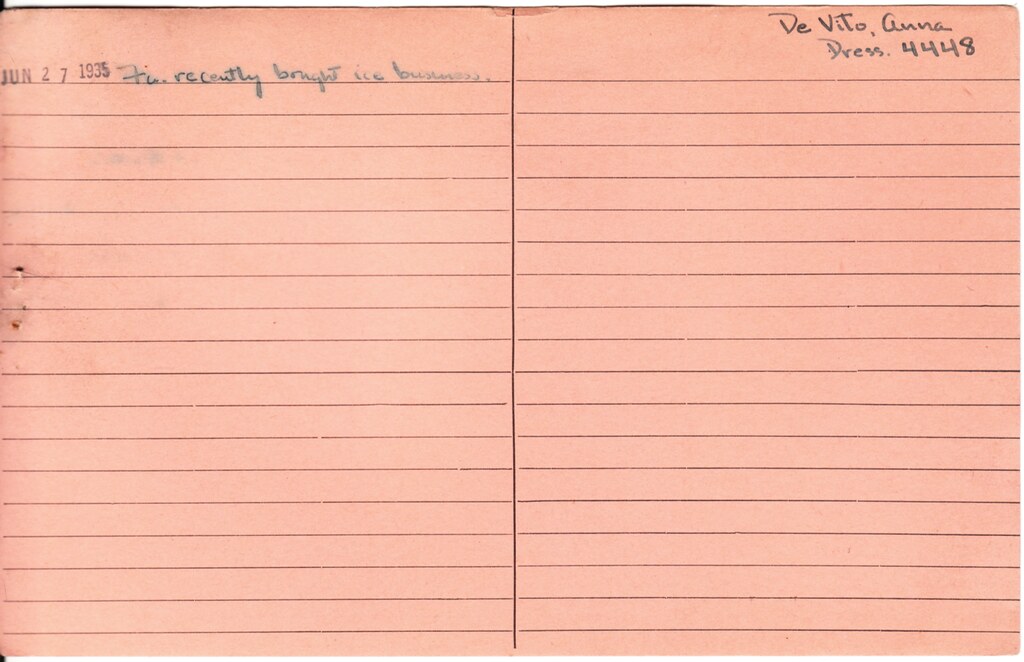
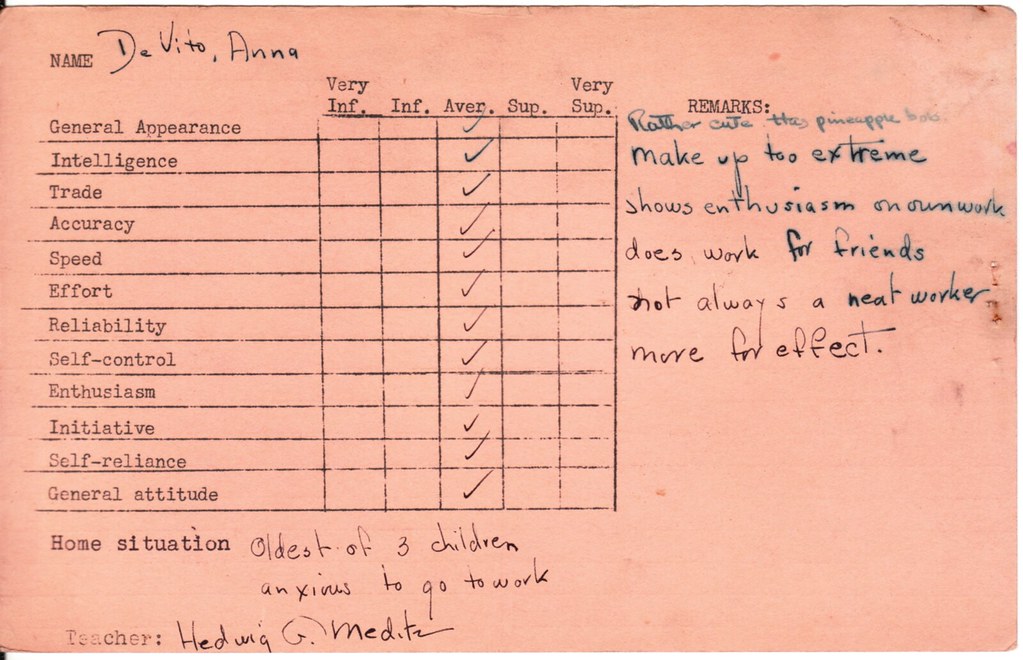
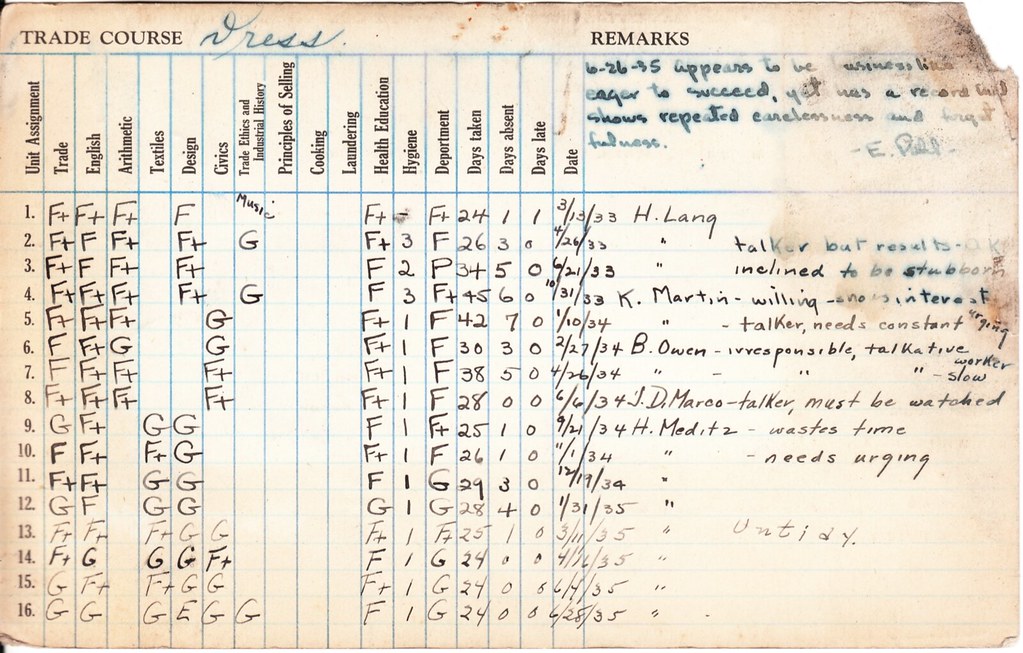
What you see above is the main card from the student file of Anna DeVito, who attended the Manhattan Trade School for Girls (or Manhattan Industrial High School, as it had recently been renamed) from 1933 through 1935. Her card is pretty much like all the others in my report card collection, but I'm nonetheless very excited about it, because it wasn't part of my collection until a few days ago.

Here's the deal: When I found the Manhattan Trade report cards back in 1996, three friends were with me. We each took a batch of cards, and then the other three people each donated their batches to me when I decided to launch the Permanent Record project. (For more details on all of this, look here.) One of those friends, Daniel Radosh, recently found two additional students' card packets, including Anna's and sent them to me.

"Our box of cards was in a filing cabinet in the basement," says Daniel. "The other day I took another box out of the cabinet and these two students' report cards were underneath. I searched around and they were the only two that had slipped out."

You can see the rest of Anna DeVito's file here (for all of these, you can click to enlarge):
2.png 3.png 4.png 5.png

Compared to some of the other reports in my collection, Anna's file isn't especially juicy, but it does offer some interesting details:

• Anna was born in October of 1917. If she's still alive, she'll be turning 95 in two months.

• I love that her father's occupation is listed simply as "Ice." Later in her file, it's explained that he "recently bought [an] ice business" -- a sharp reminder that many New Yorkers still didn't have electric refrigerators in 1935.

• Four different teachers referred to Anna as a "talker."

• Someone on the school's staff noted that Anna was "rather cute -- has pineapple bob." I'd never heard of this term, so I Googled "pineapple bob," but all I came up with was a cyclist named Pineapple Bob. Then I tried "pineapple hairstyle" -- bingo. Doesn't look like the hair in Anna's photo, but maybe she changed her ’do during her time at the school.

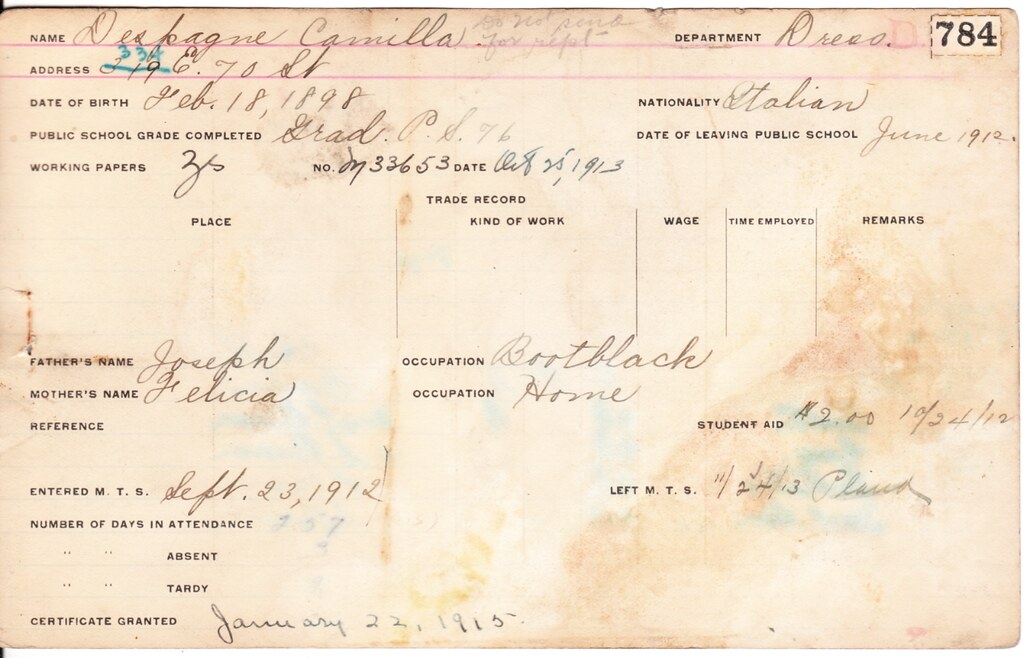
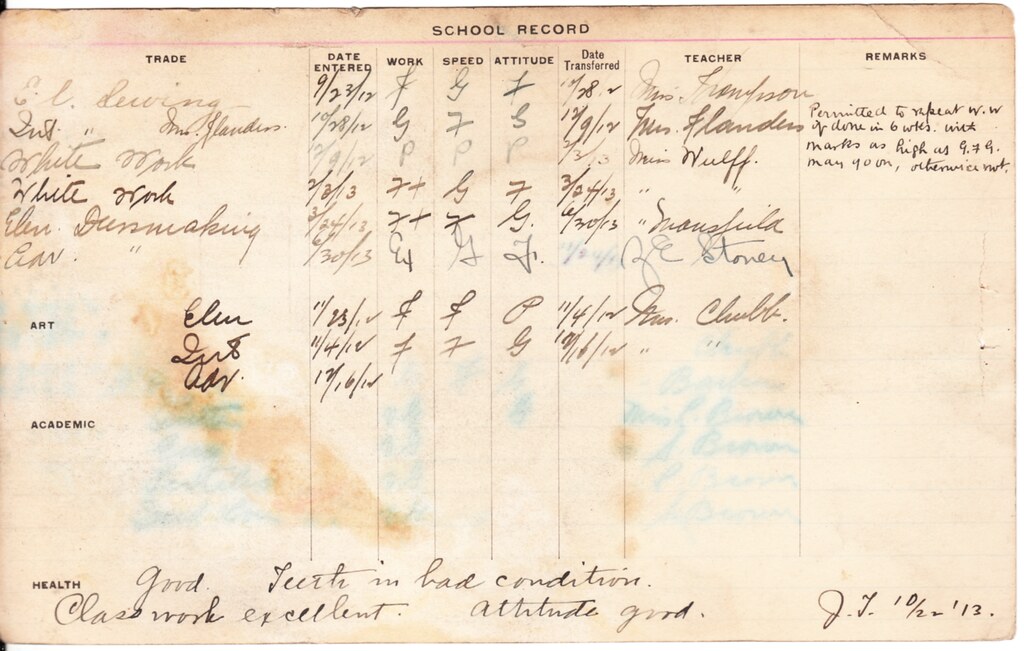
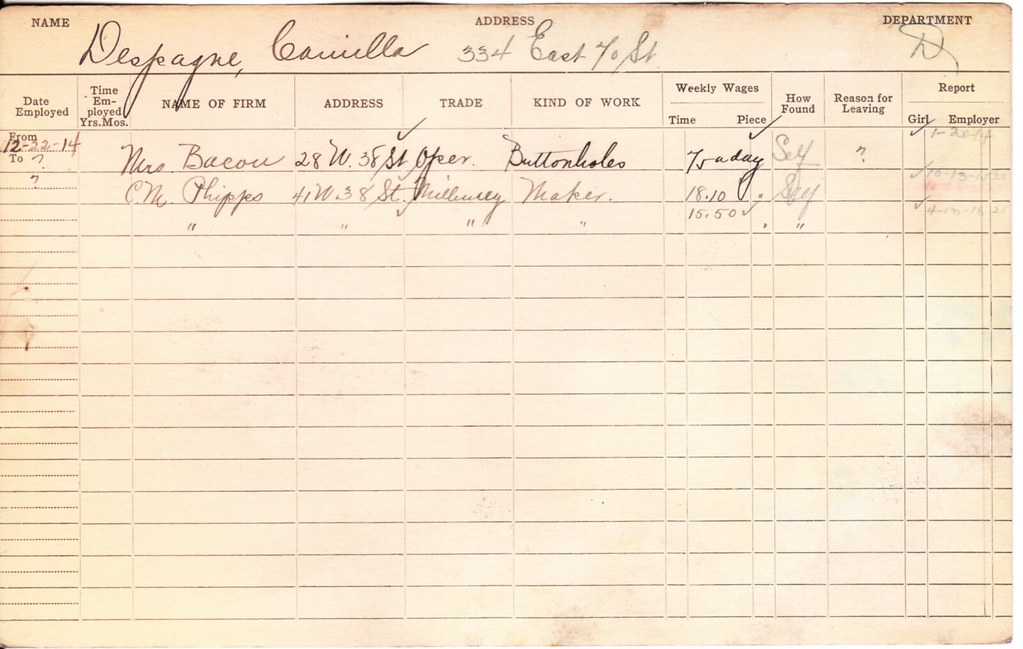
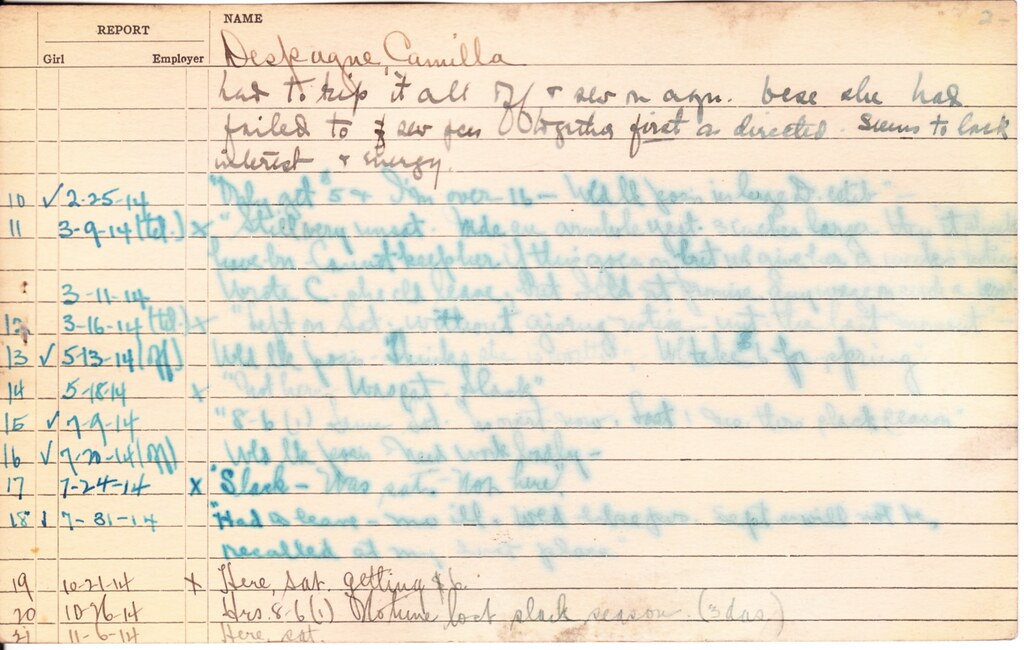
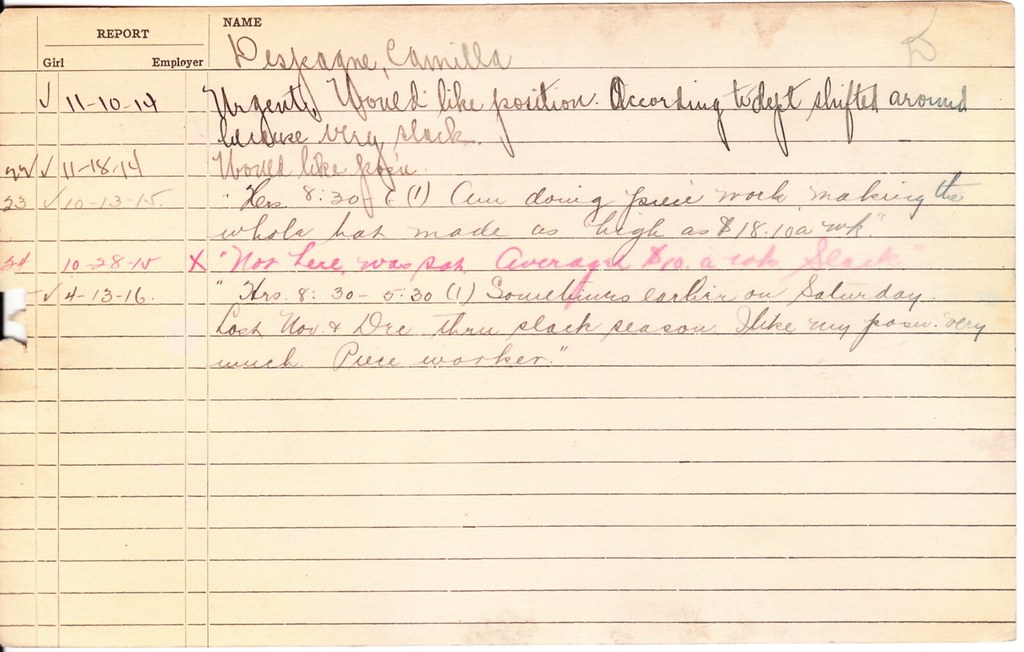
The other student whose card packet Daniel found was named Carmilla Despagne, who attended Manhattan Trade in 1912 and ’13. Unfortunately, as you can see below, her cards sustained significant water damage (again, you can click to enlarge):

1.png 2.png 3.png 4.png 5.png 6.png 7.png

Carmilla's file is harder to suss out (in part because of the water damage, but also because her file was filled out in handwriting that's a bit trickier to decipher), but there's still some interesting stuff in there:

• Her father was a bootblack. First time I've seen that term used in any of the report cards.

• At one time she worked making buttonholes! I know that was once a big niche industry in the garment district, but can you imagine working on nothing but buttonholes all day?

• Carmilla apparently liked her first job, working for a Mrs. Bunce: "Like it very much. Mrs. B. is very nice to me and I feel at home. Think I'm very satisfactory." But the feeling was apparently not mutual, as noted in this bit of feedback from Mrs. Bunce: "May have to let her go. Can sew nicely, but does not heed instruction. Talkative, sullen, and inclined to be impertinent." Eight days later, there was this: "Will have to let her go tomorrow. Have given her another week's trial. Prefer more experienced gal." A school staffer then noted parenthetically, "Her attitude apparently more at fault than her work." (To put this all in some perspective, Carmilla was only 15 at the time.)

• Unfortunately, Mrs. Bunce wasn't the only one who had issues with Carmilla's work. Another employer, Miss Wagstff, had this to say: "Not as good as at first. ... Inattentive. Slow. Took all day to sew on six yards of [illegible] and had to rip it all off and sew on again because she had failed to sew pieces together first as directed. Seems to lack interest and energy."

Despite these negative reviews, the school continued to arrange work for Carmilla for several more years.

After working with the same set of 395 cards for so long, it's exciting to have these two new students to add to the collection. New material!

Thursday, July 26, 2012

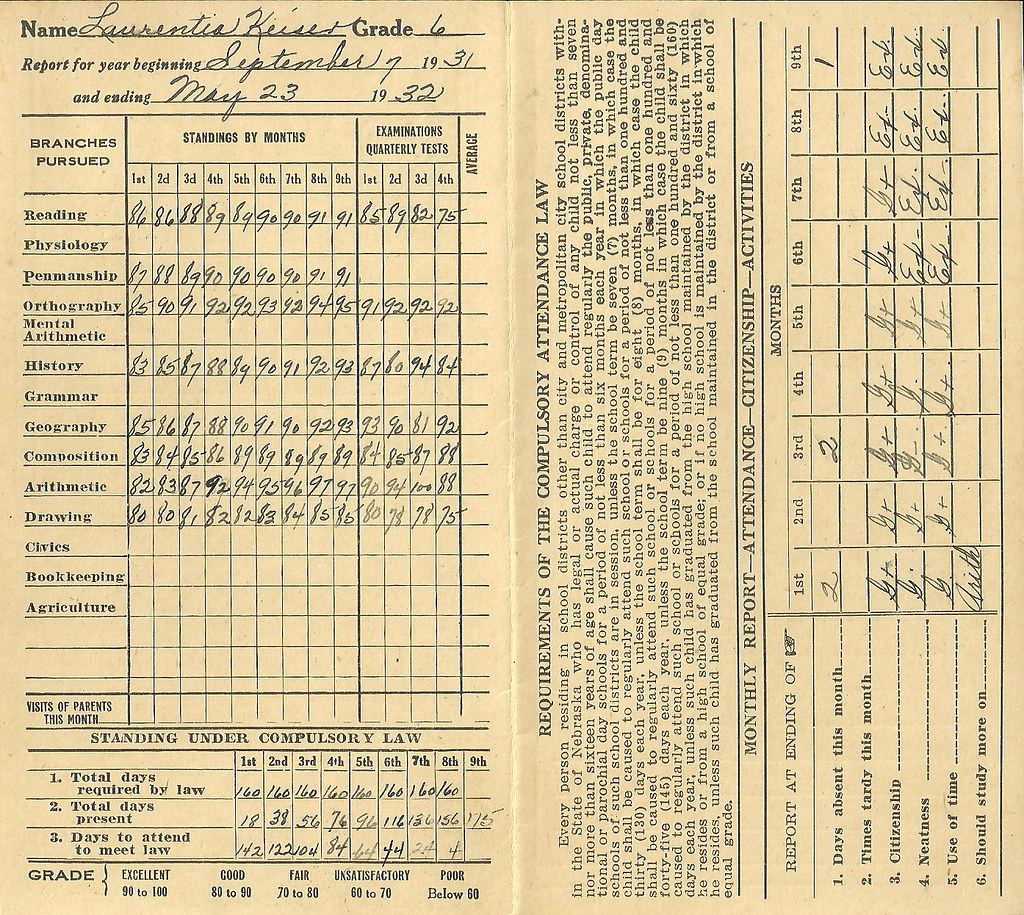
Laurentia Report Card front.jpg Laurentia Report Card Inside.jpg
Click images to enlarge

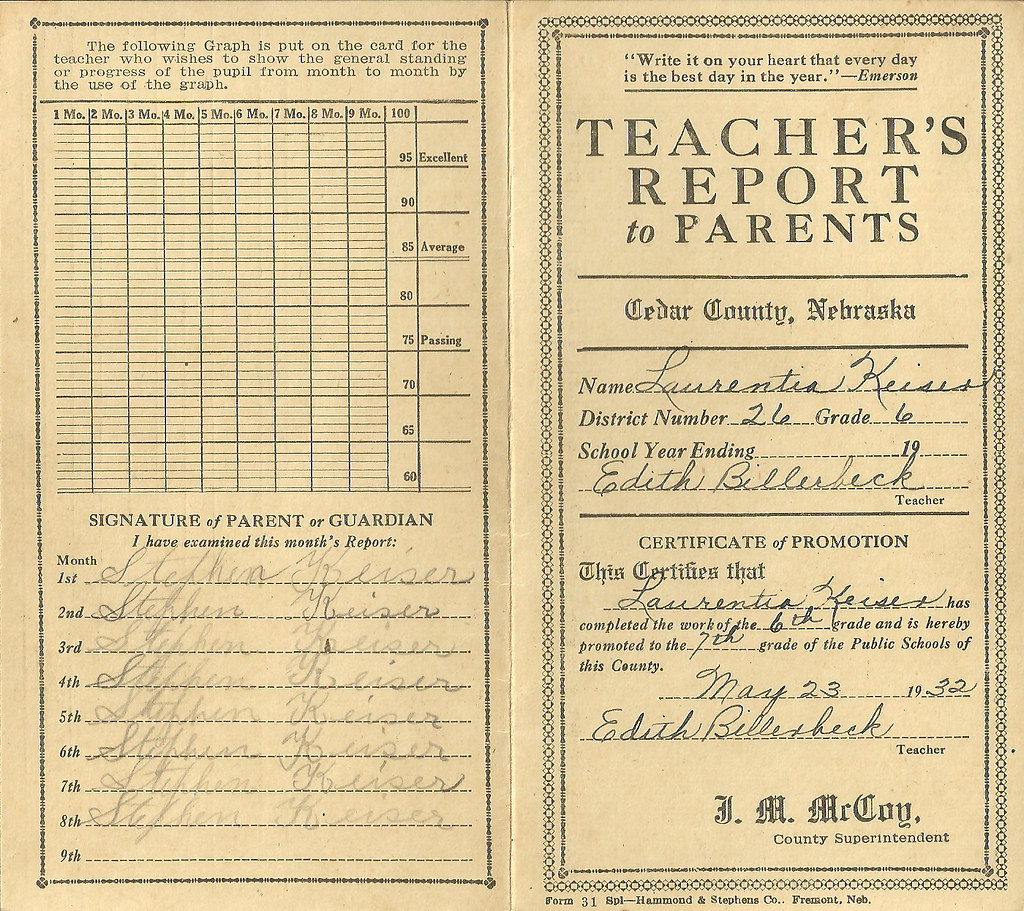
Reader Jared Wieseler recently found and scanned some school records pertaining to his grandmother, Laurentia Keiser, who grew up in Nebraska. What you see above are the inner and outer panels of her sixth grade report card from 1932.

Lots of interesting details here, beginning with the near-perfect handwriting of Laurentia's teacher, Edith Billerbeck. What was it about 20th century schoolteachers that gave them such perfect penmanship? Like, were they hired strictly on that basis or something? And do today's teachers still have great handwriting, or has that gone to hell in the computerized era?

Other items of note:

• It's also interesting that a report was sent to Laurentia's parents every month (when I went to school in the 1970s, it was quarterly).

• Laurentia's father, Stephen Keiser, must have had a strong preference for pencils over pens: He used a pencil every time he signed the report card. (Or maybe he simply couldn't afford pens -- this was during the Great Depression, after all, and inexpensive ballpoint pens wouldn't come into common use until the mid-1940s.)

• Too bad Ms. Billerbeck didn't fill out the graph on the back of the card. That would have made for a great visual.

• Laurentia didn't study arithmetic; she studied mental arithmetic. I love that.

• I don't think I've ever seen orthography listed on a report card before. In academic terms, orthography covers a wide range of subject matter; given the other topics already listed on Laurentia's card, however, I believe it referred simply to spelling. Anyone out there know more?

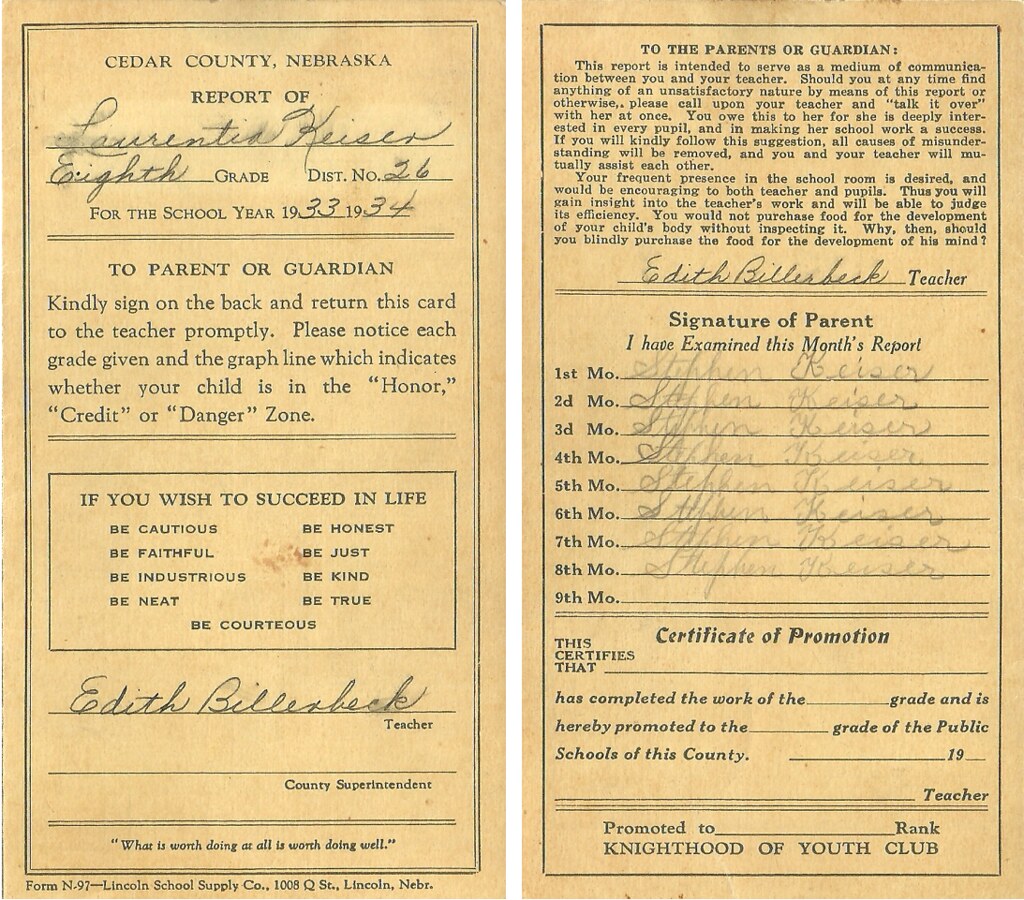
Here are the front and back of a card from two years later, when Laurentia was in the eighth grade (you can click to see a larger version):

Screen shot 2012-07-26 at 2.02.37 PM.png

Laurentia still had the same teacher, so it must have been a very small school. Good to see Mr. Keiser was sticking to his pencils, too. But what I really love about this card is the little "If You Wish to Succeed in Life" tutorial. Interesting that the very first attribute they chose to stress was caution.

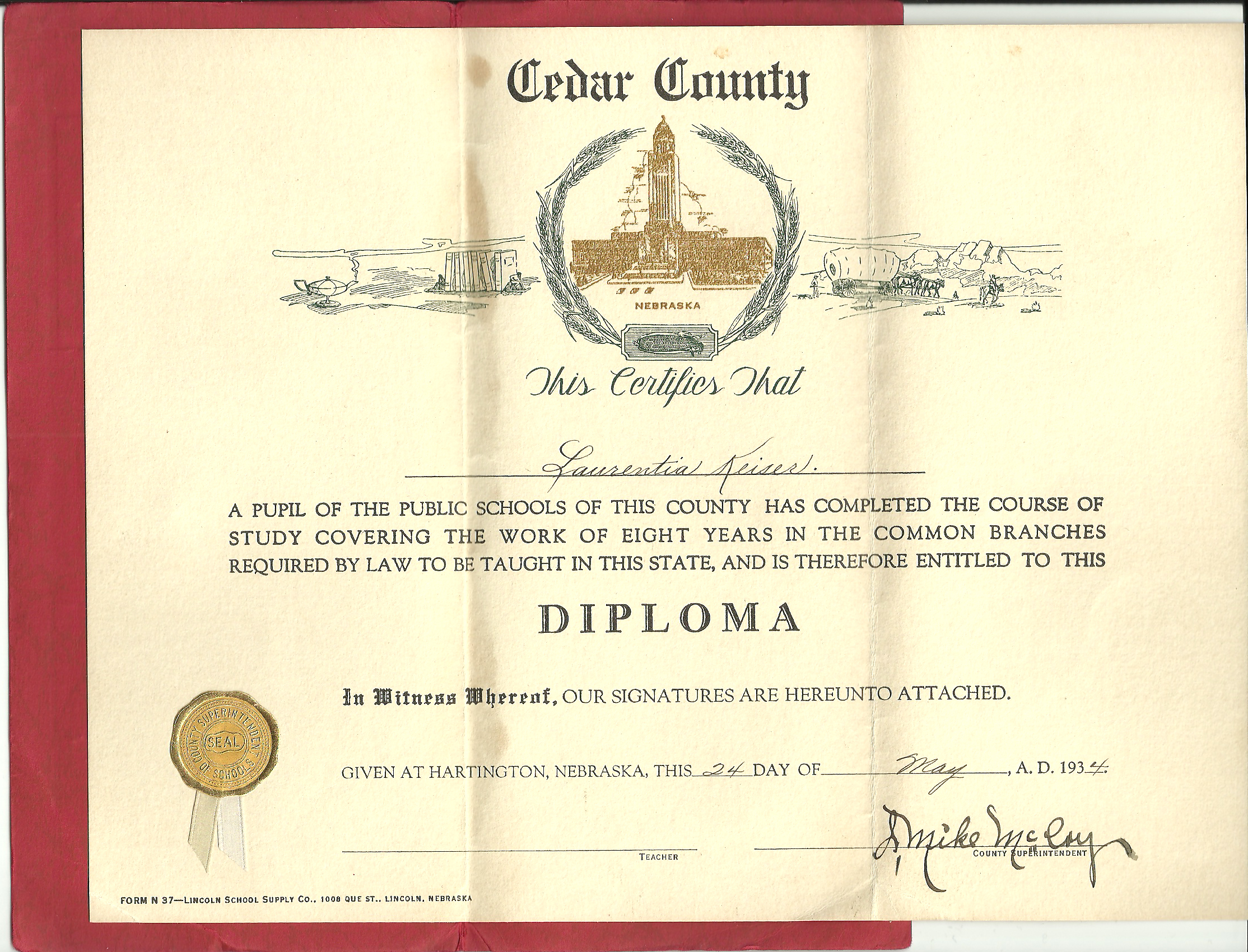
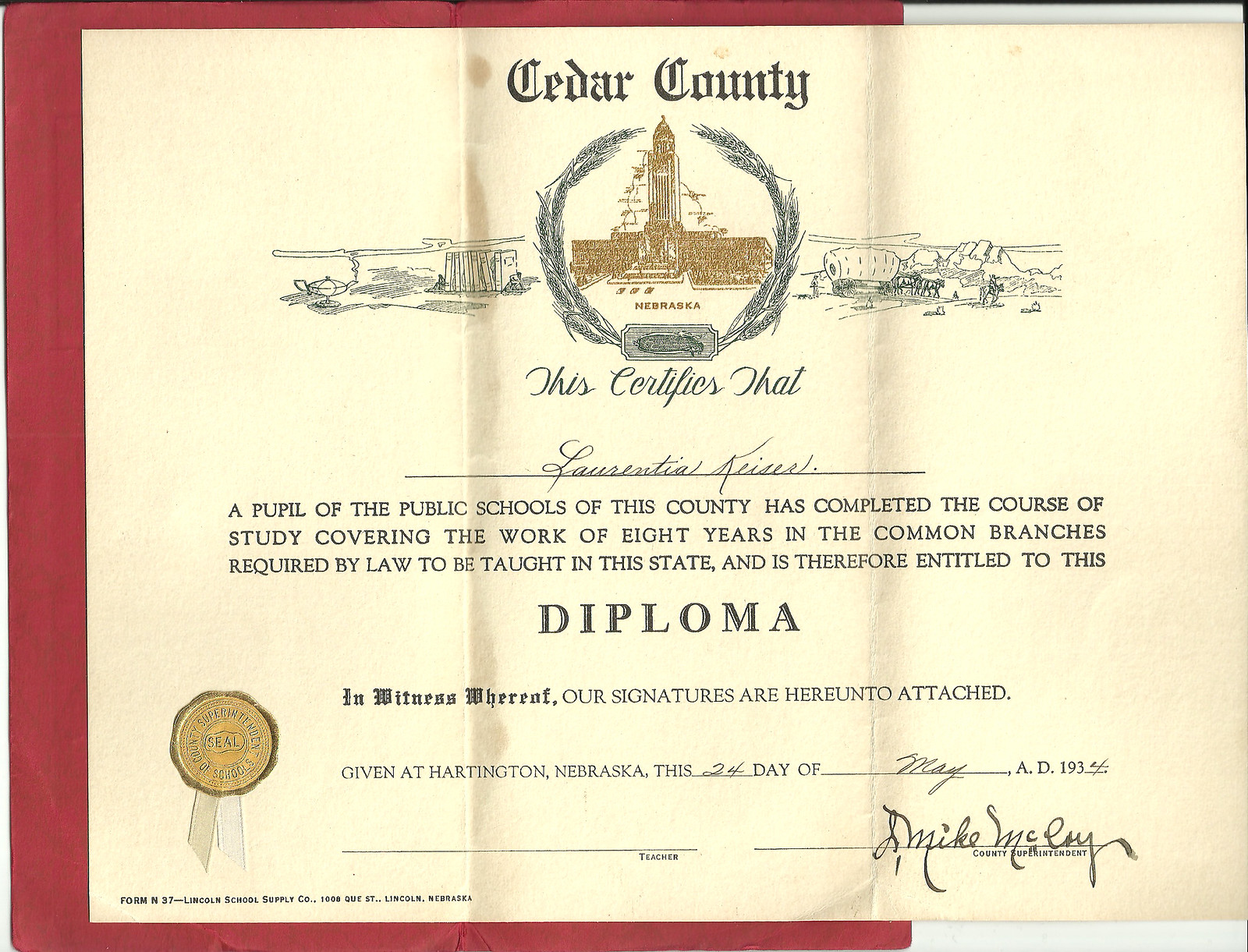
Laurentia eventually graduated from the eighth grade, at which point she was given diploma, which was produced in its own little folder (again, you can click to enlarge):

8th grade diploma cover.jpg 8th grade diploma open.jpg

I especially like the seal at the top, with the books on the left, the stagecoach on the right, and the wreath of wheatstalks sprouting from an ear of corn. The seal at lower left complete with two different colored ribbons, is a nice touch as well.

Jared -- Laurentia's grandson -- says there's lots more where this came from. "I also have an eighth grade diploma for Laurentia's sister, Teresa, that seems to be actual felt affixed to cardstock, wrapped in gold fabric that's sort of like the lining of a suit jacket," he says. "It has an added matching ribbon tied around the diploma."

Sounds amazing. Jared, if you're willing to share, let's see more!

Wednesday, July 25, 2012

23appraise1_cnd-popup.jpg
Photo by Librado Romero, The New York Times

When I found the old Manhattan Trade School report cards that eventually formed the basis of the Permanent Record project, they were about to be thrown out. I've often wondered what would have happened if a New York City garbageman had encountered them while collecting the trash on his route. Would he have cared, or would he have just chucked them in his garbage truck and moved on?

If the garbageman in question had been Nelson Molina (pictured above), there's a decent chance he might have saved them. The New York Times recently ran an article about Molina, a Manhattan sanitation worker who for years has been culling interesting objects from his daily rounds and has assembled them into a "trash museum" in one of the Sanitation Department's garages. (The article is here, and there's also a slideshow of objects from the Molina's museum.)

According to the article, the collection features over 1000 objects, including "a portrait of a grumpy-looking Winston Churchill ... a very nice pastel copy of Henri Matisse’s ‘Woman With a Hat’ ... photographs of the Brooklyn Bridge, landscapes done in watercolor, ancient tricycles and toy trucks ... four electric guitars ... [and] a Master of Business Administration diploma from Harvard." No mention of report cards, although the diploma is sort of close.

Molina's collection (which does not violate any departmental rules, because he's displaying the objects for other sanitation workers to see, not taking them for his own personal use) validates one of our culture's most enduring clichés: One person's trash is another person's treasure. It's also a de facto commentary on our disposable society. That all seems obvious and straightforward, right?

What seems missing, at least for me, is the sense that each of these objects represents a story. Where's the speculation regarding each object's history? Who painted those paintings, played those guitars, rode on those tricycles? Why were these items -- including a diploma from Harvard! -- discarded? Like, I realize Molina isn't a researcher or journalist, but doesn't he at least ponder these questions, even he doesn’t have the time or resources to go about answering them? Maybe he just doesn't think in those terms, or maybe the person who wrote the Times article chose not to go in that direction. Either way, it feels like a missed opportunity.

Meanwhile, if you're interested in the trash/treasure duality, PermaRec fan Kirsten Hively recently told me about a blog called Trash Treasures of New York City, which is run by a guy who runs a rubbish removal company. Lots of fun stuff here (including this 1959 car registration record for a blue ’53 Plymouth) -- worth checking out.

Thursday, July 19, 2012

IMG_0001.jpg
Click to enlarge

A few days ago I wrote about Russell Ries and the cigar box full of old photos he'd acquired at a flea market. That prompted me to dig out a small stash of snapshots I found at a junk shop in Reno back in 1994. My favorite is the one shown above. I love so many things about it -- the woman's festive outfit, her vivacious face and body language, the handwritten "GiRLS" with the lowercase "i," and so on. When I first saw it, I remember thinking, "That's no girl. That's a woman." I wondered what had happened to her; I still do.

When I bought this photo and a few others back in ’94, I did so sort of on a whim. I had the instinct to collect old, interesting things, but I was young and broke and hadn't yet figured out what sorts of things I wanted to collect (or, as I've since discovered, what sorts of things would collect me). I was sort of casting about in search of my niche, my collector's identity. "Oh, maybe I'll collect old paperback novels" or "Hey, these old snapshots are cool -- maybe that's what I am, a photograph collector!"

So I bought several photos that day. The shop in Reno had a big pile of them, and I spent a bit of time picking out the ones I liked best. Here's another one (for all of these, you can click to enlarge):

IMG_0004.jpg

I love old-school country bars and taverns, and this one looks like it's right up my alley. And look at those faces -- I totally want to have a beer with them! In my fantasy world, this bar would be in Wisconsin (I have a thing for Wisconsin taverns), but the two Utica Club signs on the wall suggest that this place was probably located in upstate New York. Wherever it was, I hope it's still there. Next round's on me, guys.
Next up we have a proud woman and, I'm assuming, her son:

IMG_0003.jpg

My god, look those slacks, that chest and shoulders, that posture -- they don't make guys like that anymore. You think maybe he'd just bought that car, and the photo was to commemorate the occasion?

I don't always respond all that strongly to photos of children, but I remember smiling the moment I saw this one:

IMG_0002.jpg

I really like how everyone's attention is focused on the girl who's holding the … well, what is she holding? Pick-up sticks? Something else? In any case, everybody seems to be completely oblivious to the camera's presence, which often makes for the best photos.

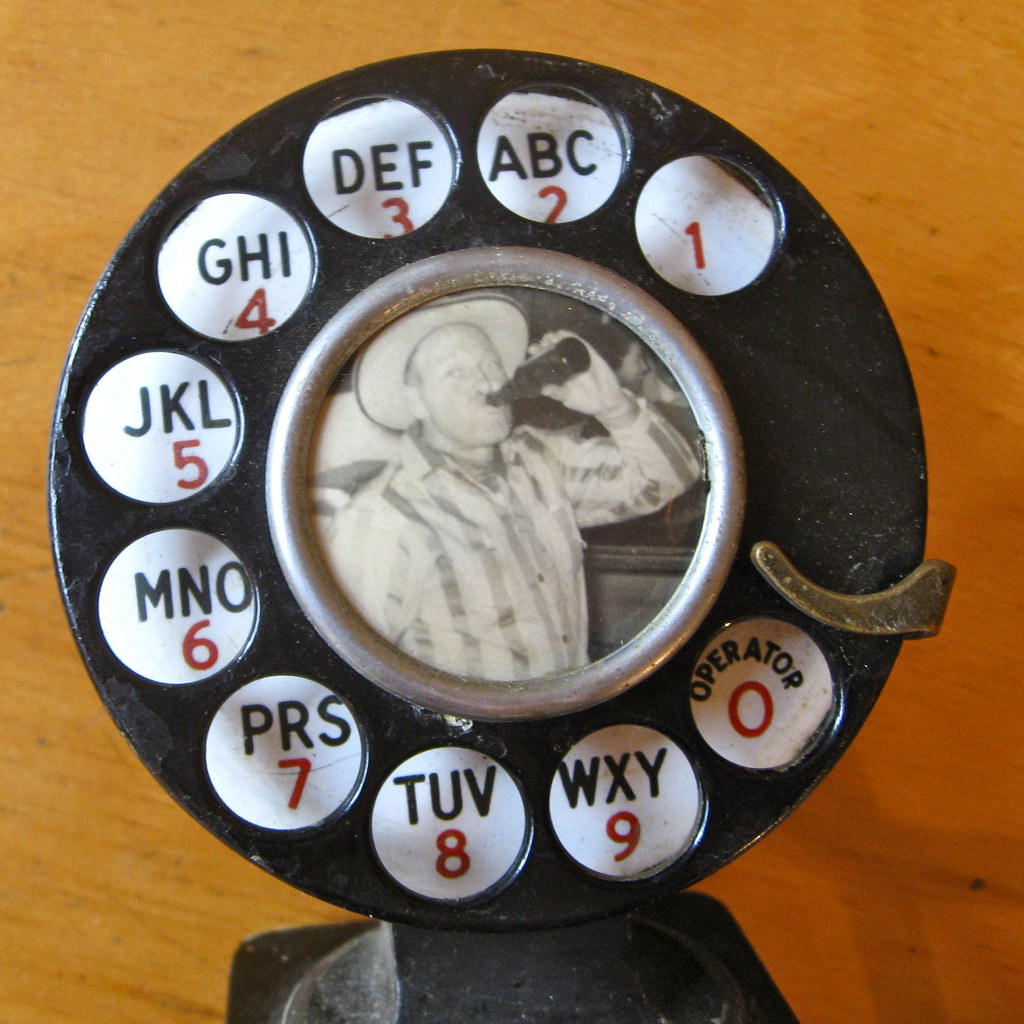
One of the photos I acquired that day ended up being repurposed. I cut out the center of it and mounted it in the dial of an old phone I had recently bought (another thing I thought I might collect):

IMG_1797.JPG

I decided his name was Otis, and I really liked the way he spun around when I dialed a number on the phone. Not a bad little art project, although I now feel bad for having destroyed a photograph.

I'm no photo expert but I know what I like, and I like these shots a lot. Maybe I dote on them a bit because they were the first discarded snapshots I ever purchased, but they really do strike me as excellent photographs. They're not technically perfect, but they all have really nice compositional elements, at least to my eye. I'm just as smitten with them today as I was back in 1994.

After I acquired these photos, I got in the habit of looking for old snapshots at flea markets and antiques shops. But I never found any that I liked as much as those first ones, so I repeatedly found myself thinking, "No, these aren't as good as the ones from Reno -- I'll pass." After a few months of that, I decided maybe I wasn't a photo collector after all and moved on to other collecting pursuits. (Soon thereafter, in September of 1996, I found the Manhattan Trade School report cards, which eventually formed the basis of Permanent Record.)

But I still love those snapshots I found in Reno. Who were the people in these photos? What happened to them? How did the photos find their way to ratty little shop in Nevada?

If you can answer any of those questions, let me know.

Monday, July 16, 2012

Screen shot 2012-07-16 at 9.59.36 AM.png

I recently received an e-mail from a Permanent Record reader named Russell Ries, who had this to say:

Much like yourself, I am fascinated by historical detritus -- items, like your report cards, that have been carried to strange places by the undulations of time. The mystery of returning them is a fun puzzle to solve, but it also gives them back their full historical significance.

A while back I bought a cigar box full of old photos [shown above — Paul] for $10 at a flea market in Monteagle, Tennessee. When I got home and started looking through the photos, I realized that they were all of the same individual. As it turns out, I had purchased some guy's entire life's worth of photographs without realizing it. Even better, there are handwritten explanatory notes on the backs of most of the pictures. So I arranged the pictures in chronological order as best I could and have been periodically posting them on Flickr. There are 144 pictures up right now, and I still have another 80 or so yet to post. You can start at the oldest photo, when the guy was 14 months old, here.

Intriguing! I wanted to know more, so I asked Russell if he'd be willing to do a quick phone interview with me. He readily agreed. Here's a transcript of our chat:

Permanent Record: First, tell me a bit about yourself. How old are you, where do you live, and what do you do for a living?

Russell Ries: I'm 28, I live in Nashville, Tennessee, and at the moment I advise people with small businesses.

PR: Interesting. How would you advise someone who's trying to make a living by writing about old report cards?

RR [laughs]: Ah, that's a good question...

PR: Just kidding, obviously. Okay, let's talk about your project. In your first email to me, you said you found the photos "a while back." When was it?

RR: It was Memorial Day weekend of 2011.

PR: What attracted you to the photos to begin with?

RR: I like collecting old photographs, because I sort of view them as the earliest stage of the visual information age in which we live. So whenever I go to flea markets, I'll go to the various booths and say, "Hey, got any old photographs?" And this one lady said, "Yeah, I've got this box -- $10." And I said okay.

PR: Do you collect other found objects, besides photos?

RR: Some, yeah, I've started to. I'm actually getting into metal detecting. It's really prevalent around here with Civil War stuff.

PR: So you buy this box of photos for ten bucks. At what point did you realize that the photos were all from one person's life?

RR: As soon as I drove home and started flipping through the photos, it sort of dawned on me. I saw the same names repeatedly written on the back of the photos. It wasn't hard to figure out.

PR: Maybe I'm missing something -- it certainly wouldn't be the first time -- but have you listed the guy's name anywhere? Like, your Flickr captions say, "With his wife and son" or "In his father's garden," but you haven't actually listed his name anywhere, at least that I can see.

RR: That's right.

PR: Do you know what his name is?

RR: Yes. In fact, I actually went back to that same flea market dealer about a month after I got the photos. I said, "Hey, you sold me this guy's photos." And the dealer said, "Oh, yeah, I got that at an estate sale. I actually have more of his stuff." I wasn't expecting that -- I just wanted to learn more about the photos, where they came from -- but I said, "Give me everything." So I now own this guy's military dog tags and medals, and also his wallet and false teeth. The only thing I didn't buy was the guy's military jacket. Some of the photos in the cigar box actually show him wearing that jacket. But the dealer wanted too much money for it, so I didn't buy that. Anyway, yeah, I know his name -- I know a lot about him.

PR: Why have you not listed his name? Was that sort of an artistic choice on your part, or just respecting his privacy..?

RR: My feeling when I started the project was that while I do own the photographs, that doesn't mean I really know the true story of his life. Photos sort of represent the down time in people's lives, when they pause to pose for the camera. I didn't feel like I could truly do justice to this guy's life. So while I do own the photos, I didn't want to say, "Hey, this is this guy's full life and this is what he was about." And yes, there was also the privacy thing -- I felt a little weird about that. But when I discovered Permanent Record and started looking at your approach, I've kinda been rethinking that. I don't know. I just chose to err on the side of caution, basically.

PR: Looking at your Flickr stream, it appears that you've been uploading the photos in batches, often with long breaks in between. Like, you did some in late October, then some more in mid-November, and then you didn't upload any more of them until early June. Is there any rhythm to all of this that you're shooting for, or is it just one of those things that you deal with when you can get around to it?

RR: Just when I can get around to it. And I had some issues with my hard drive.

PR: What will you do when you finish uploading all the photos?

RR: I'm not sure. I have wanted to go and find the guy -- well, not the guy, because he's passed away, but his relatives.

PR: Yeah, I was gonna ask you that. Have you done any research in terms of finding them?

RR: A little bit. I've been kinda wondering about that, though. I mean, nobody wanted this guy's stuff when he passed away. Like, what if his relatives didn't like him? They might not want to be contacted. I think I'd like to do it, but it's one of those bridges that I'll cross later, once I'm done uploading all the photos. I would definitely like to return his war medals to a proper home -- if not to his family, then maybe to a veterans affairs group.

PR: Did you see, I recently blogged about a guy who tries to return old war medals to the soldiers' families?

RR: Yeah, that's what got me thinking about doing that.

PR: It's weird, isn't it, to have this sort of intimate knowledge of a stranger's life? I think about that all the time with Permanent Record.

RR: It is. I think of him almost as a friend, in a strange way, because I have these tangible connections to him. But at the same time, when I got all those other artifacts -- the medals, the wallet -- it was a little bit disappointing to lose some of the mystery of just having a box full of photos.

PR: I know that feeling! Sometimes the questions, or the mystery of the questions, can be more fun than learning the answers.

RR: Absolutely.

PR: If you had the chance to do this again with another person -- going down the rabbit hole of someone's life -- would you do it?

RR: Definitely. But I feel like it was just providence that led me to this one, and that kind of thing doesn't happen very often. I don't think I'll ever find another cigar box full of one person's photos.

PR: Well, maybe. I think certain people don't have to go looking for artifacts -- artifacts find them.

---------

Great stuff. Big thanks to Russell for sharing his project and his thoughts with us.

Thursday, July 12, 2012

Screen shot 2012-07-12 at 11.19.46 AM.png

When the first Permanent Record articles appeared on Slate last September, I heard from several writers and researchers who had pursued similar projects. One of them was a historian named James Breig, who had just finished a remarkable book called Searching for Sgt. Bailey.

The book's genesis will sound familiar to anyone who's been following Permanent Record: In 2008, Breig stopped in a Virginia antiques shop, where he purchased a bunch of letters that an American soldier named James Bailey had written and sent home from World War II. Breig quickly found himself sucked into Bailey's story. "Within weeks," he writes, "I would be standing in front of the house he grew up in."

Bailey's letters eventually led Breig on an odyssey that included interviews with dozens of former American servicemen. He pieced together not only Bailey's life but also the larger story of servicemen who, as he puts it, "dutifully did what they were asked to do and then returned to anonymity." So the book isn't just a trip down the Sgt. Bailey rabbit hole -- it's a celebration of the people who helped save the world from fascism. Some did it on the front lines, others from far away (Bailey himself was a quartermaster in New Guinea), but all contributed. Even if you've long since had your fill of "Greatest Generation" chatter, the book is a fascinating look at the WWII experience, and Bailey's letters provide that same intimate connection to the narrative that my report card collection has provided for Permanent Record.

The book is available from Amazon here. And if you want to know more, here's an hour-long video of Breig talking about the Sgt. Bailey project:

"Searching for Sergeant Bailey" by James Breig from Colonie Library on Vimeo.

Monday, July 9, 2012

Screen shot 2012-07-06 at 7.55.39 PM.png

At the top of the page is a Purple Heart medal; beneath that is a photo of Army Pvt. Corrado Piccoli, who was awarded a Purple Heart during World War II before being killed in action later in the war.

Pvt. Piccoli and his Purple Heart are at the center of a really interesting report that ran on NPR on July 6. It's about a 31-year-old Vermonter named Zac Fike, who likes to seek out old military medals (in antiques stores, on eBay, etc.) and then tries return them to the soldiers' families. In the case of Pvt. Piccoli's Purple Heart, Fike was able to track down Piccoli's sister, who's now 85 years old, and return the medal to her. (Audio of the NPR story, along with a text version, is available here.)

This is, of course, very Permanent Record. As I listened to the NPR story, many of the details sounded so familiar to me. When Fike first contacted Pvt. Piccoli's sister, for example, she was initially suspicious of him, which is the same response I often get when contacting the family of a Manhattan Trade School student. By the end of the story, however, the sister tells Fike, "We were very fortunate that you were the one who ended up with the Purple Heart. You're part of our family now." I'm happy to say I've been on the receiving end of that type of sentiment as well, and it's a very humbling thing.

I don't mean to equate a report card's significance with that of a Purple Heart. But they both serve as powerful reminders that a simple object can carry stories, stir memories, and even serve as a conduit for intimacy between strangers. And like all lost items that become found, they can trigger the impulse to bring that wayward object back to where it belongs.

(Special thanks to Kirsten Hively for letting me know about the NPR story.)

+ + + + +

Finigan Update: I've now written several blog entries about the Finigan family of Darby, Pennsylvania, because I ended up with a bunch of their receipts, invoices, and other paperwork from the 1940s. In my last entry, I noted that Harold Finigan, who had established a tradition of hanging Christmas decorations in Darby, was likely deceased by now, and I wondered if anyone was now putting up the decorations in his stead.

That prompted the following note from reader Scott Jackson:

I asked a former co-worker about this. She's lived in Darby since the 1960s. She wrote back, "After Mr. Finigan died in 2005, there was a fire and the store that the family owned burned down. Everything in the store was destroyed, along with many of the decorations that Mr. Finigan put up. Darby is not the same place it used to be, which is very sad."

Too bad. But thanks for the info, Scott.

Friday, July 6, 2012

Delaware County Daily Times 3-30-63.png
Click to enlarge

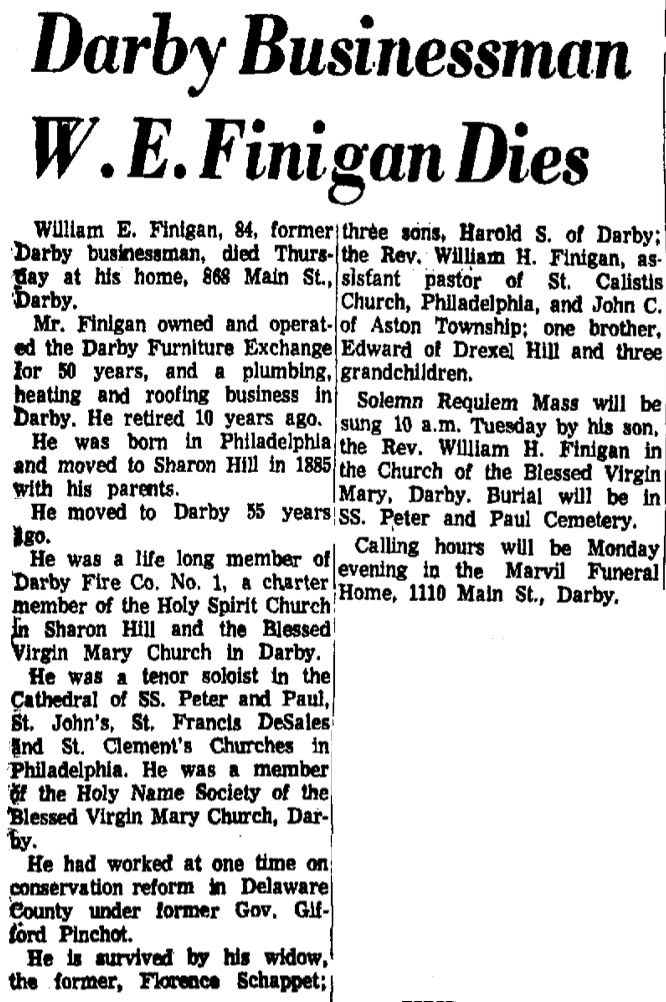
Remember my recent blog entry about William E. Finigan's invoices and receipts from the 1940s? Two readers were curious enough to do a little digging on Mr. Finigan, which led me to do a bit more research myself. One of the things I came up with, as you can see above, was Mr. Finigan's obituary, which was published on March 30, 1963, in the Delaware County Daily Times. The obituary says Mr. Finigan was 84 at the time of his death. That's consistent with the information found in this early biography of him, published in 1914, which states that he was born in 1879.

A few other notes regarding Mr. Finigan:

• As you may recall from that earlier blog entry, Mr. Finigan owned a furniture store -- the Darby Furniture Exchange. He advertised frequently in a local Pennsylvania newspaper called the Chester Times, running dozens of classified ads during the 1940s. Here are two fairly typical examples:

Screen shot 2012-06-30 at 4.18.36 PM.png

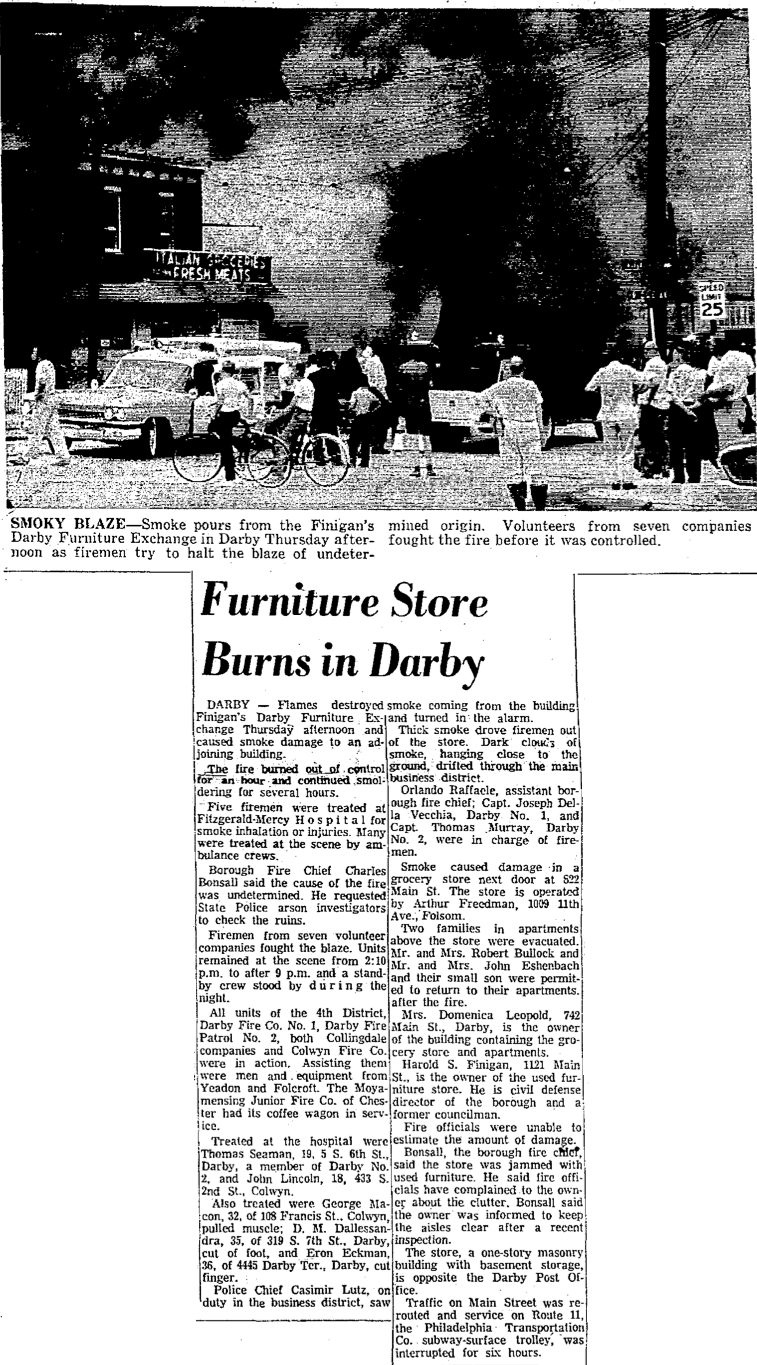
• According to the obituary, Mr. Finigan retired 10 years prior to his death, which would have been 1953. Eight years later, the furniture shop -- which by this point was being run by William's son Harold -- caught fire. Here's the story from the Sept. 8 edition of the Delaware County Daily Times (click to enlarge):

Delaware County Daily Times 9-8-61.png

According to the story, "[T]he store was jammed with used furniture. [The local fire chief] said fire officials have complained to the owner about the clutter." This is particularly ironic given that Mr. Finigan's obituary says he was "a life long member of Darby Fire Co. No. 1." Of course, he was 82 years old by the time of the fire, so he likely wasn't manning any of the hoses as the local firemen tried to save his family's shop.

• The shop was apparently rebuilt. According to this 1996 article, Harold Finigan -- William's son, who by this time was 87 years old himself -- was still running the Darby Furniture Exchange and had established a long-running annual tradition of hanging holiday decorations on Main Street around Christmastime. The article also states, "[Harold] Finigan said his father began the decorating tradition sometime during World War I."

Harold Finigan is likely deceased by now (either that or he's 103 years old). I can't find any current listings for the Darby Furniture Exchange, so the shop is likely gone as well. Does anyone out there know if anybody is still hanging Christmas decorations on Main Street in Darby?

(My thanks to Barbara Zimmer and James Breig for their contributions to this entry.)

Wednesday, July 4, 2012

6888647099_5555a52464_o.png
Click to enlarge

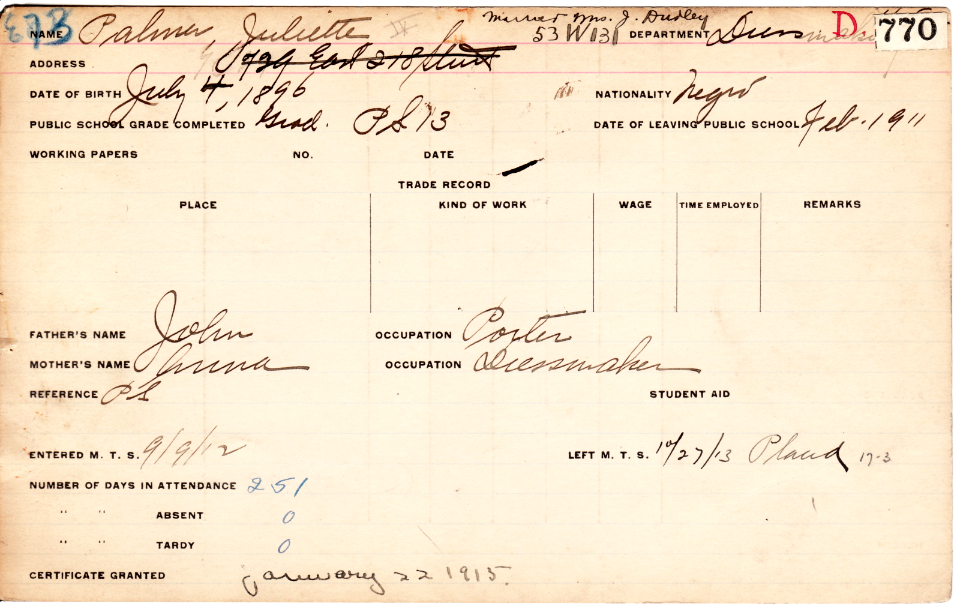
Here we have the Manhattan Trade School report card for Juliette Palmer, who attended the school in 1912 and ’13. As you can see, she was born on the Fourth of July -- she's the only student in my report card collection with that distinction. If Juliette were still alive, she'd be turning 116 years old today, which would make her almost half as old as the country! You can see her full student record here.

Happy Independence Day to all, and happy birthday to Juliette.

Tuesday, July 3, 2012

IMG_1765.JPG
Click to enlarge

On the left is Daisy Cassidente; on the right is Daisy's sister, Gina Marchese. They're holding the report card of their aunt, Carolina Cataudella, who attended the Manhattan Trade School for Girls in 1926 and ’27. She's the one whose report card listed her father's occupation as "Macaroni Laborer" -- my favorite job description in the entire report card collection.

I had the pleasure of interviewing Daisy and Gina -- and also Gina's husband, Hank -- last Friday. I'll be telling their aunt's story in a future installment on Slate. I don't want to give away too much, but let's just say that the macaroni figures prominently in the family's history.

Monday, July 2, 2012

8.png

The woman shown above is Doris Abravaya, who attended the Manhattan Trade School for Girls in the early 1930s. Her story is the focus of the latest full-length Permanent Record article on Slate, which also tells the story of the school's job placement counselor, Althea Kotter. (As you may recall, I explained how researcher Cate Bloomquist cracked that case last week.)

I'm very happy with the way this piece turned out -- hope you like it too. Check it out here.

Saturday, June 30, 2012

Screen shot 2012-06-30 at 1.44.58 PM.png
Click to enlarge

My friend Katy Amory recently told me about a project that feels very Permanent Record-ish. Here's the deal: In the mid-1700s, a British philanthropist named Thomas Coram opened the London Foundling Hospital, where poverty-stricken mothers who couldn't care for their newborn babies could anonymously "donate" the babies for adoption. In each case, the baby's record at the hospital was accompanied by a small piece of fabric or cloth provided by the mother -- a sort of textile fingerprint that could later be used for identification purposes if need be. As you can see from the example shown above, the fabric swatches were sometimes accompanied by heartfelt (and heartbreaking) notes from the mother.

Two and a half centuries later, the Foundling Hospital is now the Foundling Museum. All of the hospital's records have been kept and conserved, including the little fabric swatches (which also serve as one of the best surviving collections of 18th-century textiles). In 2010 the museum ran an exhibition called "Threads of Feeling," which focused on the swatches. You can see the exhibit here, and there's some good background information here and here.

These records feel like cousins to the Manhattan Trade School report cards -- each one represents a story waiting to be told, and collectively they tell an even bigger story. Great stuff.

Tuesday, June 26, 2012

Screen shot 2012-06-24 at 8.16.33 AM.png
Click to enlarge

Remember Miss Kotter, the job placement counselor who peppered many of the Manhattan Trade School report cards with very sharp commentary? Back in January I mentioned that volunteer researcher Cate Bloomquist had solved the puzzle of Miss Kotter's identity. I've now put that research to good use while writing the latest full-length Permanent Record article for Slate, which will be about Miss Kotter and one of the students she worked with. It should be published in a day or two.

What you see above is a 1944 obituary for Miss Kotter's second husband, Edwin Borden. It was a key piece of evidence in Cate's sleuthing. Her research on this one was so amazing that I've decided to share the paper trail with you, so you can see just how much work is involved in tracking down someone for the Permanent Record project.

First, to set the stage: Miss Kotter presented a thorny research puzzle. Some letters in the report card files referred to her as "Miss Kotter" and others as "Mrs. Kotter," so I wasn't sure if Kotter was her maiden or married name. She signed letters as "A. Kotter" and referred to herself on the report cards as "AK" or "ADK," so I didn't even know her first name.

But Cate Bloomquist connected a bunch of dots that hadn't even occurred to me. She summarized her research process for me in the following rundown:

1. In Doris Abravaya's file, letters dated 4/27/34 and 9/4/34 are addressed to "Mrs. Kotter." But the 9/4/34 letter has handwritten note at the bottom that begins "AB." It appeared to me the B had been written over a K, but in Mrs. Kotter's same handwriting (which we've seen on many of the report cards). I began to think she must have married sometime in 1934. Or perhaps she had some other reason for a name change, but marriage was the most likely explanation.

2. Sure enough, the next letter in Doris's file, dated 9/13/34, was addressed to a "Mrs. A. Borden." Evidence was mounting for a marriage.

3. Then, in Marie Garaventa's file, last index card includes notes from "AK" and "AB" -- in the same handwriting. It appeared Mrs. Kotter had become Mrs. Borden, but what was her first name?

4. Selma Kaufman's file includes a letter from "Mrs. Althea Borden, Placement Counselor." Also, Maria DeTuro's file included a card signed by "Althea Borden." Again, compare the handwriting among all of these -- they pretty clearly match. I now had a first name for Mrs. Kotter/Borden.

5. Since Althea is a relatively uncommon first name, even for the 1930s, I searched on "Althea Borden" in the New York Times index, thinking I probably wouldn't get an overwhelming number of responses to comb through. I found a 1944 obit for an Edwin Borden [this is the obituary shown at the top of the page — Paul], and it listed his widow Althea and son Matthew. They lived in Stamford, Connecticut, though. Initially I was doubtful that this would be the same Althea as "our" Althea. Therefore, I decided to research the "Kotter" angle a bit more to see if I could find something more conclusive tying our Althea ("ADK") to this Althea Borden of Stamford, Connecticut.

6. I looked up the 1930 census and was able to find an Althea Koetter (not Kotter) living in Hoboken, New Jersey, with her husband Carl. Ancestry.com also pulled up two ship passenger manifests for Carl and Althea Koetter returning from Germany in 1929 and again in 1932. The passenger lists also provided Althea's date of birth: 12/17/1906.

7. I'm not always a fan of Ancestry.com, but sometimes it's very useful, and this time it provided the gold: a newspaper entry from the Reno Gazette, dated 4/4/1934, which stated that a divorce decree had been granted for Carl E. Koetter from Althea Dreyer Koetter -- ADK!! For our purposes, this was certainly enough evidence to show that ADK became Althea Borden sometime in 1934.

8. But was this the same Althea Borden listed as the widow of Edwin Borden in the 1944 obit? I turned to Ancestry.com again. This time I searched the public family trees for an Edwin Borden who died in 1944. Sure enough, an Edwin Floyd Borden popped up with the correct death date and tie to Connecticut, and his spouse was listed as "Althea Dreyer."

9. According to the Social Security Death Index, Althea Borden died in 1971 in Florida. It becomes more difficult to track down people the closer we get to the present time mainly because of privacy laws, etc., but I'm fairly confident that Matthew Borden (Althea's son) is likely still living because I don't see him in the Social Security Death Index. I could not find him easily/conclusively. However, the person who entered the Borden family tree on Ancestry.com is named Linda Brooks and I believe that she is a niece of Althea's. I think probably the quickest route to Matthew would be to contact Linda, or if Matthew has passed away, I'm betting Linda would have some pretty good info on the appropriate next of kin, given the amount of info she has on the family tree in Ancestry. Here is her contact information, which I found on whitepages.com….

And that's how Cate led me to Althea's niece, Linda Brooks, who in turn put me in touch with Althea's son, Matthew Borden (both of whom were very forthcoming and provided wonderful interviews). It's an impressive bit of detective work, no? Now you can see why I'm so grateful to have people like Cate helping me -- I could never have pieced this together on my own.

A few notes:

• If Althea's first husband's surname was Koetter, what does all her Manhattan Trade School correspondence list her as Kotter (without the first e)? I'm not sure, and neither are her niece or son. Carl, her husband, was German, and it may be that she simply wanted to Anglicize a German name that other people were prone to misspelling.

• Although Cate didn't mention this in her notes, it's odd that the 1930 census listed Althea's occupation as "None." She was definitely working for Manhattan Trade at that time, so I don't understand why that wouldn't have been listed. If it had been, I'm sure Cate would have known much more quickly that she'd found the right Althea Ko(e)tter.

• Althea's handwriting, which was part of the key to this puzzle, has a distinctive, businesslike appearance. Her niece and son both recognized it immediately when I showed them samples from the report cards. (Personally, speaking as someone who's had to read through a great deal of Althea's notes, I'm grateful that her handwriting was so legible.)

• Althea and Carl's Reno divorce was a classic of its era. No-fault divorce laws weren't yet common in the 1930s, which made divorce a lengthy ordeal. But Nevada had much less restrictive laws, and Reno was its biggest city at the time (Las Vegas was still just a small outpost town, not a resort). So Reno became famous for "quickie divorces," which is apparently what Carl and Althea opted for. Note, however, that the Reno Gazette clipping that Cate found didn't even mention the word "divorce" -- it simply said, "Decrees Granted." I wouldn't have realized that this was referring to divorce decrees, but fortunately Kate did.

I'm happy to report that there was a lot more to Althea than the stern disciplinarian whose voice comes through on the report cards. You'll be able to read her full story in the next Slate article, which should be published within the next week.

+ + + + +

An original 1906 article about the Manhattan Trade School for Girls is currently up for sale on eBay. I've read this article before on the web, but it's interesting to see an original copy of it -- more than 100 years old!

Saturday, June 23, 2012

IMG.jpg IMG_0001.jpg

Sorry not to have blogged in a while. I've been busy with other projects (including the next feature-length Permanent Record piece for Slate, which I'll have more to say about in a minute).

What you see above are the front and back of a bill sent on June 8, 1945, from the Philadelphia Electric Company to one William E. Finigan, whose account was in arrears to the tune of $1.59. As you can see, Mr. Finnigan was given one week in which to settle the outstanding balance or else his lights would be turned off. Judging by the stern "Pay this" note on the back of the bill, someone in the Finigan household took this admonition seriously.

This bill is part of a batch of mid-1940s invoices, receipts, and bills, all relating to Mr. Finigan, that I recently acquired. They're all interesting, but "Pay this" -- for the whopping sum of $1.59 -- adds a note of pathos that easily makes this slip of paper my favorite of the batch. (And no, I didn't intend for "pathos" to echo "Pay this," although that's a nice bonus.)

This wasn't the only time Mr. Finigan had to be reminded to pay an overdue electric bill. In December of 1944, he received notice of an outstanding balance of $18.11, which he paid six days later. Note that the address on these documents is different than the one shown on the document at the top of the page, however, so maybe one was for his home and the other for his business (for all of these subsequent images, you can click to enlarge):

IMG_0003.jpg IMG_0003 copy.jpg

And on Aug. 14 of an unspecified year, he received a friendly reminder to remit an overdue sum of $8.60:

IMG_0002.jpg

But I don't mean to imply that Mr. Finigan was a chronic deadbeat. Here are four electric bills stubs (complete with that beautiful hole-punch lettering you used to see on cancelled checks, paid invoices, and so on) that, near as I can figure, he paid on time:

IMG_0001.jpg

Mr. Finigan apparently ran a furniture business. Here's a receipt for an insurance policy on his shop:

IMG.jpg

Here's a receipt from William's visit to a local hardware shop (listing yet another address), which I'm including mainly because (a) I like the logo at the top of the receipt and (b) I love the intensity of the carbon paper transfer handwriting:

IMG.jpg

William isn't the only Finigan whose paperwork ended up in this stash of documents. Here's a notice of an unpaid car insurance bill, only this one is addressed to John Finigan, at still another address (the Finigans apparently owned or rented a big chunk of Main St. in Darby). Were William and John brothers? Father and son? I'm not sure:

IMG_0001.jpg

John Finigan, like William, apparently had some ongoing issues with prompt remittance. Here are three separate reminders to pay his annual 1946 dues for the Keystone Automotive Club (along with the fun information from the back of reminder):

IMG_0004.jpg IMG_0005.jpg

That's all I have on the Finigans. I admit that it's not much of a narrative -- more questions than answers, and not particularly burning questions at that -- but I still enjoy it when I find these small batches of items all relating to a particular person or family. Ephemera like this is so disposable that I figure anything paperwork that's survived this long wanted to be found, wanted to tell its little story. So now I've done my part to help that process along.

+ + + + +

Slate update: I've delivered the next PermaRec article to my editor at Slate, which means it should run within the next week or so. It's about two characters who I introduced last fall in the fourth article in the series. I'll have more to say about that in the next installment here on the blog.

Wednesday, June 13, 2012

pb-120611-civilwar-007.photoblog900.jpg

Do you recognize this little girl? If so the Museum of the Confederacy would like to hear from you.

The picture is one of eight photographs that the museum is trying to learn more about. They were found on the battlefield during the Civil War, in the pockets of dead soldiers. According to this Associated Press article:

Typically [the photos] were found by another soldier and handed down through generations. Ultimately an attic would be cleared or a trunk would be emptied and the photo would be given to the museum. Some have been in the museum's possession for 60 years or more. ... [N]ow museum officials are releasing the unidentified images ... on the admittedly remote chance someone might recognize a familial resemblance or make a connection to a battlefield where they were found.

You can see all eight photographs here. Some of them remind me a lot of the photos on the Permanent Record report cards, and the museum's quest to find the stories behind the photos feels a lot like the Permanent Record project, no? Hope they're able to connect some of the dots.

Friday, June 8, 2012

Screen shot 2012-06-08 at 1.26.25 PM.png

As I worked on the Slate article about Eva Rosencrans and Bee Zelin, it occurred to me that it might have been intimidating to for a woman to be related to Eva or Bee. After all, they were both big shots in the fashion industry -- were they always looking at people's wardrobes with a critical eye? Did they judge how people around them dressed, even (or especially) their relatives?

Margie Rosencrans -- Eva's daughter-in-law -- ended up with many of Eva's showroom sample dresses. She told me that Eva didn't necessarily critique her sense of style but that she had very specific ideas that didn't leave much room for argument:

She'd invite me up to the showroom three or four times a year and I'd get all the samples. She'd say, "Now Margie, you need this dress if you go to a formal event, and this one if you go to a cocktail party, and this one if you go to a PTA meeting, and this is if you're meeting someone for lunch." And the truth is, I didn't always like the dress. But I couldn't say no. It was a little awkward. So I ended up taking whatever she told me to take, and then if there was one I didn't like, I never wore it.

As for Bee, her daughter-in-law, Barbara Zelin, attended the Fashion Institute of Technology, where Bee worked, so Bee respected her training and her sense of aesthetics. Later in her life, Bee even allowed Barbara -- who went on to become an interior designer -- to remodel her house. "And that went fine," said Barbara. "She trusted me."

But Barbara's daughter, Stephanie Wilson -- Bee's granddaughter -- said things could occasionally get a bit tense. "She was the kind of woman who'd dress up to go get her mail," she said of Bee. "And I was a tomboy. I'm sure that did not thrill her. Hungarians are often stubborn, and we both were."

More follow-ups on Eva and Bee are in store soon....

Monday, June 4, 2012

Front.jpg

What you see above is the front page of an old promotional brochure for Manhattan Industrial High School. That's the same school as the Manhattan Trade School for Girls -- the school changed its name around 1930. The brochure was found by Jane Montalto, whose mother, Florence Gattuso, attended Manhattan Trade from 1929 through 1931 (her report card is part of my collection). Jane, who I met and interviewed a few months ago, recently found the brochure while going through some of her mother's old papers and was nice enough to scan it for me.

I've never seen any of the school's promotional materials before, so this is an exciting find. There's no date on the brochure, but a few clues (including the name that the school was using at the time) suggest that it's probably from the 1932 to 1935 range. Interestingly, that means Florence obtained the brochure after she had already graduated from the school. Perhaps she was planning to share it with a friend or relative..?

Here are the remaining panels from the brochure (for each of them, you can click to enlarge):

Screen shot 2012-06-04 at 12.05.52 AM.png Screen shot 2012-06-04 at 12.06.08 AM.png Back.jpg

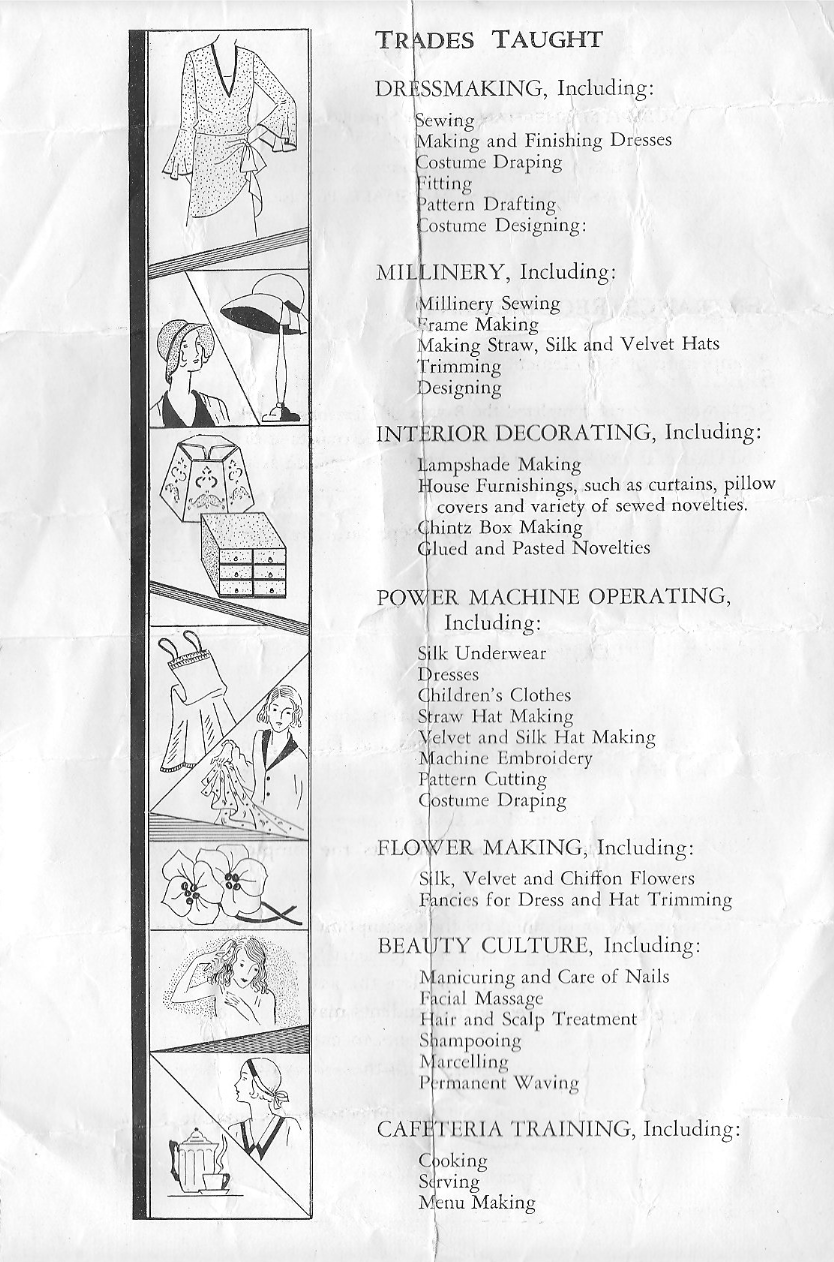
The brochure confirms some things I already knew but also has some information that's new to me and some intriguing tidbits. A few thoughts:

• The building shown on the cover, at the northwest corner of Lexington Ave. and 22nd St., still stands today and is now a high school, although the original "Manhattan Trade School for Girls" lettering is still chiseled into the façade. (For more historical background on this building and Manhattan Trade's previous locations, check out the third Permanent Record article from the Slate series.)

• I knew that most girls attended Manhattan Trade after completing the eighth grade. I didn't realize until now, however, that the completion of eighth grade was a prerequisite.

• Fascinating to see the line, "The programme is planned according to progressive methods." I'd love to know what that meant in the context of the early 1930s.

• "Each trade course is divided into 16 assignments." This explains why each report card shows grades for 16 units.

• During the school's early years -- 1902 up through at least the early 1920s -- the trade offerings were dressmaking, sewing machine operation, millinery, lampshade making, decorative box making, and catalog sample mounting. The first three of these, which were the most popular, were called the needle trades; the latter three, the glue trades. But as you can see in the brochure, things had begun to change by the 1930s: The glue trades had all been folded into a larger trade course called Interior Decorating, and new courses of study had been added -- Flower Making (I had no idea the school had ever offered this), Beauty Culture, and Cafeteria Training. It's fascinating to see how the curriculum evolved to keep pace with the women's labor market.

• The mention of "Educational trips to Washington" matches up with notes I found in some of the girls' files ("Thank you so much for recommending me for the Washington trip," that type of thing).

• Very impressive that the school had its own savings bank. This is very much in keeping with the school's mission to teach girls how to survive in the world of work and business.

An amazing document, and a huge addition to our knowledge base regarding the school. Thanks so much to Jane Montalto for sharing it.

Friday, June 1, 2012

great grandma bee005.jpg
Photo courtesy of Stephanie Wilson

The last entry here on the blog was a follow-up on Eva Rosencrans, one of two Manhattan Trade students whose stories I told in my latest full-length Permanent Record article on Slate. Today I have a follow-up item on the other student profiled in that article, Bee Zelin (shown above with her great-grandson, Spencer, in 1998, when Bee was 88).

In the Slate article, I wrote, "Bee was a solid student at Manhattan Trade and went on to hold a series of dressmaking positions in the 1920s and '30s (one of which entailed a bit of drama regarding her wages). I realize that some readers don't get around to clicking on all the links in a story, and even those who do click can have difficulty reading the handwriting on the report cards. So here's a transcription of the pertinent section from Bee's employment file:

Jan. 5, 1932 [note from placement counselor]: Has worked approximately one week and has not been paid yet. Suggested Leagl Aid Society.

Jan. 7, 1932 [from employer]: Owe Beatrice $21, which she knew would be paid by the end of this week. I suppose she didn't mention the little suit I gave her. — Felice Cotin

Jan. 8, 1932 [from Bee]: Gave me inexpensive suit that was given her and that she could not wear. Pays all other bills at once, even $45 to advertisers. Think she should pay me.

Jan. 13, 1932 [from Bee]: Received $19 from F. Cotin. Promised the rest of it tomorrow. Did not get assistance from Legal Aid in order to obtain money.

Feb. 2, 1932 [from Bee]: F. Cotin still owes me $19.25.

April 13, 1932 [from Bee]: Suing F. Cotin for salary owed.

As you can see, Bee wasn't she about standing up for herself. When I interviewed her daughter-in-law and granddaughter for the Slate article, they both said they didn't know anything about this incident but that it sounded "very much like Bee," whom they described as a tough customer on several different levels.

"She was a very stern disciplinarian to her own child, and also as a grandmother," said Babara Zelin, Bee's daughter-in-law. The big exception appears to have been Spencer, her great-grandson, who's in Bee's arms in the photo at the top of this entry. "She was much more relaxed with him," Barbara told me. "My kids certainly weren't allowed to throw toys all over her house like he was! When I saw it, I couldn't believe it. Like, 'You're letting him do what?' "

I'll have more to say about Bee and Eva in the coming days. Hope you'll all keep checking back to read more.