Tuesday, December 4, 2012

Shippensburg3 001.jpg

Today we have another installment of Charlene Dodds's rephotography project, in which she's visiting places shown on old postcards sent to and from members of her family. (In case you missed it, previous installments in this series are available here, here, and here.)

Here's the latest from Charlene:

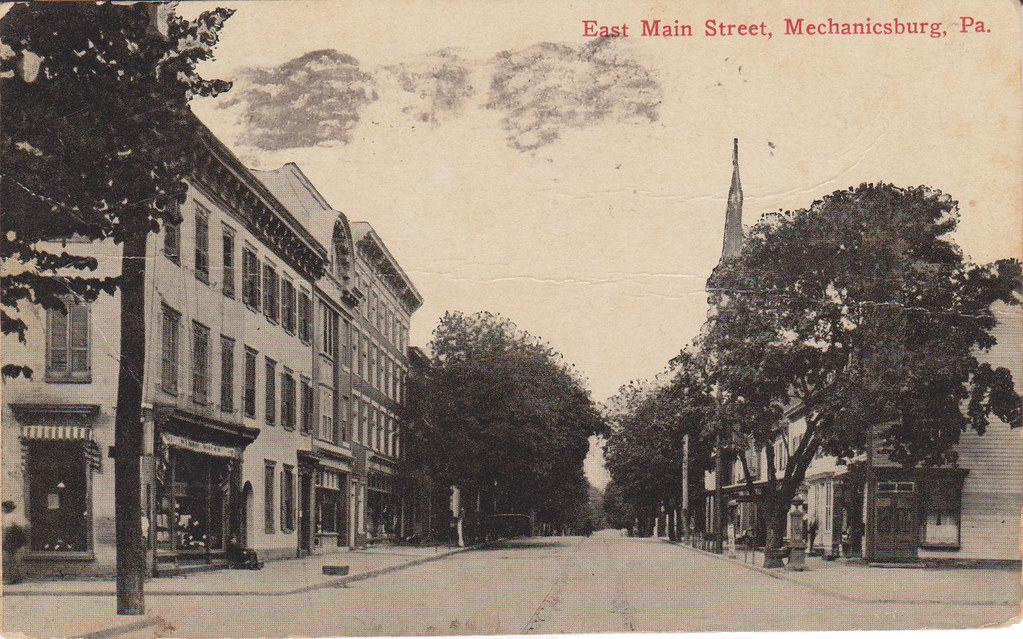
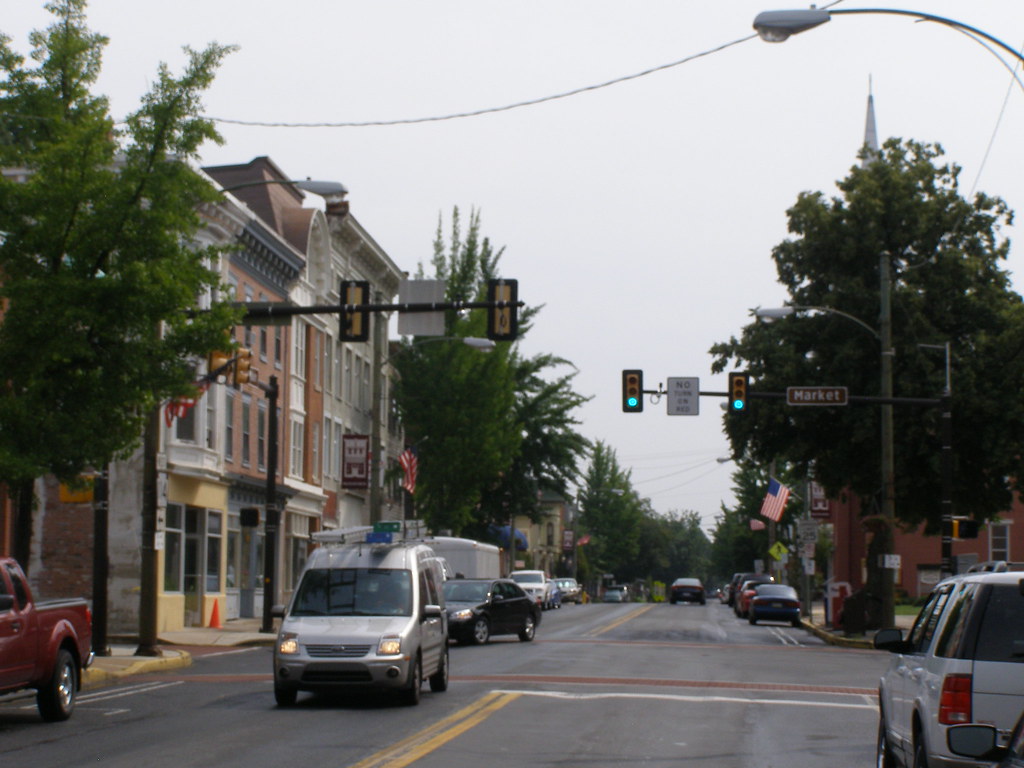
For the next leg of my trip, I drove southwest from Harrisburg, and dropped in on Mechanicsburg, Pennsylvania. Mechanicsburg was originally named for Conestoga wagon mechanics who settled this area in the early 1800s. When the Cumberland Valley Railroad came through town, bringing more growth to the area, mechanics in the burg serviced the trains. The many train lines through Mechanicsburg aided in transporting troops during the Civil War. In 1923, Jubilee Day was started by a pre-Chamber of Commerce group. This fair, which takes place on the third Thursday of June, is now considered the largest and longest-running one-day street fair on the east coast.

Many of the same buildings from a century ago are still standing, including the ones shown in a postcard that was sent to my great aunt in 1917. I matched the view in the postcard by taking a photograph looking east from Hershey Violins on West Main Street [for all of these images, you can click to enlarge]:

Mechanicsburg 2 001.jpg Mechanicsburg1 001.jpg P1010772.JPG

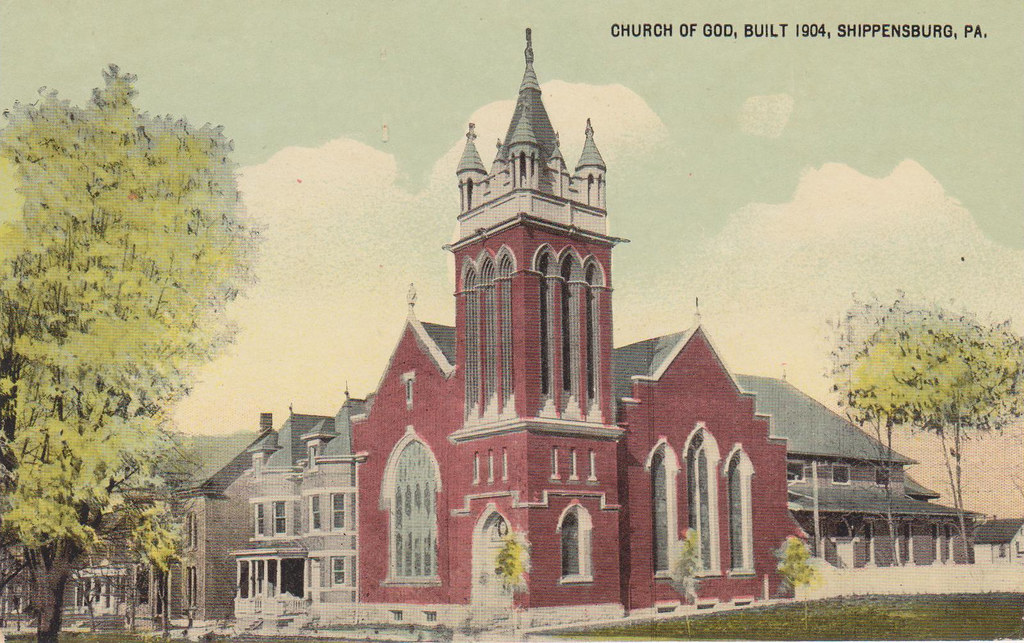
Continuing southwest, I arrived at Shippensburg, Pennsylvania. The old church on King Street, completed in 1904 still survives, albeit with a few alterations to the tower. Still, it is recognizable as the same structure shown in this old postcard:

Shippensburg3 001.jpg P1010779.JPG

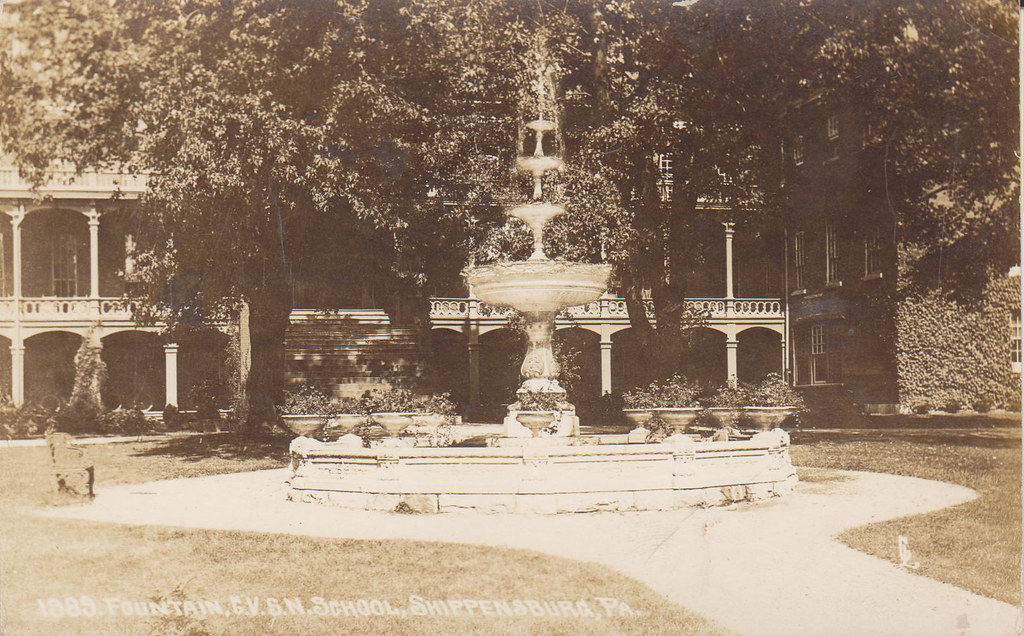
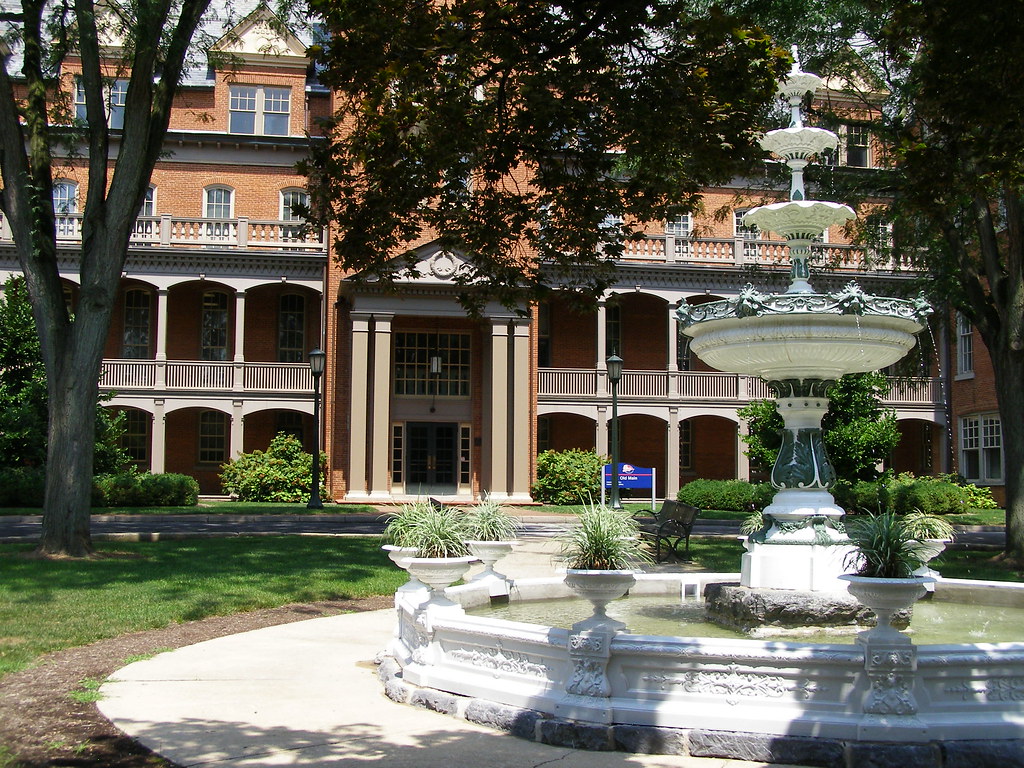
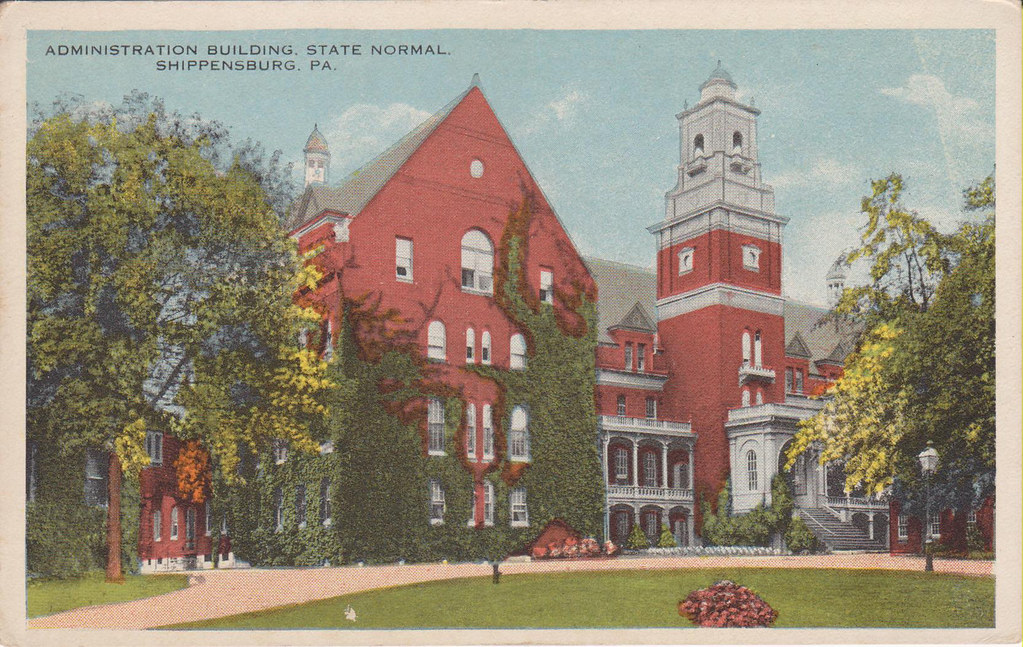
My great aunt attended Shippensburg College just outside of town. The college recently completed a refurbishing of the ornate fountain in front of the main building. The fountain and the building both look very similar to how they looked in these old postcards:

Shippensburg8 001.jpg P1010788.JPG

Shippensburg6 001.jpg P1010783.JPG

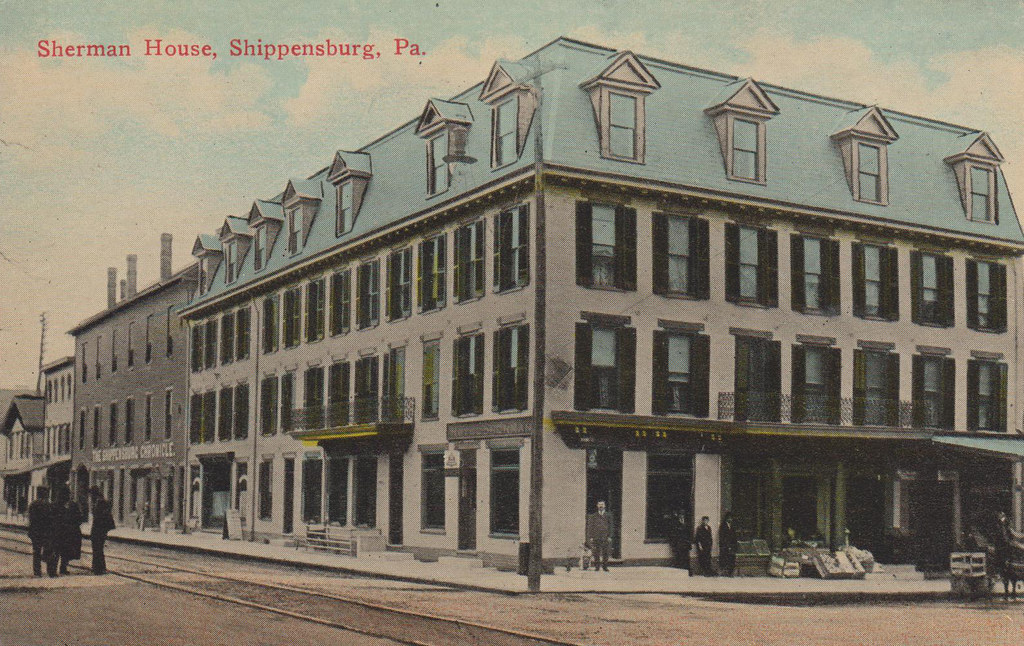
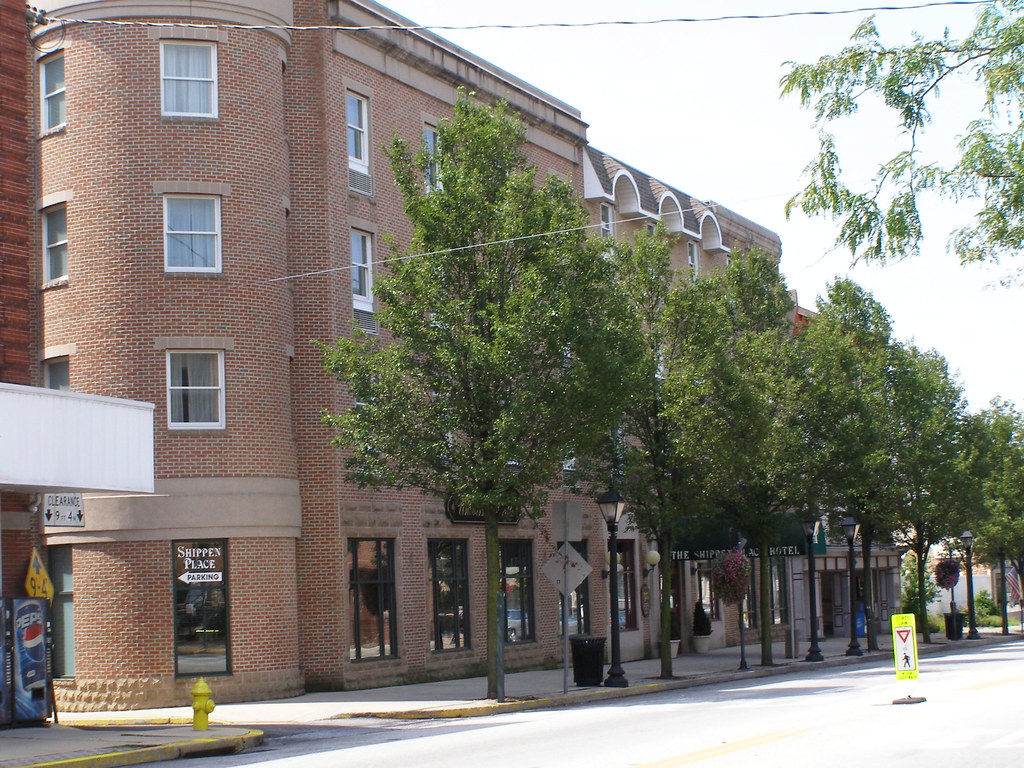
Back in town, the Sherman House has not fared as well. An old hotel originally known as the Union House, it was renamed and given new signage as Confederate troops approached, in hopes the it not be destroyed. Time has wrought worse alterations to “Shippen Place.” Looking carefully, one can see the original lines of the old hotel shown in this postcard, although xxpansion has pushed the wall outward, converting what was once a side street with rail tracks into an alley:

Shippensburg2 001.jpg P1010777.JPG
That's it from Charlene for now. I'm sure we'll be hearing more from her soon.

Monday, December 3, 2012

Screen shot 2012-12-03 at 11.02.41 AM.png

jacket.jpg

The two photos at the top of the page are West Point cadet Chester deGavre wearing his formal military jacket in his 1933 West Point yearbook photo, and that same jacket as it appears today. The lower photo shows the jacket being presented last week to deGavre's 98-year-old widow, Teresa deGavre, after the jacket had been found washed up on the Jersey Shore in the wake of hurricane Sandy.

The jacket was found by Donna Gugger (the blond woman in the lower photo), who discovered it while cleaning up debris near her home after the storm. She initially thought it was a costume jacket, but some of the interior tagging indicated that it was a genuine military jacket. With some research assistance from the folks at West Point, she was able to determine that it had been issued to Chester deGavre, who died in 1993. Some additional research led her to deGavre's widow.

That's some impressive sleuthing, although one serious mystery remains: Teresa deGavre had been completely unaware of the jacket's existence. It's not clear how it became separated from her husband, who may have owned it in the interim, or how it ended up in the ocean. In any case, it's now back where it belongs.

You can read more about this here and here, and there's a video report here:

Cadet jacket found in Sandy aftermath

(Special thanks to Sue Kendall for bringing this story to my attention.)

Thursday, November 29, 2012

file.jpg

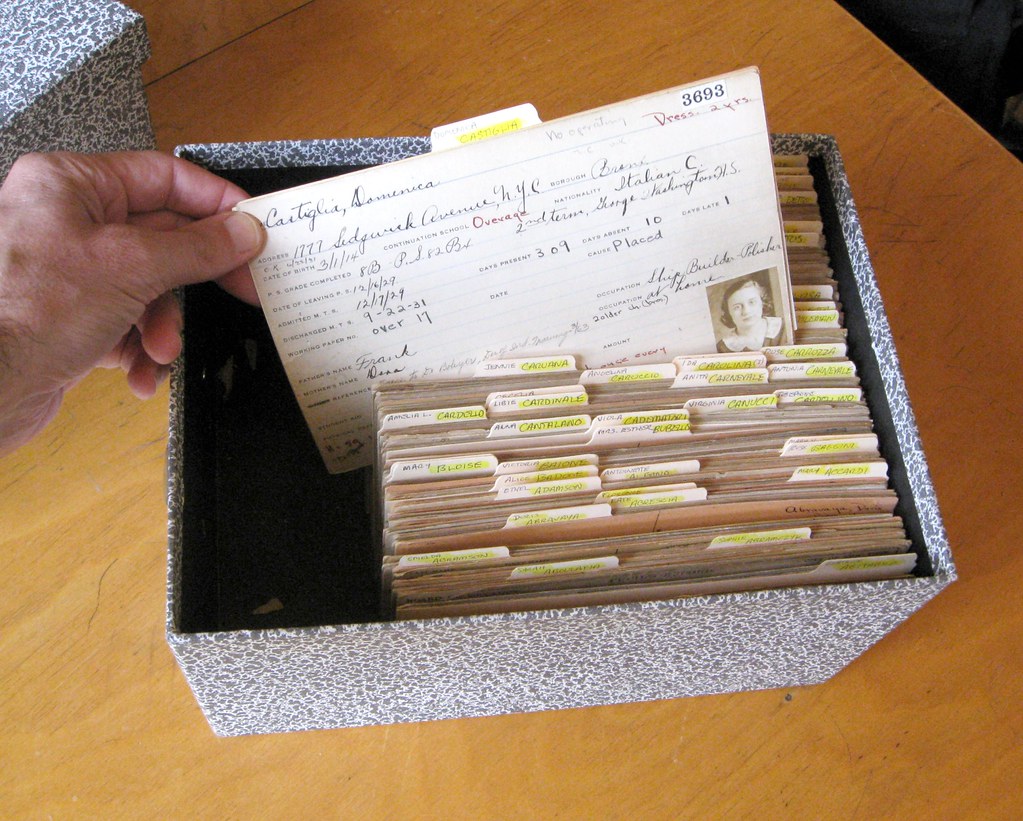
We've covered so many different stories here on the PermaRec Blog that it's easy to forget that Permanent Record is first and foremost about the amazing Manhattan Trade School report cards that I found in a file cabinet more than 16 years ago. With that in mind, here are two announcements:

1) I'll be doing a lecture/slideshow presentation about the report cards next Wednesday, Dec. 5, 7pm, at the Housing Works Bookstore Cafe in Manhattan. It'll be part of a program of several short presentations (I can't speak for the others, but I know the organizers, and they usually tend to book interesting people). Admission is free. Full details here.

2) In case you missed it earlier this week, the long-delayed 10th installment in the Slate series is now available for your enjoyment.

Saturday, November 24, 2012

Screen shot 2012-11-24 at 8.04.47 PM.png

6a00d8341bf67c53ef017c33208ce9970b-800wi.jpg

As you may have heard, there's been a remarkable PermaRec-ish story emerging out of England, where a gent named David Martin was renovating his chimney and found the remains of a long-dead carrier pigeon with a little red canister attached to its leg bone. Inside the canister was an encrypted World War II-era message. It's believed that the pigeon was sent from Nazi-occupied France during the war.

This story has received lots of media coverage, but I particularly like the treatment from Mallory Ortberg at Gawker, who approaches the story with a very endearing sense of Harriet the Spy-ish adventure. She begins by saying, "[S]ometimes life is every bit as exciting and riddled with mysteries as you had hoped it would be as a cunning, hopeful child" (a nice distillation of the PermaRec ethos, no?). Then she describes the particulars of the situation and observes:

Of course there was a small red cylinder! Of course it was rolled like cigarette paper, exactly as a secret code ought to be. We live in days of wonder.

I really like that.

As for the message, we may never know its contents, because British encryption authorities say its code is unbreakable, at least so far, and they may not have the resources to crack it. Further details here.

I have to admit, until now I thought finding a bunch of old report cards in a discarded file cabinet was about the coolest thing ever. But a finding an encrypted WWII message strapped to the decomposing leg bone of a deceased homing pigeon definitely trumps that. I know when I'm licked.

Friday, November 23, 2012

1.jpg

2.jpg

What you see above are the front and back of a postcard that was mailed from Rockford, Ill., to Elmira, N.Y., in the summer of 1943. It arrived at the address listed on the postcard just last week -- more than 69 years after it was sent.

The postcard was sent to sisters Pauline and Theresa Leisenring by their parents. The parents were visiting their son (Pauline and Theresa's brother) George Leisenring at the Medical Center Barracks at Camp Grant, which is the location shown on the front of the postcard.

The message reads as follows:

Dear Pauline and Theresa,

We arrived safe, had a good trip, but we were good and tired. Geo. looks good, we all went out to dinner today (Sunday). Now we are in the park. Geo has to go back to Grant at 12 o’clock tonight. Do not see much of him. We are going to make pancakes for Geo for supper tonight. See you soon.

Love,
Mother, Dad

Unfortunately, Pauline and Theresa no longer live at the address on the postcard (or anywhere else -- they died in 1962 and 1954, respectively), so the postcard was received by Adam and Laura Rundell and their family, who now live at that address.

It's not clear why the postcard took so long to be delivered or where it might have been stowed over the past several decades, but the Rundells were intrigued by it. According to this article, they did some PermaRec-style research, tracked down some of Pauline and Theresa's cousins, and offered the postcard to them. The story quotes Adam Rundell as saying, "They seemed interested but so far haven't picked it up."

I'm not sure why the Rundells can't simply mail the postcard to the cousins, but then this postcard has already had one harrowing postal adventure, so maybe best not to tempt fate.

(My thanks to Sue Kendall for pointing me toward this story.)

+ + + + +

Slate update: I've been told that long-delayed 10th installment of the Slate series will finally run on Monday. Fingers crossed!

Thursday, November 15, 2012

The video shown above tells the story of a stash of World War II-era love letters that were found in a box that washed ashore in New Jersey in the wake of Hurricane Sandy. The man to whom the letters had been sent died in 1991; the woman who sent the letters is still alive, although she hadn't saved the letters herself, so it's not clear who had acquired them or how they ended up getting washed out to sea. In any event, it's another classic Permanent Record-type story. Further details here.

(My thanks to reader Sue Kendall for tipping me wise to this one.)

+ + + + +

Men at Lunch update: As promised, on Wednesday afternoon I went to see the documentary film Men at Lunch, which is about the famous 1932 photograph of ironworkers posing on a high-rise steel girder. It was good, but not great. A good chunk of the film is devoted to explaining why this is such an important and iconic photograph -- good stuff, but done in a very familiar, PBS-ish way. From a Permanent Record perspective, I was a smidge disappointed, because the filmmakers were able to positively identify only two of the 11 men in the photograph. A nice movie, but ultimately unsatisfying.

Monday, November 12, 2012

6.jpg 121.jpg 8.jpg

The fellow in the photographs shown above was named Lloyd Domier. He died in 1995 after a life spent primarily in North Dakota. These photos of him, and over 100 other shots of Lloyd and his family, were recently found in a Dumpster by someone in Florida. The photos were eventually sent to the Grand Forks Herald newspaper, which was able to get in touch with Lloyd's brother, Douglas Domier, to whom the photos were ultimately returned.

That's the short version. You can get more details in this article, which includes a link to a slideshow of additional photos.

(Special thanks to reader Tim Fry for tipping me off to this one.)

Sunday, November 11, 2012

Screen shot 2012-11-11 at 9.25.10 AM.png

You've almost certainly seen this photo before. Taken in 1932, it shows an assortment of immigrant ironworkers taking their lunch on a steel girder at a New York City construction site. It has become one of history's most iconic New York photographs.

But who are the men shown in the photo? They've always been anonymous. For that matter, even the photographer's identity has long been unverified. (The photo has often been attributed to Lewis Hine, but that turns out to be inaccurate.)

A new documentary called Men at Lunch aims to solve these mysteries. I haven't yet seen the film, but it sounds very Permanent Record. You can read about it in this intriguing article. The film itself will screen this Wednesday, Nov. 14, at 3:15pm at the IFC Center in Manhattan. I'm going to try to attend. Anyone care to join me? If so, let me know.

Meanwhile, here's the film's trailer:

+ + + + +

Slate update: I'm told that the long-delayed 10th installment of the Slate series will finally be published this week. Hope so! Thanks for your patience.

Friday, November 2, 2012

Screen shot 2012-10-30 at 8.37.42 PM.png
Click to enlarge

What have we here? It's a photo of Hodel's Drug at the BaseMar Shopping Center in Boulder, Colorado. It was here that Oscar Hodel went to work each day and filled out the ledger that I eventually acquired.

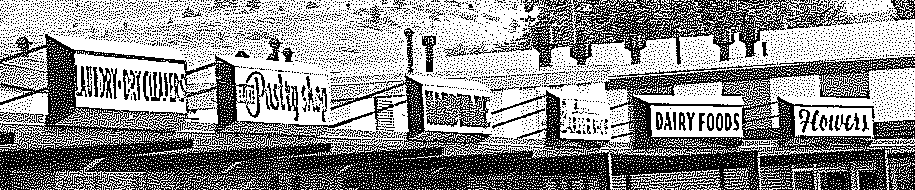
The photo was taken in 1956 -- the year that Hodel's Drug (and I think the shopping center itself) opened. While looking at the photo, I noticed something interesting. Check out the signs for the other shops (click to enlarge):

Screen shot 2012-10-30 at 8.53.41 PM.png

It's a little hard to read some of them but they say:

Laundry•Dry Cleaners
[Illegible] Pastry Shop
Hardware
[Illegible] Barber Shop
Dairy Foods
Flowers

So four of the six signs are completely generic, indicating a category of commerce rather than a shop name -- odd. I must say, I would have been very disappointed if the Hodel's Drug sign simply read "Pharmacy."

(Special thanks to Wendy Hall of the Carnegie Branch Library for Local History in Boulder for providing the photo.)

+ + + + +

As some of you know, I live in Brooklyn, New York. Fortunately, I came through Hurricane Sandy completely unscathed -- no flooding, didn't lose power, didn't even have any trees come down on my block or in my back yard. Same goes for my Mom and my brother, both of whom live in the New York area.

Obviously, millions of other people weren't as lucky. If you and/or someone close to you were affected by the storm, hang in there -- we're all thinking of you. In a bit of cosmic irony, however, on Wednesday I broke my arm in a bike accident. Typing is now very tricky, so content here on the PermaRec site may be spotty for a bit. Thanks for understanding.

+ + + + +

Slate update: As you may have guessed, the storm has futher delayed the publication of the next full-length PermaRec article on Slate. Will they get it up next week? Hope so.

Wednesday, October 31, 2012

Rockville1 001.jpg

Today we have another installment of Charlene Dodds's rephotography project, in which she's visiting places shown on old postcards sent to and from her great aunt, her grandmother, and their friends. (In case you missed it, further details on the project are spelled out here, and Charlene's first report from the road is available here.)

Here's the latest from Charlene:

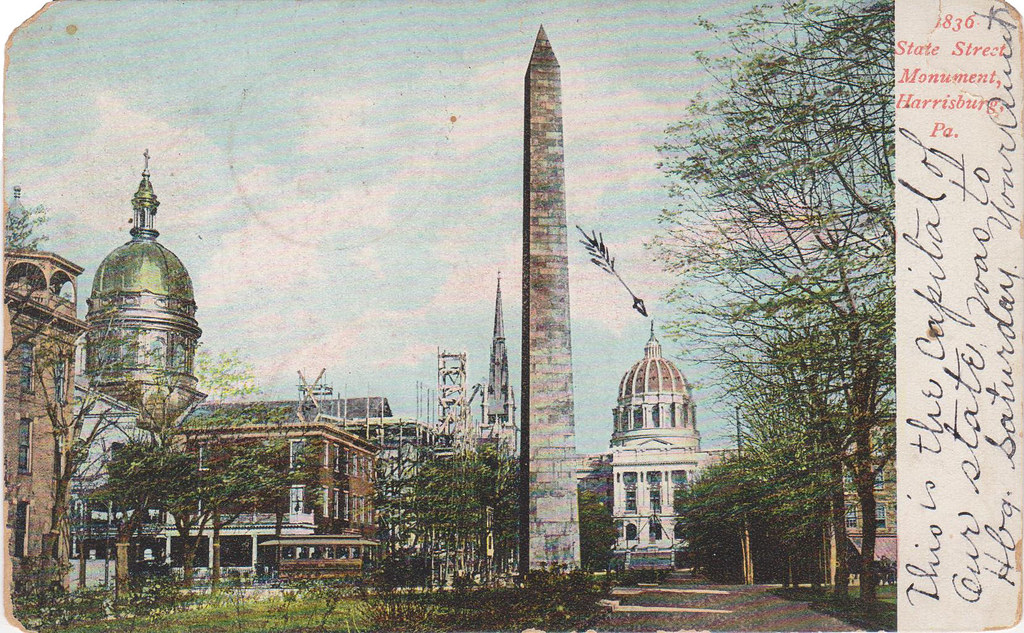
After my first stop in York, Pennsylvania, I headed north on I-83 to Harrisburg. I wanted to visit the state capitol building, which is shown on a postcard sent to my great aunt from her aunt in 1907.

Some quick background: This is actually the third capitol building in Harrisburg. The first one was destroyed in 1897 by a fire, and a second one was left unfinished due to lack of funds. The Capitol Building Commission was formed in 1901 to hold a competition open only to Pennsylvania architects. They selected a Beaux-Arts design by Joseph Miller Huston. Known as the Huston Capitol, it was designed in 1902 and dedicated in 1906, a year before this postcard was sent [for all of these images, you can click to enlarge]:

Harrisburg2 001.jpg Harrisburg1 001.jpg

Here's a roughly equivalent view from when I visited more than a century after the postcard was sent:

Harrisburg3.JPG

Obviously, something's missing. What became of the Washington Monument-like obelisk that's show in the middle of the postcard image? It took quite a bit of research to uncover the answer. The Dauphin County Veteran's Memorial Obelisk was originally erected in 1876 in memory of the county’s Civil War dead. It stood 110 feet high and weighed over 600 tons. After decades of exposure to traffic and the elements left it looking a bit grim, it was refurbished and relocated to Third and Division streets, where it remains today.

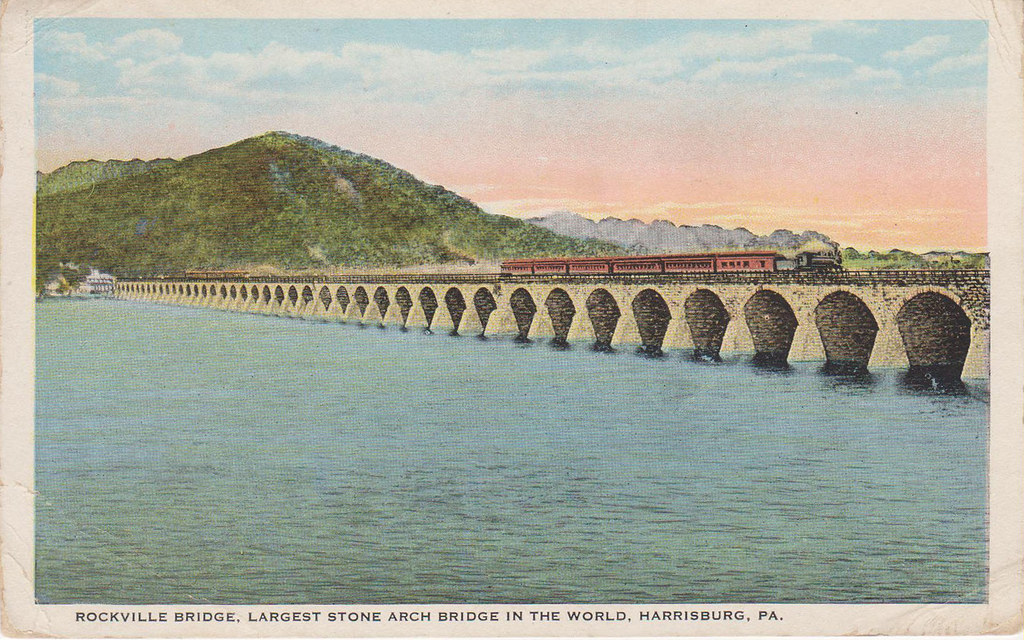
Next, I headed a few miles north of Harrisburg. My designation was the Rockville Bridge, the “largest stone arch bridge in the world,” according to this postcard sent to my grandfather in 1922:

Rockville2 001.jpg Rockville1 001.jpg

The bridge was completed in 1902. Although it's no longer the world's largest stone arch bridge, it remains the world's longest stone masonry arch railroad viaduct, with a total length of 3,820 feet. You can learn more about the bridge here.

The bridge is still in use today. Here's how it looked during my visit:

P1010767.JPG

----------

Very, very nice. Thanks for the great material, Charlene -- keep it coming.

Friday, October 26, 2012

Speed Skating Article contd & jacket pics0003.jpg

Speed Skating Article contd & jacket pics0002.jpg Speed Skating Article contd & jacket pics0005.jpg

Who's the guy with the mustache? His name was Dominic Vadini, and he was the owner of the varsity-style speedskating jacket that I recently wrote about. The photos were provided to me by Dominic's son, Steve Vadini, who I was able to track down thanks to some sensational research by Permanent Record reader Barbara Zimmer.

As you can see, the jacket Dominic was wearing in the top two photos isn't quite the same as the one I ended up buying on eBay, but it's similar -- same color scheme, similar chest patch. Apparently he had a lot of these jackets. (But he sure liked that one hat!)

As you can also see, Dominic was a middle-aged man when these photos were taken. That's one of the surprises that have emerged from this story -- I had assumed that the jacket had belonged to a high school or college student. The trajectory of Dominic's athletic career turns out to have been much more unusual than that of the typical student athlete. I'll have more to say about all of this soon, hopefully in the form of a big feature-length article (maybe with accompanying video). Stay tuned.

+ + + + +

Slate update: The next full-length PermaRec article on Slate, which I had expected to run this week, has been delayed due to logistical logjams on Slate's part (grrrr). Should run next week.

Tuesday, October 23, 2012

1971yellowpages.png

What you see above is an entry from the Boulder Yellow Pages in 1971. The circled listing is for Hodel's Drug -- the pharmacy whose owner produced the amazing ledger that I recently wrote about. I'm a little surprised they had such a no-frills, bare-bones listing -- in part because I imagined them having a higher profile in the community, or maybe just because I can imagine Oscar Hodel writing "Renewed Yellow Pages ad, paid extra for boldface type" in the ledger.

The phone book entry is one of several Hodel-related clippings that have been sent my way. I'll get to that in a minute, but first let me back up a bit to the week when my original piece about the ledger ran. Soon after I posted that piece, I heard from PermaRec reader Gregg Fanselau. He said he had attended high school with several Hodels, and he gave me the contact info for one of them -- a guy named David Hodel -- in case I wanted to get in touch with him.

So I sent David Hodel a note, explaining how I'd acquired the ledger on eBay, asking if he knew how it ended up there, offering to return it to the Hodel family if they wanted it, and showing him the what I'd written about it. Here's what he wrote back:

Oscar [the guy who filled out the ledger] was my dad's older brother. I'm thinking probably one of his kids put the ledger on eBay. Ockie was a bit of an artist and I'm sure the illustrations [in the ledger, like the little turkey for Thanksgiving] are that side of him coming out. They always kept a record of the weather because it affected traffic at the store and gave a way to compare like days to like days.

We don't have any sentimental attachment to the ledger so the Boulder History Museum is probably a good start. My dad [who, like Oscar, was a pharmacist] gave some trays and other pharmacy-related items to the University of Colorado. They were from the era when pharmacists had to make their own capsules rather than have them pre-counted and packaged.

Hmmmm. I like that Oscar's nickname was Ockie -- that's a nice detail. Aside from that, though, David didn't offer me that much information, and I was surprised by how disinterested in the ledger he was.

Fortunately, it was around then that I heard from Wendy Hall, manager of the Carnegie Branch Library for Local History in Boulder, who had seen what I'd written about the ledger and generously offered to do a bit of research for me. The phone book clipping at the top of this page is one of several things she sent me.

Wendy also sent me this newspaper article published in August of 1956, shortly after the store opened (and about six and a half years before Oscar began keeping notes in the ledger I eventually acquired). It describes the physical layout of the store, provides background on the Hodel family, and gives us our first glimpse of what Oscar looked like (click to enlarge):

Screen shot 2012-10-17 at 10.27.22 PM.png

The article mentions that Oscar's brothers, Ron and Merv, operated another Hodel's Drug outlet in Denver, and that Merv "was a stellar member of the football and other athletic teams" at the University of Colorado. That sounds like boilerplate praise, but Wendy sent me some clippings showing that Merv (whose full name was Merwin) wasn't just a collegiate standout -- he actually played pro football, albeit briefly, in the NFL! Here are some items charting his athletic career, beginning with a 1949 article touting him as the most promising U. of Colorado athlete "since the days of All-American [and future Surpreme Court justice] Whizzer White":

Screen shot 2012-10-17 at 10.09.47 PM.png

Now fast forward to January of 1952. Merv has graduated and is drafted by the New York Yanks, a short-lived NFL franchise:

Screen shot 2012-10-17 at 10.06.33 PM.png

As you can see, the Yanks promptly traded Merv's contractual rights to the New York Giants (good thing, because the Yanks folded before the start of the ’52 season). But by May of that year, Merv had decided to forego a football career in favor of entering the pharmacy biz:

Screen shot 2012-10-17 at 10.06.49 PM.png

Now skip ahead another year and a half, to the fall of 1953. Merv has apparently had a change of heart and is preparing to play for the Giants:

Screen shot 2012-10-17 at 10.24.11 PM.png

Several weeks later, however, Merv had been sidelined with torn knee ligaments:

Screen shot 2012-10-17 at 10.06.21 PM.png

That's the last clipping relating to Merv's football career, and I'm pretty sure he never played pro football again after that. He apparently saw very limited action during his time with the Giants: His career stats show that he appeared in two games, carrying the ball five times for 11 yards, and somehow managing to catch two passes for minus-15 yards (a fairly remarkable, if unfortunate, achievement). Still, that was enough for him to be immortalized in the form of a football card, as you can see below:

Screen shot 2012-10-21 at 10.49.21 PM.png

Of course, Merv wasn't the one who created the amazing ledger -- that was Oscar, Merv's brother. And Oscar had a son, also named Oscar, who worked with him at the pharmacy. The father was Oscar A. Hodel; the son, Oscar M. Hodel. Our last clipping finds Oscar M., the son, entering the real estate business in 1973:

Screen shot 2012-10-21 at 11.32.46 PM.png

Note that he had "previously managed Hodel's Drug in the BaseMar shopping center" -- the same shop whose daily records were kept in the ledger by Oscar A. Hodel. As you may recall, the final month recorded in the ledger was March of 1972, and there were indications that the store's lease was about to run out. Looks like they did indeed shut down, forcing the younger Oscar to find a new line of work.

That's enough Hodel family history for today. Big thanks to Wendy Hall at the Carnegie Branch Library for Local History in Boulder for all the clippings.

Monday, October 22, 2012

Screen shot 2012-10-21 at 12.23.50 PM.png

Screen shot 2012-10-21 at 12.24.54 PM.png

I want to talk a bit more today about The Flat, the new movie I wrote about yesterday. The photos above show the major players in the film: The top photo is a shot of Gerda and Kurt Tuchler, a pair of German Jews who emigrated to Tel Aviv in the late 1930s. The other photo shows Gerda and Kurt's daughter, Hannah Goldfinger, and her son, filmmaker Arnon Goldfinger, who were surprised after Gerda's death to discover that Gerda and Kurt had maintained a friendship with a Nazi SS officer both before and after World War II.

The film had a bit of extra resonance for me, for reasons I've never discussed before here on the PermaRec site, but maybe now is the time. (No, the story does not involve any Nazis.)

One of the film's themes is that Arnon and Hannah have lived their lives with very little sense of -- or interest in -- their family's history. As Arnon puts it at one point, the family "lives only in the present." Throughout much of the film, Hannah (Aron's mother, and Kurt and Gerda's daughter) seems largely indifferent to the issues being raised. But this isn't the over-vehement indifference of someone who's in denial or willfully trying to avoid facing up to hard truths -- it just seems like she honestly doesn't much care one way or the other. Arnon repeatedly asks her, "Why didn't you ask grandma about [whatever]?," and the response is always, "I don't know, it never really occurred to me." She seems genuinely content with this answer. No discomfort, no tension, no sense of denial, just a lack of curiosity. Arnon acknowledges that he himself shared this mindset until his grandparents' friendship with the Nazi came to light.

Some of this, I'm sure, is the standard coping mechanism of Jews from Hannah's generation. If you ask too many questions or look too hard at the past, you're going to get mired in some very difficult emotional territory. But as I've discovered in the course of Permanent Record, there are also people out there who just don't take much of an interest in family history.

And here's the kicker: I'm one of those people. I know very little about my family aside from its nuclear core, I've never much cared about genealogy, and what little I've been told about our extended family over the years has largely gone in one ear and out the other. So it's odd that I've built a creative project based on other people's family histories. My Mom is a big PermaRec fan (she doesn't use a computer, but I make printouts of the Slate articles and send them to her), and I often wonder if she finds it strange -- or even hurtful -- that I spend so much time exploring and documenting the histories of other families while taking so little interest in my own.

Why have I led such an unexamined life regarding my extended family? I've thought about this a fair amount over the years, and here are some possible reasons:

• I didn't grow up with much sense of extended family. I never knew either of my grandfathers (one of whom had been a bootlegger and gone to prison and was rarely even mentioned), my father was an only child, and my mother was estranged from her brother during my childhood, so I never knew my uncle or my cousins. (My limited interactions with them at the occasional wedding or funeral suggested that they were, frankly, rather unpleasant people who I was glad not to have in my life.) My two older brothers married but did not have children. Our family was not religious, so there were no bar mitzvahs or holiday gatherings with relatives. Our family was essentially self-contained, and there was very little discussion of the extended clan. Even my grandmothers, who were a big part of my childhood, rarely talked about their own extended families.

• My parents changed their names from Lewkowitz to Lukas shortly after getting married -- your basic assimilation move. I remember at one point I got a school assignment to create a family tree, and I was struck by how nobody else in our extended family was named Lukas. It definitely made me feel like I had less of a connection to my roots (yes, I was a bit of a literalist), and reinforced the notion that the concept of family, at least as it pertained to me, began and ended at our house.

• I've always known that I don't want to have kids. I knew this even when I was a kid myself. I'm not anti-kid, but parenthood has never appealed to me. I'm not sure which is the chicken here and which is the egg (like, am I not interested in family issues because I don't want kids, or is it the other way around?), but I suspect the two issues are related in some way.

I'm sure some of you are already thinking, "That's why he does Permanent Record -- to fill a gap." But I don't feel a gap, or a loss, or anything else along those lines. Just indifference -- much like the sincere indifference I sensed in Hannah. And if I wanted to explore my own family history, nothing's stopping me. But for some reason it doesn't interest me as much as the stories I examine as part of Permanent Record.

Part of this may be the sense that other people's lives are inherently more interesting (or more exciting, or more titillating, or whatever) than our own. In other words: the voyeurism factor. Also, I've always been fascinated by objects and artifacts, and Permanent Record is an object-based project -- the rabbit hole starts with a report card, or a pharmacy ledger, or a speed skating jacket. I like using the object as the point of entry for finding and telling a story. (Too bad there are no old report cards or evocative coins floating around in our family archives -- I've asked.)

No doubt there are other factors at work here, but I can't spend all day on the self-psychological couch. Instead, I put this question to you: Do any of you out there fit this same profile (not particularly interested in your own family histories but very interested in the family stories I explore in the course of this project)? If so, please post your thoughts in the comments, or drop me a line. Thanks.

Sunday, October 21, 2012

Screen shot 2012-10-19 at 10.55.58 PM.png

What you see above is a coin with the unlikely combination of a swastika on one side and a Star of David on the other. It's the symbol of a seeming contradiction at the heart of a new film called The Flat, which I saw on Friday night. It's something I think most Permanent Record readers will want to see.

Here's the gist: Arnon Goldfinger is an Israeli filmmaker. After his 98-year-old grandmother dies, the family gathers at her Tel Aviv apartment to go through her belongings, and Goldfinger decides to film the proceedings. Things take an unexpected turn when the family discovers old letters, photographs, and other evidence indicating that his grandparents -- German Jews who had emigrated from Berlin to Tel Aviv in the late 1930s -- had been friends with a fairly prominent Nazi SS officer both before and after World War II. The relationship baffles Goldfinger, who spends the next several years trying to understand this Nazi/Jew friendship.

Along the way, he tracks down and befriends the Nazi's daughter and her family; learns for the first time that his grandmother's mother had been murdered in the Holocaust (making the friendship with the Nazi even harder to comprehend); finds references to the Nazi in Adolf Eichmann's trial transcript; finds a whole dossier on the Nazi in the German national archives; and so on. Coming along for most of this ride is Goldfinger's mother, who somehow had no idea that her parents had been friends with a Nazi or that her grandmother had been a Holocaust victim.

The result is super-duper-powerful film with lots of PermaRec-esque elements -- old objects with stories to tell, sleuthing, family histories, family secrets, and so on. There are also several points at which Goldfinger finds himself conflicted about whether to ask certain potentially explosive questions, which is something I've experienced quite a bit during the course of Permanent Record (although, thankfully, I've never been in the position of having to ask someone, "So just what kind of Nazi was your father?").

It's an excellent film, one that I'd recommend to anyone, but that I'd especially recommend to PermaRec readers. You can see some reviews here and here, and here's the trailer:

Wednesday, October 17, 2012

IMG_0866.JPG
From foundinlibrarybooks.blogspot.com

When I recently wrote about the note that 13-year-old hiker Tim Taylor left on a mountain in 1972, I didn't give much thought to the scrap of paper on which he had written the note. But several Permanent Record readers recognized it as an old version of Western Union Form 1207, which is the form used to send a telegram. If you look closely at the lower-left corner of Tim's note, you can see that the fine print reads, "WU 1207 (R 5-68)," which means the form had been revised in May of 1968.

What you see above is a much earlier version of Form 1207. The date line at near the top right corner reads "191__," so it was obviously meant to be used in the 1910s.

That photo comes from the excellent blog Stuff Found in Old Library Books, which is produced by a seminary student named Charles Featherstone. It's similar to two other sites I've written about: Forgotten Bookmarks (which I wrote about here) and Together, as Always (which I wrote about here).

Those other two projects are both based on things written and found in used books, but Featherstone's site documents the things he's found inside books while working at the seminary library at the Lutheran School of Theology at Chicago. At the end of the day, it's all the same thing -- ephemera found in books -- but for some reason the distinction between used books and library books feels important to me, although I can't quite articulate why.

Anyway: Here's the page where Featherstone describes finding the Western Union form in a book (although he doesn't recall which book -- grrr). As you'll see, he's maybe a bit too fond of the sound of his own voice, but it's still good stuff. So is the rest of his site. Definitely worth poking around in.

(Special thanks to Paul Deaver for pointing me toward Charles Featherstone's site.)

Tuesday, October 16, 2012

store.jpg

Screen shot 2012-10-15 at 3.03.46 PM.png

Screen shot 2012-10-15 at 3.38.02 PM.png

I guess it's not surprising that there's a record store called Permanent Records -- or, as it turns out, three record stores called Permanent Records. The one at the top is located in Brooklyn and has been open at least since 2011. The one in the middle, with the annoyingly hard-to-read sign, is in Chicago and has been open since 2006. And the one on the bottom, which is a spin-off of the Chicago store, is in Los Angeles and opened in June of 2011.

It makes sense that all of these shops opened relatively recently. A record store called Permanent Records wouldn't have made sense in, say, the 1980s. But now, with vinyl records and even CDs seeming like antiquated audio formats, the name "Permanent Records" registers as a statement of defiance -- like, "Okay, most of you may have moved on to MP3s, but we're still not going away."

As it happens, vinyl records (and, to a lesser extent, CDs) can have stories to tell, just like the other objects we examine here at Permanent Record. Personally, I never wrote my name on any of my records, but I know some people who did -- sometimes on the jacket, sometimes on the inner sleeve, and sometimes on the label. I specifically remember one kid I grew up who always wrote "Property of..." and then his name on all his records, which seemed like a bit much to me at the time. I've come across lots of these personalized LPs and 45s in used record stores over the years; maybe you have too. Not sure if I still have any of those records (I've pared down my vinyl collection pretty significantly in recent years), but I'll check. It would be interesting to try to track down the record's previous owner and find out why he or she chose to part with it.

In any case, this is a good reminder that Permanent Record -- both the name and the concept -- can extend in some unexpected directions.

(Special thanks to Heather McCabe for the inspiration on this one.)

Monday, October 15, 2012

IMG_7836.JPG

IMG_7852.JPG

When I'm not working on Permanent Record, I spend a lot of my time writing about sports uniforms, logos, and athletic gear (yes, it's a very geeky niche). Occasionally those two worlds intersect, as they did back in March when I wrote about an old, unusually evocative baseball jersey. Now it's happened again.

The photos you see above are of a varsity-style jacket that I purchased on eBay a few years ago. It was apparently worn by a speedskater in Parma, Ohio, which is a suburb of Cleveland. Back in 2010, I posted those photos, along with close-ups of the patches and inner label and a description of the jacket, on another blog that I maintain.

That prompted a note that I recently received from Eric Adler -- great-grandson of Rube Adler, the name of the sporting goods shop on the back on the back of the jacket and on the label. The Here's what Eric had to say:

I just stumbled across the post in which you featured a varsity jacket from my family's store. Rube was my great-grandfather so that makes me fourth generation. After Rube retired, my grandfather took over the business. Now my grandfather is retired (although he still hangs out at the store and helps us out) and my father, another manager, and I run the place.

Please let me know if you would like more info about the jacket. I will ask my father and grandfather if they remember it.

Pretty cool, right? I'd love to know who owned the jacket before I did. If you look again at the label, it appears that the skater (or maybe the skater's mother..?) stitched the name Adini -- perhaps with an additional letter at the beginning that has since unraveled -- into the label:

Screen shot 2012-10-15 at 9.34.47 AM.png

I told Eric that I'd love to hear more about the jacket and/or the skater. No further updates yet, but this has already been a fun, interesting interaction. Just goes to show that anything can qualify as Permanent Record fodder, as long as it has a story behind it.

Update: Thanks to some sensational research by PermaRec reader Barbara Zimmer, I was able to contact the family of the skater who wore the jacket. The skater, unfortunately, is now deceased but I had a lengthy conversation with his son, who was very excited to hear about the jacket (and who clearly loves talking about his dad). Interestingly, the son has no idea how the jacket ended up on eBay, although he's asking some other family members about it. I'll definitely be writing more about all of this -- stay tuned.

+ + + + +

Slate update: I'm about to deliver the next feature-length Permanent Record article to my editor at Slate. It should run either this week or next. This will be the last PermaRec article to appear on Slate for the foreseeable future. If my research (read: Cate's and Samantha's research) turns up a particularly powerful story lurking in one of the report cards, Slate will be happy to let me write about it, but they no longer want to commit to an article every month, or every month-and-a-half, or whatever.

I can live with that, at least for now. Meanwhile, the project will remain active here on the blog as long as there are interesting things to write about (i.e., forever).