Sunday, May 5, 2013

photo (8).JPG photo (10).JPG

The photos shown above are of an old film canister that reader Tim Smith recently acquired. The canister has sent him down an interesting rabbit hole, which I'll let him describe in his own words:

Last weekend I was in an antiques store in Oceanside, California and came across an old film reel canister. It had a label on the front that said, "Surfer Girls" and "Fireball & Brushes." I thought it would make a fun knickknack on the bookshelf. When I got it home and opened it up, I found six small film reels inside:

photo (7).JPG photo (6).JPG

I'm not sure what these are. All the labels say "Fireball" and "Brushes for fireball," so my guess is that these are for a fireball explosion in a movie.

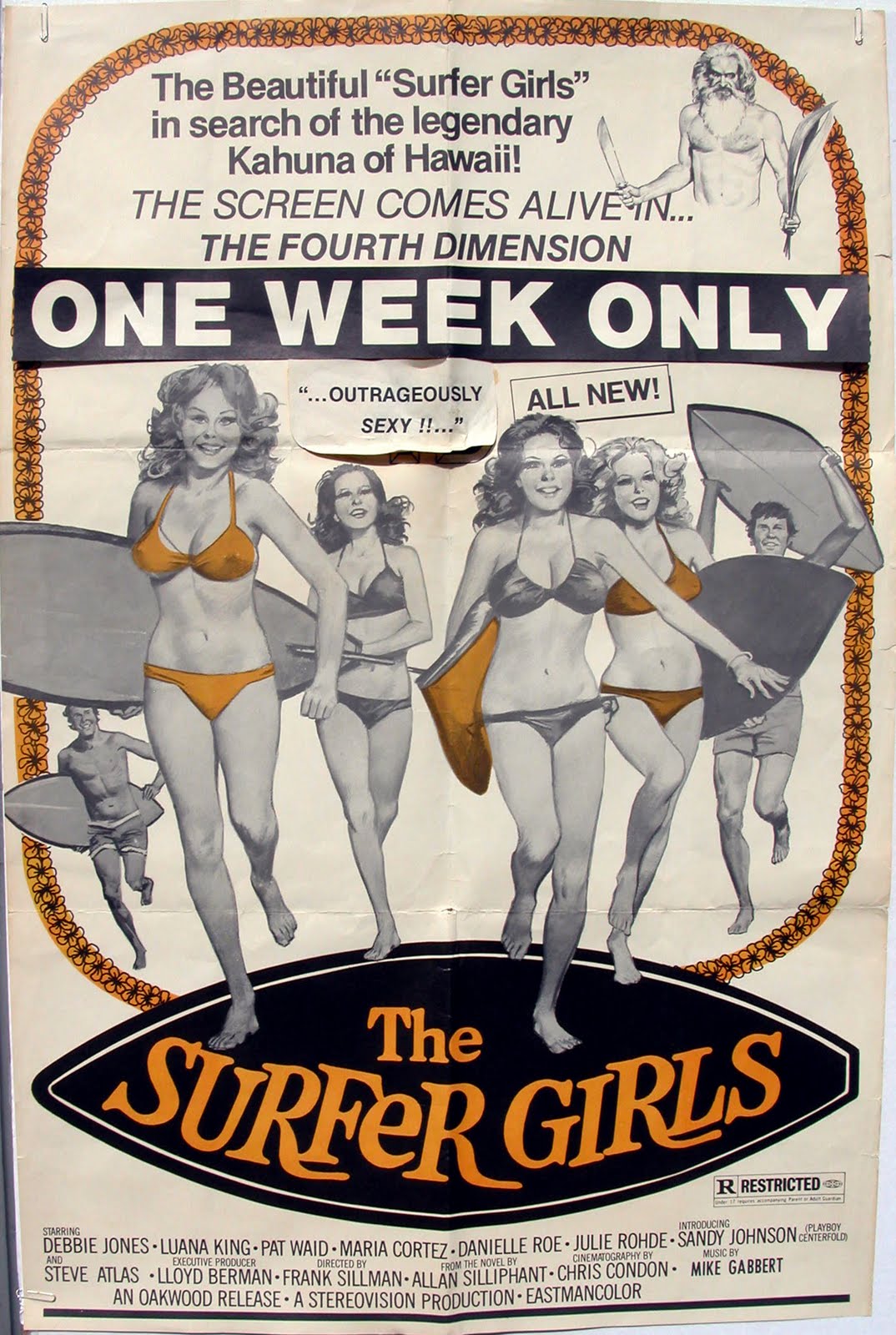
I was intrigued, so I started investigating. Here's the short version of what I found: Back in the late ’70s these two guys Al Silliman Jr. and Chris Condon produced a few movies together -- mostly low-budget grindhouse fare. One film, The Stewardesses, actually did make some money (and is still available on DVD, in a 40th-anniversary edition). The duo also produced, wrote, and directed a tank of a movie called The Surfer Girls -- the same name that's on the canister. Here's a poster for it that I found on the web [click to enlarge]:

Photo D.JPG

What's interesting about this movie is that Al and Chris started a company called Stereovision, which showcased their newly invented 3-D movie-making process. According to IMDB, The Surfer Girls originally came out in 3-D in 1978 and was then retitled Kahuna! in 1981. In 1982 it was retitled once again, as The Senior Snatch, and resissued "flat" (i.e., not in 3-D). I'm guessing this is one bad movie but perhaps a decent story for cocktail parties.

At this point I remembered that the antiques store had another film reel with "Stereovision" written on it. Eureka! I suspected that this might be The Surfer Girls itself (or one of its retitled iterations), so I went back the following morning and bought the reel:

photo (9).JPG

It's a 9-3/4" standard reel, which holds about 1,000 feet of film -- that's 12 to 15 minutes of running time. Most movies at the time were comprised of eight to ten of these reels and sent to theatres in cases of two reels each. Reels that were intended for theatre use had a bunch of markings on them so the projectionist knew when it was time to cue up the next reel. In this case, I have reel No. 7:

photo (5).JPG

Since I don't have the first reel with the opening credits (or a 35mm proector, for that matter), it's impossible to know which movie this is from. But I'm thinking it's probably from The Surfer Girls. And it's almost certainly from one of Al Silliman Jr. and Chris Condon's 3-D movies, because each frame has a double image:

photo (12).JPG

Meanwhile, some additional research reveals that Al Silliman Jr. is actually Allan Silliphant, who went on to create Anachrome -- another company specializing in 3-D technology. He is still around and lives near me in Southern California. I sent him an email telling him what I found and asked if he'd be interested in a little email correspondence for some backstory. No reply so far. (Silliman/Silliphant's partner, Chris Condon, passed away in 2010. After their moviemaking adventures, they founded Sierra Pacific Airlines. Now there are two guys I would like to have had a beer with!)

I'm toying with the idea of trying to either obtain or rent a projector so I can play the reel, or perhaps find a company that can convert it to digital. I'm also wondering what happened to the other reels. An awesome finale would be to have a screening with Allan in attendance, but that is probably a pipe dream. I'm still hoping to hear back from him, but I don't want to be pest or cross over into stalking territory.

I know very little about filmmaking. If any of your readers know more about this and can help fill in any of the gaps, I'd love to hear from them. They can contact me at this address.

---------

Fascinating stuff, right? Big thanks to Tim for sharing the story of his find. If you know more about all this, feel free to contact Tim at the link shown above, and/or post info in the comments. Thanks.

Friday, May 3, 2013

Screen shot 2013-05-02 at 10.10.25 PM.png Screen shot 2013-05-02 at 10.08.24 PM.png

The photos shown above, as well as the others interspersed throughout the text of this entry, are all part of a remarkable project that's been unfolding in southwestern Missouri. As you can see, most of these photos have been damaged, some of them severely. That's because they were all whisked away in the devastating tornado that hit the town of Joplin in May of 2011. A project called the Lost Photos of Joplin, organized by a church in the neighboring town of Carthage, has been collecting them, archiving them, and attempting to return them to their owners.

The photos -- more than 35,000 of them -- were found in four different states. Some of them ended up in Paducah, Kentucky, more than 350 miles away. Some are professional portraits; others are amateurish snapshots; many were wet and dirty when they were found. But all have been treated like the precious family artifacts they are. As of mid-April, 15,563 of them had been claimed.

Screen shot 2013-05-02 at 10.06.12 PM.png Screen shot 2013-05-02 at 10.10.05 PM.png

The Lost Photos project has cleaned and scanned all of the photos and uploaded them to Flickr and also to the project's own website, where Joplin residents (or, um, journalists who happen to be interested in found objects) can view them. If Joplin residents see photos on the site that belong to them, they can fill out an online form to claim them. The project also periodically holds "claim days," during which Joplin residents can come and search through binders of photos.

Screen shot 2013-05-02 at 10.09.00 PM.png
It's a pretty inspiring story -- so inspiring that a short documentary film about it, called Photos in the Wind, is being made. Here's the trailer:

You can learn more about the film here. Meanwhile, you can also follow the Lost Photos project on Facebook.

(My thanks to reader Jeff Whitener for bringing this one to my attention.)

Tuesday, April 30, 2013

Screen shot 2013-04-30 at 1.14.25 PM.png Screen shot 2013-04-30 at 1.15.23 PM.png

The color photos at top are of John Dodds and a vintage World War II bomber jacket that he recently purchased for $17 at a Goodwill store in Washington, DC. The black-and-white photo is of Robert Arand, the man to whom the jacket originally belonged back in the 1940s.

Dodds, a military veteran himself, was able to track down Arand, who's now 90 years old and will soon be reunited with his jacket. You can get the full story in this Stars and Stripes article.

We've had quite a few of these stories about lost military jackets being found and returned to their original owners. Part of it, I'm sure, is that military apparel is reasonably easy to track, at least compared to other vintage clothing. And part of it is no doubt that military garments resonate with strong backstories that seem to compel us to find the item's original owner. In any case, I'll keep featuring these stories as long as they keep coming up.

Friday, March 29, 2013

paul lukas.jpg

Sorry about the PermaRec slowdown -- I've been busy with other projects. But I have a few items in the pipeline that I hope to post soon.

Meanwhile: Next Wednesday, April 3, I'll be doing an hour-long radio interview regarding the Permanent Record report cards (that's me posing with a bunch of the cards back in 2010; I have different glasses now). It will air live from 10-11am eastern, and you can access the live stream here. There will also be a rebroadcast that evening at 9pm eastern here.

The person interviewing me will be Jane Wilcox, a professional genealogist who has a radio show devoted to ancestry- and genealogy-related issues. I met her last year when I was invited to do a short presentation and Q&A session on the PermaRec report cards at the New York Genealogical Society, of which she is a member. One topic that came up during that presentation was the ethical issues raised by using confidential school records as the basis for a media project. Jane plans to ask me about that during our radio interview next Wednesday, and will also touch upon other issues regarding the report card project.

Further details on all of this can be found here.

Monday, March 4, 2013

ManhattanTradeSchool.jpg

Reader Donna Mitchell spotted this 100th-birthday notice in Newsday the other day. As you can see, Jennie Scotto "attended seamstress school at Manhattan Industrial Trade School." As longtime Permanent Record readers know, that's the Manhattan Trade School for Girls (the school changed its name sometime around 1930) -- the school whose report cards I found in a discarded file cabinet back in 1996.

Was Jennie's report card among the ones I found? No, unfortunately -- I don't have a record for her. Based on the birthday notice, however, she's led an interesting life. I'm particularly intrigued by the mention of her having been "chosen to design and alter Eleanor Roosevelt's dresses." Was this in any way connected to Manhattan Trade, or was it something that happened many years later?

Let's do a little math: Jennie was born in 1913. Most Manhattan Trade students entered the school after eighth grade, roughly when they were 14, and stayed for two years. So Jennie probably attended Manhattan Trade from about 1927 through 1929, give or take.

Franklin Roosevelt did not hold elective office for most of that period (he became Governor of New York in 1929 and became our 32nd President in 1933), but he was already a prominent man, having served as a New York State Senator and Assistant Secretary of the Navy, and having been James M. Cox's running mate in Cox's unsuccessful Presidential campaign of 1920 (Cox lost to Warren G. Harding). So while Eleanor -- who married Franklin in 1905 -- was not yet a national icon during the time Jennie attended Manhattan Trade, she was nonetheless a prominent society woman. It's not far-fetched to imagine some sort of school contest in which the winner would get to work on Eleanor's dresses.

Eleanor Roosevelt was First Lady from 1933 through 1945. It's unclear from the birthday notice if Jennie worked on her dresses during this period, but it seems unlikely, since the notice mentions that she earned an accounting certification and worked for a plumbing company in that capacity. Sounds like she left dressmaking behind. My hunch is that her work for Eleanor Roosevelt was connected to her time at the school.

Either way, this marks the second instance of a Manhattan Trade student doing dressmaking work for a future First Lady. The first one was Eva Greene, who designed Mamie Eisenhower's inaugural ball gown.

Tuesday, February 19, 2013

628x471.jpg

Here's yet another story of lost military medals being found and then returned to their rightful owner. In this case, the medals were won during World War II by a soldier named Hyman Markel, who was killed toward the end of the war while his wife was seven months' pregnant. So that child, Hyla Merin, never knew her father, and her mother rarely talked about him because the memories were too painful for her.

Fast forward to last October, when the manager of a California apartment complex found a box containing letters and a Purple Heart in an old storage locker. He got in touch with a group that operates as a lost-and-found service for military medals. That group soon figured out that the Purple Heart had belonged to Markel, the WWII soldier. His widow -- the one who'd been pregnant at the time of his death -- had lived in the California apartment building in the 1960s but had apparently left the box behind.

The widow is now deceased, but her daughter -- Hyla Merin, the one who never got to know her father -- is now the proud owner of his Purple Heart, along with several other medals awarded to her father. That's her on the right in the picture at the top of this entry. You can read more details here.

At least two local news stations in California produced segments on this story. You can see them here:

(My thanks to Roger Faso for pointing me toward this story.)

Saturday, February 16, 2013

Screen shot 2013-02-16 at 10.36.00 AM.png

What you see above are two British World War I medals that were awarded to a man named Joseph Brown, who died in 1967. The medals were recently inherited by a friend of Brown's family named David Gillespie, who works at the UK's National Archives. Gillespie never knew Brown but wanted to learn more about the man whose medals he now owned, so he did some research, consulted with various family members, and came up with an account of Brown's military career.

As Permanent Record stories go, this one is fairly standard stuff. The medals weren't found objects, and Gillespie already knew the identity of the man behind them, so no serious detective work was required, and there were no major revelations. So why am I bothering to write about this storyline? Because I'm fascinated by the ribbons attached to the medals. They're so colorful and bright -- the one on the right looks almost tie-dyed!

My response to the ribbons made me realize that we (or at least I) tend to visualize World War I exclusively in black-and-white, maybe with sepia-toned accents, which has the effect of making it seem less real, more like a fable. The presence of color -- especially bright, vibrant color as seen in those ribbons -- has a completely transformative effect on my perception of the that period in history. Interesting.

By coincidence, I happen to own an old ribbon catalog. It's from the 1940s, so it's not nearly as old as Brown's medals. Still, it has some interesting stories to tell, which I wrote about in an article for the very wonderful Cabinet magazine several years ago. If you're curious, you can see that here.

(My thanks to Jacob Sherman for pointing me toward this one.)

Friday, February 1, 2013

shane arbogast 1982.jpg

The painting you see above is at the center of a very interesting story involving my friend Shane Arbogast. A stranger recently got in touch with him to say that he'd been combing through items at a Goodwill shop in Florida and had spotted a painting with Shane's signature on it. (You can just barely make out Shane's name at lower-right.) The guy didn't purchase the painting but was curious about its back-story, so he googled Shane's name and e-mailed him.

Shane immediately recognized the painting as something he'd done for a class assignment while attending art school in Sarasota, Florida, back in the early 1980s. He's not sure what happened to it after that (he thinks he may have sold it in a student show, but he's not certain), but in any event he hadn't seen or thought about the painting in 30 years. He didn't want it to vanish into the ether again, so he arranged for the guy who'd gotten in touch with him to purchase it for him:

Screen shot 2013-01-31 at 3.56.34 PM.png

The best part is that Shane and his girlfriend are longtime thrift store shoppers and have purchased their share of thrift store paintings over the years. Now Shane himself is a thrift store artist. It's a great example of something coming full-circle.

There's more here -- possibly a lot more -- but I don't want to get ahead of myself. Suffice it to say that I plan on interviewing all the principals in this story and hope to bring you a more fleshed-out version soon.

Thursday, January 31, 2013

Screen shot 2013-01-30 at 10.26.38 AM.png

Today we have our latest installment of Charlene Dodds's postcard rephotography project (previous editions of which can be found here, here, here, here, and here). Here's Charlene:

Heading northwest from Bedford, Pennsylvania, I went looking for the famous Horseshoe Curve just to the west of Altoona. The curve is shown on a postcard I found with my great aunt’s college-era postcards [see above]. It was never mailed and is blank on the back, but I suspect she and her chums took an adventure to see this engineering marvel, purchased a postcard as a souvenir, and decided they didn't want to part with it, especially since cameras were not commonly owned back then. The postcard was probably their only visual record of their visit to the curve.

I eventually located Horseshoe Curve, which is part of a rail line that was constructed to shorten the distance between Harrisburg and Pittsburg and eliminate the need for another line. The 220-degree curve was incorporated to lessen the steep grade and allow safe passage of trains. Even so, before the invention of modern braking systems, the rails were regularly pulled up and switched around to give equal wear to both sides, doubling their lifespan. So many troops were moved along this line during World War II that the Germans hatched a plot to blow up the tracks and even landed men on our shores to do just that. (The FBI ended their plans.) The curve is so ingrained into the local culture that Altoona's minor league baseball team is called the Curve.

Horseshoe Curve looks much the same today as it did back then. But trespassing on the rail tracks is illegal and dangerous, so I couldn't take a proper photo and had to settle for a contemporary postcard:

001.jpg

Next: I was intrigued by the postcard of Bickford Fire Brick Co. ("Largest Fire Brick Plant in the World Under One Roof"), which was sent to my grandmother from “Fritz & Foster” in 1924 (click to enlarge):

FireBrick Plant 001.jpg FireBrickPlant2 001.jpg

First, what is a fire brick? I discovered it is a ceramic brick made to withstand high temperatures inside a fireplace, furnace, or iron smelter -- and of course there were lots of those in nearby Pittsburgh. Clearfield County, Pennsylvania, is known for the high quality of clay used in manufacturing these bricks, and Bickford Fire Brick Co was “what is probably the finest, best equipped and one of the largest fire-brick plants in this country," at least according to in a state review in the 1930s. Alas, there is no trace of this plant left in town, so I wasn't able to photograph it.

Continuing farther west, I searched for Conneaut Lake Park, which was shown on a postcard received by my grandparents in 1948. The day I arrived was picture perfect, just as depicted in the postcard (click to enlarge):

ConneautLake2 001.jpg ConneaughtLake 001.jpg P1010711.JPG

While I was taking photos, there was a great influx of motorcycles and many vans, from which emerged various tattooed folks. Then a loudspeaker announced, “Ladies and gentlemen, we appreciate your patience. Ozzy Osbourne and Black Sabbath will be here any minute. Their plane has finally landed and they are on their way. The show will be well worth the wait.” My grandparents would roll in their graves if they knew this idyllic site was about to be overrun by the heavy metal hordes.

My continued thanks to Charlene for sharing her stories and family postcards with us.

Wednesday, January 30, 2013

I wear a lot of vintage clothing, and I'm always wondering about the people who owned the clothing before I did. Who were they? What were they doing and experiencing when they wore this sweater (or shirt, or pair of jeans, or whatever)? If the clothing could talk, what stories would it tell? Occasionally I'm able to find out the answers to those questions, as in the case of that vintage skating jacket that I was recently able to trace back to its original owner, but that's pretty rare. Most of the time I'm just left to wonder.

The folks at Racked -- a shopping web site that I just became aware of, although I gather it's fairly popular -- apparently wonder the same thing, and they've taken a novel approach toward addressing it. They recently hired a psychic and turned her loose in a Manhattan vintage store so she could tell the stories behind the clothing. The resulting video -- called, simply enough, "Vintage Store Psychic" -- can be seen above.

Frankly, it's a little disappointing. The psychic mainly comes across as a ditz, and the "revelations" she comes up with aren't particularly interesting or illuminating. But the basic concept of trying to find the stories behind old objects is a good one. And the concept isn't just limited to clothing, of course -- every old object has a history, a story to tell. That's the essence of Permanent Record.

Do you know the stories behind any of your second-hand objects? If so, post them in the comments, or feel free to e-mail them to me.

Wednesday, January 23, 2013

Screen shot 2013-01-23 at 1.07.25 PM.png

The items shown above were recovered from the person of a Guatemalan man whose dead, decomposing body was found in the Sonoran Desert in July of 2010. The man had presumably traveled to Mexico and tried to cross into the United States. Like many people who attempt this border crossing, he died along the way. The few personal effects were not enough to identify him (the I.D. card is fake), and his remains have never been positively identified.

I learned all this in a fascinating article written by Robin Reineke, a cultural anthropologist who's part of a forensics team that tries to identify migrants' bodies found in the Sonoran Desert. The desert heat renders the bodies unrecognizable within a few days, so personal effects are often the only viable clues to the migrants' identities. It's a very powerful example of the Permanent Record ethos of tracking down the stories behind found objects.

The photos accompanying that article were taken by Jonathan Hollingsworth. Turns out he recently published a whole book of similar photos, all showing personal effects from deceased migrants. I haven't gotten a copy yet, but it's on my list.

(Special thanks to Kirsten Hively for letting me know about this one.)

Thursday, January 17, 2013

Screen shot 2013-01-17 at 1.26.43 PM.png
Click to enlarge

What you see above is a book of "rules to live by," filled out by a child. As you can see, some of the rules are rather endearingly worded: "If there's no space between one person you want to sit by, don't cry or wine [sic] because there is no room," for example, and "Don't ask questions you don't want to know the answer to."

The book, which contains 157 numbered guidelines, was found in the parking lot of a California Walmart by a 20-year-old employee named Raymond Flores. He thought the book was too special to be consigned to the trash, so he contacted local media outlets in an attempt to find its author/owner. It turned out to be the work of two cousins: Isabelle Busath, 10, and Isabella Thordsen, 8. Flores was able to meet with them and return the book to them earlier this week.

Here's a short video clip about the story:


(Special thanks to Sue Kendall for pointing me toward this one.)

Monday, January 14, 2013

Screen shot 2013-01-13 at 11.37.47 AM.png

We often encounter stories about found photographs. Sometimes we'll even see a story involving found negatives. But this is a story involving a much less common phenomenon: a found memory card.

Here's the deal: A man named David Nieland was recently hiking in the mountains along the Blue Ridge Parkway in North Carolina when he spotted a memory card near a stream. He picked it up, took it home, and accessed the photos on the card, a few of which offered enough visual clues to help him track down the family that had taken the photos.

The family was particularly appreciative to have the photographs because they included a few shots of a family member who had since died of cancer. This angle made the story irresistible for the Today show, which recently produced an extremely hokey (but nonetheless informative) segment about the memory card:

As noted toward the end of the Today segment, one of the most interesting aspects of the story is that Nieland -- the guy who found the memory card -- was recently reconnected with a lost object from his own past. His grandfather's high school diploma had somehow ended up in a garbage truck, where it was found and ultimately returned to him.

(Special thanks to Jennifer Hayden for pointing me toward this one.)

Sunday, January 13, 2013

7798888.bin.jpg

The gentleman shown above is 92-year-old William Kadar of Merrillville, Indiana. He's holding the U.S. Army-issued duffel bag that he used during World War II to tote his gear around France. The bag became separated from him in November of 1944, and Kadar was captured by the Germans and marched to a POW camp soon after that. But he survived the ordeal, and his duffel bag did as well. It was found and kept for several generations by a French family, which recently decided to find the bag's owner and return it to him. You can read more about the story here.

As it turns out, the past week or so has been a busy time for PermaRec-ish stories involving war artifacts:

• In Italy, a man has found a wristwatch that probably belonged to an American World War II military transport pilot. He hopes to return it to the pilot's family.

• In California, a photography enthusiast purchased an antique camera and was surprised to find that it contained eight glass negatives showing images taken in France during World War I. Fascinating stuff.

(Special thanks to Matthew Algeo for pointing me toward two of these stories.)

Tuesday, January 8, 2013

Screen shot 2013-01-08 at 4.23.06 PM.png

The photo on the left shows a young Joe Jackson; on the right, Suzi Quatro. The photos were recently shared with me by PermaRec reader Tom Common, who describes himself as "an antiques dealer specializing in postcards, paper, and photographs." He won't tell me where he's located, but his story, and the story of these photographs, is an intriguing one. I'll let him tell it in his own words:

Around the year 2000, I went to a local flea market. One of the dealers had a large box full of photographs. There were hundreds of folders of color and black-and-white photographs, most of them accompanied by negatives. Most of the photos were of rock musicians (mostly bar bands, but the photos looked very professional, like the photographer had been hired to do publicity shots), plus there was a little bit of personal family stuff and another large group of train pictures.

I quickly negotiated a price, paid, and asked the seller where he had acquired the photos. He told me that he had gone to a garage sale in a suburb and that a woman had sold them to him.

When I got home, I sorted through the photos and I was amazed. There were photos of bands that I remembered from the 1970s, interior shots of famous local bars with the employees, and shots of musicians practicing and relaxing backstage. In addition to photographing local bands, the person had seen shows by big-name acts like Bruce Springsteen, Tom Petty, Todd Rundgren, etc. The photographer had also attended some of the huge stadium concerts. He did not have as much access to those shows, but they are pretty good shots considering the equipment he had.

The train photos were also interesting, as this person traveled all over the state documenting trains and stations. The family photos were the smallest part of the collection, and there were no family names or other identification.

I organized the photos as best I could (some had been removed from their folders and mixed up). And I attempted to identify the bands, using what little info was included on the envelopes. Then I put the collection on the back shelf for a while, always wondering who, what, and why.

Fast forward about five years. I was listening to a local college radio show, and a guy from a band was being interviewed live. He was in one of the bands that had been photographed. I called the show and spoke with the guy, explained the situation, and arranged to meet with him at a coffee shop.

On the scheduled date, two guys showed up to meet me. They introduced themselves, and it turned out that one of them was a photographer. I had brought along some of the photos I'd purchased at the flea market, and I showed the photos to them. The photographer guy said there were only three people doing this kind of work at the time, and he said he was pretty certain it was "John Doe." I asked about John Doe, and the guy said that he believed Doe had ended up in prison.

After the meeting I went home and did a bit of internet research. Sure enough, John Doe had been incarcerated, but he was out on probation.

Doe had been in prison at the time I bought the photos, My best guess is that his wife sold the photos. I think the reason there were so few family photos is that the wife kept most of those.

In any event, the photos of the bands are an important document of a specific time when rock music was the life blood of my hometown. I know they could be crafted into a fine book. I also know I would have to get in touch with all the people in the bands and find out stuff about the fans and behind-the-scenes people. But I am unskilled at the business of book publishing, and I have concerns about John Doe's role in all of this. I have not yet attempted to contact him.

I have talked to a few people and their reaction has been mixed. I honestly do not know how to proceed. Can you offer me any advice?

As I explained to Tom, I'm no attorney, but my layman's understanding of copyright law is that the original photographer -- whether it's John Doe or someone else -- still holds the copyright to the photographs, and that the photos therefore can't be published without his permission or compensation. But Tom should really consult a legal professional on that point.

What I do feel qualified to comment on is the question of whether Tom should contact John Doe. Tom hasn't shared John Doe's real identity with me, or the details of his criminal record, so I can't offer fully informed advice here, but my general feeling is that Tom should go ahead and contact him. Just because someone's an ex-con, that doesn't make him a bad or dangerous person. If he's out on parole, then he's supposedly paid his debt to society. And he may have an emotional connection to those photos, which he's probably assumed are gone forever.

As I've said before, I'm a storyteller, so my instinct is always to connect the dots and follow where they lead, even if they lead in some potentially uncomfortable directions. I hope that's what Tom ends up doing. If you have other advice for him, feel free to post it below, and/or contact him directly. He's eager to hear feedback (and not just of the squealing electric guitar variety).

Thursday, December 27, 2012

Today we have the latest installment of Charlene Dodds's rephotography project, in which she's visiting places shown on old postcards sent to and from members of her family. (In case you missed it, previous installments in this series are available here, here, here, and here.)

Here's the latest from Charlene:

The next stop on my tour of Pennsylvania was Waynesboro, a town General Robert E. Lee passed through after the Battle of Gettysburg. A schoolmate of my great aunt’s had sent her a postcard from Waynesboro over the summer break in 1917. The postcard showed three grand houses along Clayton Avenue. I had no trouble finding the proper street, but I had to drive back and forth several times before I realized that the tiny trees shown in the postcard had grown so much in 95 years that they now largely obscure the houses, one of which you can just barely see peeking through in the photo I took [for all of these images, you can click to enlarge]:

Waynesboro2 001.jpg Waynesboro 001.jpg P1010793.JPG

You can get a better view of that house in this shot, although it doesn't duplicate the original postcard perspective.

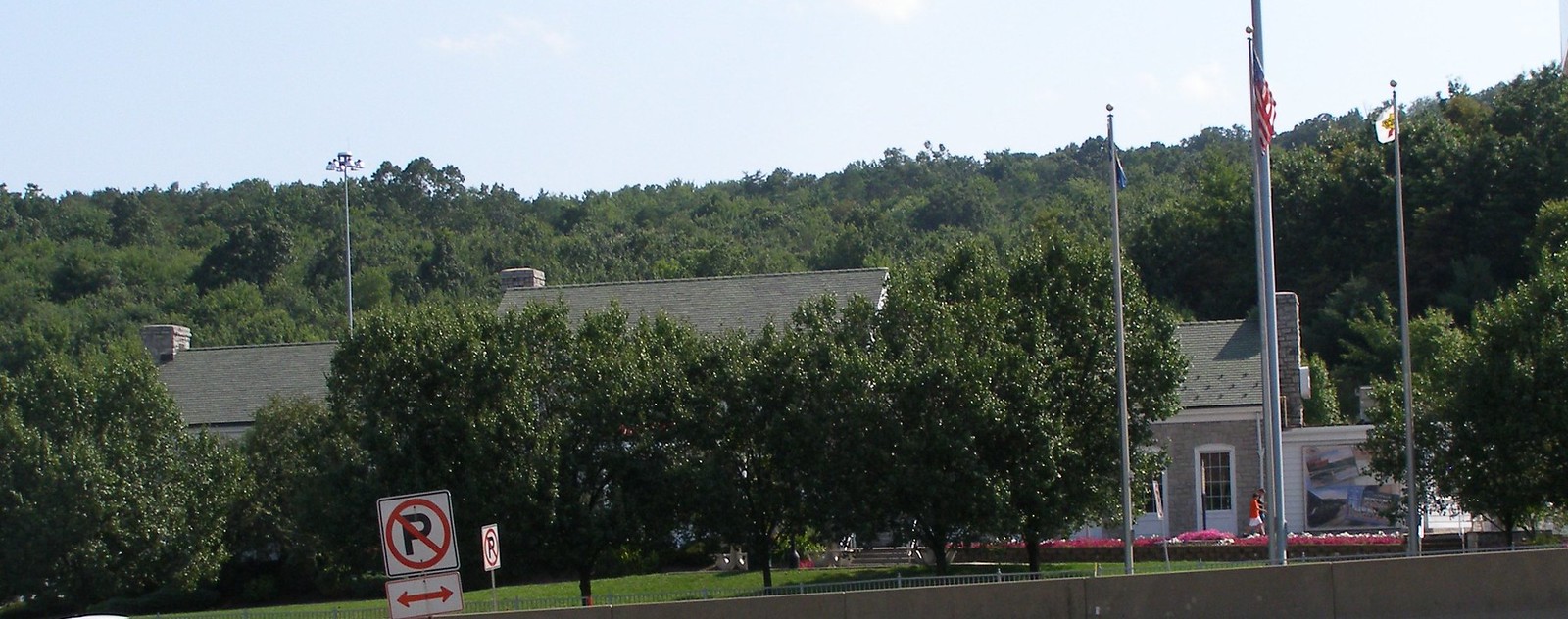
My next stop was the Bedford rest station on the Pennsylvania Turnpike. This spot was a big hit for my paternal grandfather, who sent many postcards back home to his kids from this place, including a view of a Howard Johnson restaurant known as "the Midway." I discovered that the building shown is on the south side of the roadway. Roadway traffic necessitated a high concrete wall dividing the directional traffic lanes, so a second, near-identical restaurant was built on the north side of the road. That one is still there -- but much like the houses in Waynesboro, it's now largely obscured by trees:

Bedford6 001.jpg Bedford5 001.jpg P1010817.JPG

My other grandfather, on my mother's side, also had a connection to the Turnpike. He had been the surveyor for this road many years earlier. My mother -- his daughter -- has regaled me with stories of when she was very small and he would take her along in the dead of night to “shoot the stars” with a sextant, which is how the workers plotted where to lay the roadbeds before GPS. It's fascinating to me that both sides of my family had a link to the Turnpike years before my parents would eventually meet.

That's it from Charlene for this time around. More soon.

Wednesday, December 26, 2012

994241.jpg

994231.jpg

Earlier this month I wrote about story behind an old military jacket that had washed ashore after Hurricane Sandy, and how the person who found it was able to return it to the widow of the cadet who'd originally worn it at West Point in the early 1930s.

The jacket shown above is not that same jacket, but it's very similar. It was purchased 20 years ago at a consignment shop by a Minnesota woman named Mary Helen Taft. When she read a news article about the jacket that had washed ashore, she became curious about the one she had bought, which was stowed away in her closet. So she dug it out and then did what the person who'd found the other jacket had done: She contacted West Point and asked if officials there could use the marks on the jacket's tags to tell her more about its original owner.

In this case, the jacket had been worn by a cadet named Joseph Francis Albano, who graduated in 1971. (West Point cadet jacket design apparently didn't change much in the four decades.) He's still alive, although he and Mary Helen Taft hadn't yet spoken or met as of a few days ago.

Further details on all of this, along with a mention of yet another vintage West Point jacket being traced back to its original wearer, can be found here.

(Special thanks to Barbara Zimmer for pointing me toward this one.)

Saturday, December 22, 2012

Screen shot 2012-12-21 at 3.01.55 PM.png

Screen shot 2012-12-21 at 3.02.23 PM.png

Screen shot 2012-12-21 at 3.05.46 PM.png

The three front/back photo pairings you see above are all from the book Talking Pictures: Images and Messages Rescued from the Past by Ransom Riggs, who puts an unusual spin on a common hobby. He collects old snapshots that he finds at flea markets and junk shops (nothing new about that), but only if they're annotated with handwritten inscriptions -- usually on the back, but sometimes on the front.

Several hundred of photos from Riggs's collection are compiled in Talking Pictures, and the result is a compelling series of partially told stories that leave you wanting to know more. As you page through the book and read the annotations, you can't help but wonder "Hmmm, what happened to that couple?" or "How did that guy end up with a black eye?" or "Did that smallpox-ridden child survive?"

It's a great book, and very reasonably priced. Highly recommended to all PermaRec readers.

I'll close this entry with an assortment of additional images from the book -- enjoy.

Screen shot 2012-12-21 at 3.26.29 PM.png

Screen shot 2012-12-21 at 3.05.07 PM.png

Screen shot 2012-12-21 at 3.03.30 PM.png

found-a-baby-girl-560x800.jpg

Screen shot 2012-12-21 at 3.04.26 PM.png

Screen shot 2012-12-21 at 3.28.06 PM.png

Screen shot 2012-12-21 at 3.06.05 PM.png

Friday, December 21, 2012

image.jpeg

I've written several times now about Russell Ries. As you may recall, he's the guy who purchased a cigar box full of old photos and other personal effects, all pertaining to the same person (who I refer to as John Doe). Russell did a little digging and discovered that John Doe was accused child neglect that resulted in the death of one of his children. Russell also discovered that while John Doe himself was now deceased, another one of his children was living in the Nashville area -- where Russell himself lives. He wondered if he should get in touch with the son and offer the photos and other items to him, or if he should keep his distance because the subject might be too painful. Several Permanent Record readers offered their own opinions on this.

Russell ultimately decided to get in touch with the son, whose name is Bill. (I had referred to him as Andy, to help protect his identity, but Russell is now ready to use his real first name.) Bill agreed to meet with Russell, and the meeting took place in Westmoreland, Tennessee, a few days ago. The photo above shows Russell on the left and Bill on the right.

Russell provided a detailed account of the meeting, including the following:

Until starting my drive to Westmoreland that morning, the full reality of the situation hadn't dawned on me. This was probably the final chapter of my connection to Bill and his family.

I had purchased the cigar box over Memorial Day weekend in 2011. And since that time, I had come to see myself as something of a steward of the memories contained within it. I had always hoped this day would come. But now faced with it, I began to lament the loss of my role in the story.

The truth was, no matter how close I may have felt to Bill or his father, I was a complete stranger to him. Some guy who, only last week, sent him a letter about pictures of his dad. He had been a compelling character in my life for over a year but I had literally just entered his. Would I be able to find any real connection with this man when we met? How would I feel about preserving and returning these memories to him if he turned out to be a jerk? It was a petty and small way to feel, I know. Fortunately, it proved to be without merit when we finally met.

There's more -- a lot more. To see how it all turns out, check out the full story on Russell's blog.

+ + + + +

A few housekeeping notes: It's been over two weeks since the last post here on the site. Sorry about that -- been busy with other projects. But Permanent Record is very much alive and well. In the coming days I'll be posting about a very PermaRec-ish book that I'm extremely excited about, along with the latest installment of Charlene Dodds's rephotography project, and hopefully a few other things.

Several people noticed the note at the end of last month's PermaRec article on Slate, which mentioned that there would be no more Slate articles for the foreseeable future. Just to clarify that, I plan to keep researching and investigating the stories behind the Manhattan Trade School report cards, and the Slate editors are happy to keep publishing PermaRec articles if I come across a student with a particularly powerful story. But they feel the basic goals of the series -- to tell about the school and its students -- have now been met. So any future articles will only be about report cards with particularly extraordinary stories to tell. (Of course, I think they're all extraordinary, but I understand the editors' point.)

My best wishes to all PermaRec readers for a safe and happy Christmas.