Wednesday, April 30, 2014

Photos by Chuck Miller; click to enlarge

The camera you see above is a Kodak Vest Pocket Autographic, a model that was produced from 1912 through 1926. Blogger and PermaRec reader Chuck Miller recently acquired it on eBay.

As you can see, the camera was inscribed with a series of etched notations. That's because the each Vest Pocket Autographic came with its own engraving pencil. The pencils were supposed to be used to write notes on the film, allowing the users to annotate their photos, but most people didn't bother with that and instead wrote notes directly on the camera case. You can see the pencil mounted at the bottom of the camera in this next photo, which also shows lots of additional inscriptions (click to enlarge):

If you look near the top of that last photo, you'll see the name "Frank D. Row" surrounded by a series of military locations. Miller (the guy who acquired the camera) figured Row must have had some sort of military connection and had charted his travels on the camera, sort of like a vacationer slapping place-themed decals on a suitcase.

Miller wanted to know more about Row and his travels with the camera, so he did some research and learned that Row served in the Red Cross during World War I and helped to establish a military hospital in France, among other things. Miller's research on Row and his unit turned up evidence that matches up with most of the places etched into the camera. You can read the full story here.

Row died in 1966, but the Red Cross chapter that he belonged to still exists, and Miller plans to return the camera to them shortly — a nice way for the camera to return home.

Miller sounds like a very PermaRec kind of guy. "For years, I've been trying to acquire cameras that have undeveloped film in them — maybe half a roll before the previous owner stopped taking pictures and the camera was lost," he says. "Unfortunately, in most cases the film is so deteriorated that it's undevelopable, or the company I sent it to that promised to develop rare film simply took my money and never gave anything back. So this Vest Pocket Autographic is the first time I've actually been able to get a camera that can tell its story."

Friday, April 25, 2014

Click to enlarge

As you can see above, a 1922 high school sophomore named Jennings Keffer liked to doodle. Those scribblings — and many more, as I'll show you in a minute — appear in an old Shakespeare text that was recently found at a bookstore by a music blogger who calls himself Devil Dick. Although the Shakespeare book has nothing to do with music, Devil Dick found the doodles so enticing that he decided to post them on his blog and try to find out more about Jennings Keffer.

So what sort of doodles did a high school fella create in 1922? Pictures of girls, for starters. And what kinds of girls would be of interest in 1922? Take a look (for all of these images, you can click to enlarge):

It's hard to express how much I love that. I particularly like the cigarette and the bells — scandalous! It's worth noting that while flappers were just becoming a pop-cultural phenomenon in the early 1920s, the term "flapper" has much deeper roots and was long associated with prostitutes, so the word may have had an extra forbidden-fruit quotient or with young Jennings.

Here's another set of doodles from the book:

The most interesting thing here, at least to me, is the pair of baseball drawings on the left side, because Jennings was coming of age at just the right time to be swept up in the national mania surrounding Babe Ruth. The Babe had set a single-season record by hitting 29 home runs in 1919 (the previous record of 27 had stood since 1884) and then completely changed the sport by hitting 54 homers in 1920 and 59 more in 1921. When Jennings was making these doodles in the spring of 1922, Ruth was at the peak of his larger-than-life celebrity arc, and baseball was coming into its own as a powerful cultural and economic engine. Even without televised games, it all must have been a very exciting time to be a teen-aged baseball fan.

If Jennings was a high school sophomore in 1922, that means he was probably born around 1906. Sure enough, Devil Dick did some research and determined that Sidney Jennings Keffer was born in 1906 in West Virginia and died in 1995 in Ohio. You can see Devil Dick's post about all this, including several more pages of doodles, here.

(My thanks to reader Jeff Ash for letting me know about this one.)

Thursday, April 24, 2014

On the left is a snapshot from 1933, showing a boy and girl hugging on a sunny day in Syracuse; on the right, a tissue paper collage based on that photo. The collage was done by the children's book author Eric Carle, who also happens to have been the boy in the original photo.

Carle, who's now in his 80s, was three years old when the photo was taken. Last November he told USA Today that he couldn't recall her name — only that she had been his friend and was the daughter of Italian immigrants. He said he had frequently looked at the photo over the years and wondered what had happened to her, so he created the collage based on the photo and used it as the cover illustration for his latest children's book, Friends.

That USA Today article from last November caught the attention of Syracuse Post-Standard writer Sean Kirst, who decided to see if he could track down the little girl in the photo. And now, thanks to some persistent research and a few lucky breaks, he's succeeded. (You can get more info on how he connected the dots here.) Not only has the little girl been identified, but she's still alive. She and Carle spoke on the phone last Sunday, and there's talk of a face-to-face meeting. Great stuff.

(My thanks to reader Anne McNelis for letting me know about this one.)

Friday, April 18, 2014

Photos from JillSobule.com

About a dozen years ago, the singer/songwriter Jill Sobule received a vintage charm bracelet as a birthday gift. She had no interest in wearing the bracelet ("not really my style," she would later comment) but nonetheless became obsessed with it. As she wrote on her website in 2012:

Who was the original owner? What did she do? I do know her name was Dottie, as there is a round engraved "Dottie" charm. ... She was not from a wealthy family — the 22 charms are pewter as opposed to silver or gold. She traveled domestically, gathering mementos from Florida to Mackinac Island to New York City. She played piano. She liked big, sculpted poodles. She liked cowboys. She was a working girl; there is an ABWA union (American Woman Business Association) charm and an office chair. She was Jewish — a mezuzah. I keep saying “was” [but] maybe Dottie is still alive. Who knows?

Totally Permanent Record, right? Sobule decided to use the charm bracelet as the organizing theme for a concept album: a dozen songs, each relating to one of the charms on the bracelet, forming a fictional (but plausible) composite view of Dottie's life. But she didn't write the lyrics herself. Instead, she enlisted a bunch of writers — mostly novelists and academics like Jonathan Lethem, Luc Sante, and Rick Moody — and had each of them write a set of charm-based lyrics. She then added the music. The resulting album, Dottie's Charms, is being released on vinyl this weekend (in conjunction with Record Store Day) and will be available digitally on May 5.

Interestingly, Sobule had already been contemplating a similar project before she hit upon the charm bracelet idea. At one point she had considered purchasing a random old high school yearbook on eBay and constructing a concept album around that. But the charm bracelet idea ended up working out better.

The collaborative nature of Dottie's Charms has echoes of the Significant Objects project, in which the writers (and my friends) Rob Walker and Josh Glenn acquired about 200 cheap thrift store items, assigned a writer to create a short story about each of them, and then auctioned off the objects and the stories on eBay. (The stories were later packaged into an excellent book.)

You can learn more about Dottie's Charms in this article, and Sobule will be playing a record-release party for the album on April 24 at City Winery in New York. As she recently wrote on her blog, "Maybe Dottie will show up."

Incidentally, a few years ago I considered writing a song about the Manhattan Trade School report cards that formed the basis of the Permanent Record project. I figured I'd write some lyrics (something I'd never done before), and I asked my friend Lianne Smith — a great singer/songwriter who also happens to be a big PermaRec fan — if she'd be willing to come up with the music and then add the song to her repertoire. She was agreeable, but I never came up with a full set of lyrics. Only managed to do the chorus, the bridge, and part of a verse. This is all a good reminder that I need to dust off that project.

Monday, April 14, 2014

I'm a big fan of prewar country blues, and of course I'm also a fan of artifacts with hidden stories to tell. So I was super-excited when I saw The New York Times Magazine’s cover story this past Sunday: a long-form account of writer John Jeremiah Sullivan's extended research-based attempts to find out something — anything — about Geeshie Wiley and Elvie Thomas, two female blues singers who cut six sides for Paramount in 1930. One of those six songs, "Last Kind Words Blues" (credited to Wiley, as you can see on the label, but with Thomas accompanying her on guitar), is embedded above. If you're not familiar with it, go ahead and give it a listen.

The six Wiley/Thomas sides have long enjoyed a fairly rarefied status among blues connoisseurs and scholars. But those same scholars have failed to turn up any information about Wiley or Thomas. The mystery surrounding the two women is underscored by how rare their recordings are. In the case of one of their records, "Motherless Child Blues" with "Over to My House" on the flip side, only two copies are known to exist.

Many researchers and scholars over the years have loved Wiley and Thomas's music and wanted to know more about them. But Sullivan — the author of the NYT Mag article — seems to have been particularly smitten with them after first hearing their music in 1994. His article details his increasingly obsessive attempts to unlock the stories of these women's lives, and I don't think it's giving too much away to say he ends up hitting a certain degree of paydirt by the article's end.

While the two blueswomen are the article's protagonists, there's another significant character worth mentioning: Mack McCormick (shown at right; click to enlarge), a Houston-based 85-year-old who is said to have the world's largest archive of original blues research content — interview tapes, transcripts, photographs, record company ledgers, birth certificates, death certificates, you name it. I qualified that with "is said to" because McCormick's archive is so massive and unruly (he calls it "the Monster") that even he isn't sure of what he has anymore, which has led some skeptical rival scholars to question whether he really has all that much to begin with. The fact that McCormick is afflicted with bipolar disorder hasn't helped either his reputation or his attempts to organize his archive while he's still alive.

McCormick, who I'd heard of before but didn't really know that much about, comes off as the most fascinating character in the article. Part field researcher, part folklorist, part cultural historian, and part nosybody, he's a white man who was born into a very segregated era and has devoted most of his life to investigating and documenting the history of early-20th-century black American music. At one point he took a job with the census and specifically asked to be assigned to a particular black precinct where he thought (correctly) he'd find lots of old musicians and old records.

But McCormick has become paralyzed by (or maybe victimized by, or even captured by) the scope and depth of his work. He supposedly knows more than anyone has ever known about the most famous country blues singer of all, Robert Johnson, but has been unable to write a book on Johnson — in part, one suspects, because of his mental illness, but also because he got in so deep that he can't create a coherent narrative. And the Johnson situation serves as a metaphor for the rest of his archive, which is uncatalogued and is likely filled with untold stories that could add to our understanding of blues history.

Sullivan's article spends a lot of time discussing McCormick. It seems clear that the two men have a complicated relationship that veers from mentor/acolyte to rivalry, and I wonder if Sullivan envisions — or worries — that one day he'll end up like McCormick, an old man who got so immersed in his life's work that he neglected to shape it into a functional legacy. It raises a question I've often thought about while working on Permanent Record: At what point do we devote so much time and energy to investigating past lives that we lose sight of our own? Or, maybe more to the point, does a fascination with past lives indicate a feeling of emptiness about one's own?

Such introspections notwithstanding, Sullivan's article is superb. Like all stories about the blues, it's also a story about race in America, and a really good one. It's also very, very Permanent Record. It's long — about 14,000 words — but it's absolutely worth your time. Lots of good audio and video content, too. You can check it out here, and there's a follow-up "story behind the story" piece here. Don’t miss.

Tuesday, April 8, 2014

I occasionally look for PermaRec-ish items on eBay and Etsy — old passports, old ledgers, old scrapbooks, that kind of thing. A week or so ago, for reasons I can't fully explain, I found myself thinking, "Hmmm, I wonder if anyone's selling old prescriptions?"

As you can see above, someone certainly was. In fact, as I soon discovered, there are a fair number of people on the internet selling old scripts. The two shown above are from a batch of 25 — all from 1959, mostly from the Kentucky/Tennessee region — that I purchased on Etsy for $3. (If that sounds like a good deal, you can get in on it, because the seller apparently has plenty more.)

Like any old documents, the prescriptions are evocative and feel like they have stories to tell. They've also raised all sorts of issues in my mind. For example:

1. PermaRec has often entailed some ethical concerns about violating people's privacy. I've usually been able to rationalize away those concerns, either because the people involved were likely deceased or because I convinced myself that the pursuit of an artifact's underlying story was worth the risk. But prescriptions feel different — they'd fall under doctor/patient confidentiality, no? And some of the people for whom these prescriptions were written may still be alive. So as you can see, I've blurred out the patients' surnames, which seems like the right approach to take, especially for a prescription like this one:

2. Somewhat related to the above: How did these scripts end up for sale on the internet to begin with? Wouldn't the pharmacy have disposed of them? Or did pharmacies keep paper prescriptions for their recordkeeping in the days before electronic records? The two holes on the left side of each script may indicate that they were all kept in a two-ring binder.

Still, even if the pharmacy kept them around for a bit, it seems surprising (at least to me) that they weren't eventually discarded. So I asked the Etsy seller how she obtained them. Here's how she responded:

The prescriptions came from a Hopkinsville, Kentucky pharmacy. I acquired them some time ago and sadly I don't remember where. However, I buy my inventory from auctions, estate sales, and antique shows, so it was from one of those. ... When I bought them they were in a vintage black pharmacy box with the date and record range on the cover.

I had hoped to pick her brain a bit more in a phone interview, but she declined my request. A pity.

3. Prescriptions are notorious for being rendered illegibly. But the batch I bought ran the gamut from schoolmarm-perfect penmanship to a few that looked like they were written by a caveman with crayon. The worst of the batch was this next one — even with the surname rewritten somewhat more legibly (presumably by someone at the pharmacy), I don't see any need to blur this one out:

4. Leaving aside the legibility factor, prescriptions often feature their own little alphabet of symbols, like the squiggle — which I believe is the symbol for ounces, right? — that appears twice on this one:

(Update: Longtime PermaRec supporter Kirsten Hively has pointed me toward a page that helps decipher old prescription symbology. Thanks, Kirsten!)

5. I was struck by how these 1959 scripts don't have any provision for renewals or generics.

And so on. I'm sure there are some doctors or other medically inclined folks among the the PermaRec readership, so please fill us in on some of the issues I've raised here by posting some info in the comments.

Meanwhile, now that I have the prescriptions, I don't really know what to do with them. Any suggestions?

Saturday, April 5, 2014

Photo by Stephanie Strasburg, Pittsburgh Tribune-Review

Chris Togneri, a writer for The Pittsburgh Tribune-Review, was recently doing some work on his 1890 house. While tearing out an old attic, he found a bunch of items, including the framed display of old century-old baseball cards you see above.

The cards are from the T206 series, which was produced from 1909 to 1911 — the same series that included the famous Honus Wagner card that's generally considered the most valuable baseball card of all time. Unfortunately for Togneri, the cards he found in the attic didn't include a Wagner, although they did feature several other Hall of Fame players. You can read more and see additional photos here.

My favorite part of that article is this passage:

[B]ecause of [the house's] age, it provides countless little treasures. ... While tearing water-stained walls out of the attic, I found old Pittsburgh Press clippings. While digging around in the backyard, I found a tombstone. (It did not come with a body, thankfully. After contacting the family, we were told that Barbara Tremel [the name on the tombstone] was buried in Reserve Township. They could not explain the duplicate tombstone, but were glad to take it off our hands.)

Wow! The baseball cards are cool, but a duplicate tombstone — that's much more PermaRec-ish! Indeed, what is a tombstone if not, literally, a permanent record? I wish Togneri had written more about that instead of relegating it to a parenthetical mention. (Update: For more on the tombstone, scroll down to Taha Jamil's comment below.)

(My thanks to Brian Justman for bringing this one to my attention.)

Thursday, April 3, 2014

MysteryMan1Final.jpg.CROP.original-original.jpg
Click to enlarge

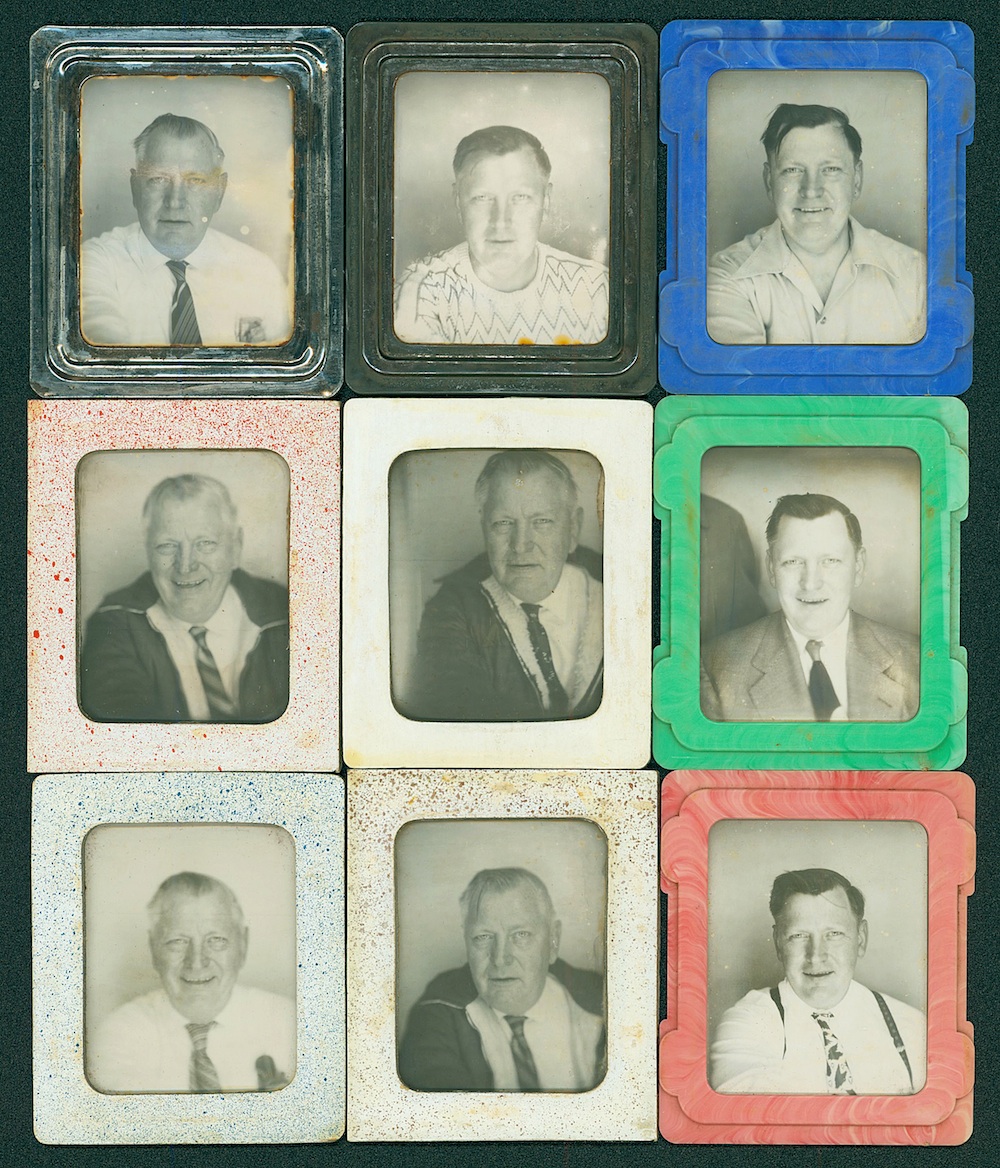
Lots of people this week have been calling my attention to the photobooth self-portraits shown above. They're nine images out of a collection of 445, apparently taken over the course of several decades, all showing the same man. The 445 images are currently being exhibited as part of a new art show about portraiture at Rutgers University.

I'm sure the whole exhibit is worthwhile — I hope to see it at some point this spring — but it's the photobooth images that are currently garnering the most attention. Writing at Slate, the history blogger Rebecca Onion did a good job of capturing their appeal:

The images are undated and unsorted, but you can make a mental game out of guessing how they might be organized chronologically. The man’s hair grows silver; his face gets craggy. In some frames, he smiles broadly — the grin of a kind uncle or grandfather.

The 445 photobooth shots are owned by historian Donald Lokuta, who purchased them from an antiques dealer in 2012. Lokuta has tried — so far unsuccessfully — to determine the subject's identity and why he took and saved so many photos of himself. Were the photos part of an art project? A neurotic obsession? Simple narcissism? It's a good PermaRec-ish puzzle, at least for now. Given the publicity the photos are currently receiving, I have a feeling this mystery will be solved fairly soon. (You can read more about the how Lokuta came to acquire the photos here.)

As an aside, the first person to tell me about the photobooth shots was longtime PermaRec supporter Kirsten Hively, who has a new blog about portraiture and self-portraiture, called Reflectology. She plans to use it as, among other things, a forum for portraits of herself (like many of us, she doesn't like how she looks in photos, so she's hoping all the portraits will help her come to terms with that). So far she's posted a self-silhouette and an x-ray. Not sure if she's planning to make it all the way to 445 or if she'll be content with a smaller number. Either way, it's a good start.

Tuesday, April 1, 2014

ghost.png
Click to enlarge

Permanent Record is all about uncovering the stories lurking within found objects. It's a determinedly fact-based approach, employing archival research to determine what really happened.

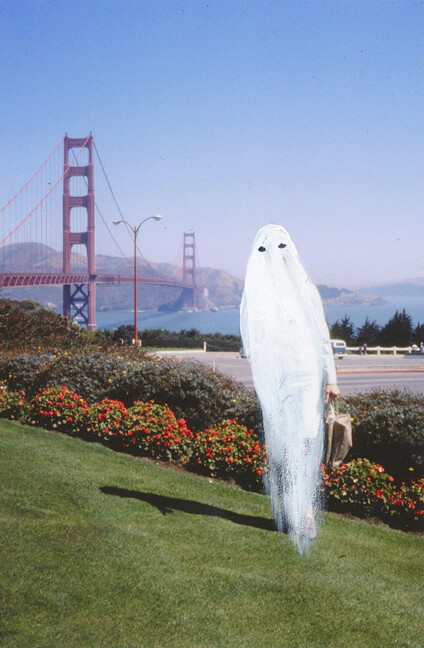
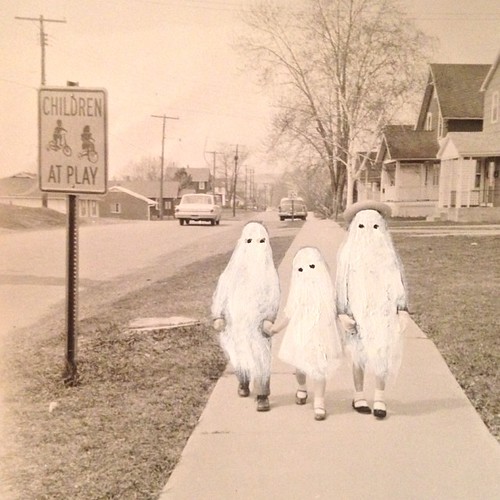
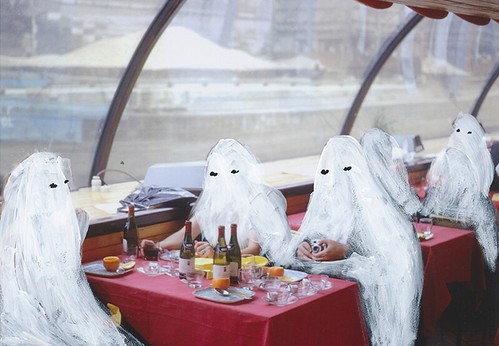
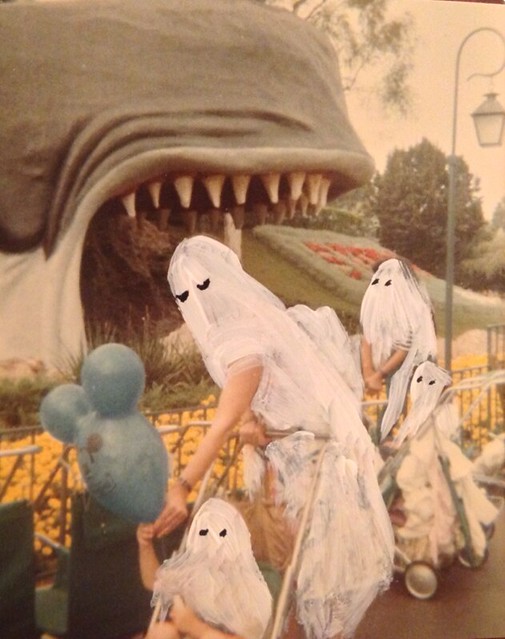
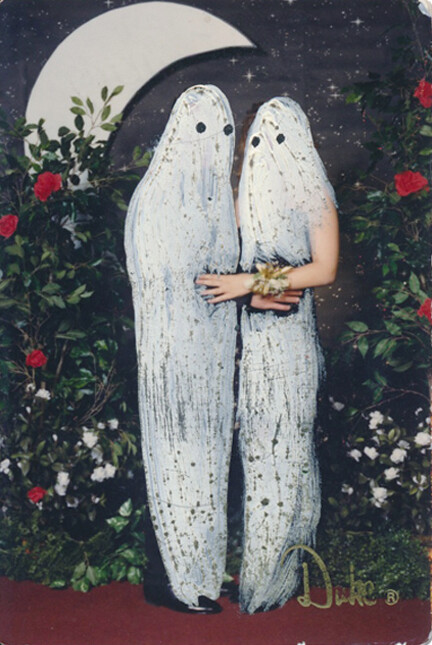
But found objects also provide lots of opportunities to spin fantasies about what might have been, or to project ourselves into other people's stories, or just to mess around with our perceptions of reality. That's the approach taken by the Florida-based artist Angela Deane, who has a very interesting specialty: She procures old snapshots and paints over most of the people in those photos, transforming them into ghosts. The resulting images, which she calls ghost photographs, can be seen on her Tumblr site (from which all the images in this PermaRec entry were taken).

Deane's response to found objects is obviously very different from mine, which is precisely why I find her project so interesting. It would never even occur to me to modify or alter an artifact like she does. But hey, that's why she's an artist and I'm a journalist, right?

In any case, Deane and I both find inspiration in found objects, so I wanted to learn more about her project. She recently agreed to answer a bunch of my questions via email:

Permanent Record: When and how did you decide to start this project? What was the impetus?

Angela Deane: I started it by a happy accident, really. In the fall of 2012 I had an artist residency in New Mexico. I had bought a bunch of photographs on eBay and at thrift stores, which I planned to use to create collages. When I spread out the photos in my studio, I started wondering what would it be like/mean/look like to paint a ghost over a photograph, to erase the particular of an identity or the ownership of an experience. And so I launched in.

Hours later I sat back and stared down at about 40 or so "ghosted" pictures and was blown away. I knew I was on to something.

ghost3

PR: Roughly how many ghost photos have you made? Have you posted all of them on your Tumblr site? If not, how many more have you done besides the ones on the site, and how do you decide which ones go on the site and which ones don't?

AD: I'm on about number 325. Only a handful are on the Tumblr site. Being fairly new to it, I'm taking my time and picking and choosing mostly on whim. Recently I've been sourcing photos based on themes (embraces, birthday parties, parades), so they may post in waves of these moods for some time to come.

PR: Where do you get the found photos? Like, do you hunt for them at flea markets? Did you already have a big stash of them when you started this project?

AD: My initial stash was probably about 100, sourced mostly from eBay and from some from thrift stores in Miami and other places in Florida. In New Mexico I met this guy who had a whole garage full of photos — he even had a deal with all the local thrift stores to give him any of the photos they received first — so I struck a deal with him and got to go through a lot of boxes out there. Got some great ones. I'm back south for the spring and summer, so I'll definitely be hitting up some flea markets! I'll be looking for some good vacation photos, I think.

ghost2

PR: How do you decide if a photo is "good enough" or "right" for being painted? Is there a particular type of scene (or feel, or whatever) that you look for?

AD: Mmmm, it remains much of a mystery why I choose the ones I do. In general I'd say I look more for color photos (black and whites make it a little more morbid; more about death, which isn't really how I think of them). I like snapshots. In essence they're just these little moments, generally when people are feeling good, are engaged with one another or with nature. I like those moments where you can feel a pulse in the inattention of what's taking place. Does that make sense?

PR: Why ghosts?

AD: There's a line from a Band of Horses song that goes, "We are the ever-living ghost of what once was." I think of these ghosts not as of people that have passed but each and every one of own experiences that has passed. How to hold memories has always been something that has provoked me to create lots of my art in life. Can we retain them as experiences or do they just turn into anecdotes?

These are intended as ghosts of moments. And in painting away the specificity of the people experiencing them, I like to think it opens things up for any of us to place or project ourselves into that space. They could be our memories now. Of course, that is what a life ends up to be — a collection of moments, experiences, memory — so ultimately I suppose it does grapple with mortality. But I don't think of them morbidly.

And I notice that the ghost photos make most people smile or laugh, which is great. I think the choice of the snapshots contributes to this. A writer on Flavorwire the other day described them as "ghosts having fun" and then did a riff on the whole celebrity mag thing and said, "Ghosts: They're just like us!" I loved it.

ghost4

PR: What paint (or white-out, or whatever) do you use to paint the ghosts?

AD: Mostly acrylic, sometimes gouache.

PR: How long does one of the photo paintings typically take you?

AD: Most of them take only about 30 minutes or so, but lately I've been doing some with upwards of 100 or 200 ghosts in them, and I spend a few hours with those.

PR: At first I thought you turned every person in each photo into a ghost. But then I saw you sometimes leave some people un-ghosted (like the people in the background of this shot). Is there a rule or system you use when deciding who gets ghosted and who doesn't?

AD: Not really; just a gut feeling. Sometimes I imagine myself as the un-ghosted people, looking on at the "ghosts" and "spaces to project other people in" and want to keep them intact so they can be more concrete witnesses to something magical happening. It gives a different focus to the ghosted characters. And once in awhile it's just as simple as finding their face simpatico, or liking their stance, and therefore wanting to leave them intact.

ghost6

PR: Do people send found photos to you to paint, either for commissions or just as a "I thought you'd like to have this" kind of thing?

AD: Yeah, I have a few commissions under my belt. I love doing them. This past December I had a show with F.L.A. Gallery and was put in touch with Amy Sedaris, who is crazy for ghosts and commissioned me to paint a bunch of family photos to gift to her siblings. Very cool!

PR: Have you had any other ghost photo gallery shows besides that one?

AD: Yeah, I've had a couple. The last was in Los Angeles at a friend's spot called "Matters of Space" in Highland Park. It was well-received and has brought me a couple projects in the works, which I can't get into yet but are very exciting. The F.L.A. Gallery show was also terrific and was so beneficial, as it was the first time I'd seen so many of the photos framed in a group rather than just in my studio.

PR: Have you ever tried to find any of the people in any of these photos, and/or has anyone ever told you, "Hey, I recognize that photo"?

AD: Only once, out in New Mexico! And actually I never painted over that photo because it's so great — an older man out in his front lawn, standing proud. Sometimes there are names written on the back of the photos, but I've never thought to Google anyone. Maybe I should..? Hope they'd be cool with being turned into spirits.

I also haven't done any personal photos of my own yet. But may do a few soon. Some goofy ones from junior high or something, maybe my softball team portrait.

PR: How long do you think this project will keep going?

AD: I keep getting nervous that I'm not "over" it yet. But I gotta tell you, my curiosity remains piqued with each one that I make. And they're just beginning to get out into the world to such a nice reception, which makes me feel okay for wanting to paint maybe 3,000 of these guys. These last few years I've been bouncing around cities (Miami, New York, Seattle, Gainesville), so the fact that these are so portable — very different from my larger-scale paintings — is pretty addictive.

PR: Any other thoughts about found objects?

AD: Just that I love them. Much of my décor is second-hand. I love the hunt of it, I love the slow meandering and contemplation of the hunt — it's never speedy. Stories that are embedded yet unknown, endless mystery in objects and a reminder that time just continues on.

ghost5

My thanks to Angela for answering all my questions. I was particularly struck by this passage from one of her responses: "How to hold memories has always been something that has provoked me to create lots of my art in life. Can we retain them as experiences or do they just turn into anecdotes?"

I totally relate to this notion of experience morphing into anecdotes. You start by experiencing something, and then proceed to remembering that experience. But if it's a memory that you tell or explain to others, sometimes the memory gets superceded by the telling and retelling of the memory, until you no longer remember the original experience — you just remember how you've told the story, like a script that you've internalized. Or at least that's what I've often found to be the case. Even the experience that gave birth to the Permanent Record project — the night I found the old Manhattan Trade School report cards at my friend Gina's birthday party in 1996 — falls into this category. I don't really remember much about that night anymore; what I remember is the countless times I've told the story about that night. That troubles me a bit, because it feels like the original experience has gotten lost along the way.

For those who want to see and hear more about Angela's work, here's a good video interview with her, which was produced in conjunction with one of her recent gallery shows:

(Extra-special thanks to Heather McCabe for bringing Angela's Tumblr site to my attention.)

Monday, March 31, 2014

In 2007, a 26-year-old Chicagoan named John Maloof was working on a book about Chicago history. Maloof lived across the street from an auction house that was selling a stash of several thousand old negatives shot by a Chicago photographer several decades earlier. The auction house had acquired the negatives from a storage locker after the photographer had let the locker's account go delinquent. Maloof thought the negatives might be helpful for his book project, so he bought them for $380.

When Maloof looked at the negatives, he was quickly struck by how evocative they were. The photographer — a total unknown named Vivian Maier, who died shortly after Maloof acquired the negatives — clearly had a special feel for street photography. Her senses of framing, composition, portraiture, storytelling, pathos, and wit were all superb. But Maloof couldn't find any information about her. It appeared that none of her work, including the photos Maloof had acquired, had ever been exhibited or published. The more Maloof looked at the photos, the more convinced he became that he'd stumbled upon the work of a major overlooked artist. His hunch became even stronger when he scanned some of the negatives and posted them on Flickr, where they immediately generated lots of very positive response. (That's one of Maier's photos shown above, and the other photos scattered throughout this entry are hers as well.)

Thus began John Maloof's trip down a deep, deep rabbit hole that continues to this day. He has essentially become the chief custodian and cheerleader of Vivian Maier's legacy. Or, to put it another way, he's devoted his life to hers. Along the way he learned that Maier spent most of her adult life employed as a nanny, so he interviewed many of the families that hired her, including some of the now-grown children she looked after. He also visited her family's ancestral village in France. And he sought out and acquired thousands and thousands of additional Maier negatives (many of them salvaged from another storage locker she left behind), along with hundreds of rolls of film that she shot but never got around to developing (ditto). In short, Maloof is trying to be as encyclopedic about Vivian Maier as he can be. But there are still many pieces of the puzzle that he hasn't yet been able to put together, because Maier was intensely secretive and seriously eccentric. Among other things, she appears to have had a hoarding disorder. (Storage lockers and hoarding — this story reads like a reality TV treatment.)

This odd backstory has probably helped Maloof's efforts to promote Maier's work, because it adds an element of intrigue. In any case, the art world has embraced Maier's photography, which is now compared to the works of Diane Arbus, Robert Frank, and other great American populist photographers. Maloof has successfully shepherded her photos into an assortment of gallery shows, book projects, and more. Prints of her work, sold by a New York gallery that has partnered with Maloof, now sell for prices starting at about $1800.

And now there's new documentary film called Finding Vivian Maier. I saw it last Saturday and was blown away. It's a great story, superbly told. If you're into found objects and PermaRec-ish stories, it's absolutely essential viewing — don't miss. (As a bonus, Maloof, who co-directed the film, was on hand at the screening I attended, so I got to hear some of his commentary and participate in a short Q&A session he conducted.) Here, take a couple of minutes to check out the trailer:

Some of you may be thinking, "This Maloof guy is just profiting off of this dead woman's work. That's exploitation!" That's an understandable gut reaction, but I don't think it's accurate. While I could be wrong, I don't get the impression that Maloof is getting rich off of any of this (he needed a Kickstarter campaign to help finance the documentary), especially since a lot of the money that comes in from sales of Maier's prints is getting rolled back into the project's overhead (Maloof still has thousands of negatives to scan and hundreds of rolls of film to develop). I do think he's making a living off of all this, and good for him — that's a fair trade for the time and energy he's invested. It's pretty clear to me that he cares deeply about Maier and her work, and that he's made some pretty serious sacrifices to devote himself to this project. He didn't go looking to acquire something valuable. But once he realized what he had, he felt (and still feels) a strong responsibility to bring it to light and share it with the world. By his own account, he's also fairly obsessive, so it's his nature to keep following the rabbit hole, wherever it leads.

I relate to all of this. When I found the Manhattan Trade School report cards in that discarded file cabinet years ago, I knew had to do something with them — that was the responsibility I took on when I grabbed the cards. Frankly, given how important I think the report cards are, part of me feels a little ashamed for not having made them a full-time pursuit, the way Maloof has done with Maier's photography. I respect and admire how far he's taken this project.

Anyway: If you want to know more about Maier and her photography, look here. Meanwhile, Finding Vivian Maier is tremendous. See it!

Thursday, March 27, 2014

IMG_3513

Researcher extraordinaire Bill Maselunas has once again tracked down the details on a photo I.D. badge employee. This time it's Fred H. Talbot, whose badge is shown above. (If you're new to the photo I.D. badge scene, you can see how I first became fascinated by the badges here, and you can see the results of Bill's two previous badge research efforts here and here.)

Here's what Bill managed to find regarding Fred Talbot:

This guy proved to be somewhat enigmatic in his adult life. Also, the research was complicated by the fact that Googling for "Fred Talbot" yields a lot of hits for the Major League Baseball pitcher of the same name and a British weatherman who was recently rung up on some unfortunate charges. Finding our Fred Talbot means eliminating a lot of results for these two guys, which can be tiresome.

I've patched together bits and pieces from a bunch of sources, including user-created family trees from Ancestry.com, which are hit-and-miss in the accuracy department. So, lacking other rock-solid sources, I took people at their word and made a couple of guesses based on hunches below, which seem to be correct, but it's hard to be sure. Here we go:

• Born Fred (or Frederick) Parker, March 31, 1912, to John P. Parker and Maria Hortensia "Hortense" Quesada (1893-1994), also known as Maria Hortensia Quesada Aguirre Velton. Her secondary name, taken when her mother remarried, turned out to be a clue in finding Fred's place of birth (see next point).

• Fred's place of birth on census records is always listed as California. In California birth records on Ancestry, there's an entry for March 31, 1912, in Orange County under "Jno. P. Parker," with the mother's name listed as "Felton." It's not uncommon for the father to be listed in birth records of that era, and the misspelling of his mother's name would seem to be an easy one to make. That was hunch No. 1.

• Hortense married Clyde Edwin Talbot (1895-1992) on Sept. 12, 1917, in Ray, Arizona.

• Fred's middle name and initial are listed inconsistently, depending on the source. Sometimes he is "Fred E." and sometimes "Fred H." The 1945 Tacoma City Directory lists his occupation twice, once as "artist" and once as "draftsman TPS." I suspect "TPS" was for "Todd Pacific Shipyards," as shown on his badge. That was hunch No. 2.

• Sibling Lorraine H. (Parker) Talbot was born about 1915 in Ray, Arizona, and June 1978 in Washington. Unknown if she was married or had children.

• Half-sibling Clydelle Rae Talbot was born on Aug 16, 1918. in Ray, Arizona, and died on Nov. 27, 1989, in Tacoma, Washington. Married Hugo Smith (1914-2000) on May 10, 1938, in Port Orchard, Washington. Three children: Sharon Rae Smith, William T. Smith, James J. Smith.

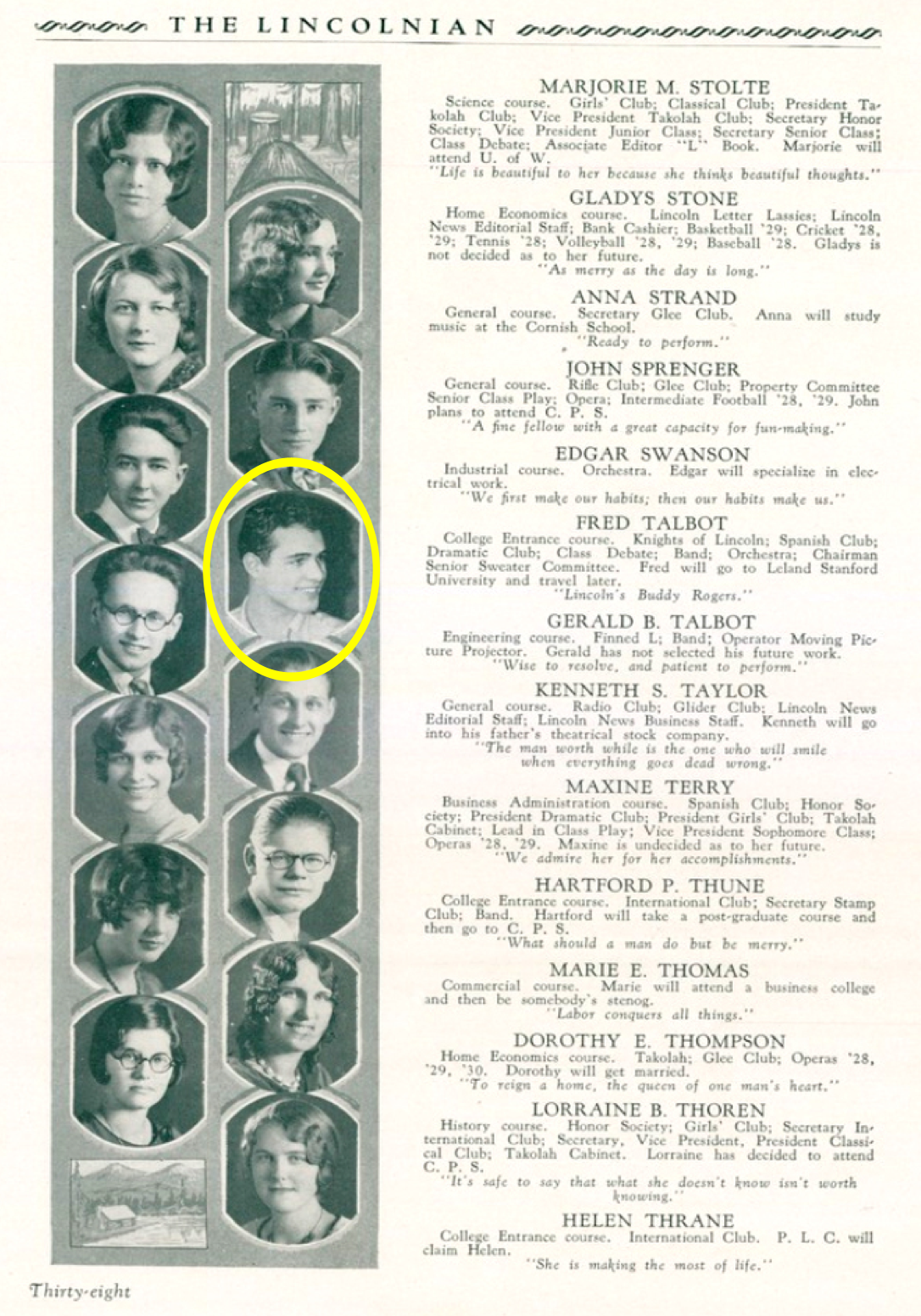
• Fred attended Tacoma Lincoln High School, class of 1930, as seen in this yearbook page [click to enlarge]:

yearbook.png

• His yearbook entry said he was planning to attend "Leland Stanford" University, but a search of the 1934 Stanford yearbook shows no Fred Talbot. Did he not actually go? Did he go but not graduate?

• His yearbook entry hints at his artistic side, calling him "Lincoln's Buddy Rogers." This is backed up by a clipping from The Tacoma Times that describes his furniture making and designing of theater sets:

• Unknown if he ever married or had children. Searches have turned up no obituary, though I have a request in with the Tacoma Pierce Genealogical Society to see if they can find one. Stay tuned.

• Died July 14, 1994 in Seattle. Burial unknown.

• I identified one living relative: Sharon R. Housiaux, a niece, in Puyallup, Washington. I attempted to contact her by U.S. mail but never heard back.

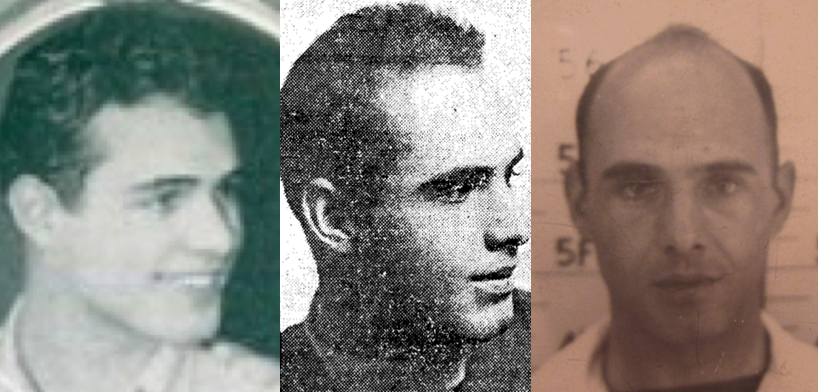
Great work again, Bill. I like how we can see the progression of Fred's facial development from yearbook to newspaper article to employee badge (click to enlarge):

threesome.png

But dang -- yet another badge employee for whom we can't find a living relative. Maybe next time.

Monday, March 24, 2014

Another day, another story about a lost class ring. This latest one, shown above, belonged to a Virginia high school student named Shannon O'Donnell, who lost it while riding an amusement park ride in 1999. It was recently found by man named James Lawrence, who returned it to Shannon's high school.

Although Shannon's name was etched into the ring's inner band, the school's staff no longer had contact info for Shannon. So they put a photo of the ring on the Facebook page for the school's alumni, which set the wheels in motion for Shannon to reclaim her ring. You can read further details in this article.

(My thanks to Beverley Brookes for letting me know about this story.)

Saturday, March 22, 2014

alyce stephenson.png

About a week ago I posted about how reader Bill Maselunas had tracked down the history of the person shown in one of the photo I.D. badges I've recently been obsessing over. He's now done the same for the badge you see above. (If you missed the entry in which I introduced the topic of employee photo badges and want to get caught up on that, look here.)

Bill did all the heavy lifting here, so I'll turn this over to him:

I'm fairly certain the person shown on this badge is Alyce Katheryne Stephenson of West Chester, Ohio. The unusual spelling of Alyce's name made the research somewhat easier than it might otherwise have been (although in some places it was recorded as "Alice"). Here's what I discovered about her:

• She was born Alyce Katheryne Stephenson on Jan. 10, 1910, in Butler County, Ohio, to Samuel James (1883-1956) and Anna Katheryne (Dietiker) Stephenson (1890-1948).

• Sibling Samuel Wilbur "Bud" Stephenson was born on Sept. 30, 1914, West Chester, Ohio; died on June 26, 1935, in West Chester, Ohio; buried in West Chester, Ohio. Appears to have died tragically from an accidental, self-inflicted gunshot wound on his farm. Never married.

• Alice resided in Butler County, Ohio, for most of her life and lived in Sharonville (the location of the facility that issued her employee badge) at the time of her mother's death in 1948.

• She attended Miami University of Ohio, Class of 1931. She's shown at the bottom-left corner of this page from the school's 1931 yearbook [click to enlarge]:

yearbook.png

As you can see, that yearbook page used an unusual variant of the spelling of her first name. But the spelling shown on her employee badge was used on this next page, where she's listed as a member of a campus women's organization. She may also be among the students shown in the group photo at the bottom of the page [click to enlarge]:
yearbook2.png

Although her employee badge was issued by the Sharonville Engineer Depot, her primary career appears to have been as a teacher and educator. She was teaching at Princeton High School in Cincinnati in 1960, and her Ohio Death Record lists her occupation as an elementary school teacher. She is cited as a contributor in this course guide.

• She died on July 21, 1996, in Mongomery, Ohio, apparently without having married or having had children. No survivors were listed in her obituary:

• Her father, Samuel, worked for various railroads, which may explain Alyce's apparently temporary employment at the Sharonville Engineer Depot, a major railroad and industrial center. It's a little hard to figure out when she worked there and why. Was it during her college summers? Part of the war effort? Given that she worked in academia all her life, it's a bit baffling to me that she would have worked there at all.

Speaking of the Sharonville Engineer Depot, it was built in 1942 by the U.S. Army Corps of Engineers to stockpile strategic metals (magnesium, titanium, zinc, etc.). The site was occupied from 1942 to 1949 by the Air Force. Of the original 603 acres, approximately 50 comprise the current Sharonville Engineer Depot, now occupied by the Defense Logistics Agency, which operates a facility known as the Sharonville Depot Defense National Stockpile Zone. The site was investigated by the EPA in the 1980s and 1990s for contaminated soil and water, but no remedial actions were taken. Some further information about the facility is available in this discussion board thread.

Research thanks to Samantha Loopstra from Ohio's amazing "Know It Now" program, available at Ohio public libraries, and to Jennifer Rusche, Reference Librarian at the Public Library of Cincinnati & Hamilton County.

Another great research job. The only downer is that Alyce doesn't appear to have any descendants we can contact. The same was true of Martha L. Cannaday, the previous badge employee Bill had researched. I'm hoping we'll eventually be able to track down a living relative of one of the badge subjects. And with that in mind, I'm happy to report that Bill is already working on another badge history — stay tuned.

Wednesday, March 19, 2014

Last summer, in the space of a month, I ran three separate items about messages in bottles (look here, here, and here). Now, as you can see above, we have another one. This one was recently discovered on Martha's Vineyard, where a man named Keith Moreis found it.

This one is a drift bottle — a tool used by scientists to help track the ocean's currents. People who found the bottles and followed the pink card's "Break This" instructions would find the following documents inside:

The kicker is that this may have been the very last drift bottle ever cast into the sea by the United States government. Get the full story on that here.

+ + + + +

The letter and money order you see above, both of which are nearly 100 years old, were found amidst a pile of mail that a Canadian man named Larry McLean recently discovered under his front porch. McLean had lived in his house for 35 years without realizing the treasures were hiding right under his nose. He found the mail when pulling out his porch during some home renovations. The letters were addressed to a family that had lived in McLean's house a century ago.

Many of the letters were sent to or from a family member who had enlisted and been sent to Europe during World War I. Get the full story here.

+ + + + +

The letter shown above, which carries a 1945 postmark, was recently found by a Dallas woman named Shelia Polk, who discovered it inside an old book she had purchased at Goodwill. She initially refused to open it, because the letter was "personal." But after ascertaining that both the sender and recipient were deceased — and after consulting the U.S. Postal Service, which gave the go-ahead -— she opened the envelope and found a love letter from one military member to another. Unfortunately, it appears that the couple in question never formed a lasting bond.

(My thanks to James Poisso and Jim Borwick for alerting me to these stories.)

Sunday, March 16, 2014

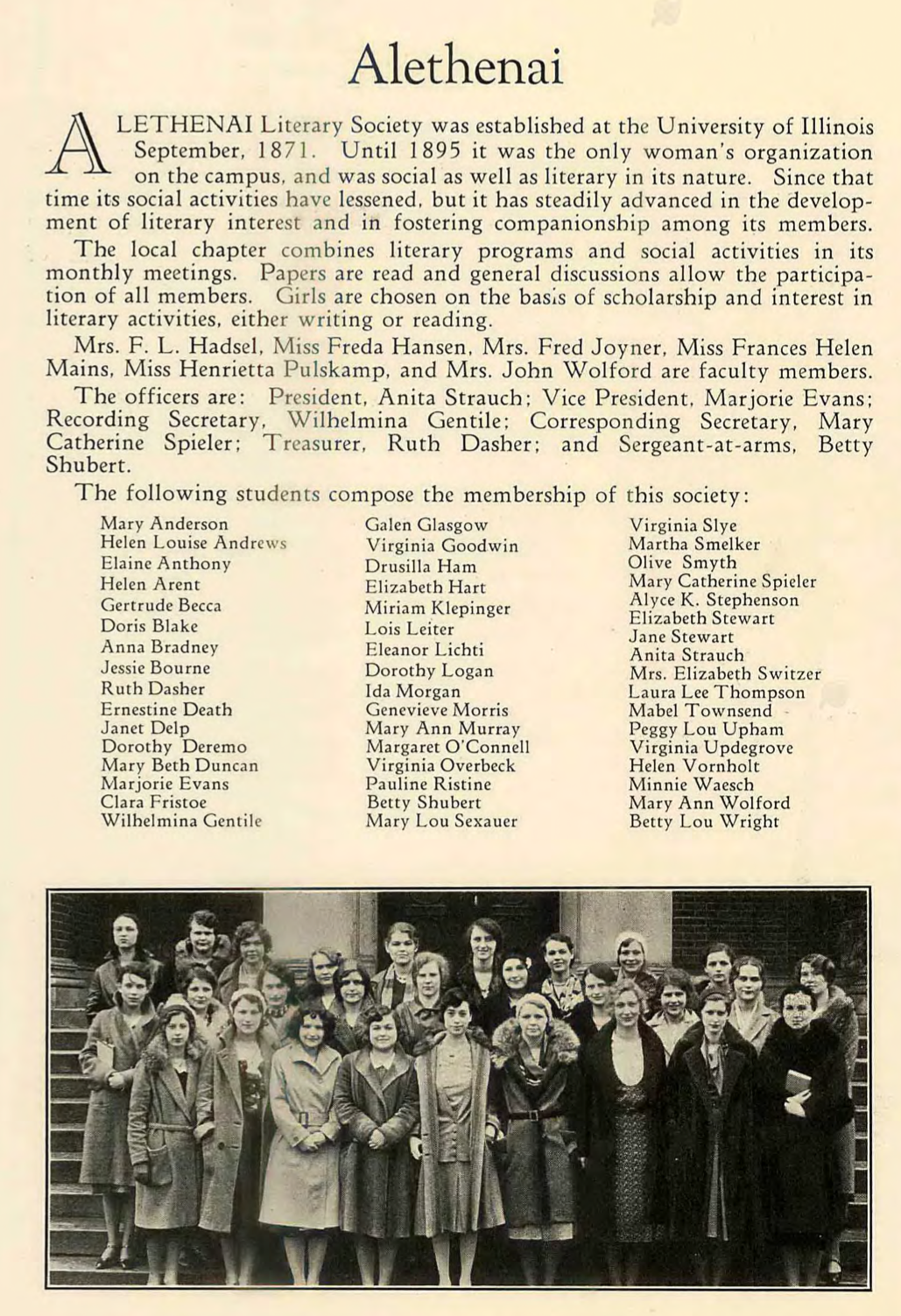
12729206324_48f57e48aa_h_clipped_rev_1.png
Click to enlarge

I recently posted an entry about my newfound interest fascination obsession with old photo employee I.D. badges. At the end of that entry, I invited PermaRec readers to contact me if they wanted to try to suss out the stories behind any of the badges. Reader Bill Maselunas promptly volunteered to work on the one shown above, for a Wichita school matron named Martha L. Cannaday. Her badge is among the 250 that were recently exhibited at the Ricco Maresca Gallery in New York.

Before we get to Bill's findings, I should mention that Martha's badge was one of my favorites from the gallery show, and I wasn't alone in that regard — several PermaRec readers mentioned it as one of their favorites when I first wrote about the badges earlier this month. At the risk of being disrespectful to Martha, it seems pretty obvious that a big part of her badge's power is the pathos in her portrait and the way her job title — "Matron" — mirrors her matronly appearance. The discomfort I felt when writing that sentence (which you may also be feeling now that you've read it) is the karmic payback that comes with examining artifacts like the badges: We get a little voyeuristic thrill from these glimpses into other people's lives, but we also feel a bit of shame for violating their privacy and making superficial and sometimes condescending judgments about them.

So I was happy when Bill chose Martha's badge as his volunteer research project, because I wanted to be able to know more about her as a human being, not just as a mug shot on a badge. Here's Bill's report on what he found:

This has been a bit of a challenge, because Kansas has not made a lot of its public records and vital statistics available online. But Martha Cannaday is mentioned by name in this Find A Grave entry. That led me to lots of additional information, which allowed me to piece together the following:

• She was born Martha L. Tomlinson, April 27, 1919, in Kansas, to David Tomlinson Jr. and Mildred Chadbourne Tomlinson.

• Sibling Myrna M. Tomlinson was born March 22 1909, in Kansas. A nurse and a lifelong bachelorette. Died Oct. 1, 1985, and buried in Garfield Cemetery, Garfield, Kansas.

• Sibling Betty Jean Tomlinson was born June 10, 1924, in Garfield, Kansas. Died March 1, 2005, and buried in Garfield Cemetery, Garfield, Kansas. Was married to William Roy Kitchens (1923-1984). No kids that I have been able to find.

• My guess as to the date of her Wichita Public Schools badge is in the 1940s or ’50s. I've reached out to both the Wichita Public Schools and the local school museum, but no luck in tracking down any record of her employment. Her role as "matron" would basically have been that of a head nurse, which makes sense, given that her sister was also a nurse. I've checked the Wichita high school yearbooks that are available online, but again no luck.

• She died on April 19, 2007, in Kansas — likely Wichita. Garfield cemetery sexton Ray Wetzel believes he recalls a simple ceremony, attended by a single relative, with no obituary and no headstone placed. His recollection is that there was talk of buying one, but it never materialized.

• Her last known address was 5111 Funston St. in Wichita, an address shared by her sister Betty Jean, which leads me to believe they may have lived together after the deaths of their husbands.

• Martha and her sister Betty Jean both lived in Colorado at one point, perhaps in the Pueblo area. Their Social Security numbers were both issued there.

• The identity of Martha's husband is a mystery so far. Part of the problem is the inconsistent spelling of the surname. Depending on where one looks, it might be Cannaday (as shown on the badge), Canaday, Cannady, Canady, and others. This makes it somewhat challenging to say with any certainty which Cannaday is which. There are numerous male "Cannadays" of about the right age in Kansas in 1940, when Martha was still unmarried, but none in the immediate vicinity of Garfield, where the Tomlinsons (her family) lived.

• No children yet identified.

This pretty much exhausts the online resources. I have a request in at the Wichita Public Library to scan some old phone books and other records, but that could take some time.

Wow — no headstone, few if any descendants, one sister a spinster and the other a childless widow who became her roommate. If anything, this just adds to the pathos. But we still don't know about Martha's husband or marriage, and I'm hoping those provided some joy in her life.

Huge thanks to Bill Maselunas for his excellent research work (and Bill in turn wants to thank Ed Carlson, the curator of the findagrave.com pages for the Tomlinsons, and Ray Wetzel, the sexton at the Garfield Cemetery, for their assistance). Meanwhile, if anyone from Wichita can help us fill in some of the blanks regarding Martha and her family, please get in touch. Thanks.

Monday, March 10, 2014

IMG_6131
Click to enlarge

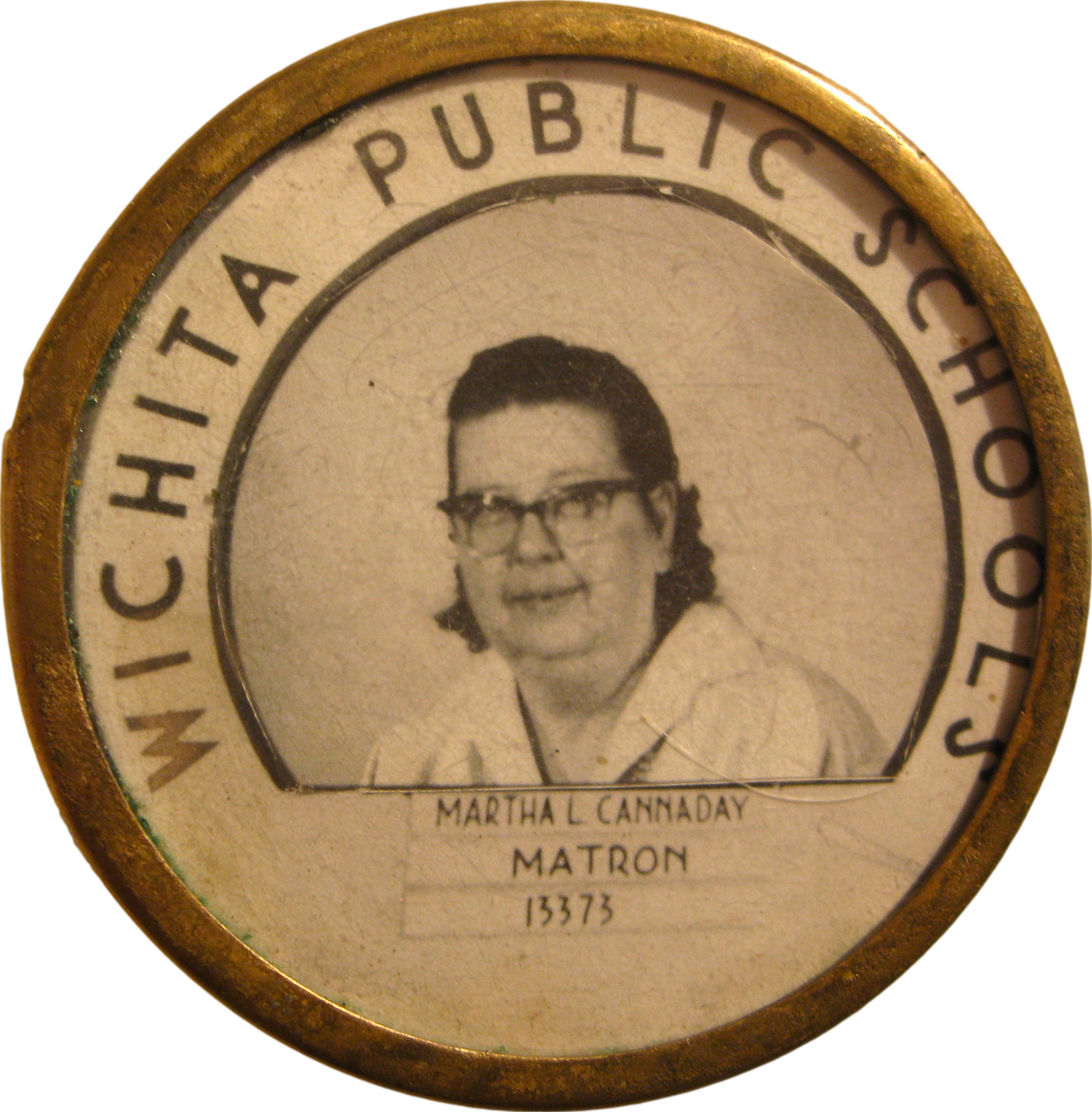
Yesterday we took a look at Rose Simone's Manhattan Trade School autograph book and then examined the report card of one of the students who had signed that book, Jennie Grillo. Today we're going to look at the student file of another student who signed Rose's autograph book, Pasqualina Guccione. Her note in Rose's book is shown above.

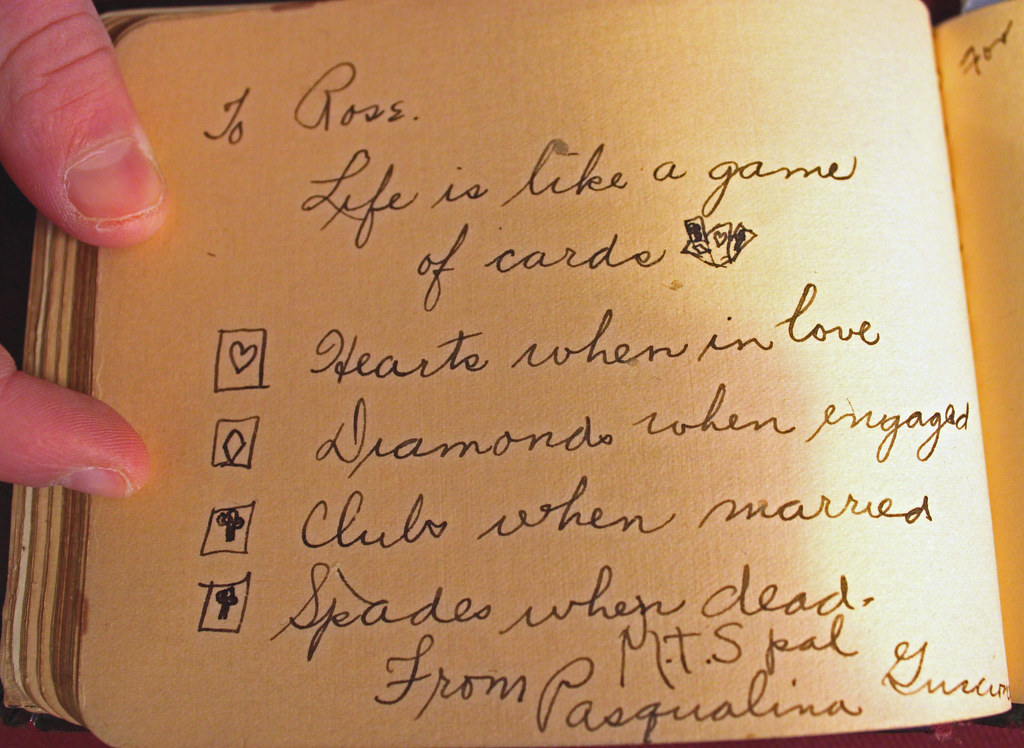
Pasqualina Guccione's student record is part of my collection. Unfortunately, her report card, like Jennie Grillo's, does not include a photograph, so we don't know what she looked like. But her story appears to have been an interesting one. Let's start with her main card (for all the images in today's entry, you can click to enlarge):

1

There are a few points of interest here. First, Pasqualina apparently preferred to be called Patricia. But she used Pasqualina when signing Rose's book, so I think I'll continue to refer to her as Pasqualina. Second, Pasqualina lived with her grandfather, Saverio Rozzo, not with her parents. Were they deceased?

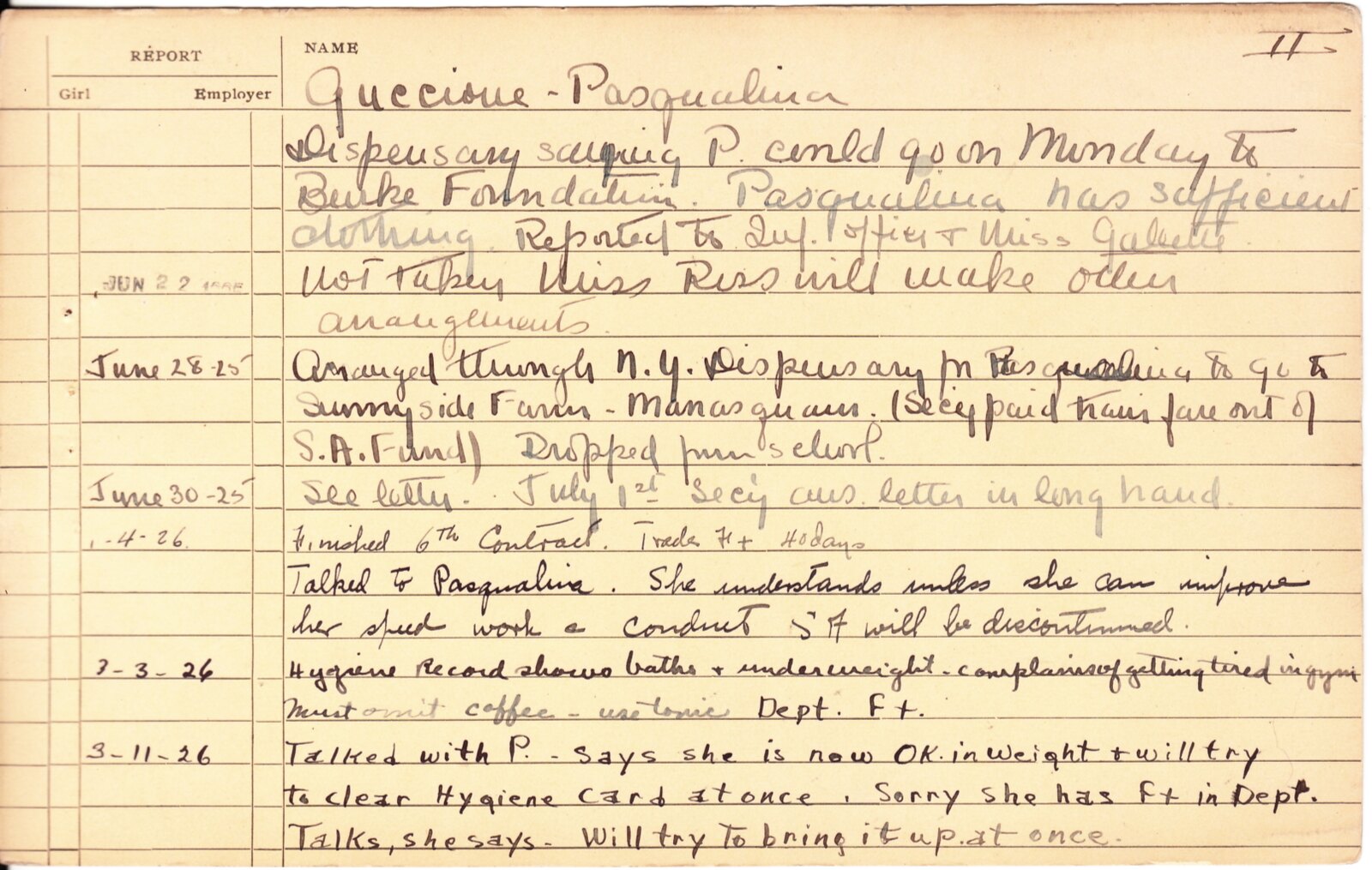
But the most interesting thing about this card is the indication, toward the bottom, that Pasqualina received financial assistance from the school — "Lunches & carfare (50¢)." Student aid, based on hardship or need, was available to all Manhattan Trade School students but was usually granted only if the student's family was going to pull her out of school so she could work to help support the household. This apparently didn't come up very often, because very few of the report cards in my collection have any notations relating to the aid program. Because financial aid was granted to Pasqualina, however, her student record includes a series of forms and entries not found in most of the other students' files, beginning with this card from the school's financial aid office:

2

From this card we can see that Pasqualina's parents were indeed deceased (as indicated by the "dec." notations in the "Occupation" column). She lived not just with her grandfather but with both of her grandparents, along with an older sister who was working as a stenographer. She was referred for student aid by one of her teachers, Miss Meaghre. The card also indicates that Pasqualina was born in Italy, which makes her something of a rarity among the Manhattan Trade students I've investigated, most of whom were born in New York to immigrant parents. At the bottom-right corner of this card are the initials of an "Investigator" — M.A.U. This was apparently the financial aid case worker who was assigned to Pasqualina after she was referred to the aid office by her teacher. I'm fairly certain that that it was M.A.U. who wrote the fascinating entries that appear on the following cards:

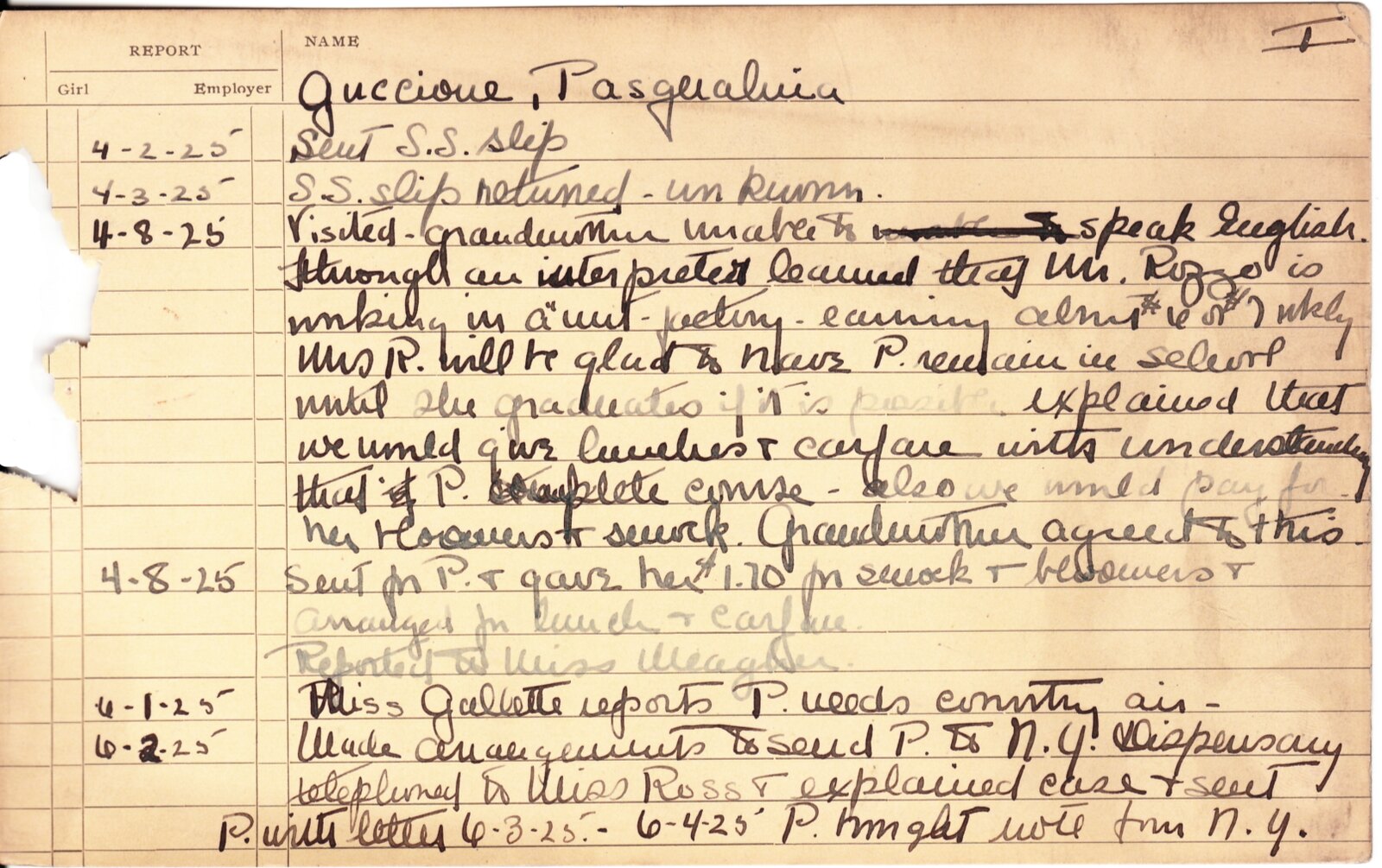
4 5 6

Cards like these do not appear in most of the student files in my collection. They only appear in Pasqualina's because she received financial aid. The handwriting is a little hard to make out, so here's a transcription (for the sake of clarity, I've spelled out a few terms that were abbreviated and added a few annotations):

April 2, 1925: Sent S.S. slip.

April 3, 1925: S.S. slip returned — unknown. [I don't know what this "S.S. slip" refers to. It definitely doesn't have anything to do with Social Security, which didn't yet exist in 1925. — Paul]

April 8, 1925: Visited grandmother [who was] unable to speak English. Through an interpreter learned that Mr. Rozzo [Pasqualina's grandfather] is working in a nut factory, earning about $6 or $7 weekly. Mrs. Rozzo will be glad to have Pasqualina remain in school until she graduates if it is possible. Explained that we would give lunches and carfare with understanding that Pasqualina complete course. Also, we would pay for her bloomers and smock. Grandmother agreed to this. [The bloomers and smock were likely part of either the school uniform or the togs that would be worn during gym class. Both can be seen in this amazing 1912 film about the school. — Paul)

April 8, 1925: Sent for Pasqualina and gave her $1.70 for smock and bloomers and arranged for lunch and carfare. Reported to Miss Meaghre.

June 1, 1925: Miss Gallette reports Pasqualina needs country air. [It was fairly common during this period for girls and women suffering from "exhaustion" or "a nervous condition" to be recommended for a "rest cure" outside the city. That appears to be what was happening here with Pasqualina. — Paul]

June 2, 1925: Made arrangements to send Pasqualina to N.Y. Dispensary. Telephoned to Miss Ross and explained case and sent Pasqualina with letter. [The New York Dispensary was a philanthropic medical service. Further info here. — Paul]

June 4, 1925: Pasqualina brought note from N.Y. Dispensary saying she could go on Monday [June 8] to Burke Foundation [which was another philanthropic medical facility — Paul]. Pasqualina has sufficient clothing. Reported to [illegible] and Miss Gallette.

June 22, 1925: Not taken. Miss Ross will make other arrangements.

June 28, 1925: Arranged through N.Y. Dispensary for Pasqualina to go to Sunnyside Farms, Manasquan. Secretary paid train fare out of student aid fund. Dropped from [illegible]. [Sunnyside Farms was a "respite home for convalescent girls" in Manasquan, New Jersey. You can get a sense of the accommodations from this 1951 postcard, which shows one of the bedrooms. The facility now functions as a nursing home. — Paul]

June 30, 1925: See letter.

July 1, 1925: Secretary [illegible] letter in longhand. [Unfortunately, this letter was not included in Pasqualina's student file. — Paul]

Jan. 4, 1926: Finished 6th contract. Trade F+ 40 days. [This means Pasqualina had finished her sixth unit of coursework at the school and had received a grade of F+ — a bit better than fair. — Paul] Talked to Pasqualina. She understands that unless she can improve her school work and conduct, student aid will be discontinued.

March 3, 1926: Hygiene record shows baths and underweight. Complains of getting tired in gym. Must omit coffee — use tonic. Deportment: F+.

March 11, 1926: Talked with Pasqualina. Says she is now OK in weight and will try to clear hygiene card at once. Sorry she has F+ in Deportment. Talks, she says. Will try to bring [the grade] up at once. Says grandmother very good to her. Pasqualina attends Italian evening school (Children's Aid Society), where she learns embroidery. Miss Garbarini [is her] teacher. Sister has new position with Steel Co. on Fifth Ave. Makes $21.75 weekly. ¬

May 24, 1926: Pasqualina going to farm. Bought regulation suit for her — $2.25. She thinks she can furnish everything else. [The farm is Sunnyside Farms, the same facility Pasqualina had visited the previous summer. — Paul]

June 3, 1926: Letter from Pasqualina at farm. Mrs. Lynn, of the Margaret and Sarah Switzer Foundation [the philanthropy that operated Sunnyside Farms], called to say they will take Pasqualina at Sunnyside Farms again this year if we will make out a check for board at $3 a week for two or three weeks. Then, after Pasqualina has come home, they will return check to us. They have a rule this year to take no one [for] free, but they had Pasqualina last year for several weeks [for] free and liked her so well, [so they] will be glad to have her again.

Nov. 5, 1926: Getting along well — Hygiene Good, Trade Good. Not absent or late in contracts 9 and 10.

Dec. 6, 1926: Teacher's report: Physical Training Good, Hygiene Excellent, Work Good, Attitude Good. Very willing. Has been transferred to Miss Meditz's class today.

Wow — that's quite a narrative. It really shows how the school kept close tabs on everything relating to a student who was receiving financial aid — her home life, her schooling, her health. I'm fairly certain the school was concerned about these aspects of every student who attended Manhattan Trade, but only the students receiving financial assistance had all of these details documented in so much detail.

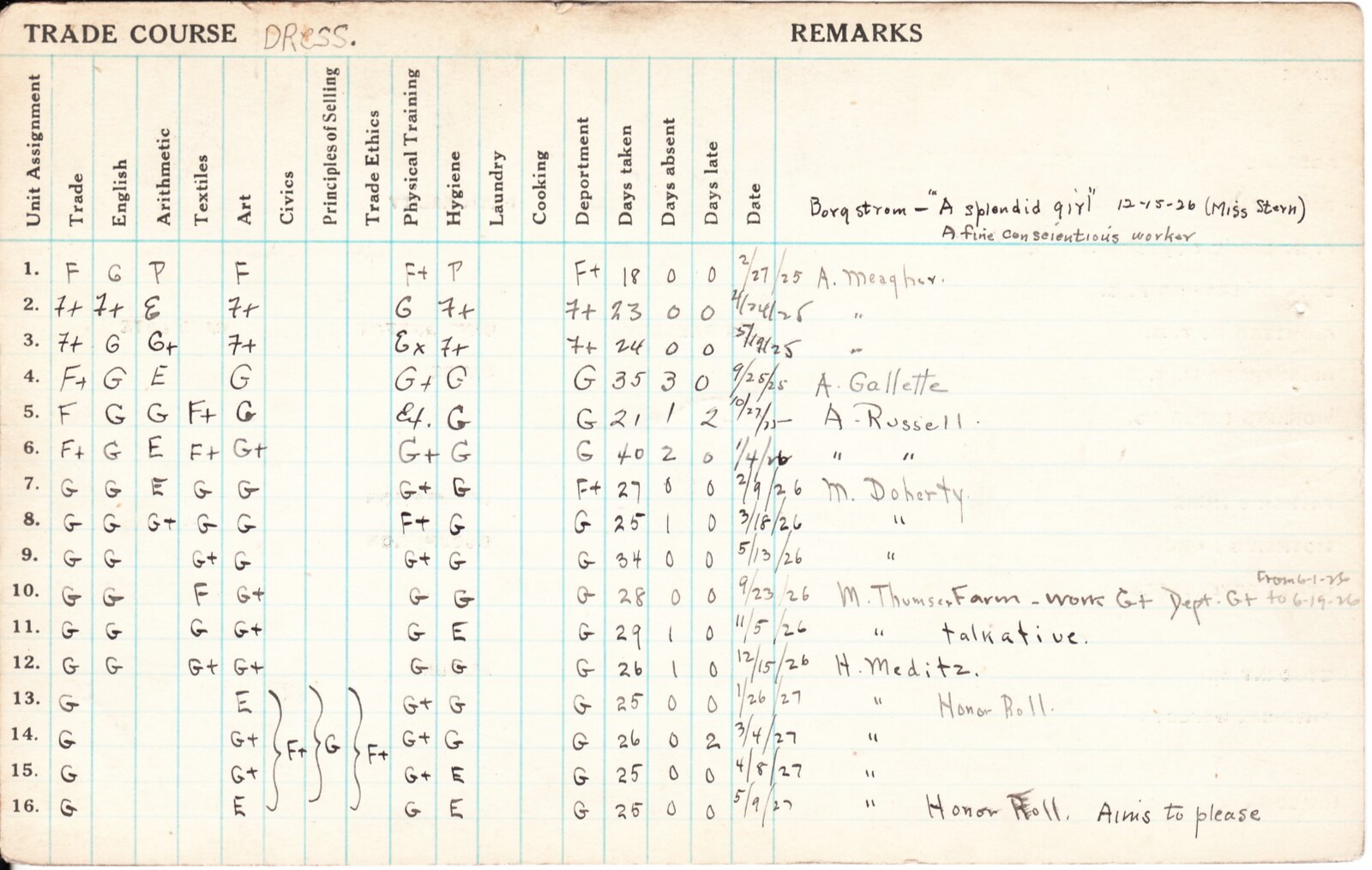
Okay, back to Pasqualina's student record. Next up are her grades (several of which were referenced in the financial aid notes) and teachers' comments:

3

As you can see, Pasqualina's grades and teacher feedback were generally good, although there's a note about her being "talkative," which matches up with that earlier note about her chatty deportment.

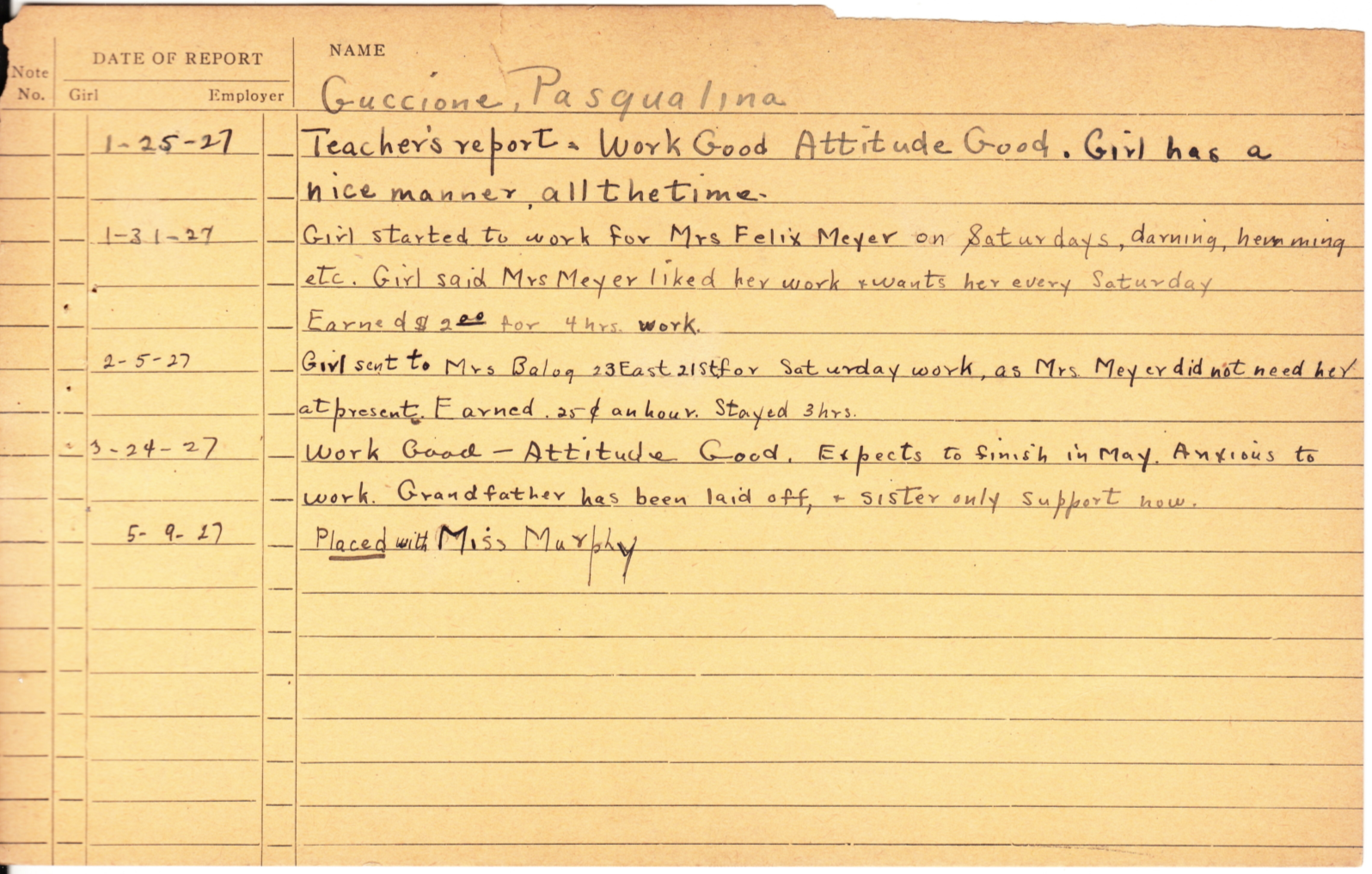
Pasqualina, like all Manhattan Trade students, had to demonstrate proficiency in her trade (dressmaking) before she could receive her diploma, so the school's job placement office arranged some work for her. Here's her work record, along with comments from her employers:

7 8

Nothing unusual here, except for the troubling note on March 4, 1927, that Pasqualina's grandfather had been laid off from his job, leaving her older sister as the family's sole means of financial support.

That's the end of Pasqualina's student record. The only other thing we know about her is the cheery note she left in Rose Simone's autograph book.

If Pasqualina is still alive, she'll be celebrating her 102nd birthday later this month. Realistically, though, she's probably deceased. My research assistants and I haven't previously tried to track down her descendants, or those of Jennie Grillo (the student whose record we looked at in yesterday's entry), but we may have to do some digging on them now, thanks to their connection to Rose's autograph book. Stay tuned.

+ + + + +

Pasqualina's and Jennie's report cards have been in my collection for years, but I had never taken a close, detailed look at them until now. Why? A big part of it is because their cards didn't include photographs — the non-photo cards seem inherently less interesting, less inviting, than the photo-inclusive cards. Also, we've largely concentrated on some of the students who would now be "younger" — i.e., in their 90s — in the hopes of finding one who's still alive. (We succeeded in that regard once.)

Really, though, a lot of it is just a matter of the large number of student records in my collection (nearly 400) and the limited amount of time and resources for examining and investigating them. In this case, there was a bonus connection — Jennie's and Pasqualina's notes in Rose Simone's autograph book. That provided the impetus to pull out Jennie's and Pasqualina's report cards and give them a closer look.

I wish I had Rose's report card as well. I'm super-grateful to her granddaughter, Sara Dunphy, for contacting me and sending me photos of the pages from the autograph book. She also sent me Rose's lovely graduation photo, which shows her holding her Manhattan Trade School diploma:

IMG_6134

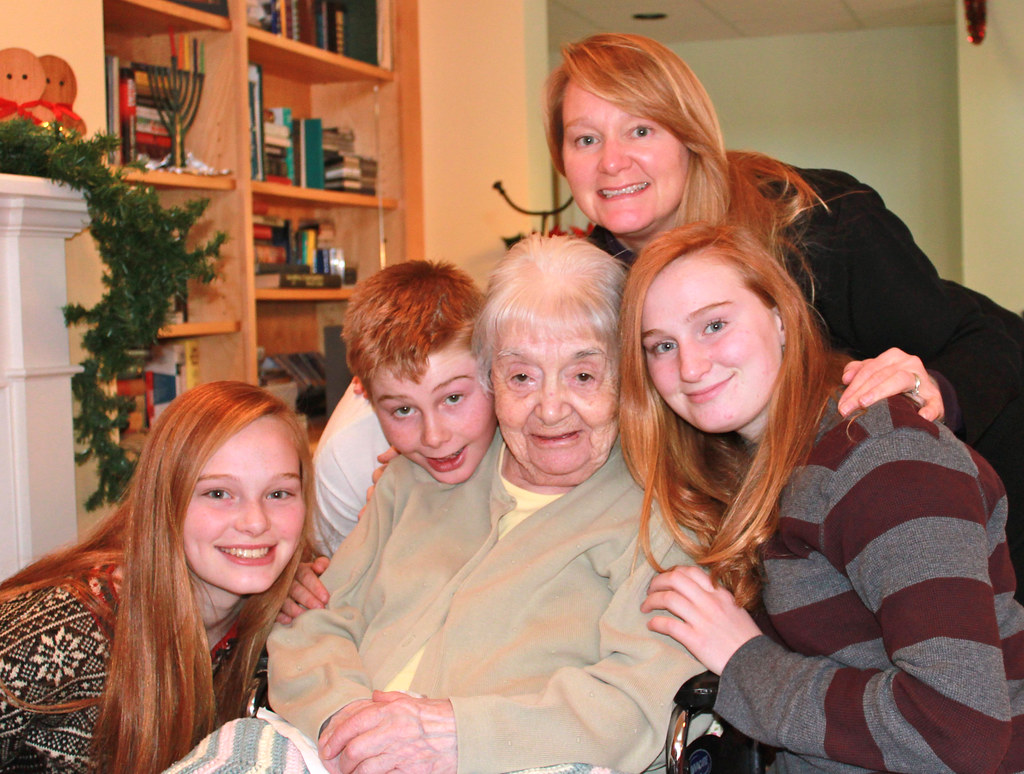
Sara also sent one additional photo — a family shot of Rose (center), Sara (top), and Sara's children. The photo was taken a month before Rose's death at the age of 102:

IMG_2270

Thanks again for everything, Sara. And Rose, RIP.